IB Physics SL C.3.9 Young double-slit equation
Practise applying the Young double-slit equation to calculate wavelength, fringe spacing or angular separation from screen data.
- Syllabus
- First assessment 2025
- Objective
- —
- Level
- SL
Practise applying the Young double-slit equation to calculate wavelength, fringe spacing or angular separation from screen data.
This question is about interference.
Light from a laser is incident on two identical parallel slits. The light from the two slits produces a fringe pattern on a screen.
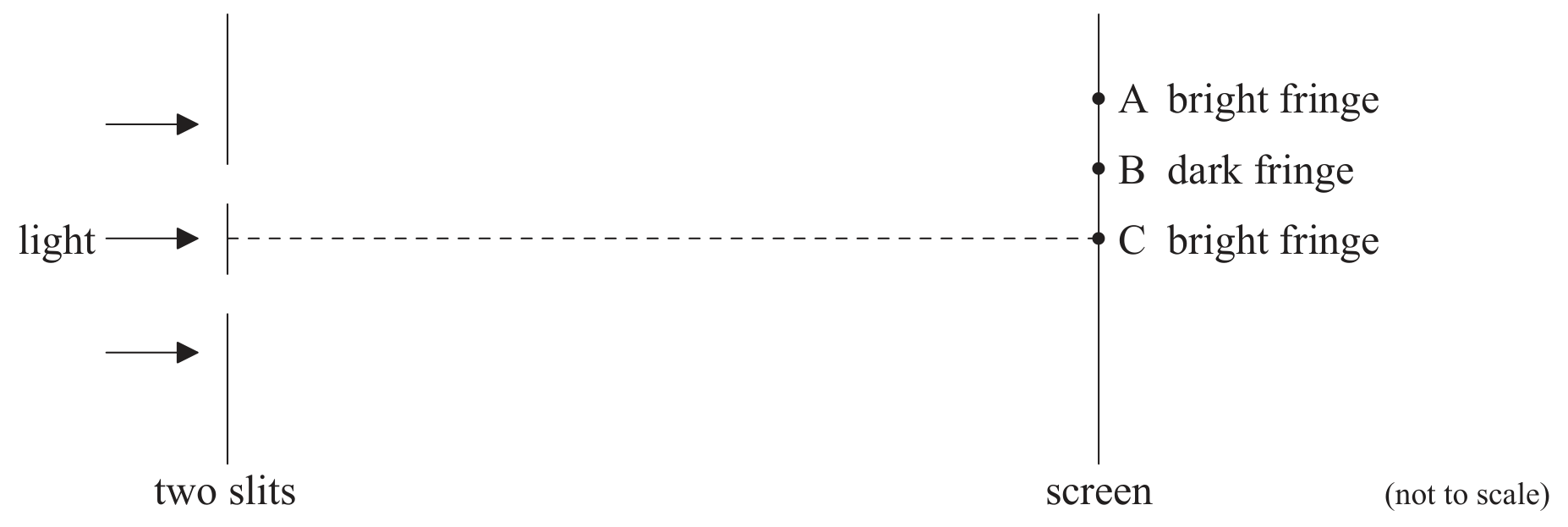
A central bright fringe is produced at C . The next bright fringe is produced at A . There is a dark fringe at B .
The distance from the two slits to the screen is 1.5 m . The distance BC is 1.8 mm and the distance between the slits is 0.30 mm .
Show that the laser produces light of wavelength equal to 720 nm .