EduNinja

1.5 Growth and evolution Topic Practice

1.5 Growth and evolution Topic Practice
IB Business Management syllabusBusiness Management SL/HLFirst assessment 2025

Students practise applying growth concepts to real business scenarios—weighing scale benefits against coordination costs, and choosing between organic expansion and acquisition.

Exam points

  • compare internal and external growth options using case-specific constraints like capital availability,
  • evaluate whether a growth recommendation balances economies of scale against diseconomies like communication

Question 1(a)

[Maximum number: 2]

1. AXL
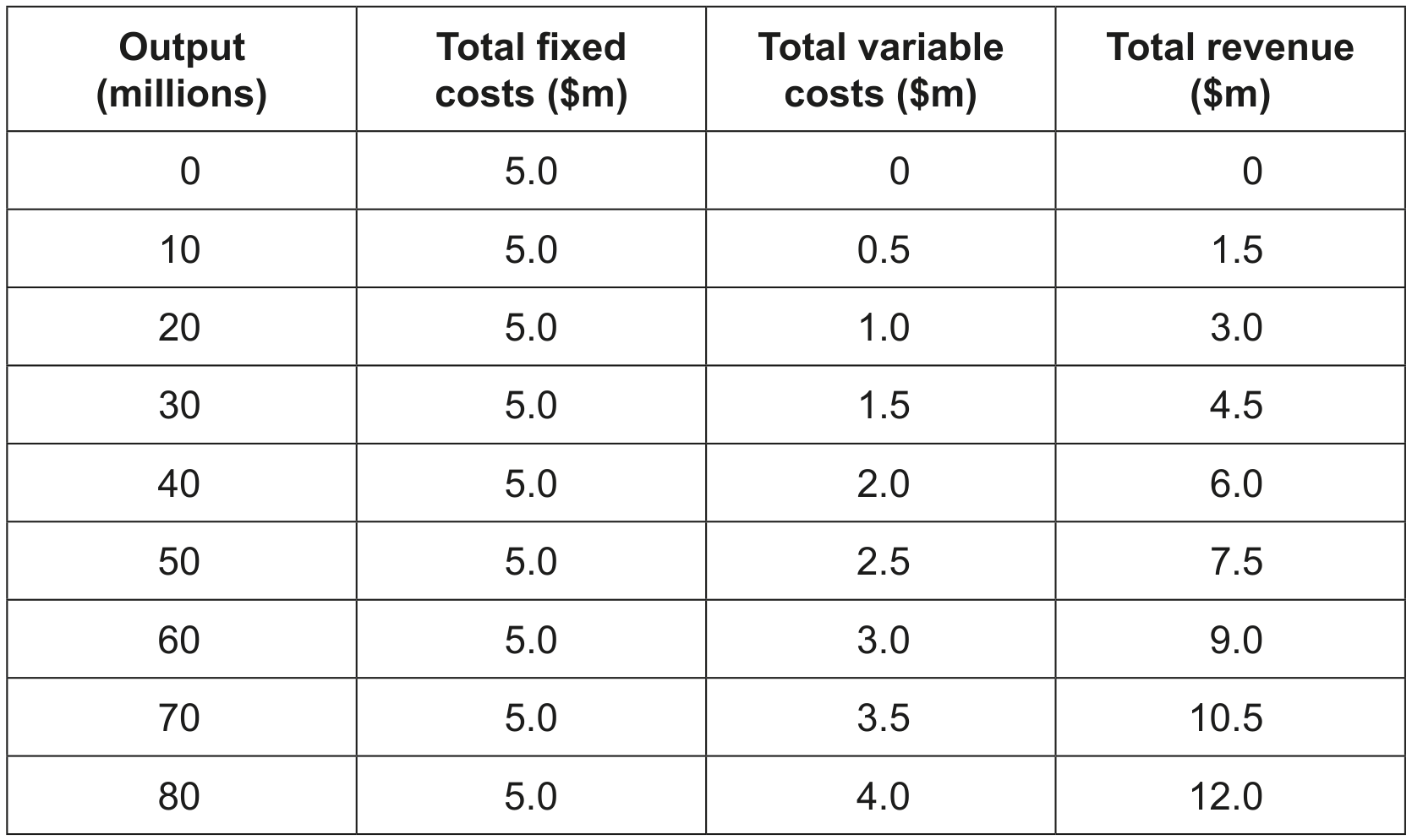
A X L has two factories, in which it manufactures aluminium cans for the soft drinks industry. A X L has a maximum production capacity of 80 million cans per year.

Table 1: AXL's forecasted sales revenue and costs for 2023

Table 1: AXL's forecasted sales revenue and costs for 2023

AXL plans to close its two factories and move production to a new, larger factory to obtain economies of scale.

In the first six months of 2022, increased competition led to a fall in AXL's sales. For the final two months of 2022, AXL plans to increase the trade credit period it offers to customers from 30 to 60 days.

Define the term economies of scale.

Question 1(a)

[Maximum number: 4]

With reference to M M, describe two features of a merger (lines 20-22).

Question 2(a)

[Maximum number: 4]

Outline two possible economies of scale that are likely to have been achieved through the takeover of H4 (lines 49-81).

Question 3(c)

[Maximum number: 4]

3. EkoLogiczne Ltd. (EL)
EkoLogiczne Ltd. (EL) is a packaging company owned 60 % by Marek Kowalski and 40 % by his father. EL is a private limited company. Marek founded the company when he realized that the rise in e-commerce would mean the demand for packaging would always increase.
Originally, Marek imagined that EL's unique selling point/proposition (USP) would be to offer recyclable packaging. However, the eco-friendly market was dominated by one large company, Big Boxes (BB), which enjoyed economies of scale. Marek reimagined his USP: E L would have small factories that enabled customized orders to be fulfilled quickly.
Over time, EL opened four factories across Poland and the Czech Republic. Its customers, which included online retailers and small manufacturing companies, placed orders online; if the factory nearest the customer was too busy with other orders, the order would be shifted to another factory. Many customers chose E L rather than B B for this reason. With growth, however, EL began to experience diseconomies of scale and increasingly failed to fulfil orders on time.
Marek is now considering bidding on a large five-year contract for all the packaging solutions for WszystkoMart (WM), a huge traditional retailer trying to expand its e-commerce presence. The contract would require building a huge factory and focusing almost exclusively on keeping costs low. In terms of scale, E L would be almost as big as B B, the large company dominating the eco-friendly packaging market.
To finance the new factory, Marek would either have to sell many shares and reduce his and his father's combined ownership to 40 % or take a 30 -year loan from a bank.

Explain two diseconomies of scale that EL may have experienced.

Question 3

[Maximum number: 14]

3. EkoLogiczne Ltd. (EL)
EkoLogiczne L t d. (EL) is a packaging company owned 60 % by Marek Kowalski and 40 % by his father. EL is a private limited company. Marek founded the company when he realized that the rise in e-commerce would mean the demand for packaging would always increase.
Originally, Marek imagined that EL's unique selling point/proposition (USP) would be to offer recyclable packaging. However, the eco-friendly market was dominated by one large company, Big Boxes (BB), which enjoyed economies of scale. Marek reimagined his USP: E L would have small factories that enabled customized orders to be fulfilled quickly.
Over time, EL opened four factories across Poland and the Czech Republic. Its customers, which included online retailers and small manufacturing companies, placed orders online; if the factory nearest the customer was too busy with other orders, the order would be shifted to another factory. Many customers chose E L rather than B B for this reason. With growth, however, EL began to experience diseconomies of scale and increasingly failed to fulfil orders on time.
Marek is now considering bidding on a large five-year contract for all the packaging solutions for WszystkoMart (WM), a huge traditional retailer trying to expand its e-commerce presence. The contract would require building a huge factory and focusing almost exclusively on keeping costs low. In terms of scale, E L would be almost as big as B B, the large company dominating the eco-friendly packaging market.
To finance the new factory, Marek would either have to sell many shares and reduce his and his father's combined ownership to 40 % or take a 30 -year loan from a bank.

Question 3(c)

(a)

Explain two diseconomies of scale that EL may have experienced.

[ 4 ]

Question 3(d)

(b)

Discuss whether EL should enter into the contract with W M if they have the winning bid.

[ 10 ]

Question 3

[Maximum number: 14]

Tijeras (TJ)

Tijeras (TJ), a private limited company, manufactures surgical scissors. It has four shareholders and operates one factory in Peru. TJ sells in Central American and South American markets. Its sales have grown for the last 10 years, which has led to both economies of scale and diseconomies of scale.

The chief operating officer (COO) analysed the situation. He discovered that:
- current work areas are overcrowded
- workers are specializing more than in previous years
- maintenance costs are increasing
- the firm now buys raw materials in bulk.

The market for surgical equipment, including scissors, in the United States (US) is large and highly competitive. Recently, some hospitals in the US purchased TJ's scissors.

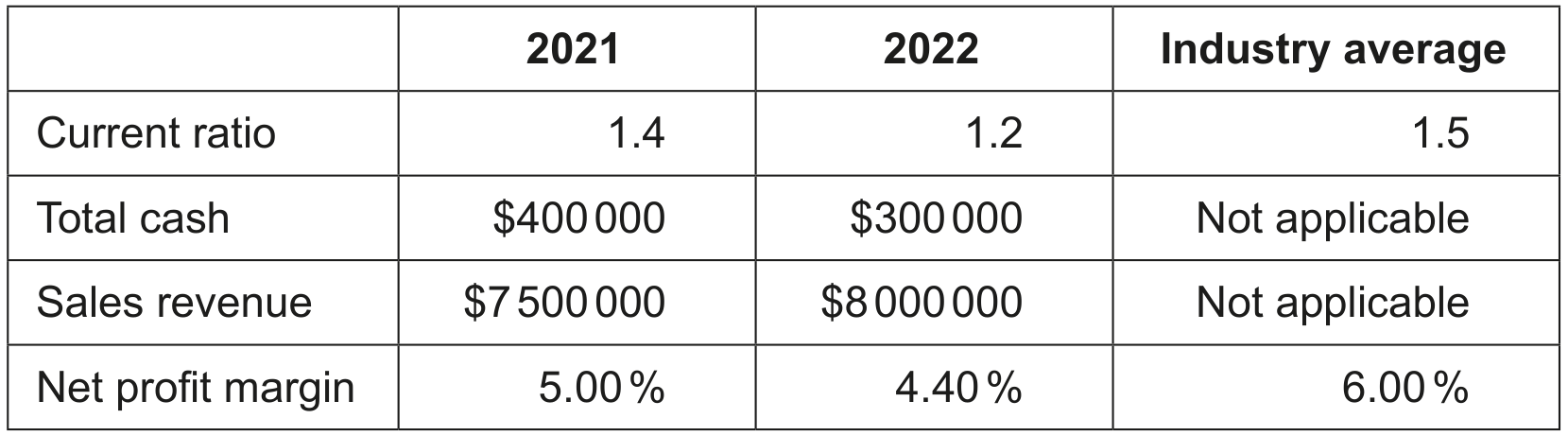
Table 3: Selected financial information for TJ on 31 May 2021 and 2022 and for the years ending 31 May 2021 and 2022

Table 3: Selected financial information for TJ on 31 May 2021 and 2022 and for the years ending 31 May 2021 and 2022

The COO determined that TJ needed more manufacturing capacity and put forward two options:
- Option 1: Keep the current factory in Peru and build a second one in Mexico, closer to the North American market. TJ's bank has agreed to provide a long-term loan to finance the new factory.
- Option 2: Build a new factory that is large enough for all of T 's manufacturing-capacity needs and sell the old factory for $ 400000. This new factory cannot be financed solely with external borrowing.

Table 4: Forecasted costs of Option 1 and Option 2

Table 4: Forecasted costs of Option 1 and Option 2

Question 3(b)

(a)

With reference to T J, explain one economy of scale and one diseconomy of scale.

[ 4 ]

Question 3(d)

(b)

Recommend whether TJ should choose Option 1 or Option 2.

[ 10 ]

Question 4(d)

[Maximum number: 10]

4. Smith's Foods Ltd (SF)
Charles Smith and seven friends started a private limited company, Smith's Foods Ltd (SF), to produce ready-made healthy meals for people with diabetes*. Using a cost-plus (mark-up) pricing strategy, SF's mission is to make inexpensive, widely available meals that help diabetics manage their carbohydrate intake accurately.
Despite reliance on inexpensive social media marketing, S F grew rapidly. Due to this rapid growth, however, the quality of its products deteriorated, and a number of its meals were found to contain different quantities of carbohydrate than those stated on the packaging. Negative comments appeared on SF's Instagram page. Charles responded quickly to reassure customers and offered refunds. SF's response led to the company receiving an industry award for ethical behaviour.
Charles introduced flow production to reduce the cost of S F 's meals, which changed S F 's scale of operations and increased its gearing ratio. However, Charles had little business experience of using flow production and problems emerged.
External stakeholders began to look into SF's operations. One supermarket chain, Good Foods (GF), contacted Charles and offered to take over SF, keeping Charles on the board of directors. This takeover would allow SF's meals to be produced at a lower cost and reach a wider target market. GF would also finance research and development into new meals with more carefully controlled carbohydrate levels.
However, SF would close. Negative publicity would be considerable. The remaining shareholders have threatened to launch a new business, creating their own brand of meals for people with diabetes in direct competition with GF.
* diabetes: a medical condition that causes a person's blood sugar level to become too high. People with diabetes need to be mindful of the amount of carbohydrates (which includes sugar) they include in their diet.


Discuss whether Charles should accept GF's offer of a takeover.

0 selected