
EduNinja

4.1 Introduction to marketing Topic Practice

4.1 Introduction to marketing Topic Practice
IB Business Management syllabusBusiness Management SL/HLFirst assessment 2025

Students practise distinguishing market and product orientation, calculating market share, and interpreting growth or leadership trends using case data and quantitative evidence.

Exam points

  • calculate market share using revenue or volume data from case studies and interpret its implications
  • explain shifts in market share by linking case evidence to competitive positioning

Question 4(b)(i)

[Maximum number: 2]

In 2022, the global home water filter market was $14 billion.

SVT's product penetration in Europe and the United States of America (USA) is high and growing but low in the rest of the world. In 2022:
- SVTs total sales revenue from home water filters was $ 4.9 billion
- the average revenue earned per water filter was $ 20
- 90 % of SVTs home water filter sales were to Europe and the USA.

In 2022, SVT announced the closure of its European and USA water filter manufacturing factories. Water filter profit margins had fallen for three years, partly because of increasing costs of energy, rent and labour. SVT has since built a huge new factory in Asia to manufacture home water filters.

SVT's market research, using quota sampling, found that 80 % of households that purchased an SVT water filter:
- had an above-average income
- owned two or more cars.

In January 2023, SVT:
- launched an advertising campaign in Europe and the USA highlighting the lack of potable water for millions of people in less economically developed countries (LEDCs)
- announced a 5 % worldwide increase in the price of its home water filters.

SVT committed to use the revenue from the 5 % price increase to provide two million free WF15 water purifiers annually to charities in LEDCs. It costs SVT $10 to make a water purifier.

Some disagreement occurred among the board of directors regarding this price increase. Some directors felt it would highlight SVTs vision and commitment to helping people in LEDCs, but others believed sales might fall, impacting profits in SVTs Consumer Products Division.

Calculate SVTs home water filter market share in 2022 (show all your working).
Question 4

[Maximum number: 4]

In 2010, ELE owned 4.5 % of the European Union (EU) car rental market. In 2019, ELE's car rental division had revenues of EUR 0.9 billion in a market worth EUR 16.8 billion. Initially, ELE only provided car rentals in its gasoline stations in Belgium. By 2014, ELE had expanded the service to its stations in France, Spain and the UK.

In 2016, Giselle also reorganized ELE's car rental offices so that each office operated as a profit centre. An entrepreneurial approach was adopted. Office teams received substantial bonuses if they exceeded profit targets, but only offices that met their targets qualified for these bonuses. These targets were set, without consultation, by Giselle. Over a five-year period, targets were met by 85 % of offices. Giselle's reorganization was not welcomed by employees.

In 2021, Monica recommended that ELE trial the business model she had proposed for the new In3T brand in two major cities in the EU for one year: if successful, the brand and its model could then be launched in all major cities in the EU. Monica said, "We must do it. I'm convinced that our rivals will adopt this business model within two years. If we don't act now, we will be left behind and our rivals will beat us to it."

Giselle, however, disagreed strongly. She had built the car rental division from its inception. She believed high levels of customer service and well-trained staff were two reasons why the car rental division remained successful. She was also unhappy with the EUR 100 million cost and payback of three years.

Question 4(b)(i)

(a)

Calculate ELE's market share for car rentals in 2019 (show all your working).

[ 2 ]

Question 4(b)(ii)

(b)

Explain one reason why ELE's market share has grown.

[ 2 ]

Question 4

[Maximum number: 4]

ELE is continuing to focus on all three of its divisions.
Car rental division
In 2010, ELE owned 4.5\% of the European Union (EU) car rental market. In 2019, ELEs car rental division had revenues of EUR 0.9 billion in a market worth EUR 16.8 billion. Initially, ELE only provided car rentals in its gasoline stations in Belgium. By 2014, ELE had expanded the service to its stations in France, Spain and the UK. Giselle believes that maintaining high levels of customer satisfaction is an important factor in the car rental division's continuing success.
Zeat division
Zeat's MiniC production line, based in the UK, has 125 employees, most of whom have been with the business since 2000.
Currently, approximately 90 % of MiniC sales are to customers in the EU, and profit margins for the MiniC air compressors have fallen significantly due to rising costs in the UK. Lucas recommended to ELE directors that MiniC production be outsourced to a manufacturer in Hungary in the EU.
Gasoline station division
The gasoline station division accounted for 35 % of ELE's operating profits in 2021. Perrana PLC, a global supermarket chain, has offered to purchase all of ELE's gasoline stations. The offer significantly exceeds the current market value of ELE's gasoline stations.
Perrana would close the gasoline stations and open supermarkets on the sites. All ELE gasoline station employees would face redundancy. ELE's workforce will feel betrayed. Although Hugo is very unhappy about the proposal, Giselle has mixed feelings: she would need to find new locations for her 700 car rental offices, but the sale could help finance the expansion of ELE car rentals into India.

Question 4(b)(i)

(a)

Calculate ELE's market share for car rentals in 2019 (show all your working).

[ 2 ]

Question 4(b)(ii)

(b)

Explain one reason why ELE's market share has grown.

[ 2 ]

Question 4(b)(i)

[Maximum number: 2]

M M is reviewing its hotel and mining operations.
To understand customer opinions about its hotels, M M will distribute questionnaires at two of its hotels and use a convenience sampling method. M M is also considering introducing flexitime for hotel employees.
For its gold mining operations, M M wants to increase its market share worldwide to 1 % by 2030. In 2020, MM produced 17 tonnes of the global production of 3200 tonnes.
In another development, M M wants to enter the rapidly growing lithium market. M M has rejected the idea of buying an existing lithium producer and is considering two options: opening its own lithium mine in Australia or entering a joint venture with a lithium mining company.
Option 1: Open a lithium mine in Australia
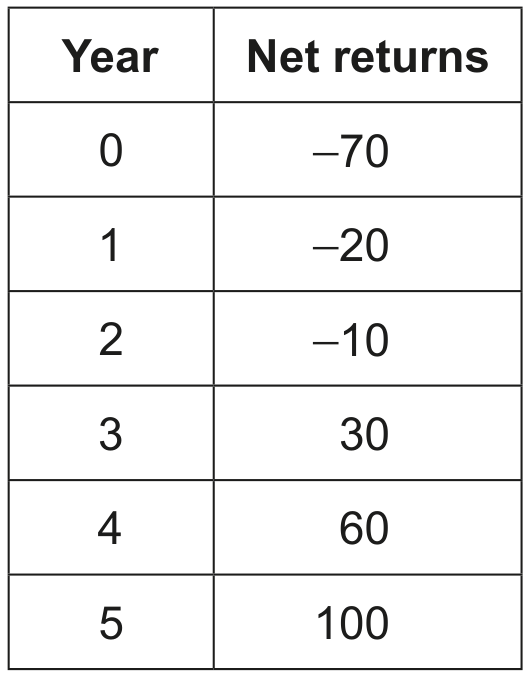
M M has identified a site in Australia, and the Australian government, which is keen to develop its country's lithium mining industry, will approve a mining license for it. Development of the mine would take three years and cost $ 100 million. Table 2 shows the forecasted net returns for the first six years.

Table 2: Forecasted net returns for the lithium mine (in millions of \$)

Table 2: Forecasted net returns for the lithium mine (in millions of \$)

M M will sell the lithium to battery manufacturers in China, a market familiar to the Australian mining industry. Transport costs would be high. Environmental pressure groups oppose the mine because of the water and air pollution they think it would create.
Option 2: A joint venture with CanLith (CL)
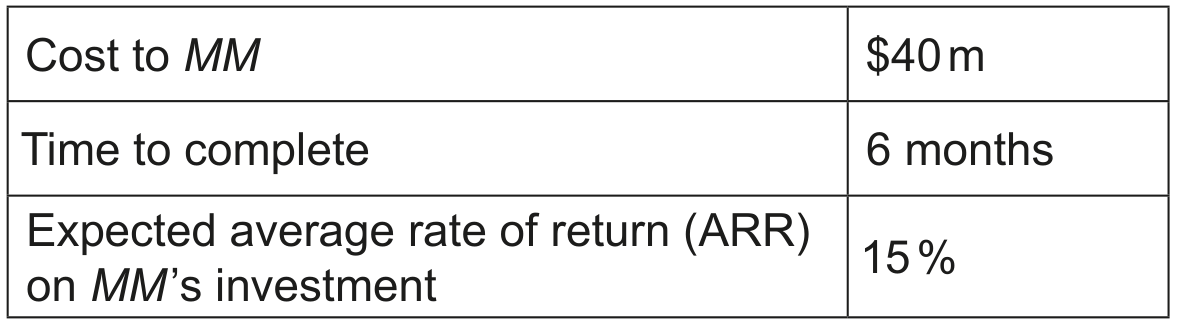
C L, a lithium mining company, is seeking expansion with a new mine and needs finance. A joint venture with M M would bring M M 's expertise and corporate values to the expansion. M M and C L would have equal ownership of the new mine and jointly manage it. C L would appoint a board of directors. However, C L has attracted bad publicity because of its poor environmental record, and local people oppose the new mine. Information on the joint venture is shown in Table 3.

Table 3: Information on setting up the joint venture

Table 3: Information on setting up the joint venture

Calculate for M M :

its market share worldwide in gold in 2020 (show all your working);

Question 3(a)

[Maximum number: 2]

3. Hums Athletics (HA)
Hums Athletics (HA) manufactures running shorts, sweat shirts, and sports bras. Operating only in the secondary sector, HA has a head office and three manufacturing facilities, one for each product. These are located in its home country in Europe. Labour costs are high. The quality of labour is excellent.
HA produces goods under its own HA brand, which it sells to wholesalers. HA also manufactures for other sportswear companies. HA puts the other sportswear companies' logos on the running shorts, sweat shirts, and sports bras. Sales to other sportswear companies are an important revenue stream for H A.
HA has many levels of hierarchy. Managers at each level have a narrow span of control, and the company is organized by product. HA's management believe that these features of organizational structure ensure product quality, which they view as essential for brand loyalty.
The sportswear manufacturing industry is becoming more competitive. Some foreign manufacturers have begun using penetration pricing to gain market share. For three years, none of HA's revenue streams have increased, despite increasing unit sales. HA's gross and net profit margins have declined. However, its sales have increased for the last three years. HA has had to raise additional external finance to increase production.
In response to the increasing competition, H A is considering two options:
- Option 1: Outsourcing some of its manufacturing overseas.
- Option 2: Entering the rapidly growing online business-to-consumer (B2C) retail market.
Market research has shown that consumers increasingly expect to buy online.

State two ways in which market share can be measured.

Question 5(a)

[Maximum number: 2]

5. KapTan
KapTan (K T), which manufactures rechargeable batteries for cordless consumer products like vacuum cleaners, began five years ago as a business with a product orientation. It sells business to business (B2B). Multinational companies dominate the rechargeable battery industry, and K T suffered from cash-flow problems in its first year of trading. Its profits are small and, in the last two years, have fallen.
K T has now developed an innovative battery that is small and lightweight. This battery is an emergency power source allowing electric cars to reach a charging station. However, the battery can only be used ten times before it runs out. K T has insufficient finance to create a battery that can be recharged an unlimited number of times.
Through market research, K T has discovered that:
- no other emergency batteries for electric cars exist
- owners of electric cars fear running out of power
- KT's new battery could be obsolete in five years.
K T has the capacity to produce 90000 of these new batteries each year. The average cost is $ 200 per unit. KT has insufficient funds to invest in additional capacity.
K T is considering two options:
Option 1: Market and sell directly to existing car owners through business to consumer (B2C) at a retail price of $ 400. KT will need to borrow significant capital to finance this option.
Option 2: Accept an offer of a five-year strategic alliance with a manufacturer of electric cars. K T would provide its product exclusively at $ 250 per unit. Sales are guaranteed.

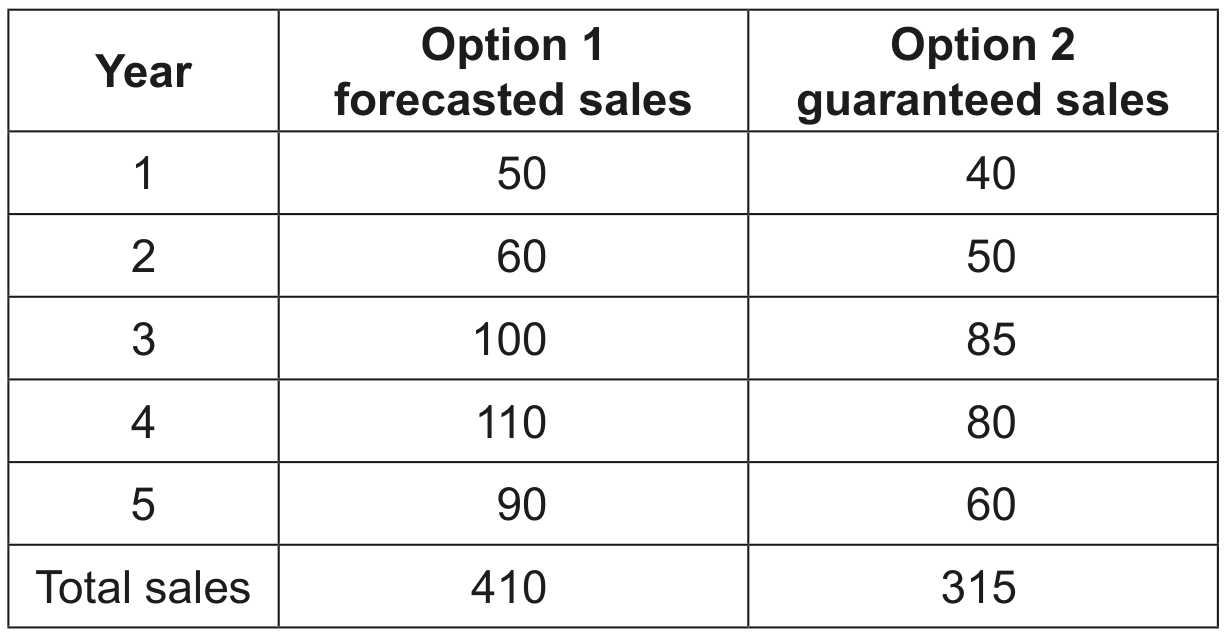
Table 3: KT's forecasted and guaranteed worldwide unit sales (in 000s) for the two options

Table 3: KT's forecasted and guaranteed worldwide unit sales (in 000s) for the two options

Define the term product orientation.

Question 5(a)

[Maximum number: 2]

5. KapTan
KapTan (K T), which manufactures rechargeable batteries for cordless consumer products like vacuum cleaners, began five years ago as a business with a product orientation. It sells business to business (B2B). Multinational companies dominate the rechargeable battery industry, and K T suffered from cash-flow problems in its first year of trading. Its profits are small and, in the last two years, have fallen.
K T has now developed an innovative battery that is small and lightweight. This battery is an emergency power source allowing electric cars to reach a charging station. However, the battery can only be used ten times before it runs out. K T has insufficient finance to create a battery that can be recharged an unlimited number of times.
Through market research, K T has discovered that:
- no other emergency batteries for electric cars exist
- owners of electric cars fear running out of power
- KT's new battery could be obsolete in five years.
K T has the capacity to produce 90000 of these new batteries each year. The average cost is $ 200 per unit. KT has insufficient funds to invest in additional capacity.
K T is considering two options:
Option 1: Market and sell directly to existing car owners through business to consumer (B2C) at a retail price of $ 400 . K T will need to borrow significant capital to finance this option.
Option 2: Accept an offer of a five-year strategic alliance with a manufacturer of electric cars. K T would provide its product exclusively at $ 250 per unit. Sales are guaranteed.

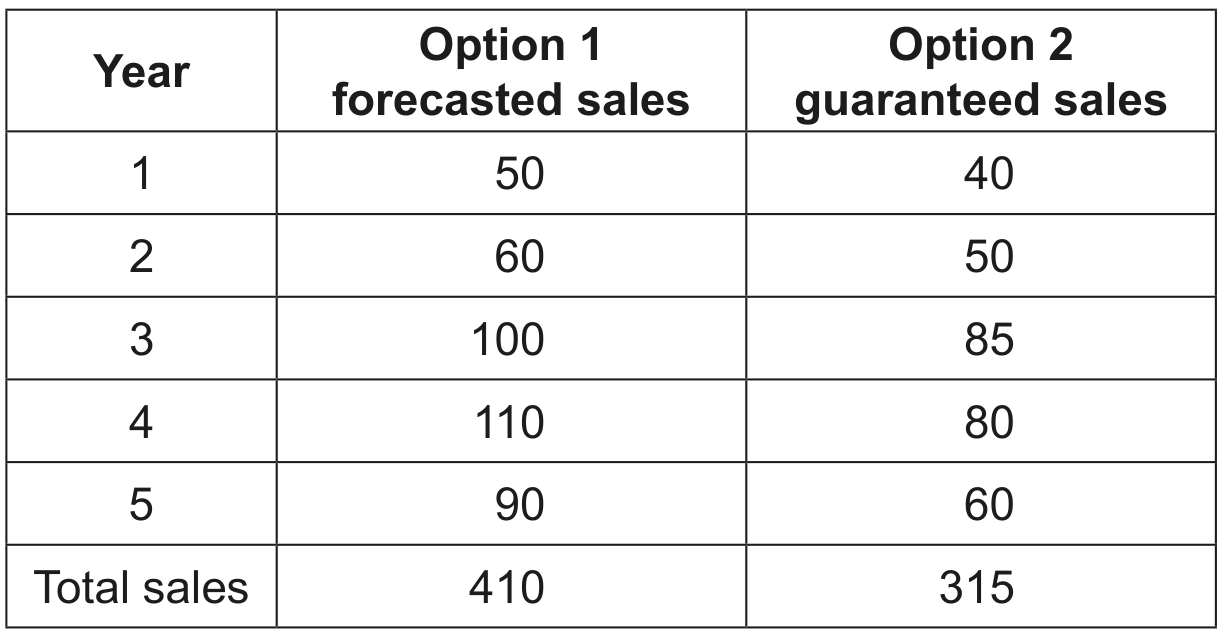
Table 2: \(\boldsymbol{K

Table 2: \(\boldsymbol{K

Define the term product orientation.

0 selected