CAIE A-Level Economics 7.5 Types of cost, revenue & profit, short-run & long-run production Question Bank

CAIE A-Level Economics 7.5 Types of cost, revenue & profit, short-run & long-run production Question Bank
Cambridge International AS & A Level Economics 9708 syllabus for exams in 2026, 2027 and 20282026–2028

Practise interpreting production, cost and revenue evidence for firms across short-run and long-run output decisions.

Exam points

  • calculate productivity, marginal cost or revenue from firm output and cost tables
  • interpret SRAC, LRAC and revenue diagrams to identify efficient or profit outcomes
  • explain economies, diseconomies and returns to scale from changes in inputs and output

Question 5

[Maximum number: 1]

A firm has fixed costs of $ 300 and can produce two units per hour. Its total variable costs are $ 200 for one unit and $ 300 for two units.

Which cost will fall by the lowest amount when the second unit is produced?

A

average fixed cost

B

average total cost

C

average variable cost

D

marginal cost
Question 7

[Maximum number: 1]

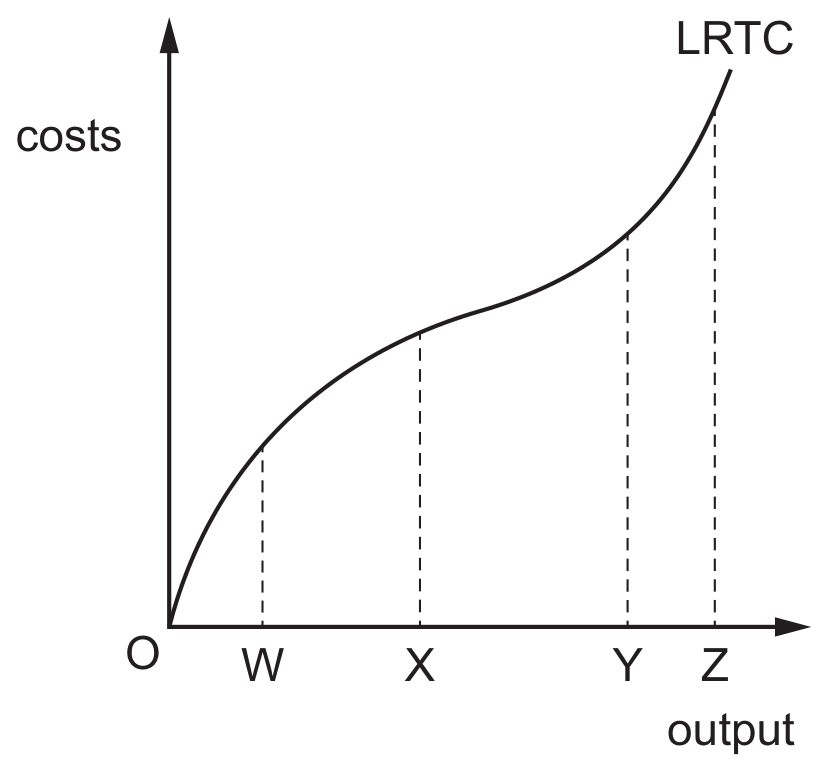
The diagram shows the long-run total cost (LRTC) curve of a firm.

Figure for Question 7 — CAIE A-Level Economics

At which output is the long-run average total cost at its minimum?

A

OW

B

OX

C

OY

D

OZ

Question 10

[Maximum number: 1]

What is true about economies of scale but not diseconomies of scale?

A

They occur because average revenue is increasing.

B

They occur because of management policy changes.

C

They occur in the short run.

D

They occur with decreasing average cost.

Question 11

[Maximum number: 1]

When a firm increases all its inputs fourfold, its output increases threefold.
What does this illustrate?

A

decreasing marginal costs

B

decreasing returns to scale

C

economies of scale

D

the law of diminishing returns

Question 16

[Maximum number: 1]

As the number of workers employed by a firm increases, the marginal product of labour decreases but remains positive.

What happens to the firm's total output?

A

It stops increasing.

B

It increases at a constant rate.

C

It increases at a falling rate.

D

It increases at a rising rate.