CAIE A-Level Economics 7.4 Private and Social Costs and Benefits Question Bank

CAIE A-Level Economics 7.4 Private and Social Costs and Benefits Question Bank
Cambridge International AS & A Level Economics 9708 syllabus for exams in 2026, 2027 and 20282026–2028

Practise calculating private, external and social costs or benefits, locating market and social optima and evaluating externalities and projects with welfare-loss and…

Exam points

  • derive MSC from MPC plus MEC and MSB from MPB plus MEB in diagrams or data
  • compare market output at MPB=MPC with the social optimum where MSB=MSC
  • identify welfare loss and evaluate a project by whether discounted social benefits exceed social costs

Question 1

[Maximum number: 8]

Market Economies

From Adam Smith onwards, most economists have regarded competitive markets as the main mechanism of economic activity. They argue that the interaction between producers and consumers can lead to both allocative efficiency and productive efficiency.

It can, however, be questioned whether the market automatically produces the best solution. Sometimes there are significant reasons for governments to intervene in a market in order to produce a better outcome than market forces alone. These situations are market failures.

When producing goods and services firms consider the private costs they pay and private benefits they receive. For example, a steel producer accounts for the cost of iron ore, fuel, labour and administration. It offsets these costs against the revenue from selling the steel. However, those people who live near the steelworks suffer the consequences of the noise, dirt and polluted air generated as part of the production process. Similarly, in many areas the extraction of iron ore can lead to environmental destruction such as the degradation of ground water for domestic consumption and a reduction in the variety of wildlife and flowers.

Competitive markets as envisaged by economists, however, may not exist. Firms may integrate to gain the benefits of economies of scale, to realise their ambition to rule the market or to increase their market share. Such integration might lead to the development of a monopoly market structure. Many believe that a monopoly always operates against the interests of the consumer because of its lack of efficiency. As a result, governments often restrict the operation of monopolies.

Question 1(b)(i)

(a)

Explain what is meant by a negative production externality.

[ 2 ]

Question 1(b)(ii)

(b)

Identify from the extract a negative production externality resulting from steel production.

[ 1 ]

Question 1(b)(iii)

(c)

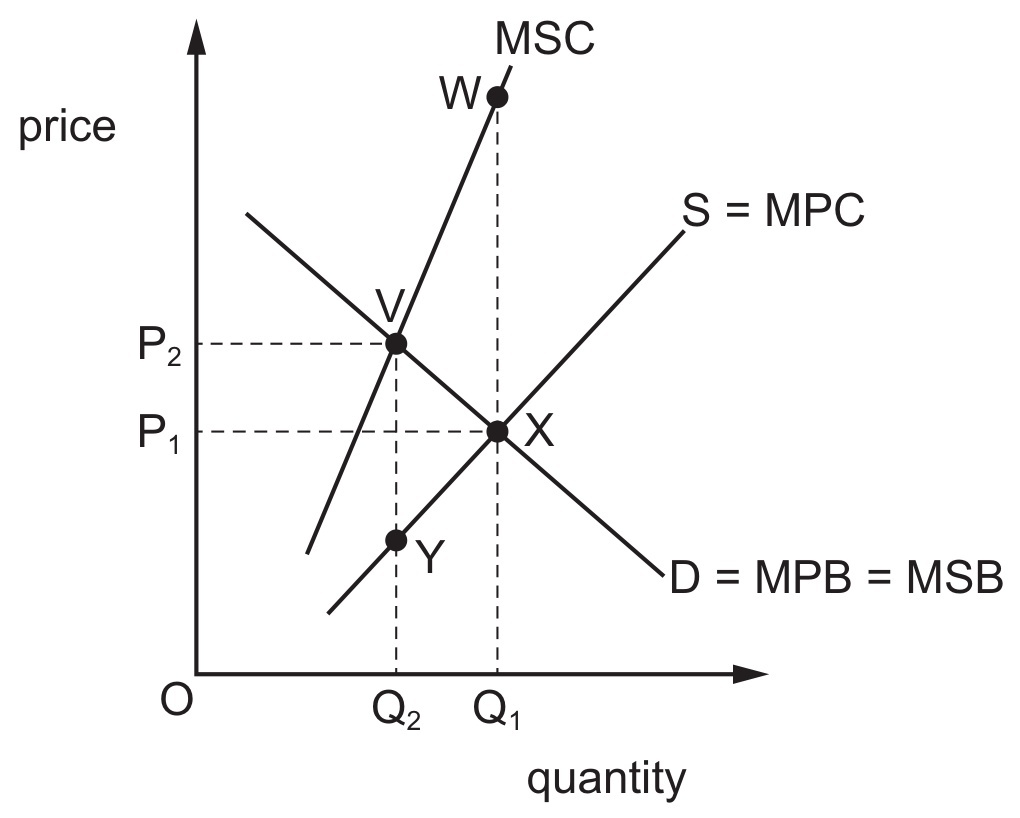
Explain, with the aid of a diagram, the consequences for output and price if the steel market is required to take into consideration negative production externalities.
[ 5 ]

Question 2

[Maximum number: 1]

What is equivalent to social benefits?

A

the amount that the government spends on social security benefits

B

the benefit gained by society from total government spending

C

the benefit to third parties from household consumption of a good

D

the private and external benefits from household consumption of a good

Question 3

[Maximum number: 1]

A medical team provides vaccinations for children to prevent an outbreak of an infectious disease.

Why would this be described as a positive externality?

A

Additional benefit might be gained as the disease no longer spreads.

B

Any kind of medical help will improve the condition of the children.

C

No action would be taken unless the medical team intervened.

D

The social benefits of vaccination are less than the social costs.

Question 6

[Maximum number: 1]

The diagram shows market failure caused by negative production externalities.

Figure for Question 6 — CAIE A-Level Economics

Identify the correct combination of the result of the market failure and the area on the diagram that shows deadweight welfare loss.

result of market

failure

area showing

deadweight

welfare loss

overproduction

VWX

overproduction

XYV

underproduction

VWX

underproduction

XYV

Question 10

[Maximum number: 1]

Some multinational oil companies extracting oil in developing countries are now required to repair the damage they do to the environment.

What best describes the total costs incurred by the oil companies in such circumstances?

A

external costs

B

private costs plus external costs

C

social costs plus external costs

D

social costs plus private costs