CAIE A-Level Economics 7. The price system & the microeconomy Question Bank

CAIE A-Level Economics 7. The price system & the microeconomy Question Bank
Cambridge International AS & A Level Economics 9708 syllabus for exams in 2026, 2027 and 20282026–2028

Practise microeconomic analysis using utility, budget lines, efficiency, costs, revenues, market structures and firm objectives.

Question 1

[Maximum number: 1]

The table shows the total utility gained by a consumer from the consumption of water.

quantity<br>consumed<br>/bottlestotal<br>utility
00
130
240
348
454
558

What can be concluded from this table?

A

Marginal utility increases as consumption increases.

B

The consumer cannot switch expenditure to another product to increase total utility.

C

The marginal utility of the 3rd unit is 8 .

D

The marginal utility of the 5th unit is 2 .

Question 1

[Maximum number: 20]

Market Economies

From Adam Smith onwards, most economists have regarded competitive markets as the main mechanism of economic activity. They argue that the interaction between producers and consumers can lead to both allocative efficiency and productive efficiency.

It can, however, be questioned whether the market automatically produces the best solution. Sometimes there are significant reasons for governments to intervene in a market in order to produce a better outcome than market forces alone. These situations are market failures.

When producing goods and services firms consider the private costs they pay and private benefits they receive. For example, a steel producer accounts for the cost of iron ore, fuel, labour and administration. It offsets these costs against the revenue from selling the steel. However, those people who live near the steelworks suffer the consequences of the noise, dirt and polluted air generated as part of the production process. Similarly, in many areas the extraction of iron ore can lead to environmental destruction such as the degradation of ground water for domestic consumption and a reduction in the variety of wildlife and flowers.

Competitive markets as envisaged by economists, however, may not exist. Firms may integrate to gain the benefits of economies of scale, to realise their ambition to rule the market or to increase their market share. Such integration might lead to the development of a monopoly market structure. Many believe that a monopoly always operates against the interests of the consumer because of its lack of efficiency. As a result, governments often restrict the operation of monopolies.

Question 1(a)

(a)

Explain the meaning of 'allocative efficiency and productive efficiency'.

[ 4 ]

Question 1(b)(i)

(b)

Explain what is meant by a negative production externality.

[ 2 ]

Question 1(b)(ii)

(c)

Identify from the extract a negative production externality resulting from steel production.

[ 1 ]

Question 1(b)(iii)

(d)

Explain, with the aid of a diagram, the consequences for output and price if the steel market is required to take into consideration negative production externalities.

[ 5 ]

Question 1(c)

(e)

Consider whether 'a monopoly always operates against the interests of the consumer'.

Answer one question.

EITHER

[ 8 ]

Question 1

[Maximum number: 1]

Economists normally assume that the marginal utility from consuming additional goods is positive and diminishing.

What is the effect on total satisfaction of consuming extra units of the good?

A

Total satisfaction falls at a decreasing rate.

B

Total satisfaction falls at an increasing rate.

C

Total satisfaction rises at a decreasing rate.

D

Total satisfaction rises at an increasing rate.

Question 1

[Maximum number: 1]

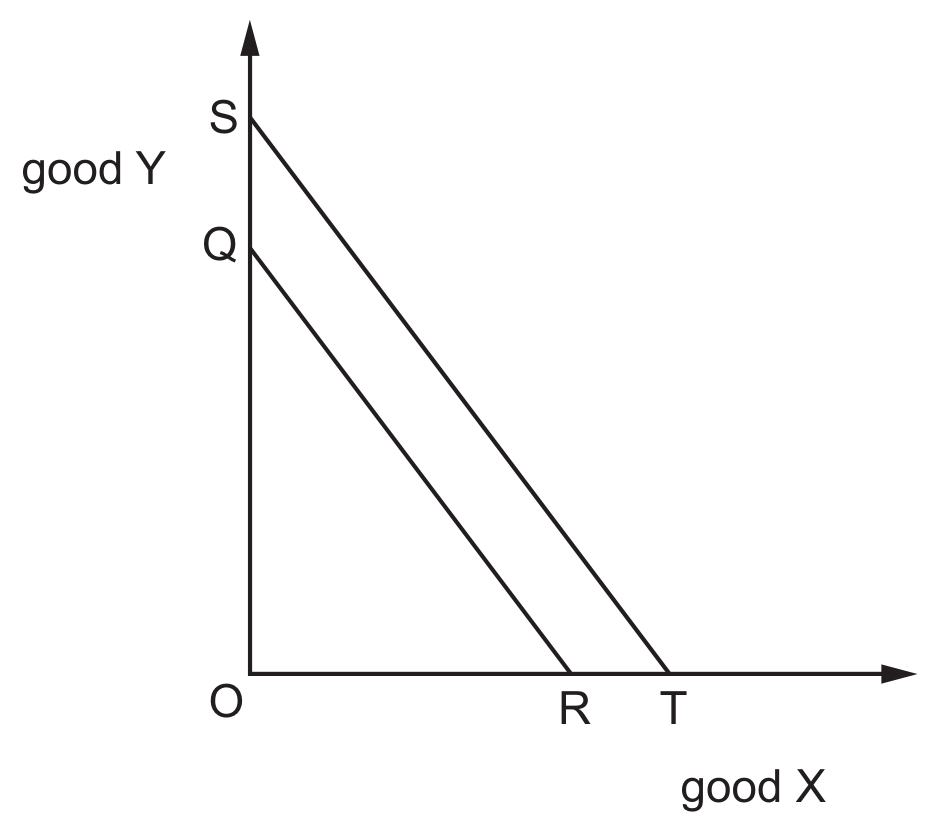
The diagram shows budget lines for an individual consumer.

Figure for Question 1 — CAIE A-Level Economics

What could explain the shift in the budget line from QR to ST?

A

a decrease in the consumer's real income

B

a decrease in the quality of both goods

C

an increase in the consumer's money income

D

an increase in the price of both goods

Question 2

[Maximum number: 1]

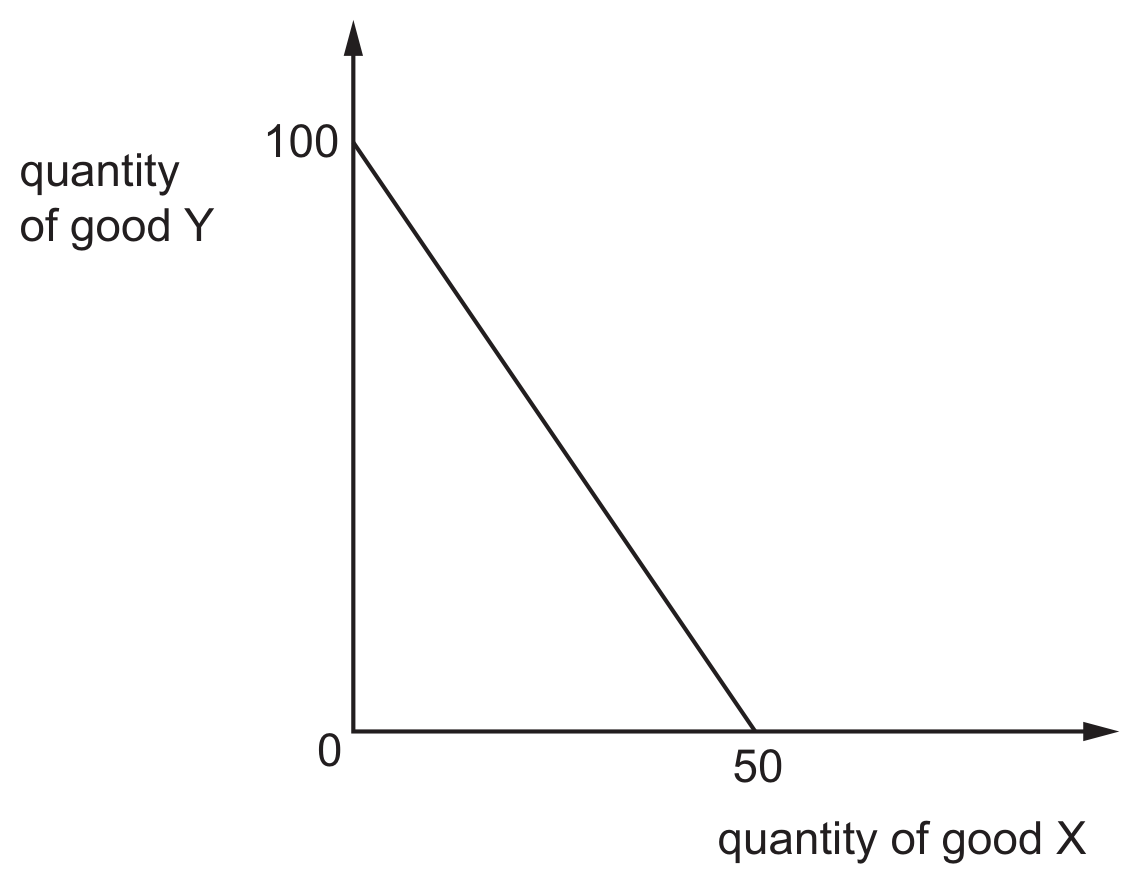
The diagram shows a consumer's budget line.

Figure for Question 2 — CAIE A-Level Economics

What determines the slope of the budget line?

A

the marginal rate of substitution of good X for good Y

B

the price of good X multiplied by the price of good Y

C

the ratio of the price of good X to the income of the consumer

D

the ratio of the price of goodX\operatorname{good} X to the price of goodY\operatorname{good} Y

Question 8

[Maximum number: 1]

Firms often remain small even when growth could result in technical economies of scale.
What is not a likely reason for this?

A

Demand for the product tends to change often and rapidly.

B

Individual entrepreneurs wish to keep a tight personal control over their own firm.

C

The entrepreneurs who establish the firms tend to be ambitious risk-takers.

D

The market in which they operate is very specialised in nature, often selling unique products.

Question 8

[Maximum number: 1]

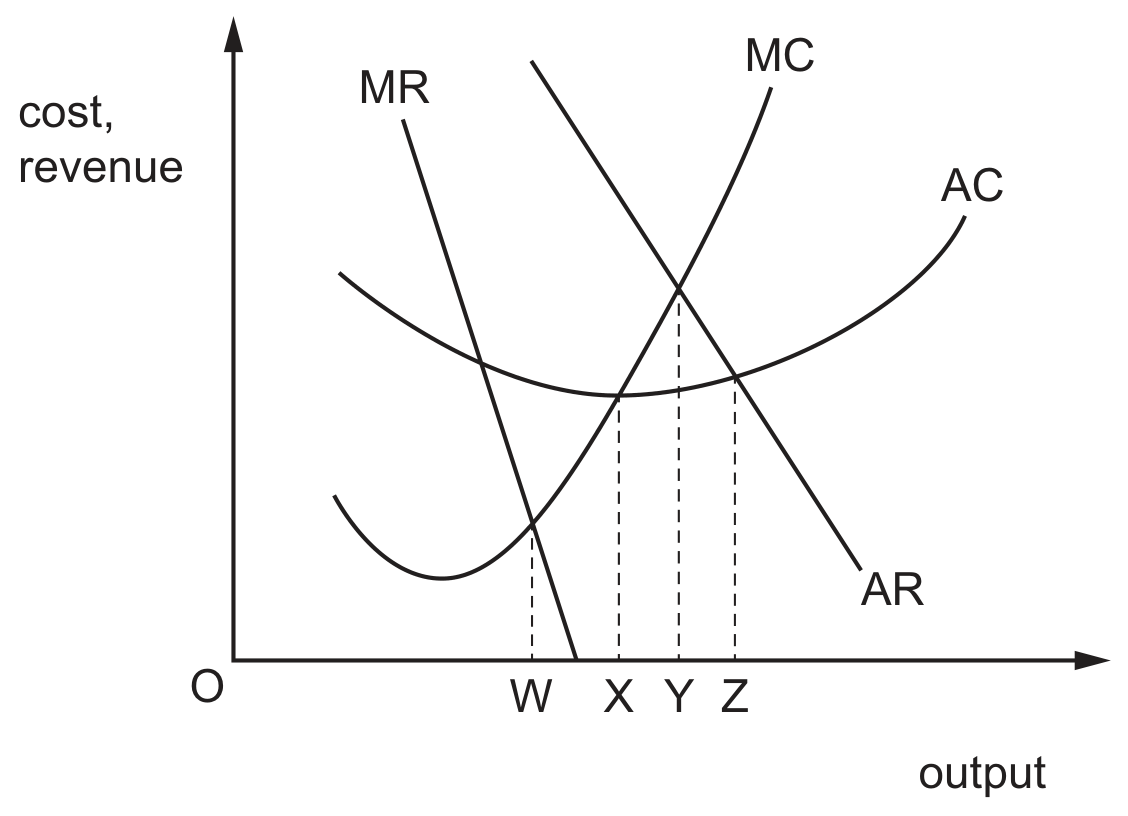
In the diagram
M C= marginal cost; A C= average cost; M R= marginal revenue; A R= average revenue.

Figure for Question 8 — CAIE A-Level Economics

What will be the output of a profit-maximising firm whose cost and revenue functions are shown above?

A

OW

B

OX

C

OY

D

OZ

Question 10

[Maximum number: 1]

Some multinational oil companies extracting oil in developing countries are now required to repair the damage they do to the environment.

What best describes the total costs incurred by the oil companies in such circumstances?

A

external costs

B

private costs plus external costs

C

social costs plus external costs

D

social costs plus private costs

Question 10

[Maximum number: 1]

Which statement is correct for a firm classed as a natural monopoly?

A

It will always operate in the public sector and earn normal profits.

B

It will have high barriers to entry and be the dominant producer.

C

It will easily benefit from external economies of scale.

D

It will have higher average costs than a monopolistically competitive firm.

Question 16

[Maximum number: 1]

As the number of workers employed by a firm increases, the marginal product of labour decreases but remains positive.

What happens to the firm's total output?

A

It stops increasing.

B

It increases at a constant rate.

C

It increases at a falling rate.

D

It increases at a rising rate.