CAIE A-Level Economics 7.2 Indifference curves & budget lines Question Bank

CAIE A-Level Economics 7.2 Indifference curves & budget lines Question Bank
Cambridge International AS & A Level Economics 9708 syllabus for exams in 2026, 2027 and 20282026–2028

Practise indifference curve and budget line analysis using diagrams, price and income changes, and consumer choice evaluation.

Exam points

  • interpret budget line slope, shifts and feasible combinations from two-good diagrams
  • use indifference curves to identify maximum satisfaction and marginal rate of substitution
  • evaluate how price changes affect demand through income and substitution effects

Question 1

[Maximum number: 1]

The diagram shows budget lines for an individual consumer.
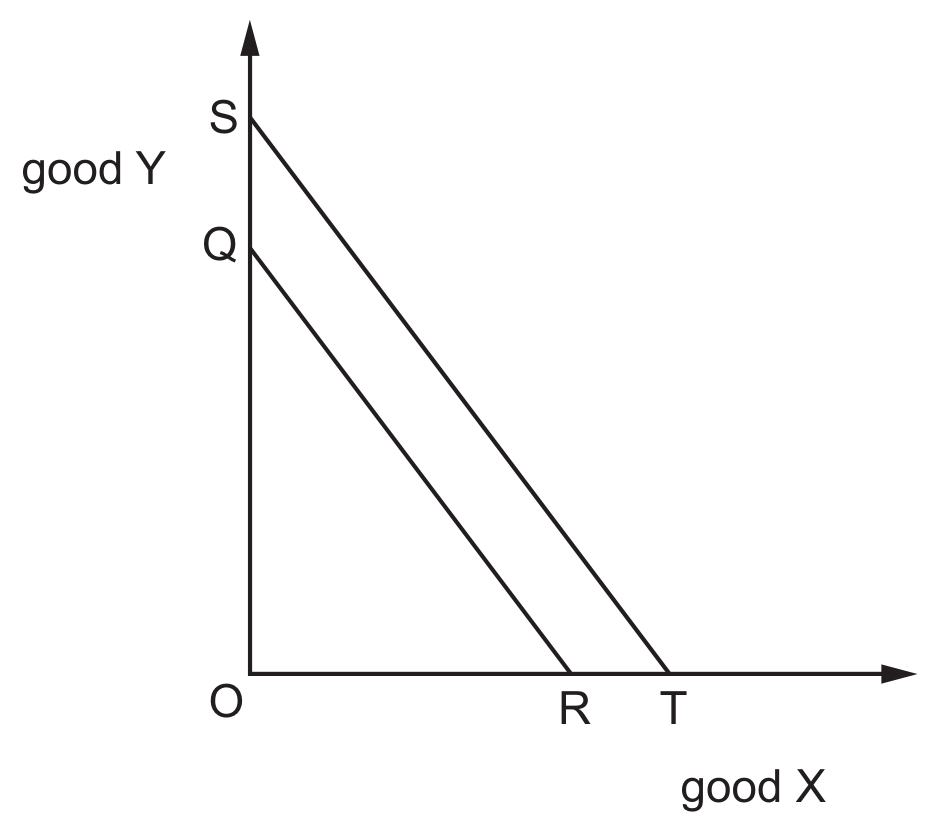
Figure for Question 1 — CAIE A-Level Economics

What could explain the shift in the budget line from QR to ST?

A

a decrease in the consumer's real income

B

a decrease in the quality of both goods

C

an increase in the consumer's money income

D

an increase in the price of both goods
Question 2

[Maximum number: 1]

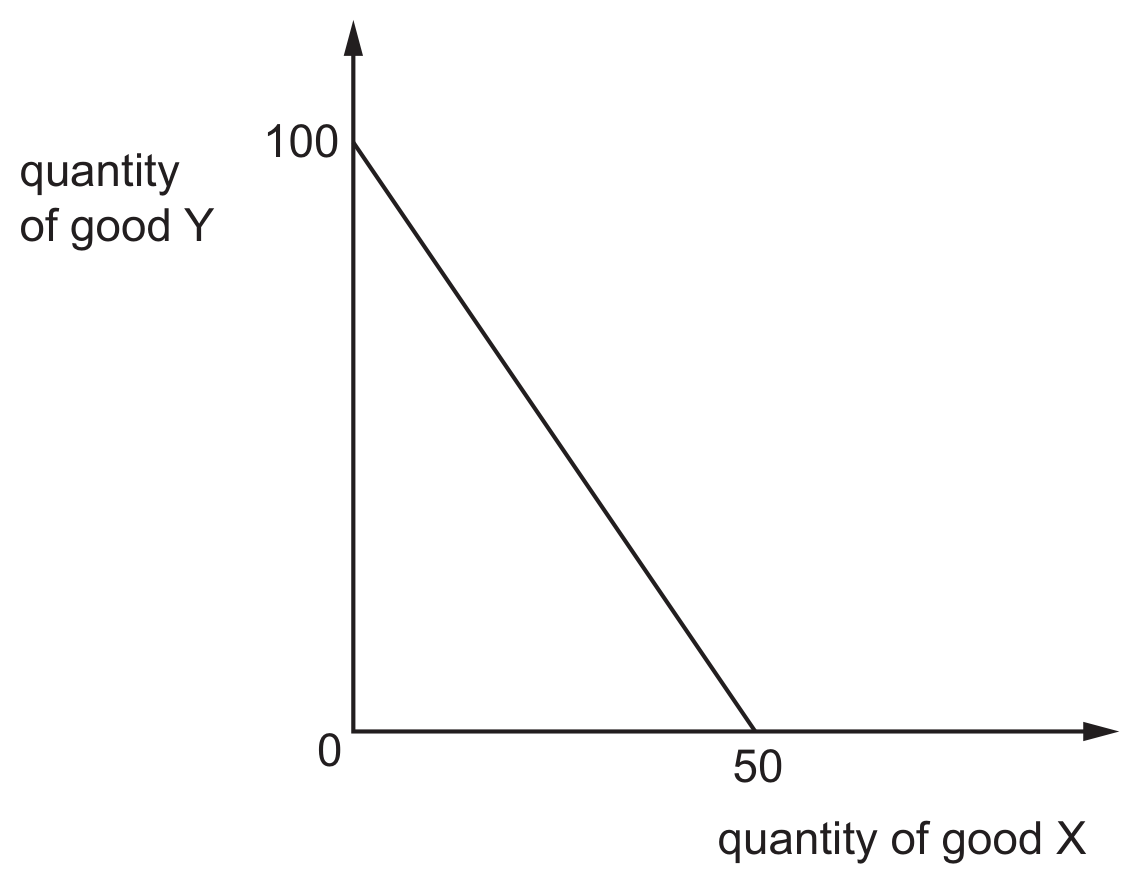
The diagram shows a consumer's budget line.

Figure for Question 2 — CAIE A-Level Economics

What determines the slope of the budget line?

A

the marginal rate of substitution of good X for good Y

B

the price of good X multiplied by the price of good Y

C

the ratio of the price of good X to the income of the consumer

D

the ratio of the price of goodX\operatorname{good} X to the price of goodY\operatorname{good} Y

Question 2

[Maximum number: 1]

Which feature of indifference curve theory is most likely to apply in reality?

A

The consumer can express preferences between all possible combinations of goods.

B

The consumer has a limited income to spend.

C

The consumer will always behave rationally.

D

The consumer will always get positive utility from having more of the goods.

Question 2

[Maximum number: 20]

With the help of a diagram, evaluate the use of indifference curve analysis to explain the relationship between a change in the price of a product and the change in an individual consumer's demand for this product.
[20]
OR