CAIE A-Level Economics 3 Government Microeconomic Intervention Question Bank

CAIE A-Level Economics 3 Government Microeconomic Intervention Question Bank
Cambridge International AS & A Level Economics 9708 syllabus for exams in 2026, 2027 and 20282026–2028

Practise reasons, methods and effects of government microeconomic intervention, including public goods, indirect taxes, subsidies, price controls, information and inequality…

Question 1

[Maximum number: 10]

In 2023, Mexico's energy policies looked increasingly out of step with those in the rest of the world. The Mexican President reversed recent reforms of Mexico's energy market. These reforms increased the role of private sector firms. He changed the balance of the mixed economy by prioritising state-owned companies and stressed that Mexico should produce its own energy rather than importing it.

The government invested in a new oil refinery and decided to keep coal-fired power stations running. It also gave state-owned electricity and oil companies priority over private sector rivals, so it was harder for private firms to obtain permits to generate electricity or to explore for oil.

Mexico has traditionally exported crude oil and imported natural gas. However, the new plan is that the oil will be used to generate the country's electricity. There has been a global shift towards energy self-sufficiency but it is unclear whether Mexico has the capacity to produce enough electricity for its 130 million people. There may also be an impact on the country's balance of trade in goods which was in deficit for nine months of 2022, as shown in Figure 1.1.
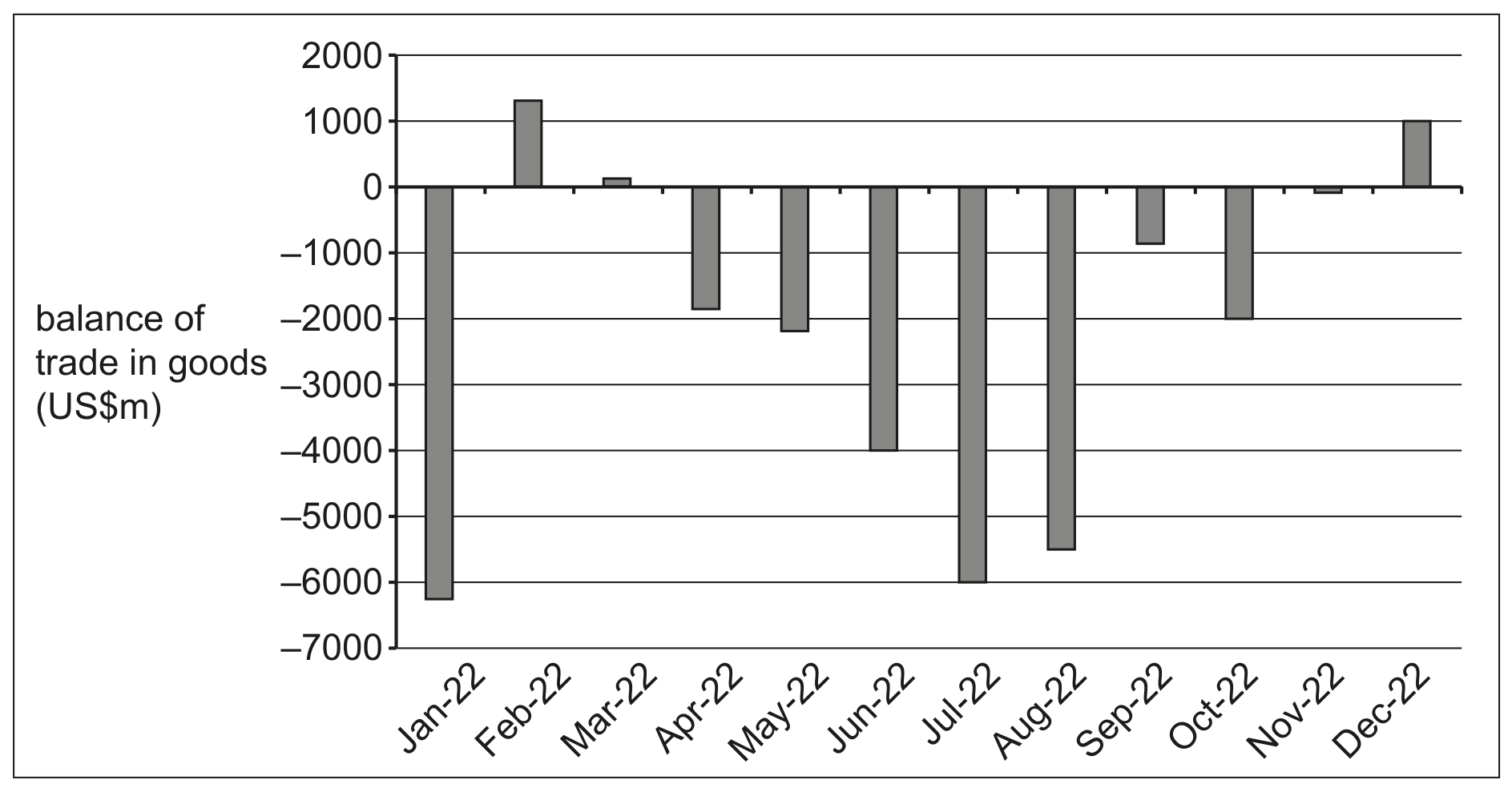
Figure for Question 1 — CAIE A-Level Economics

Energy is likely to become more expensive. Operating costs of the state-owned electricity producers are significantly higher than their private sector rivals. Its old and inefficient plants are expensive to maintain. These costs will be passed on to the consumer, either directly or by the government having to spend more on subsidies to keep down the price.

The environment will also suffer. Mexico will see less investment in renewable energy because of its change in energy policy. In the past, domestic and foreign firms in the private sector did much of the investing. The policy change means that Mexico is unlikely to meet its pledge to produce 35%35 \% of its electricity from renewable sources by 2024.

The impact of the energy policy may be felt in the economy more broadly. The earlier energy reforms had helped to bring manufacturers to Mexico by making power cheaper and more reliable. Now the uncertainty is deterring investors.

The opportunity cost of Mexico's new energy policy is huge. Economists reckon that Mexico could have produced almost half its electricity from renewable sources long before its target of 2050. Multinational companies were looking at Mexico as an alternative location to other countries, but because of Mexico's change in energy policy, those companies are likely to go elsewhere.

Question 1(c)

(a)

Consider the extent to which direct provision of electricity in Mexico through state-owned companies may be advantageous to consumers.

[ 4 ]

Question 1(d)

(b)

With the help of a diagram, assess whether the potential advantages of providing a subsidy to keep down the price of electricity in Mexico will outweigh the potential disadvantages.

[ 6 ]

Question 2

Question 2(a)

(a)

Explain what is meant by the incidence of an indirect tax and consider the extent to which it is possible for the incidence to pass from a producer of a good to a consumer of that good. [8]

[ 8 ]

Question 2(b)

(b)

Assess the extent to which a government should subsidise the production of merit goods to increase the consumption of these goods.

OR

[ 12 ]

Question 10

[Maximum number: 1]

What is an example of direct provision by a government?

A

The government introduces a subsidy on renewable fuels to help the environment.

B

The government introduces a unit tax on cigarettes to discourage consumption.

C

The government sets a maximum rent on housing to protect tenants.

D

The government takes over a private library to improve local services.

Question 3

Question 3(a)

(a)

Explain what is meant by a merit good and why governments provide merit goods such as healthcare free of charge and consider why such provision may not always be successful.

[ 8 ]

Question 3(b)

(b)

Assess whether a charge made for healthcare at the point of use is likely to be more beneficial to consumers and providers than if healthcare is available to all free of charge.

Section C

Answer one question.

EITHER

[ 12 ]

Question 3

Question 3(a)

(a)

The Gini coefficient for South Korea was estimated to be 0.39 in 2019 and 0.33 in 2022.
Explain what this data means, how it might be used by the government of South Korea and consider its usefulness.

[ 8 ]

Question 3(b)

(b)

Assess why it is easier for a government such as that of South Korea to redistribute income rather than redistribute wealth.

Section C

Answer one question.

EITHER

[ 12 ]

Question 12

[Maximum number: 1]

Which policy is most likely to solve the free rider problem caused by public goods?

A

an advertising campaign

B

a direct provision by the government

C

a minimum price

D

a tax on a substitute good

Question 13

[Maximum number: 1]

What would be included in a measure of wealth?

A

annual income

B

benefits and pensions

C

interest earned on savings

D

savings held in bank accounts

Question 14

[Maximum number: 1]

The income Gini coefficient of a country changes from 0.29 to 0.33 over time.
What might explain this change?

A

an increase in food and energy subsidies

B

an increase in structural unemployment

C

an increase in the national minimum wage

D

an increase in the top rate of income tax

Question 14

[Maximum number: 1]

Why might a government introduce a minimum price for a product?

A

to benefit poorer consumers

B

to encourage consumption of a merit good

C

to encourage production of a public good

D

to support the incomes of producers

Question 24

[Maximum number: 1]

What is the most likely reason for a government to introduce a progressive tax?

A

to discourage the consumption of a particular good

B

to distribute disposable income more evenly

C

to increase the disposable income of households

D

to reduce demand for healthcare services