
Question 1
The impact of demonetisation in India
India has a vast informal economy, where products and labour are exchanged for cash without official records, so that the authorities cannot easily trace the transactions. In November 2016, this informal economy was affected by a government decision to adopt a policy of 'demonetisation'. This involved the withdrawal from circulation of India's two most used bank notes, the 500 and 1000 rupee notes. This policy removed 14 trillion rupees of cash from the most cash-dependent major economy in the world. There were long queues outside banks as people tried to open bank accounts to deposit these notes before they were no longer valid.
The policy was intended to remove cash hoarded by the very rich elite, criminals and the large number of people who did not pay tax. The government later said that demonetisation was also the first step in a 'cashless' revolution to move the billions of transactions undertaken each day in India through the banking system so that the tax authorities could trace them. In 2016, only 1\% of workers paid income tax.
India's Labour Minister announced that it would become compulsory for employers to pay their employees through bank accounts, a hugely ambitious step in a country where as many as 90% of workers were paid in cash. Many business owners were dreading the prospect of paying their employees through bank accounts. One factory owner in Delhi commented: "How do you think I can pay the workers with a cheque if they don't have a bank account? It takes three days to clear a cheque. What will they eat during those days?"
The Indian government's vision of a cashless economy does not seem to correspond to the reality of working life in India. Another factory owner stated that this would affect the production process: "Rickshaw pullers transfer goods from my factory to the shops. For one trip I pay a rickshaw puller 100 rupees. Does the government expect me to give them a cheque for such a small amount? How do I pay them if I am not allowed to use cash? If I have to write a cheque for every payment this will increase my costs considerably."
The workers are also concerned about the change to the law that will force them to have their wages paid directly into banks. Money performs a number of important functions in an economy and cash has an acceptability that still matters for many workers. One worker commented: "I am a daily wage worker and I am not sure if I will have a job tomorrow. If I receive cash in hand, I know I have the money".
If demonetisation is to succeed, the Indian government will need to introduce incentives to persuade millions of people to open bank accounts. However, this will not be easy to achieve because around 30% of people in India still do not have bank accounts.
Fig. 1.1 shows India's money supply as measured by M1, which consists of notes and coins in circulation and balances in bank deposits that can be spent immediately e.g. through withdrawals, cheques or debit cards.
India's M1 money supply (trillions of rupees)
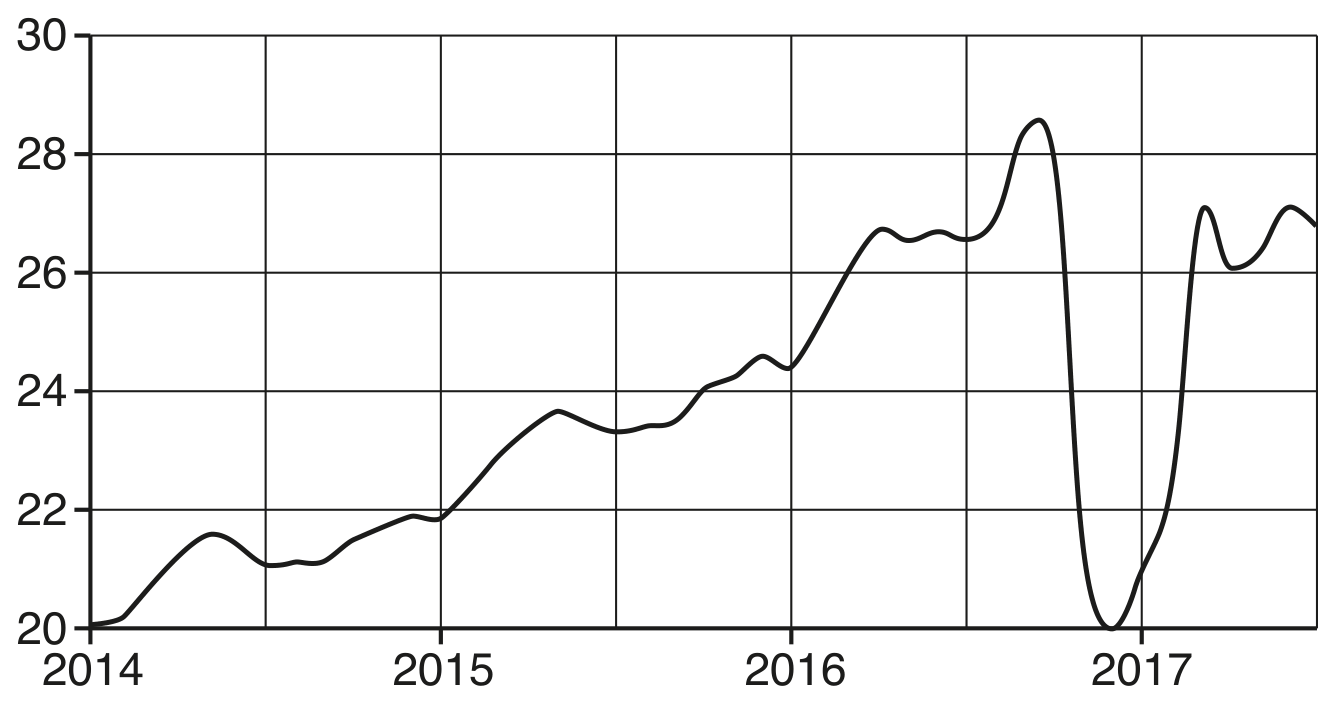
Fig. 1.1: India's M1 money supply, 2014-2017
Question 1(a)(i)
Describe, using Fig. 1.1, the immediate impact of demonetisation on India's M1 money supply.
Question 1(a)(ii)
Explain a possible reason why India's M1 money supply increased early in 2017, as shown in Fig. 1.1, after the most used bank notes were withdrawn from circulation.
Question 1(b)
Explain whether a cheque should be regarded as money.
Question 1(c)
Explain how the Indian government's decision to withdraw the two most used bank notes is likely to affect the use of cash as a store of value in India over time.
Question 1(e)
Discuss whether demonetisation in India is likely to be inflationary.
Answer one question.