Economic problems in Kyrgyzstan
Rouble decline affects Kyrgyzstan
Kyrgyzstan is a developing economy which has a border with Russia. At the local market in the capital, Bishkek, the price of meat increased by 9% in six weeks in 2014. A local butcher said that as a result sales had fallen. 'I usually sell 400 kilos of meat every month, but in September I sold only 250 kilos,' she complained. In Bishkek, food prices increased by up to 25% over 12 months. Another shopkeeper increased what he charged for flour by 15%, but sales did not decline by very much. 'We all need flour because we all need to eat bread, macaroni, dough,' he said. 'It's not something people can cut back even if it becomes very expensive.'
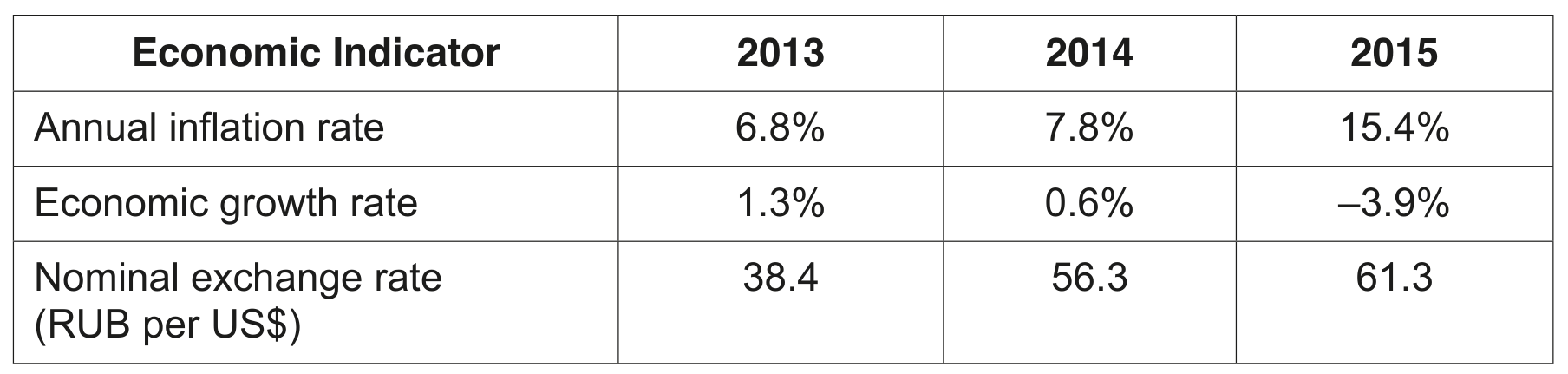
Meanwhile, a sharp decline in the value of Russia's currency, the rouble, since early September is having an impact upon countries across Central Asia, where economies are dependent on remittances (transfers of income) from workers in Russia. By October 2014 the value of the rouble had fallen 20\% against the US dollar since the start of the year. The fall had accelerated in September as the price of oil - Russia's main export - dropped to a four-year low. As local currencies followed the value of the rouble downward, the costs of imported essentials rose.
In Kyrgyzstan, remittances from the millions of workers in Russia have started to fall. In recent years, these cash transfers have contributed the equivalent of about 30% of national income to Kyrgyzstan's economy. As the rouble depreciates, however, it purchases fewer US dollars to send home. Any further drop may significantly reduce consumer demand.
This month the International Monetary Fund said it expects consumer prices in Kyrgyzstan to increase by 8.0% in 2014 and 8.9% in 2015, compared with 6.6% last year. One factor that could have an effect is a policy shift at Russia's central bank, which has already spent over US$50 billion this year attempting to protect the value of the rouble. Some people have condemned efforts to support the currency, arguing that a weaker rouble is good for exports.
In Kyrgyzstan the central bank has used some of its limited reserves to reduce the fall in the currency. Nevertheless, Kyrgyzstan's currency, the som, has fallen in value by 12% against the US dollar this year.
Source: Adapted from Asia Times Online, October 2014