CAIE A-Level Economics 5 Government Macroeconomic Intervention Question Bank

CAIE A-Level Economics 5 Government Macroeconomic Intervention Question Bank
Cambridge International AS & A Level Economics 9708 syllabus for exams in 2026, 2027 and 20282026–2028

Practise macroeconomic objectives and government intervention through fiscal, monetary and supply-side policies, using AD/AS analysis, tax design and policy-effectiveness evidence.

Question 1(d)(i)

[Maximum number: 2]

The Lagos economy is working

Nigeria discovered oil 50 years ago and is now the world's sixth biggest oil exporter. The recent increase in global oil prices has had a very large positive effect on the country's balance of trade and has also improved the country's terms of trade.

Lagos is the largest city in Nigeria, with a population of over 20 million, and has undergone a successful economic transformation in recent years. It has used the private sector to become the most productive and dynamic part of Nigeria's economy. The owner of one of Nigeria's largest companies has stressed the enormous economic progress that the country has made in recent years: "I'm a great believer in Nigeria because the opportunities here are enormous." His company's success shows what private enterprise can achieve in a mixed economy especially if it is provided with the right incentives by the government.

Most Nigerian entrepreneurs are operating in Lagos and entrepreneurship has certainly played a key role in the modern Lagos economy. Start-up initiatives have been encouraged and the need to be innovative has been increasingly recognised, leading to the development of new goods, services and markets. The city is the centre of thriving music, fashion, film and technology industries that have significant influence throughout Africa.

A 'free trade zone' on the edge of Lagos has been established where private sector firms pay no business taxes to the government and there are now numerous start-up enterprises that are thriving. The government aims to lower costs, reduce bureaucracy and make the economy more flexible and efficient with the hope of boosting trade. The zone is located next to a deep sea port and has good road connections with both the rest of Nigeria and other countries in the region.

Lagos is an important transport hub, with three major ports and West Africa's most important international airport. In 2016 the output of Lagos was valued at US$136 billion while Nigeria's total national output was valued at US$405 billion.

A former governor of the Nigerian central bank, has stated: "Since 2000, Lagos has been transformed. In terms of an improved infrastructure and a supportive economic environment, the government has given firms a greater opportunity to thrive."

Source: Adapted from The Financial Times, 26 March 2018

Explain why 'free trade zones' (FTZ) can be considered a supply-side policy.
Question 19

[Maximum number: 1]

A central bank is asked by the government to help achieve price stability.

If inflation rises steeply, which policy will not be directly within the control of the central bank?

A

increasing the rate of interest to reduce consumer spending

B

managing a reduction of the money supply

C

using credit restrictions to regulate lending by commercial banks to households

D

restricting wage increases in the private and public sectors

Question 20

[Maximum number: 1]

What is not a likely reason for a government having the objective of economic growth?

A

to improve living standards

B

to improve business confidence

C

to increase inflationary pressures

D

to increase consumer choice

Question 23

[Maximum number: 1]

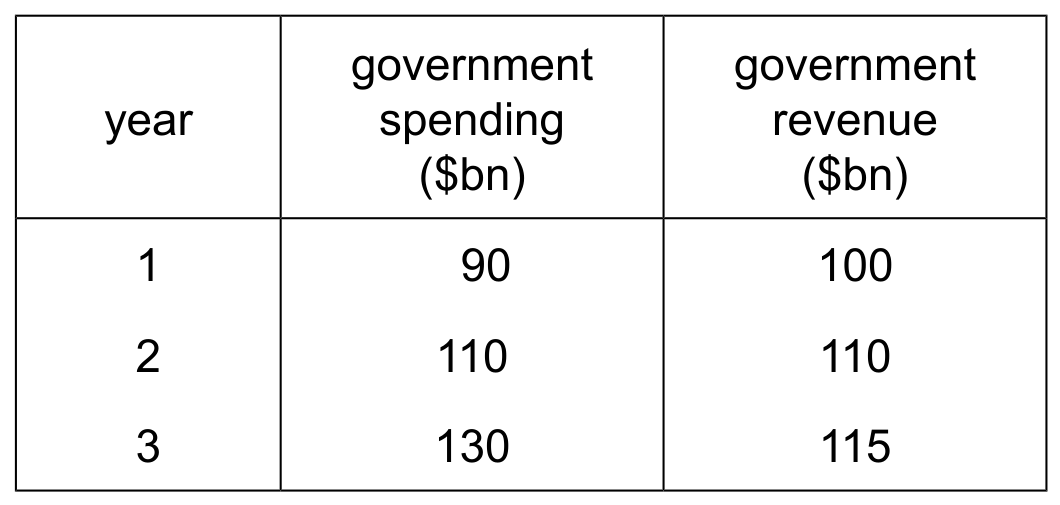
The table shows government spending and revenue over a three-year period.

Table for Question 23 — CAIE A-Level Economics

What can be concluded from the data?

A

A budget surplus becomes a budget deficit in year 3 .

B

National debt is likely to be falling by the end of year 3 .

C

The current account balance is in equilibrium in year 2 .

D

The economy is at full employment equilibrium in year 2.

Question 23

[Maximum number: 1]

What is an example of a supply-side policy?

A

an import quota to restrict the supply of goods

B

a rise in interest rates to encourage the supply of savings

C

a specific tax on the supply of goods to raise revenue

D

a subsidy to businesses to promote the supply of training courses

Question 24

[Maximum number: 1]

What is the most likely consequence when there is an increase in the national debt?

A

the creation of additional money

B

a current account deficit on the balance of payments

C

a surplus in the government's budget

D

the crowding out of private sector investment

Question 24

[Maximum number: 1]

A worker earns $ 10000 and pays $ 1000 in income tax.
Another worker earns $ 30000 and pays $ 4500 in income tax.
A third worker earns $ 150000 and pays $ 50000 in income tax.
Which type of tax is this?

A

indirect

B

progressive

C

proportional

D

regressive

Question 25

[Maximum number: 1]

An increase in interest rates is an example of which type of policy?

A

contractionary fiscal policy

B

contractionary monetary policy

C

expansionary monetary policy

D

restrictive supply-side policy

Question 28

[Maximum number: 1]

Which combination identifies a main aim of supply-side policy and a measure used to achieve this target?

main aim

policy measure

economic growth

deregulation

full employment

increasing the money supply

income equality

more progressive taxation

stable prices

decreasing interest rates

Question 30

[Maximum number: 1]

Which policy's principal aim is to ensure sound public finances?

A

environmental policy

B

fiscal policy

C

monetary policy

D

supply-side policy