CAIE A-Level Economics 4 The Macroeconomy Question Bank

CAIE A-Level Economics 4 The Macroeconomy Question Bank
Cambridge International AS & A Level Economics 9708 syllabus for exams in 2026, 2027 and 20282026–2028

Practise national income, circular flow, aggregate demand and supply, growth, unemployment and inflation through calculations, data interpretation, diagrams and policy analysis.

Question 1

[Maximum number: 14]

The COVID-19 pandemic had a very significant impact on the global economy in 2020. Negative economic growth rates were recorded for all major economies. The speed, unexpected and unprecedented nature of the downturns has been devastating for businesses, governments and populations. Individual economies reacted to the pandemic differently. Fig. 1.1 shows quarterly economic growth rates in 2020 for four selected countries compared to the OECD (Organisation for Economic Co-operation and Development) average.
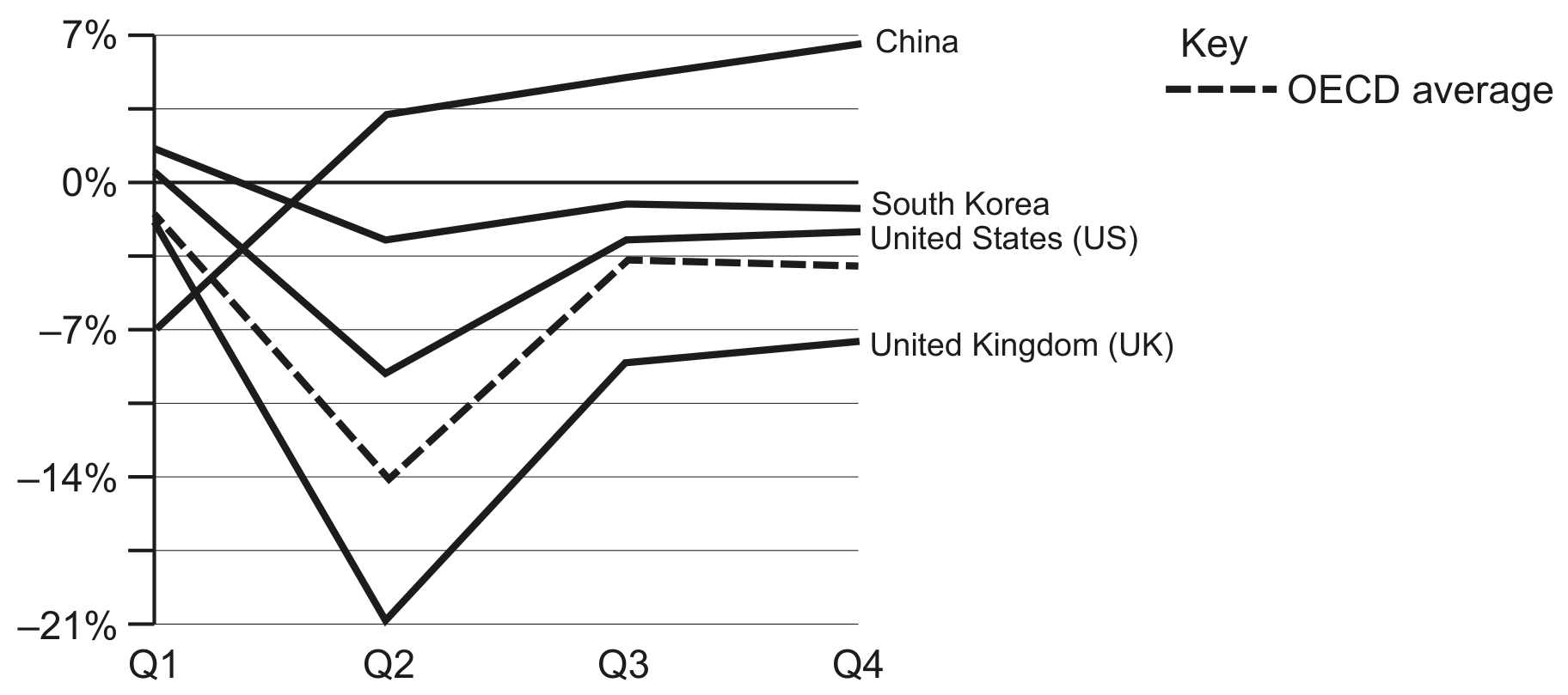
Fig. 1.1 Annual change to quarterly gross domestic product (GDP) in selected countries in 2020 compared to the OECD average.

Fig. 1.1 Annual change to quarterly gross domestic product (GDP) in selected countries in 2020 compared to the OECD average.

China's economic performance in 2020 was the exception. China was the first country to experience the pandemic. It has also been the first economy to recover from recession, a period of two consecutive quarters of negative economic growth. The Chinese government was quick to enforce lockdowns to limit the pandemic and there was rapidly increasing demand for exports of PPE (personal protection equipment) and other Chinese-made products.

The case of neighbouring South Korea was different. Like China, the impact of the pandemic was more effectively contained than in other economies and growth in South Korea's economy was less affected. There was, however, little evidence in the data that by the end of 2020, South Korea's economy would recover to its pre-2019 position of strong economic growth.

The economies of the US and the UK had negative quarterly economic growth throughout 2020. Economists in these countries have disagreed about how best to increase the rate of economic growth after the pandemic. The governments of both countries introduced very high government spending programmes to encourage the return to economic growth in 2021. However, monetary policies have been widely promoted by many economists as an alternative to more traditional fiscal measures.

Question 1(a)

(a)

Explain the meaning of 'negative economic growth'.

[ 2 ]

Question 1(b)

(b)

Which country shown in Fig. 1.1 experienced the most severe recession in 2020? Justify your answer.

[ 2 ]

Question 1(c)

(c)

State two likely economic reasons why China experienced strong economic growth starting in the second quarter of 2020 and consider which of these is likely to have generated the greater rate of growth.

[ 4 ]

Question 1(d)

(d)

Assess how economic recovery is likely to have affected employment and price stability in China.
[ 6 ]

Question 4(a)

[Maximum number: 8]

With the help of a diagram, explain what is meant by the circular flow of income in an open economy and consider the extent to which it can explain economic growth in such an economy.

Question 15

[Maximum number: 1]

What is an example of an injection into the circular flow of income in an open economy?

A

consumer spending on goods

B

expenditure on a government construction project

C

spending by households on holidays abroad

D

repayment of loans to commercial banks

Question 16

[Maximum number: 1]

Which source of income is not included in measuring real GDP?

A

pension paid to retired people

B

profits made by firms

C

rent paid to landlords

D

wages paid to nurses

Question 17

[Maximum number: 1]

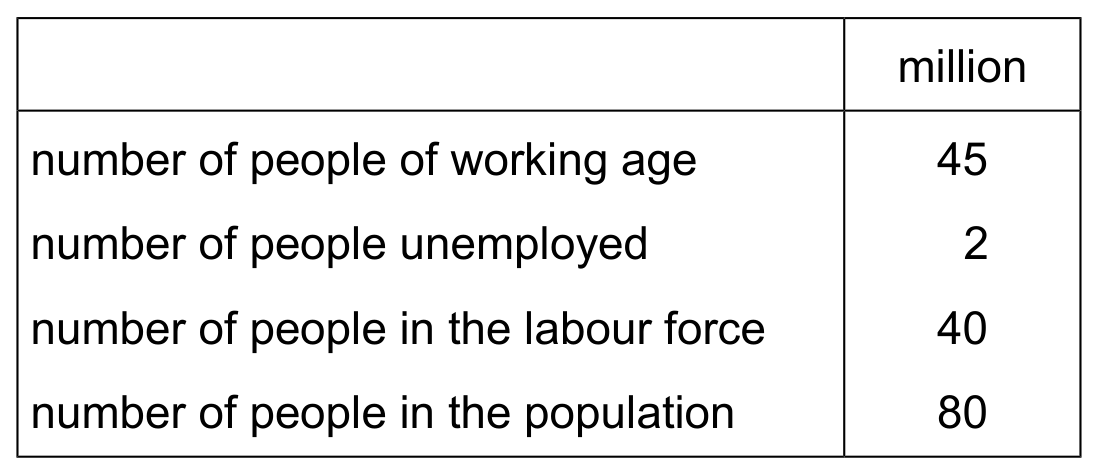
The table shows some labour market statistics.

Table for Question 17 — CAIE A-Level Economics

What is the unemployment rate?

A

2.5%

B

5\%

C

6.25\%

D

12.5\%

Question 21

[Maximum number: 1]

A government statistical office measured changes in income from employment, pensions and benefits, then subtracted income tax and welfare contributions and adjusted for inflation.

What did the final figure represent?

A

changes in nominal income

B

changes in nominal net earnings

C

changes in real disposable income

D

changes in real gross earnings

Question 21

[Maximum number: 1]

What is a correct description of an aggregate demand (AD) curve?

A

It is a curve obtained by adding the market demand curves of all consumer goods traded in an economy.

B

It is a curve determined by the horizontal summation of all individual consumer demand curves for a product.

C

It is a curve that shows the total amount of goods and services firms are willing to buy at a given price in an economy.

D

It is a curve that shows the total demand of all goods and services produced at all price levels in an economy.

Question 22

[Maximum number: 1]

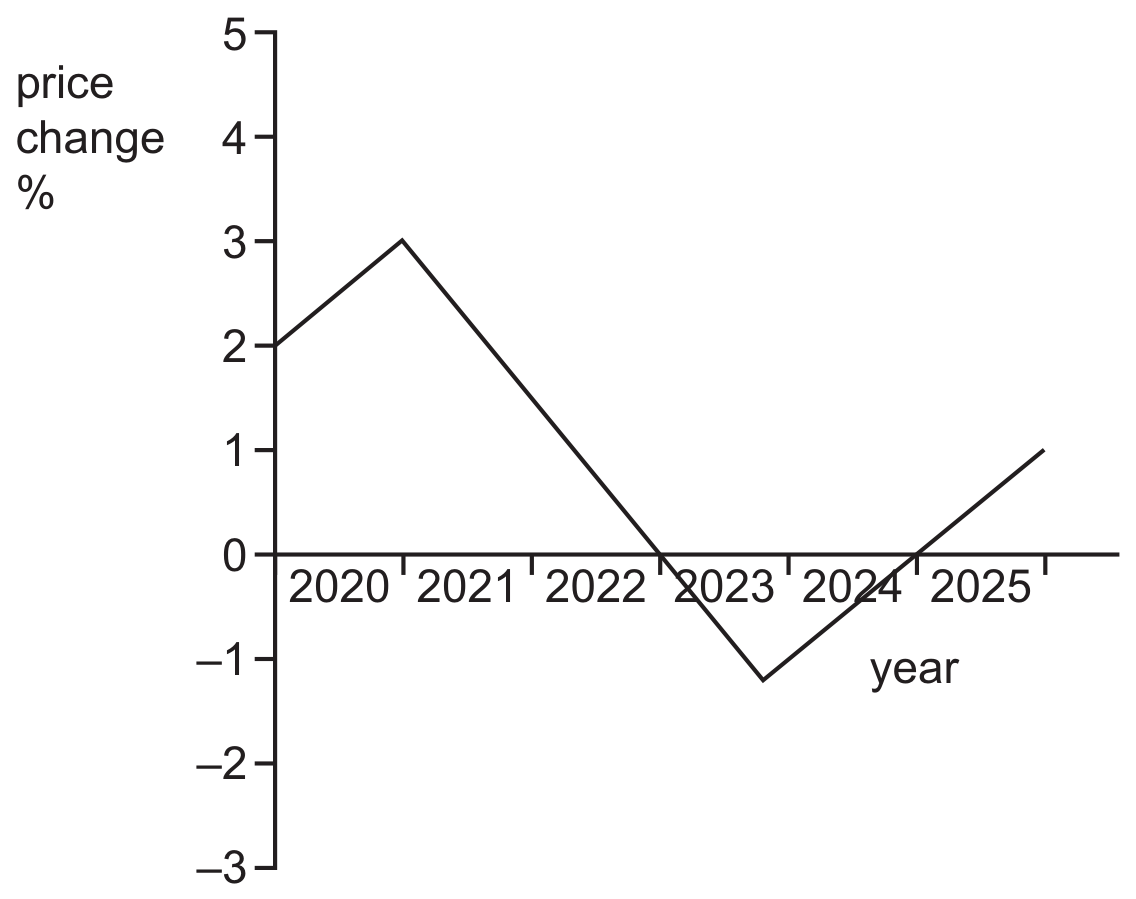
The diagram shows changes in a country's price level over a number of years.
During which period of time did only disinflation occur?

Figure for Question 22 — CAIE A-Level Economics
A

from the start of 2020 to the end of 2025

B

from the start of 2021 to the end of 2022

C

from the start of 2021 to the end of 2023

D

from the start of 2023 to the end of 2024

Question 22

[Maximum number: 1]

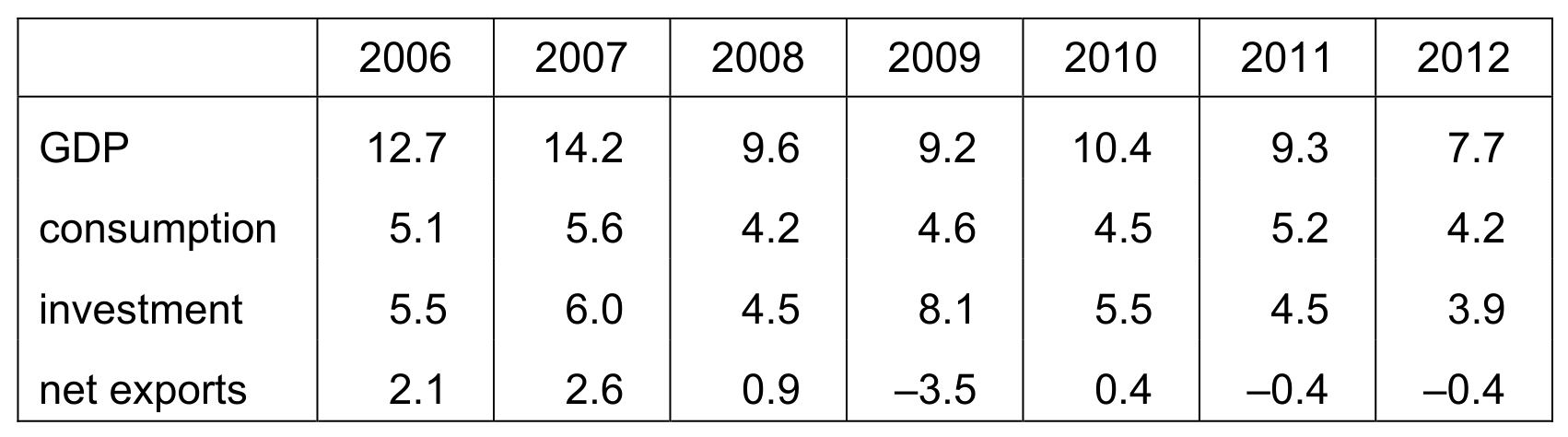
The table shows the annual percentage (\%) change in China's GDP and the contribution of some of its component parts between 2006 and 2012.

Table for Question 22 — CAIE A-Level Economics

What can be concluded about China's economy between 2006 and 2012?

A

China's current account was in surplus more years than it was in deficit.

B

China's economic rate of growth fell in more years than it rose.

C

China's growth was greater overall in consumer goods than in capital goods.

D

China's standard of living rose at a decreasing rate.

Question 30

[Maximum number: 1]

What are the components of aggregate demand?

A

consumption + investment + government spending + (exports - imports)

B

consumption + investment + taxation - (exports - imports)

C

consumption + saving + taxation - (exports - imports)

D

consumption + saving + taxation + (exports - imports)