CAIE A-Level Economics 1 Basic Economic Ideas and Resource Allocation Question Bank

CAIE A-Level Economics 1 Basic Economic Ideas and Resource Allocation Question Bank
Cambridge International AS & A Level Economics 9708 syllabus for exams in 2026, 2027 and 20282026–2028

Practise scarcity, opportunity cost, factors of production, economic methodology, resource allocation, production possibility curves and classifications of goods.

Question 1

[Maximum number: 1]

What is a common criticism of economics?

A

It fails to establish theories of economic behaviour.

B

It is unable to construct models of how an economy might work.

C

It lacks the ability to use and apply mathematics.

D

It is very difficult to undertake laboratory experiments in economics.

Question 1

[Maximum number: 4]

In 2023, Mexico's energy policies looked increasingly out of step with those in the rest of the world. The Mexican President reversed recent reforms of Mexico's energy market. These reforms increased the role of private sector firms. He changed the balance of the mixed economy by prioritising state-owned companies and stressed that Mexico should produce its own energy rather than importing it.

The government invested in a new oil refinery and decided to keep coal-fired power stations running. It also gave state-owned electricity and oil companies priority over private sector rivals, so it was harder for private firms to obtain permits to generate electricity or to explore for oil.

Mexico has traditionally exported crude oil and imported natural gas. However, the new plan is that the oil will be used to generate the country's electricity. There has been a global shift towards energy self-sufficiency but it is unclear whether Mexico has the capacity to produce enough electricity for its 130 million people. There may also be an impact on the country's balance of trade in goods which was in deficit for nine months of 2022, as shown in Figure 1.1.

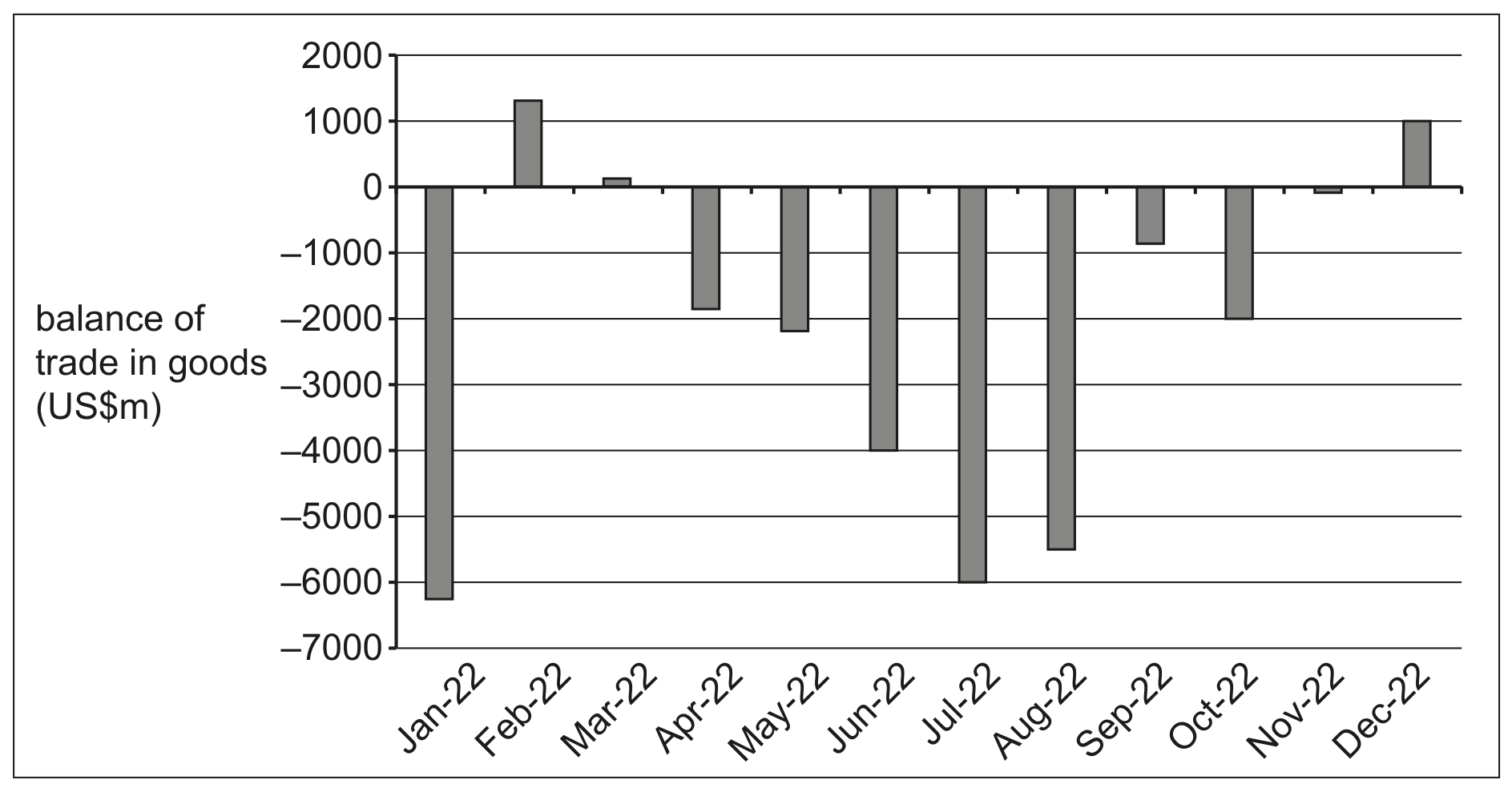
Figure for Question 1 — CAIE A-Level Economics

Energy is likely to become more expensive. Operating costs of the state-owned electricity producers are significantly higher than their private sector rivals. Its old and inefficient plants are expensive to maintain. These costs will be passed on to the consumer, either directly or by the government having to spend more on subsidies to keep down the price.

The environment will also suffer. Mexico will see less investment in renewable energy because of its change in energy policy. In the past, domestic and foreign firms in the private sector did much of the investing. The policy change means that Mexico is unlikely to meet its pledge to produce 35%35 \% of its electricity from renewable sources by 2024.

The impact of the energy policy may be felt in the economy more broadly. The earlier energy reforms had helped to bring manufacturers to Mexico by making power cheaper and more reliable. Now the uncertainty is deterring investors.

The opportunity cost of Mexico's new energy policy is huge. Economists reckon that Mexico could have produced almost half its electricity from renewable sources long before its target of 2050. Multinational companies were looking at Mexico as an alternative location to other countries, but because of Mexico's change in energy policy, those companies are likely to go elsewhere.

Question 1(a)

(a)

Using the information provided, explain whether Mexico is a mixed economy.

[ 2 ]

Question 1(b)

(b)

Explain what is meant by 'The opportunity cost of Mexico's new energy policy is huge.'

[ 2 ]

Question 1

[Maximum number: 1]

What must follow when scarcity exists?

A

Consumers have to make choices.

B

Governments are unable to supply public goods.

C

Producers must be misallocating resources.

D

Workers must be earning low wages.

Question 1

[Maximum number: 1]

The following appeared in a newspaper article.
'The economies of the poorest nations have large international debts; the richest nations should cancel the debts of these nations and reduce poverty.'

What is the nature of each statement?

poorest nations have
large international
debts

richest nations should
cancel these debts to
reduce poverty

normative

normative

normative

positive

positive

positive

positive

normative

Question 3

[Maximum number: 1]

A wine producer and bottler wanted to expand its production significantly. To finance the expansion it offered investors discounts on restaurant meals if they bought 2000 shares in the company.

Which factors of production are most likely to be involved in this expansion?

A

labour, land, capital and enterprise

B

labour, land and capital only

C

enterprise and land only

D

enterprise only

Question 4

[Maximum number: 1]

What is essential to eliminate scarcity?

A

the existence of sufficient resources to meet all needs and wants

B

producers consistently produce in excess of demand

C

the government has a surplus budget

D

there is equilibrium in all markets

Question 4

[Maximum number: 1]

What does a production possibility curve show?

A

the actual demand in an economy given its existing resources

B

the maximum output an economy can achieve using existing resources

C

the maximum output an economy can ever achieve

D

the minimum combinations of output an economy can achieve

Question 4

[Maximum number: 1]

A country increases its spending on education and training. It pays for this by reducing unemployment benefit payments and increasing taxes on imports of machinery.

What is the likely effect of these changes?

human capital

physical capital

decreases

decreases

decreases

increases

increases

decreases

increases

increases

Question 4

[Maximum number: 1]

Which change in the way resources are allocated in an economy is consistent with moving from a planned economy to a market economy?

A

A minimum price guarantee for apple producers is removed.

B

A new government authority is established to monitor inefficiencies in apple production.

C

The production of apples is subsidised to increase output.

D

The sale of apples has a maximum price imposed.

Question 3(a)

[Maximum number: 8]

With the help of examples, explain the nature and characteristics of free goods and private goods (economic goods) and consider the significance of the distinction between these two types of good.