Question 1
Question 1(a)
(a)
(a)Complete Table 1.1 using relevant information from the Periodic Table.

Table 1.1
[ 2 ]
Question 1(b)
(b)
(b)State and explain the difference in the ionic radius of compared to .
[ 3 ]
 EduNinja
(a)Complete Table 1.1 using relevant information from the Periodic Table.
Table 1.1
(b)State and explain the difference in the ionic radius of compared to .
The model of the nuclear atom was first proposed by Ernest Rutherford. He developed this model on the basis of results obtained from an experiment using gold metal foil.
Complete the table with information for two of the particles in an atom of .
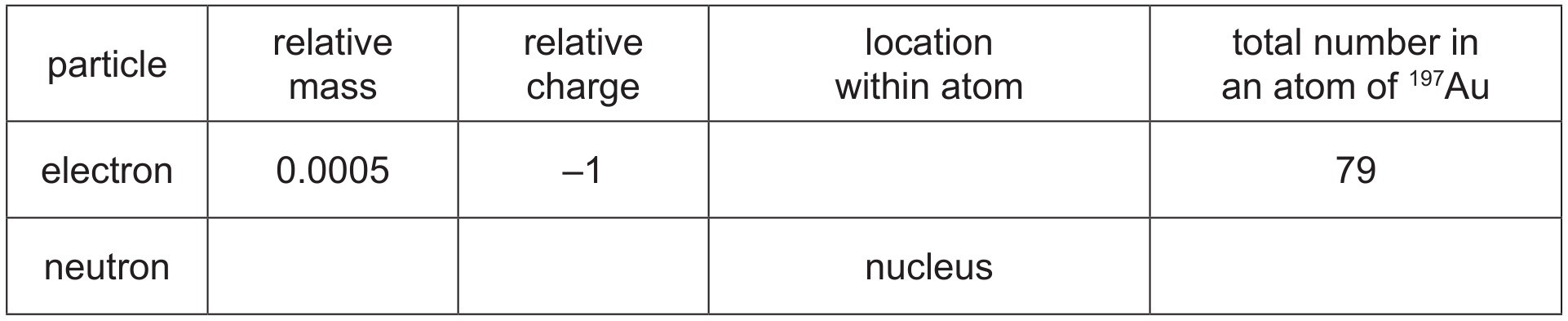
Atoms contain the subatomic particles electrons, protons and neutrons. Protons and electrons were discovered by observations of their behaviours in electric fields.
The diagram shows the behaviour of separate beams of electrons and protons in an electric field.
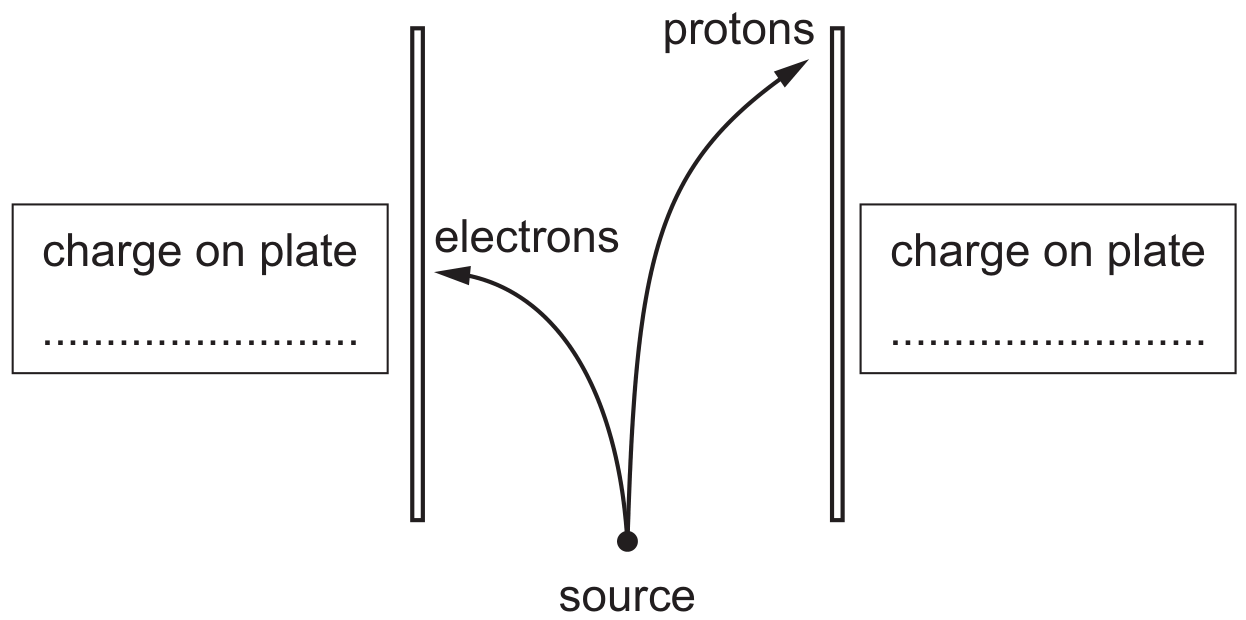
Complete the diagram with the relative charge of each of the electrically charged plates.
On the diagram, draw a line to show how a separate beam of neutrons from the same source behaves in the same electric field.
Species such as and are examples of molecular ions.
Complete Table 1.1 to show the total numbers of protons and electrons in the molecular ions and .
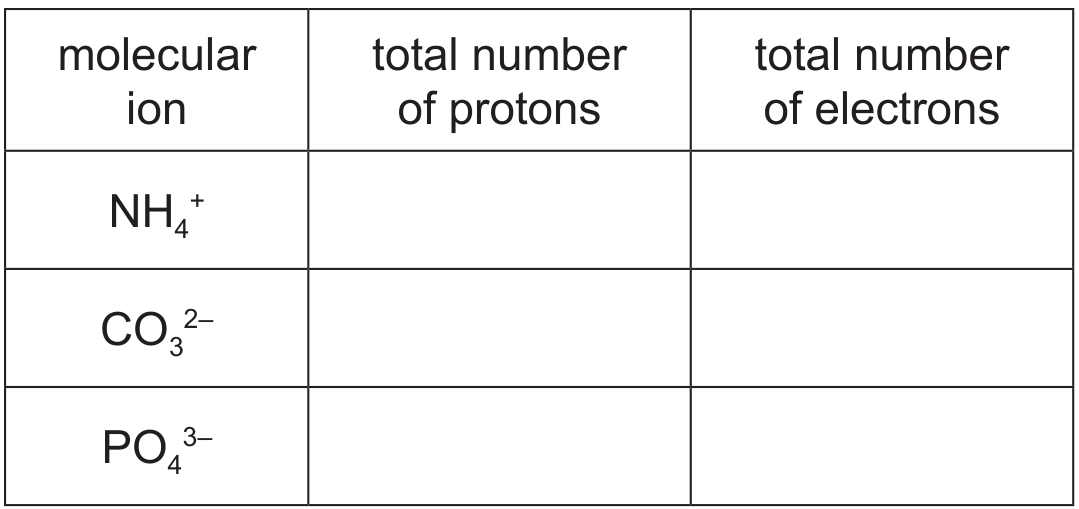
Table 1.1
Atoms with nuclei containing an odd number of protons tend to have fewer isotopes than those with an even number of protons.
Gallium has two stable isotopes, and .
Complete Table 1.1 to show the numbers of protons, neutrons and electrons in the two stable isotopes of gallium.

Table 1.1
The elements phosphorus, sulfur and chlorine are in Period 3 of the Periodic Table.
Table 1.1 shows some properties of the elements P to Cl .
The first ionisation energy of S is not shown.
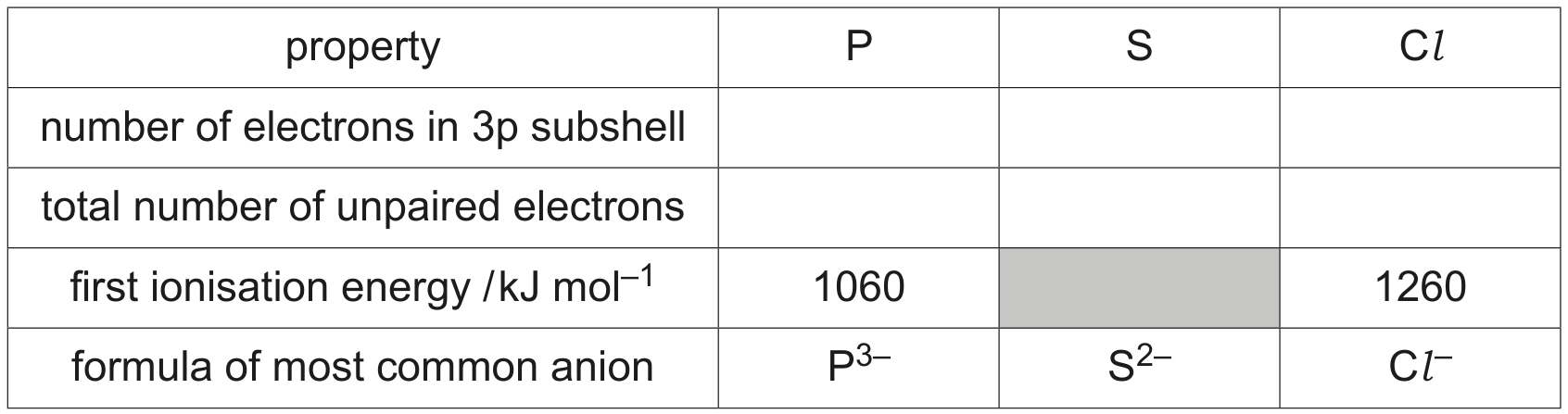
Table 1.1
and have the same number of electrons.
State the trend in ionic radius shown by and .
Explain your answer.
In which species are the numbers of protons, neutrons and electrons all different?
In which pair do the atoms contain the same number of neutrons?
and
and
and
and
The ion contains 18 electrons and has a mass number of 31.
How many protons and neutrons does contain?
protons
neutrons
15
16
15
18
18
13
21
10
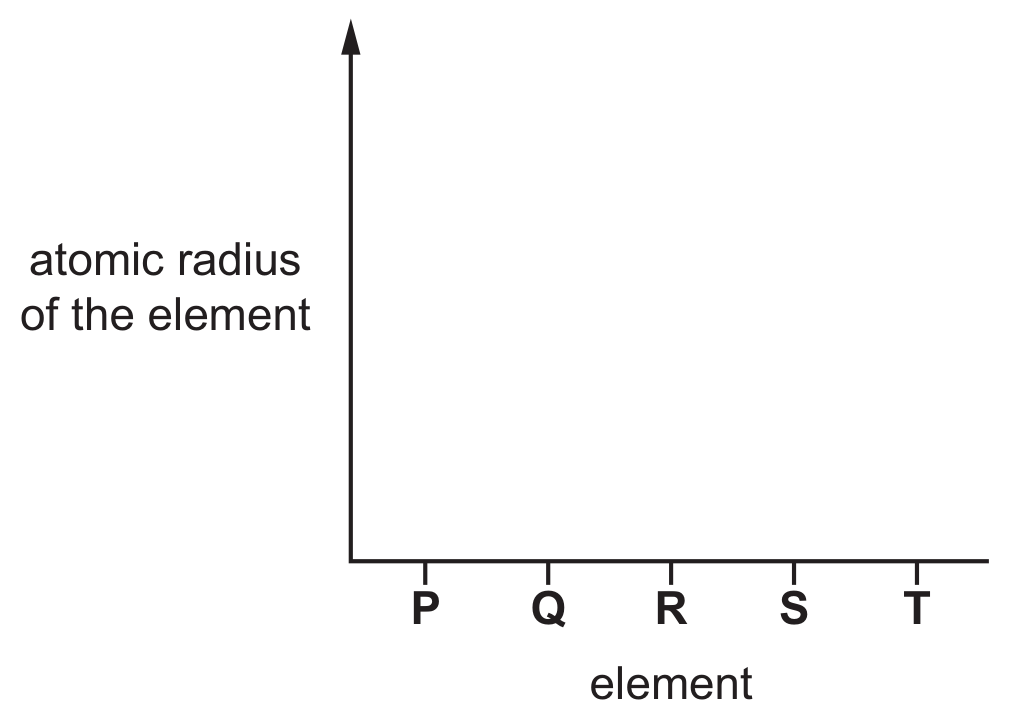
P-T are successive elements in Period 3 of the Periodic Table.
The letters are not the symbols of the elements.
On the axes, sketch a graph to show the trend in the atomic radius of the elements P-T.
Explain your answer.
explanation