2.2.11 (HL)—Resonance structures

Syllabus
First assessment 2025
Objective
2.2.11
Level
HL

Resonance and Delocalization

HL only

Resonance structures represent alternative valid positions for multiple bonds while preserving the atom framework. The actual bonding is described using delocalized electrons, not a molecule switching between drawings.
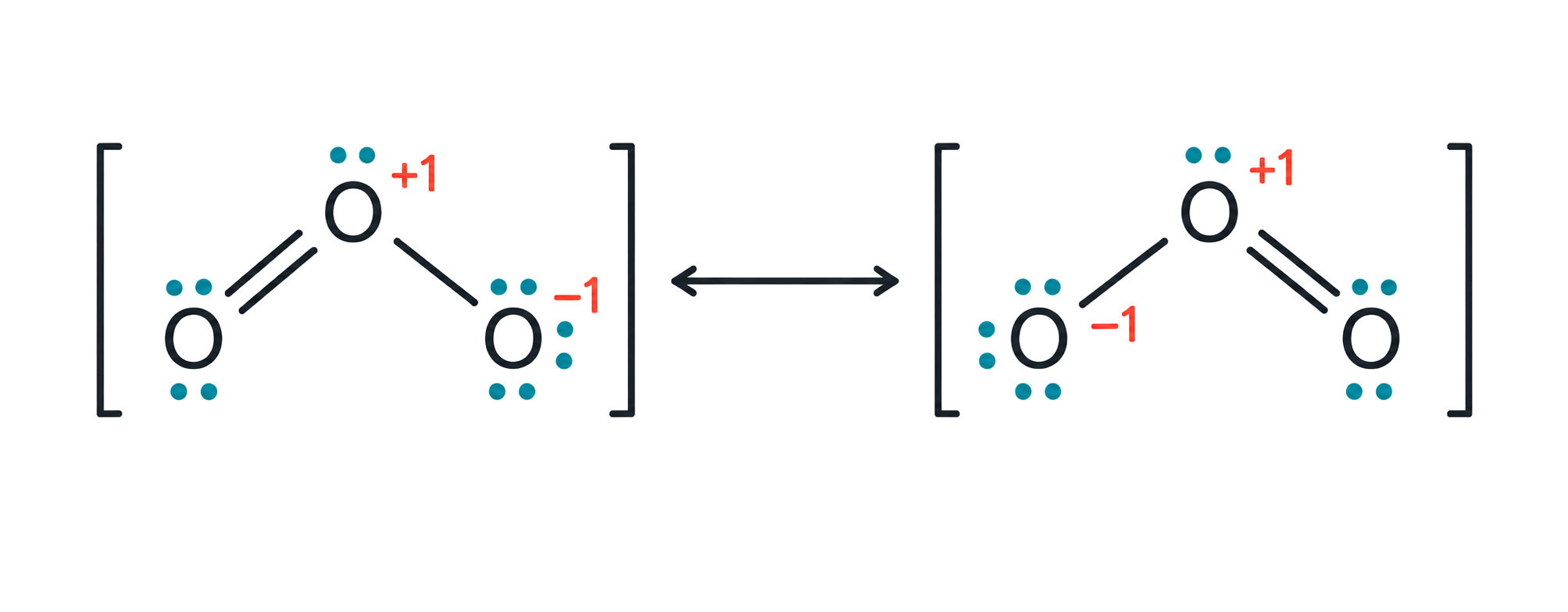
Keep atom connectivity and total electrons consistent, draw each valid arrangement, and use delocalization to describe the shared bonding picture.

For CO₃²⁻, place the C=O bond in each of three valid positions while keeping atom positions and total charge fixed. The observed C–O bonds are equivalent because the π electrons are delocalized; the ion does not alternate among three localized structures.

Drawing Resonance Structures

HL only

Assessment in practice

Representative question

Question 1

[Maximum number: 2]

Predict, with a reason, the bond lengths of the nitrate ion. Use section 11 of the data booklet.

The Covalent Model Summary

Retrieve the covalent pathway: shared pairs and bond order lead to geometry, polarity and molecular polarity; structure determines network properties, IMF behaviour and chromatography; HL representations extend to resonance, formal charge, sigma/pi bonds and hybridization.

Check the representation first, then count domains, apply geometry, identify polarity or forces, and connect the structure to the requested property or HL bonding description.