Reactivity 1. What drives chemical reactions?
- Syllabus
- First assessment 2025
- Section
- —
- Level
- HL

Published Concept pages under this syllabus area do not have tagged past-paper appearances in the selected level yet.
Recent 5 years
Topic 1.1
A chemical reaction transfers energy between the system and surroundings. Total energy is conserved. Heat is energy transferred because of a temperature difference; temperature describes the thermal state.
State which part is the system, which part is the surroundings, and the direction of energy transfer before interpreting a temperature change.
For an exothermic hand-warmer reaction, define the reacting chemicals as the system: energy leaves that system and enters your hand and the air as surroundings. A temperature rise is evidence about the surroundings, while heat names the energy crossing the boundary; neither quantity is 'stored temperature'.
Representative question
Consider a reaction mixture that is in thermal equilibrium with the surroundings. When a reaction takes place, the temperature of the mixture decreases.
Which row correctly shows the changes in energy when the new thermal equilibrium is established?
Energy of system
Energy of surroundings
decreases
decreases
increases
increases
decreases
increases
increases
decreases
D
| Type | Energy direction | Surroundings temperature |
|---|---|---|
| Endothermic | Absorbed by the system | Decreases |
| Exothermic | Released by the system | Increases |
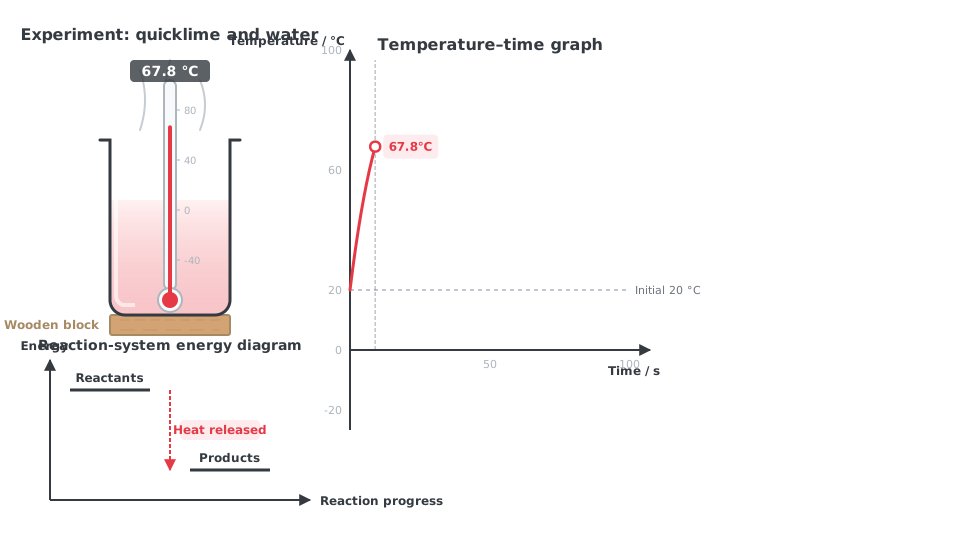
Classify from the direction of energy transfer, then check that the observed temperature change of the surroundings agrees.
Connect three representations: exothermic means energy flows out of the system, the surroundings warm, and ΔH for the system is negative; endothermic gives the opposite pattern and positive ΔH. State the observed part before inferring the reaction type.
Representative question
Which statement about an exothermic reaction is correct?
Temperature decreases and the products have higher enthalpy than the reactants.
Temperature decreases and the products have lower enthalpy than the reactants.
Temperature increases and the products have higher enthalpy than the reactants.
Temperature increases and the products have lower enthalpy than the reactants.
D
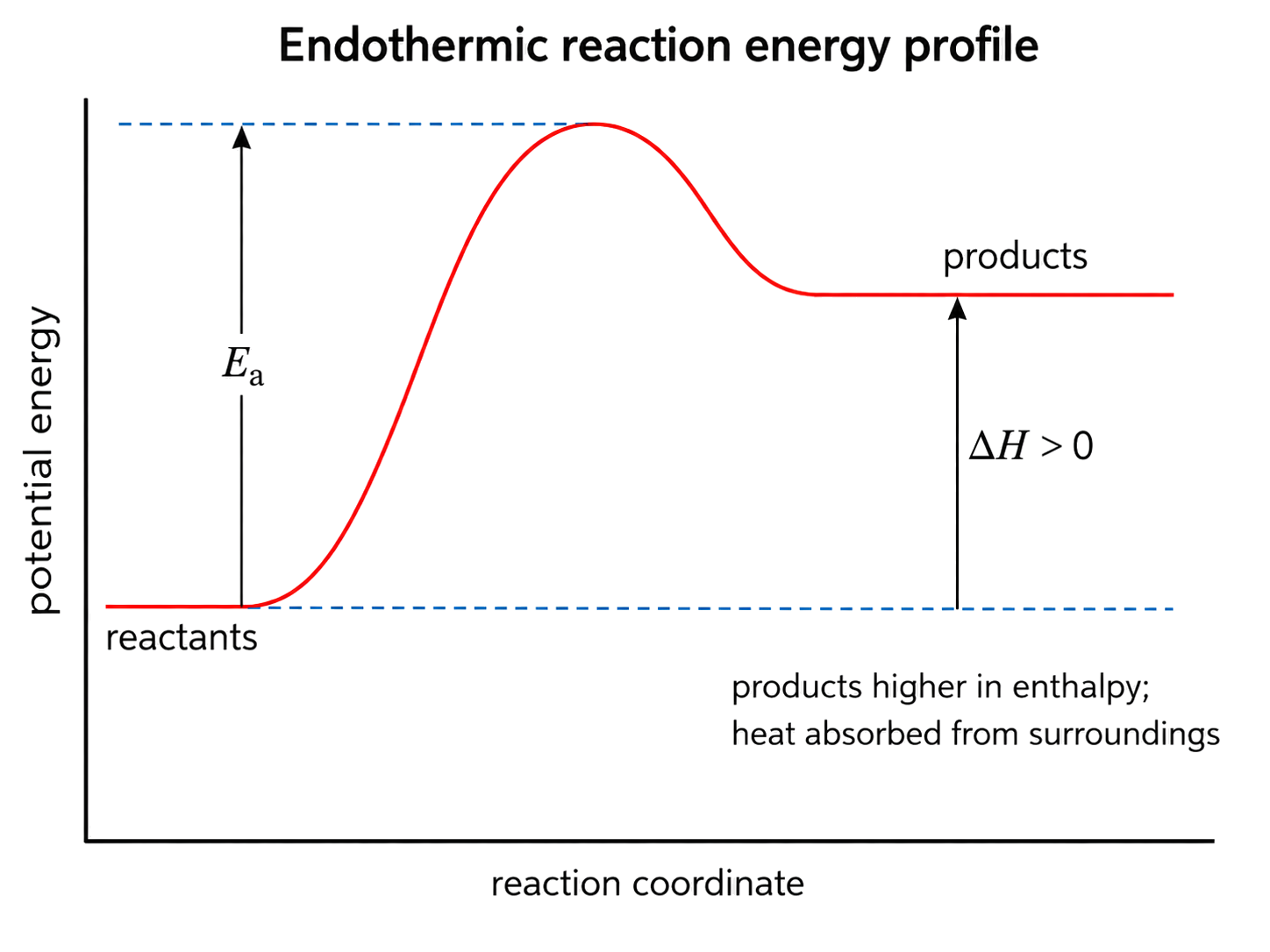
Lower relative energy corresponds to greater relative stability. In an exothermic reaction the products are lower in energy than the reactants; in an endothermic reaction the products are higher.
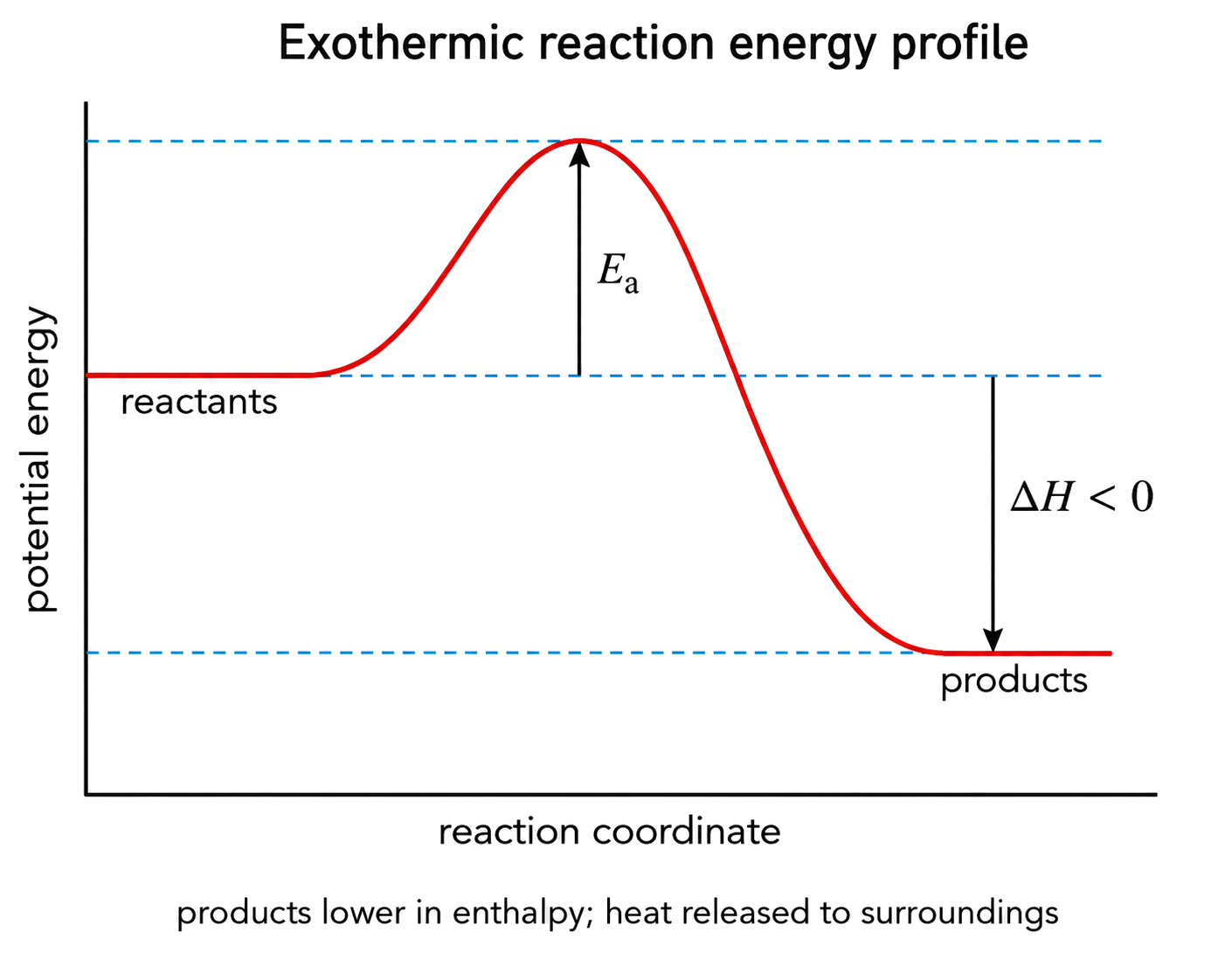
Label the horizontal axis reaction coordinate and the vertical axis potential energy. Then read reactant and product levels, identify the sign and direction of ΔH, and distinguish ΔH from activation energy.
On a profile, ΔH is the vertical difference between product and reactant levels, while activation energy rises from reactants to the peak. A catalyst lowers the peak by changing the pathway but leaves the two energy levels, ΔH and the relative stability of reactants and products unchanged.
An energy profile identifies an activation barrier but does not by itself determine an observed rate: temperature, particle concentrations/collision frequency and the available pathway also matter. Use the diagram to compare energetic barriers only when the profiles and conditions make that comparison valid.
Representative question
The forward reaction is endothermic, uses iron(III) oxide as a catalyst, and takes place at 900 K .
Sketch the energy profile for the reaction, both with and without the catalyst, labelling ΔH and the activation energies.
two curves, each passing through a maximum AND reaching same energy level
endothermic enthalpy change labelled
both activation energies correctly labelled
Do not penalize curve showing multiple steps for the catalysis in M1.
Accept double-headed arrows or lines in M2 and M3, but not arrows pointing down.
Q=mcΔTandΔH=−Q/n
At constant pressure, calculate heat transferred from mass, specific heat capacity, and temperature change, then divide by reacting moles and apply the sign convention. Check standard conditions and units.
Worked calculation: if 100.0 g of solution warms by 6.0 K and c=4.18Jg−1K−1, q(solution)=mcΔT=(100.0)(4.18)(6.0)=2.51×10³J=+2.51kJ. Therefore q(reaction)=−2.51kJ. If 0.0500mol of limiting reactant reacted, ΔH=−2.51/0.0500=−50.2kJmol−1: the negative sign means the reaction released energy. Heat loss or ignored calorimeter heat capacity usually makes the measured magnitude too small.
A standard molar enthalpy change belongs to the balanced reaction as written, with substances in their stated standard states under standard conditions. A classroom calorimetry value is an experimental estimate: report its conditions and uncertainty separately from a data-book or theoretical standard value. Heat loss to the surroundings or ignored calorimeter heat capacity commonly makes the measured magnitude too small.
Representative question
What is the standard enthalpy change, ΔHcombustion ⊖, according to the data?
Amount of fuel burned =0.110 mol
Mass of water =200 g
Initial temperature of water =21.0∘C
Final temperature of water =25.0∘C
Specific heat capacity of water, cw=4.18 J g−1 K−1Q=mcΔT
−2110 kJ mol−1
−30.4 kJ mol−1
+30.4 kJ mol−1
+2110 kJ mol−1
B
Retrieve the route: define system/surroundings transfer, classify endothermic or exothermic, read stability from energy profiles, then calculate Q and ΔH with the correct sign.
Check the energy direction, surroundings temperature, reactant/product levels, moles, units, and ΔH sign.
Topic 1.2
ΔH≈Σ(bondsbroken)−Σ(bondsformed)
Breaking bonds absorbs energy; forming bonds releases energy. Count every bond with its stoichiometric multiplicity before applying the signed sum.
For H₂ + Cl₂ → 2HCl, break one H–H and one Cl–Cl bond, then form two H–Cl bonds. Average bond enthalpies give an estimate because the tabulated value averages that bond across different gaseous molecules.
Worked example — bond enthalpies: for CX2HX4(g)+HBr(g)CX2HX5Br(g), the local course book gives C−H=414, C=C=614, H−Br=366, C−C=346 and C−Br=285kJmol−1. ΔH=[4(414)+614+366]−[5(414)+346+285]=2636−2701=−65kJmol−1. The negative estimate means the bonds formed release more energy than the bonds broken absorb; it remains approximate because the values are gaseous averages.
Representative question
Calculate the enthalpy change for the reaction, ΔH. Use section 12 of the data booklet.
Alternative 1:
«bonds broken»
121O=O+4C−H+Cl−Cl/121×498+4×414+242/2645 «kJ mol −1 » «bonds formed»
C=O+2C−O+2H−O+2H−Cl/804+2×358+2×463+2×431/3308 « kJ mol−1 » ΔH= «2645-3308=»-663 «kJ mol-1» (correct calculation: reactants-products) OR
Alternative 2:
«Bonds broken» [12(414)+2(346)+242+1.5(498)] =6649 V
«Bonds formed» [8(414) + 804+2(358)+2(346)+2(431)+2(463)]=7312.
ΔH= «6649-7312=» -663 « kJmol−1 » (correct calculation: reactants-products)
Marking guidance:
Award [3] for correct final answer.
Award [2 max] for +663 « kJmol−1 ».
Accept breaking and remaking all the other bonds.
Hess's law states that enthalpy change is independent of reaction pathway. Enthalpy values can therefore be combined through a balanced cycle.
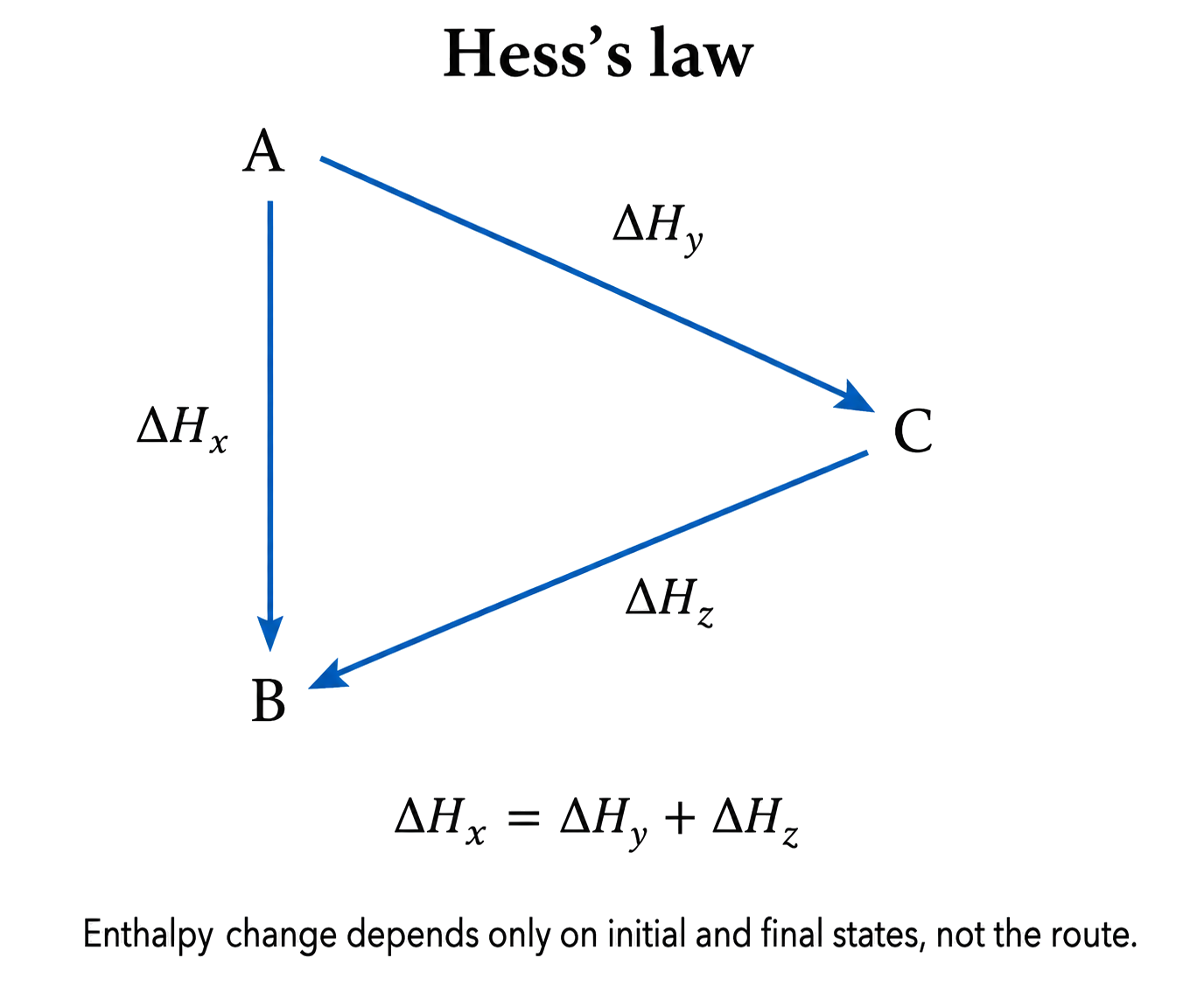
Reverse an entire balanced equation by changing the sign of ΔH; scale every coefficient and ΔH by the same factor; then add equations and cancel identical species in identical physical states. Never change a chemical subscript, formula or state symbol merely to force cancellation. The surviving equation must exactly match the target before enthalpies are summed.
Treat chemical equations like algebra: reverse a step and reverse its ΔH sign; multiply all coefficients and ΔH by the same factor; then add and cancel species. The surviving overall equation must exactly match the target before the enthalpies are summed.
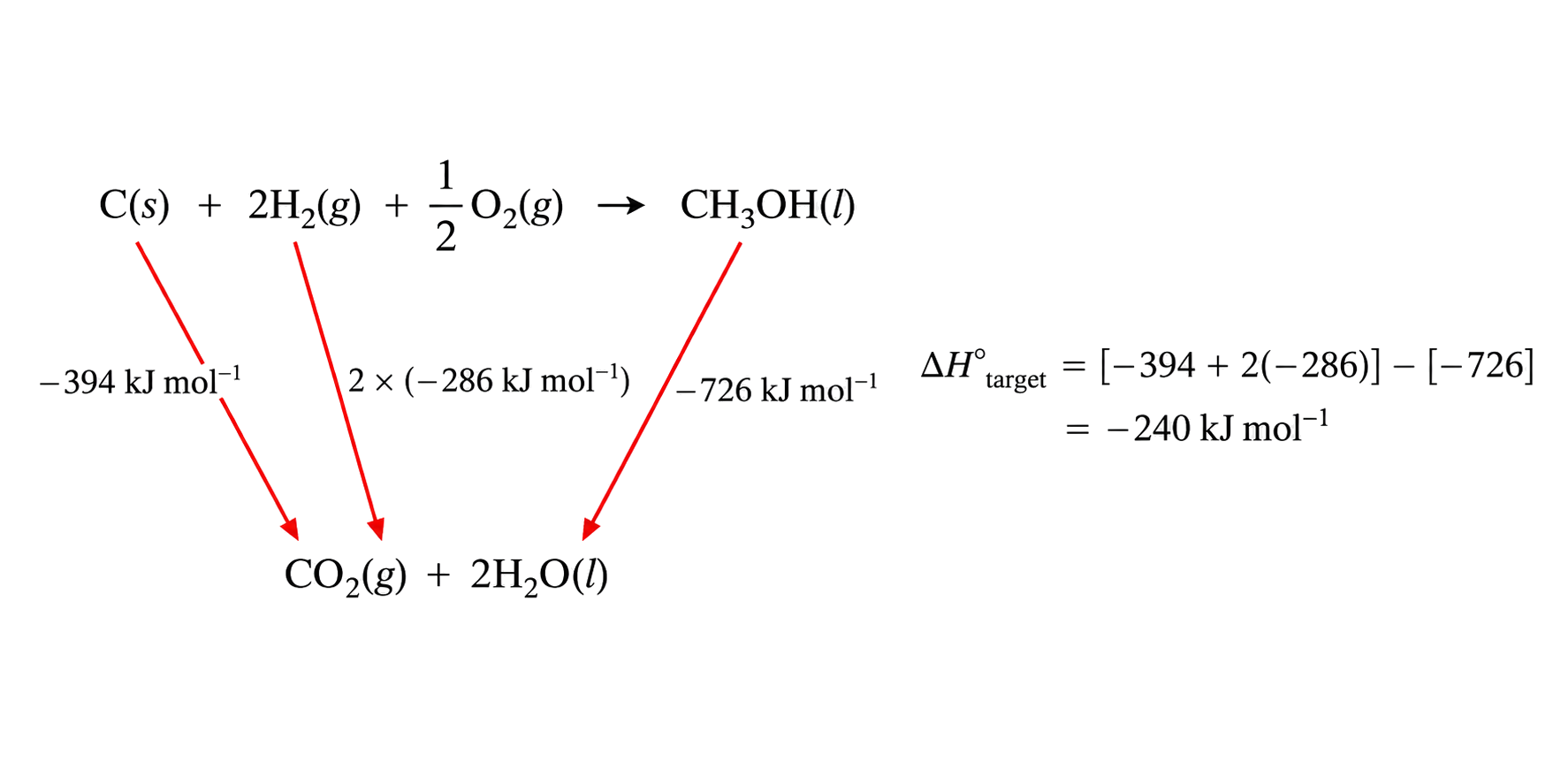
Worked example — Hess's law: target C(s)X2+HX2(g)X1+/2OX2(g)CHX3OH(l). Use CX+OX2COX2, ΔH=−394kJmol−1; double HX2X+1/2OX2HX2O(l) to give −572kJmol−1; reverse methanol combustion to give +726kJmol−1. After cancelling COX2 and HX2O, ΔH=−394−572+726=−240kJmol−1 for the target equation.
Representative question
Determine the enthalpy change, ΔH, in kJmol−1, for the hydration of solid anhydrous magnesium sulfate, MgSO4.
ΔH(=ΔH1−ΔH2)=−99( kJ mol−1);
Marking guidance:
Award [1] if -86 is used giving an answer of −104( kJ mol−1).
| Quantity | Equation constraint |
|---|---|
| ΔHf° | Form one mole of compound from elements in standard states |
| ΔHc° | Completely burn one mole of substance in oxygen under standard conditions |
Use correct standard states and coefficients; do not mix formation and combustion definitions in one equation.
A formation equation must produce exactly one mole of the compound from elements in their standard states, so fractional coefficients may be necessary. A combustion equation must burn exactly one mole completely in O₂; keep the stated standard state of water because changing H₂O(l) to H₂O(g) changes ΔH°.
Worked scaling example: ΔHc∘(CX2HX6)=−1560kJmol−1 refers to complete combustion of one mole of ethane. For the corresponding balanced combustion of two moles, multiply the complete equation and its enthalpy by two: ΔH∘=2(−1560)=−3120kJ. Do not report kJmol−1 for the two-mole equation unless the result is normalized back to one mole.
Representative question
Calculate the enthalpy of reaction, in kJmol−1, when 1 mol of potassium reacts with water. Use section 12 of the data booklet. ΔHf of KOH(aq) is −481.8 kJ mol−1.
Alternative 1:
« ΔHf(H2O(l))= » -285.8 «kJ mol −1 »
≪ΔHreaction =ΣΔHf( products )−ΣΔHf( reactants ) 》
«ΔHreaction =(2(−481.8)+0)−(0+2(−285.8))»
« ΔHreaction = » -392.0 «kJ»
<ΔH=>−196.0<kJmol−1≫
Alternative 2:
« ΔHf(H2O(l))= » -285.8 «kJ mol −1 »
K(s)+H2O(l)→KOH(aq)+1/2H2( g)
OR
≪ΔHreaction =ΣΔHf( products )−ΣΔHf( reactants ) »
«ΔHreaction =»(−481.8)−(−285.8)
« ΔHreaction = » -196.0 «kJ»
Marking guidance:
Award [3] for correct final answer.
M1 may be awarded from working.
ΔH°=ΣΔHf°(products)−ΣΔHf°(reactants)ΔH°=ΣΔHc°(reactants)−ΣΔHc°(products)
Apply stoichiometric coefficients to every term, preserve signs, and use the formation or combustion formula that matches the supplied data.
For formation data, imagine every reactant and product connected to the same elements: product sums minus reactant sums gives the target. For combustion data the paths run toward common combustion products, reversing the subtraction. Write coefficients beside every tabulated value before calculating.
Worked example — formation data for pentane combustion: CX5HX12(l)X8+OX2(g)5COX2(g)X6+HX2O(l). Using ΔHf∘[CX5HX12(l)]=−173, ΔHf∘[COX2(g)]=−394, ΔHf∘[HX2O(l)]=−286 and ΔHf∘[OX2(g)]=0kJmol−1, ΔH∘=5(−394)+6(−286)−[−173+8(0)]=−3513kJmol−1. The negative sign identifies exothermic combustion.
Representative question
Calculate the standard enthalpy change of formation, ΔHθf, in kJmol−1, of ethyl ethanoate, C4H8O2. Use sections 1 and 13 of the data booklet and the value of −4 kJ mol−1 for the standard enthalpy change of reaction, ΔHθr.
−4=ΔHfθ( ester )+(−286)−(−278+(−484)) «kJ mol-1−1 ↓ « −4+286−278−484 » =−480 «kJ mol −1 »
Award [2] for the correct final answer.
M1 for the correct expression or rearrangement.
Award [1] for +480 « kJmol−1 »
A Born–Haber cycle tracks the energy changes that form an ionic solid from its elements. It includes atomization, ionization, electron affinity, and lattice enthalpy terms with the correct stoichiometry.
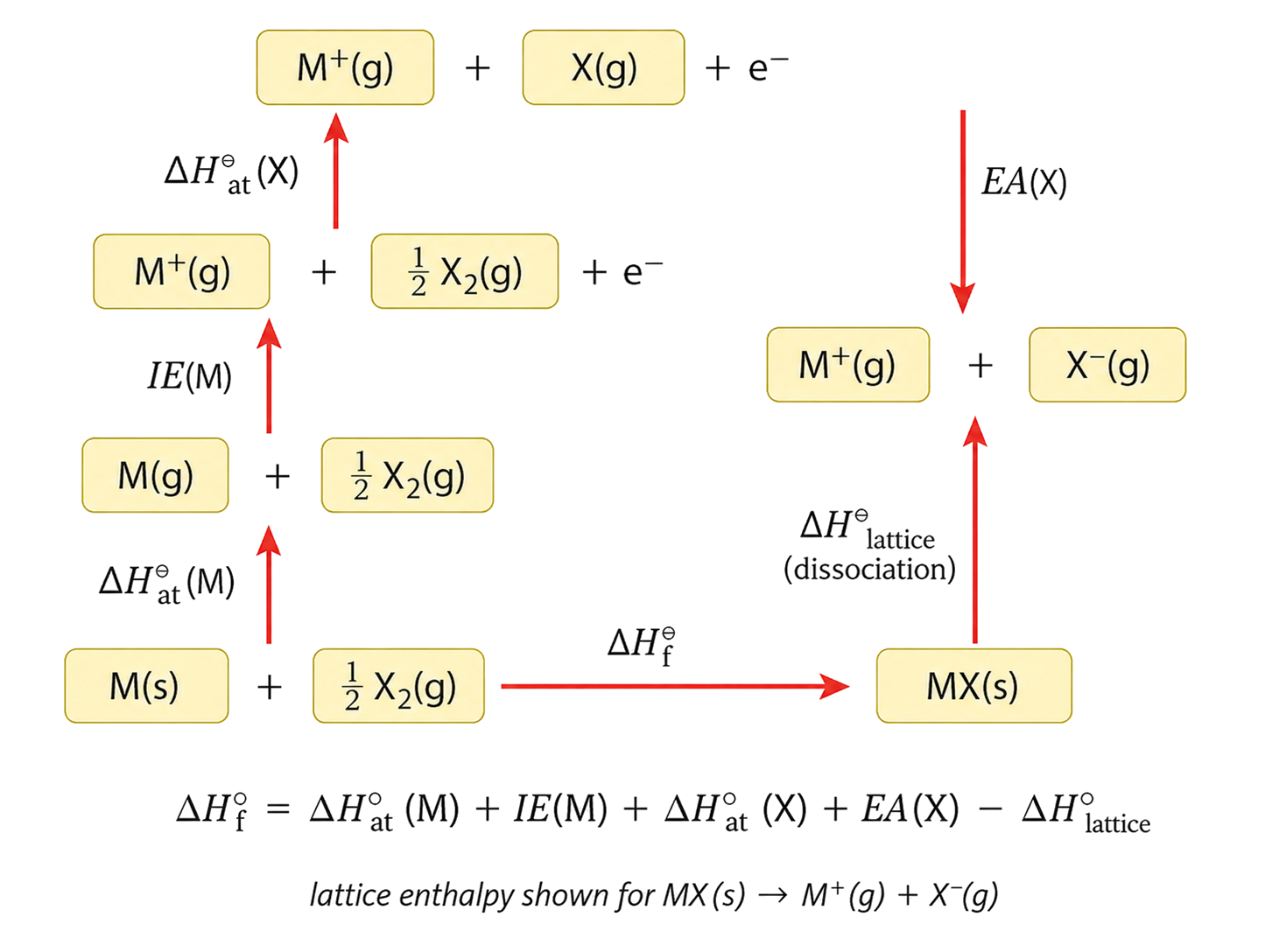
Create a state-and-particle ledger before summing: convert each element from its standard state to the required gaseous atoms (including sublimation/phase change and bond dissociation where needed), apply every ionization-energy and electron-affinity step with its coefficient, then form the lattice. For divalent ions include both electron steps, and fix whether lattice enthalpy means formation or dissociation before assigning its sign.
Build the cycle from physical steps and electron accounting: atomize each element, ionize the metal the required number of times, add electrons to the non-metal, then form the lattice. For a 2− ion include two electron-affinity terms, and confirm whether the supplied lattice enthalpy is defined for formation or dissociation before assigning its sign.
Worked example — KBr lattice enthalpy: use the DP lattice-dissociation convention KBr(s)KX+(g)X+BrX−(g). Following the alternative path in the local cycle, ΔHlattice∘=−(−392)+89+419+112−325=+687kJmol−1. The formation enthalpy is reversed, atomization and ionization are positive, and the first electron affinity is negative. The positive result is consistent with separating a solid lattice into gaseous ions.
Representative question
Determine the standard enthalpy change of formation, ΔHf⊖, of NaCl(s), in kJmol−1, using a Born-Haber cycle and tables 7, 10 and 13 of the data booklet. The standard enthalpy change of atomization (standard enthalpy change of sublimation), ΔHat ⊖, of Na(s) is +108 kJ mol−1.
atomization of chlorine =21 bond enthalpy / 21243/121.5( kJmol−1);\ncorrect values for ionization Na(+496 kJmol−1) and electron affinity Cl(−349 kJmol−1)\nand lattice enthalpy of NaCl(+790 kJmol−1/+769 kJmol−1);\nBorn-Haber energy cycle;
Retrieve the route: count bond breaking/forming, manipulate Hess equations, define standard formation/combustion values, apply product–reactant sums, and track every Born–Haber energy term.
Check equation direction, coefficients, signs, standard states, lattice enthalpy convention, and one-versus-two-electron steps.
Topic 1.3
In complete combustion with excess oxygen, carbon forms CO₂ and hydrogen forms H₂O. The fuel's other elements must also appear in the products.
Write the correct products first, then balance C, H and any other atoms before balancing O₂ last. Check every atom and state symbol.
For ethanol, write C₂H₅OH + 3O₂ → 2CO₂ + 3H₂O by balancing C, then H, then oxygen. Complete combustion specifies products, not automatically conditions or state symbols; use the question's conditions to decide whether water is liquid or vapour.
Representative question
Write an equation for the complete combustion of methane.
CH4( g)+2O2( g)→CO2( g)+2H2O(l)
When oxygen is limited, carbon may form CO and/or elemental carbon instead of only CO₂. The available oxygen and the fuel's elements determine the product set.
Include the products specified by the question, then balance all atoms. Do not replace a required CO or C product with CO₂ simply because the fuel contains carbon.
One valid carbon-monoxide equation is 2CH₄ + 3O₂ → 2CO + 4H₂O; with still less oxygen, elemental carbon can also form. Use the product set named by the question and rebalance from scratch—there is no single universal incomplete-combustion equation.
The product change has chemical consequences: carbon monoxide binds strongly to haemoglobin and reduces oxygen transport, while fine carbon particulates damage respiratory health and can alter atmospheric heating. Incomplete combustion also releases less usable energy per mole of fuel than complete conversion to CO₂ and H₂O; distinguish these separate health, environmental and energy claims.
Representative question
Which products may form when propane undergoes incomplete combustion?
CO2 and H2 only
CO, C and H2
CO2,H2O and H2
CO2,CO and C
D
Compare coal, crude oil and natural gas using carbon dioxide released per unit of useful energy, energy output, and pollutants such as CO, particulates and volatile organic compounds from incomplete combustion.
A lower carbon footprint is a specific comparison, not a blanket claim that a fuel causes no pollution. Include methane leakage when evaluating natural gas.
Compare fuels on a common service basis such as kilograms of CO₂ per megajoule of useful energy, not per mole of fuel. Natural gas can have a lower combustion CO₂ intensity than coal yet lose part of that advantage through upstream methane leakage; define the system boundary before ranking.
Greenhouse link: atmospheric CO₂ absorbs selected outgoing infrared wavelengths and re-emits energy in multiple directions, reducing net energy loss to space at those wavelengths. A sustained increase in CO₂ changes Earth's energy balance until a warmer state restores balance. This mechanism is separate from comparing absolute fuel emissions or emissions per unit useful energy.
Representative question
Outline why the combustion of methane has a lower environmental impact than gasoline.
methane produces less CO2 per kJ of energy
methane produces fewer pollutants/particulates/CO/VOCs
For M1 do not accept simply methane produces less CO2.
For M2 accept gasoline undergoes incomplete combustion.
Biofuels are renewable when their carbon is replenished through biological carbon fixation, such as photosynthesis, on a relevant timescale.
Evaluate both sides: possible benefits include renewable supply and lower net carbon or sulfur emissions; disadvantages include land competition with food production and other production impacts. State the evidence for each claim.
Test a carbon-neutral claim with a life-cycle boundary: count cultivation, fertilizer, processing, transport, land-use change and combustion, then credit carbon taken up during regrowth on the relevant timescale. Renewable describes replenishment, not automatically low impact or zero net emissions.
Representative question
Outline two advantages of using ethanol as a fuel instead of gasoline (petrol).
Any two:
«ethanol is» renewable / sustainable resource
«ethanol has» low/zero carbon footprint / produces less CO2
less sulfur dioxide «than fossil fuels»
OR
less acid rain «than fossil fuels»
less incomplete combustion «than fossil fuels»
OR
less carbon monoxide/soot «than fossil fuels»
Marking guidance:
Accept "ethanol is biodegradable /less toxic than gasoline".
Do not accept just "less harmful".
2 max
A fuel cell converts chemical energy from a spontaneous redox reaction directly into electrical energy. Oxidation occurs at the anode and reduction at the cathode.
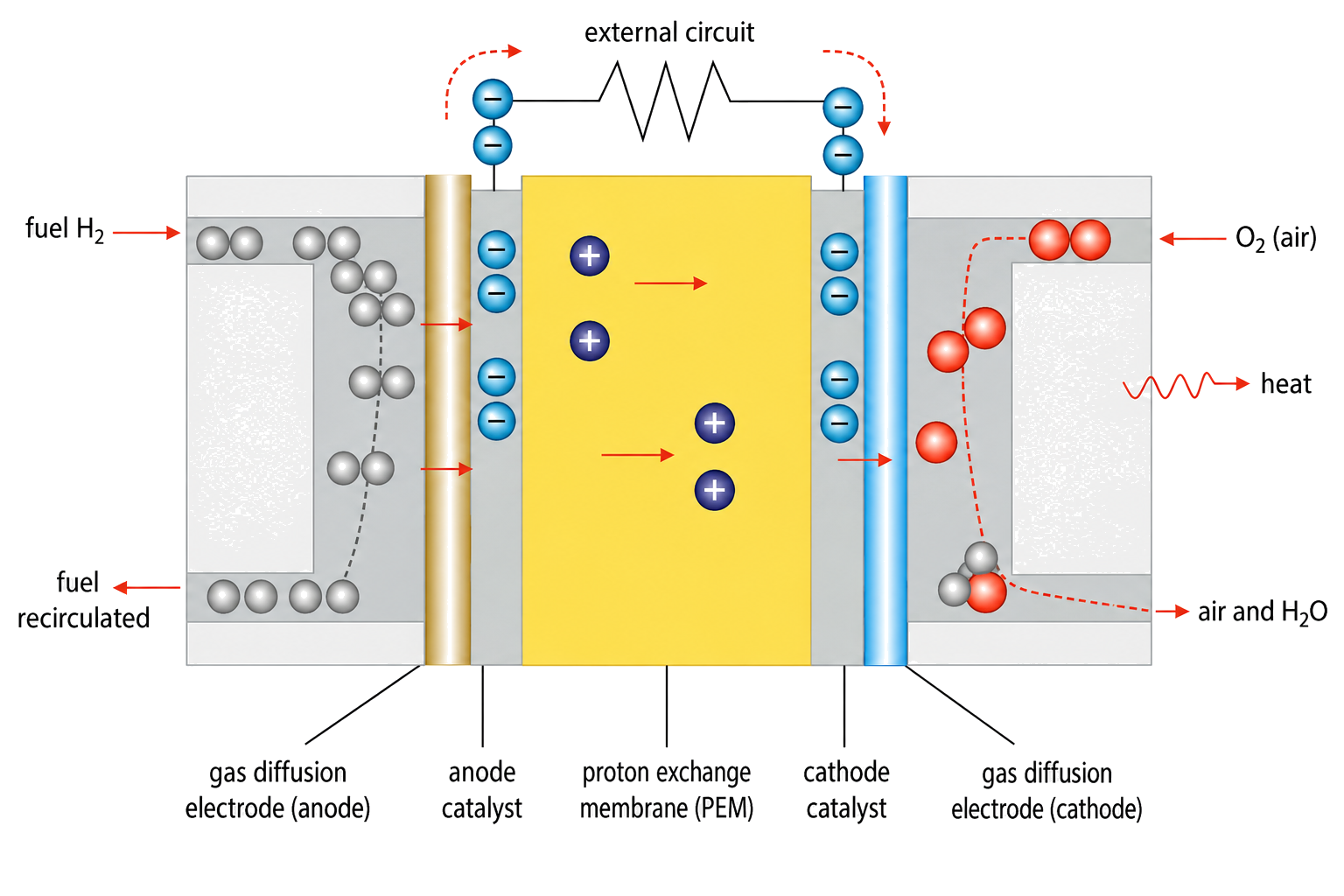
Deduce each half-equation from the fuel-cell reactants and electrolyte context, balance atoms and charge, then add the half-equations to obtain the overall reaction. Hydrogen and methanol cells require different oxidation half-equations.
For a hydrogen fuel cell, oxidation of H₂ supplies electrons at the anode and O₂ gains electrons at the cathode; the half-equations must match the acidic or alkaline electrolyte before they are added to 2H₂ + O₂ → 2H₂O. Direct electrical conversion does not remove the need to evaluate fuel production and storage.
A fuel cell operates while fuel and oxidant are supplied continuously from outside; a conventional battery stores a finite set of reactants internally. Point-of-use water from a hydrogen cell is not a complete environmental assessment—fuel manufacture, transport, storage and electricity source remain inside a lifecycle comparison.
Worked equations — acidic hydrogen cell: anode HX2(g)2HX+(aq)+2eX−; cathode OX2(g)+4HX+(aq)+4eX−2HX2O(l). Double the anode equation before adding, giving 2HX2+OX22HX2O. Direct-methanol cell: anode CHX3OH(aq)+HX2O(l)COX2(g)+6HX+(aq)+6eX−; cathode 23OX2(g)+6HX+(aq)+6eX−3HX2O(l). Adding and cancelling gives CHX3OH+23OX2COX2+2HX2O. Match each half-equation to the stated electrolyte; proton-exchange-membrane construction details are not assessed.
Representative question
Deduce half-equations for the reactions at the two electrodes and hence the equation for the overall reaction.
Anode (negative electrode):
Cathode (positive electrode):
Overall:
Anode:
CH3OH(aq)+H2O(l)→CO2(aq)+6H+(aq)+6e−
Cathode:
O2(aq)+4H+(aq)+4e−→2H2O(l)
Overall:
2CH3OH(aq)+3O2(g)→2CO2(aq)+4H2O(l)
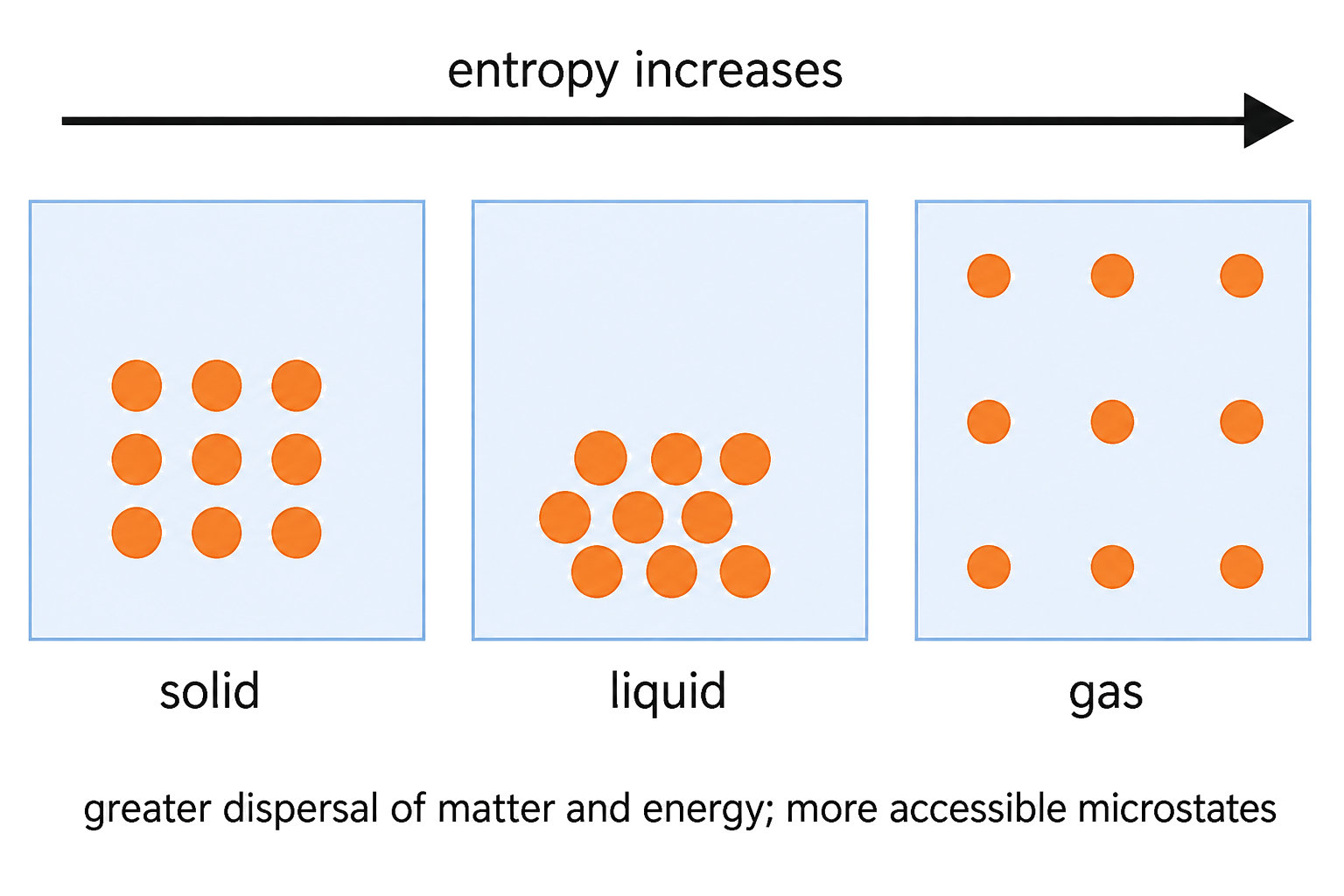
S(gas)>S(liquid)>S(solid)
Entropy describes the dispersal of matter and available energy. For the reaction system, calculate ΔS° = ΣS°(products) − ΣS°(reactants), including every coefficient, and report J K⁻¹ mol⁻¹ for the reaction as written. System ΔS° is not the same as total entropy change of system plus surroundings; state the boundary before using entropy to discuss spontaneity.
Use phase and particle count to predict a likely sign before calculating: producing more gas particles usually increases dispersal. Treat that prediction as a check, not a replacement for the standard-entropy sum.
Worked entropy example: for HX2(g)+ClX2(g)2HCl(g), use S∘(HCl)=187, S∘(HX2)=131 and S∘(ClX2)=223JK−1mol−1. ΔS∘=2(187)−[131+223]=+20JK−1mol−1. The small positive value is plausible because gas moles are unchanged; the tabulated values, not gas count alone, determine the sign.
Representative question
Calculate the standard entropy change, ΔS⊖, of the reaction between carbon monoxide and chlorine to form phosgene. Use section 13 of the data booklet and the following data:
Standard entropy S⊖, of chlorine =223 J mol−1 K−1
Standard entropy S⊖, of phosgene =284 J mol−1 K−1
entropy change «= 284-223-198»
=−137≪ J mol−1 K−1≫
ΔG°=ΔH°−TΔS°
Use an absolute temperature in kelvin and convert ΔS° to the same energy units as ΔH° before subtracting TΔS°. The result is the Gibbs energy change for the stated reaction.
Under the stated standard conditions, ΔG° < 0 is thermodynamically favourable, ΔG° = 0 marks equilibrium, and ΔG° > 0 favours the reverse direction. This criterion predicts feasibility, not how fast the change occurs.
Worked Gibbs example: for propane combustion to gaseous water, the local course book gives ΔH∘=−2045kJmol−1 and ΔS∘=+103JK−1mol−1 at 5∘C. Convert T=278.15K and ΔS∘=0.103kJK−1mol−1; then ΔG∘=−2045−(278.15)(0.103)=−2074kJmol−1. Its negative sign means the stated reaction is spontaneous under those standard conditions, not necessarily fast.
Representative question
Calculate the Gibbs energy change, ΔGθ in kJmol−1, for this reaction under standard conditions. Use the value of −4 kJ mol−1 for ΔHθr and your answer from (d)(iv). If you did not obtain an answer for (d)(iv) use −10JK−1 mol−1, although this is not the correct answer. Use sections 1 and 4 of the data booklet.
conversion to common units
⟨ΔGθ=−4 kJ mol−1−298 K−0.008 kJ K−1 mol−1»−6.4« kJ mol−1» ↓
M1 is for conversion to common units M2 is for correct value.
Award [2] for correct final answer. If −10 J K−1 mol−1 is used, the answer will be -1.0 « kJmol−1 ».
| Condition | Meaning |
|---|---|
| ΔG < 0 | spontaneous in the stated direction |
| ΔG = 0 | equilibrium |
| ΔG > 0 | non-spontaneous in the stated direction |
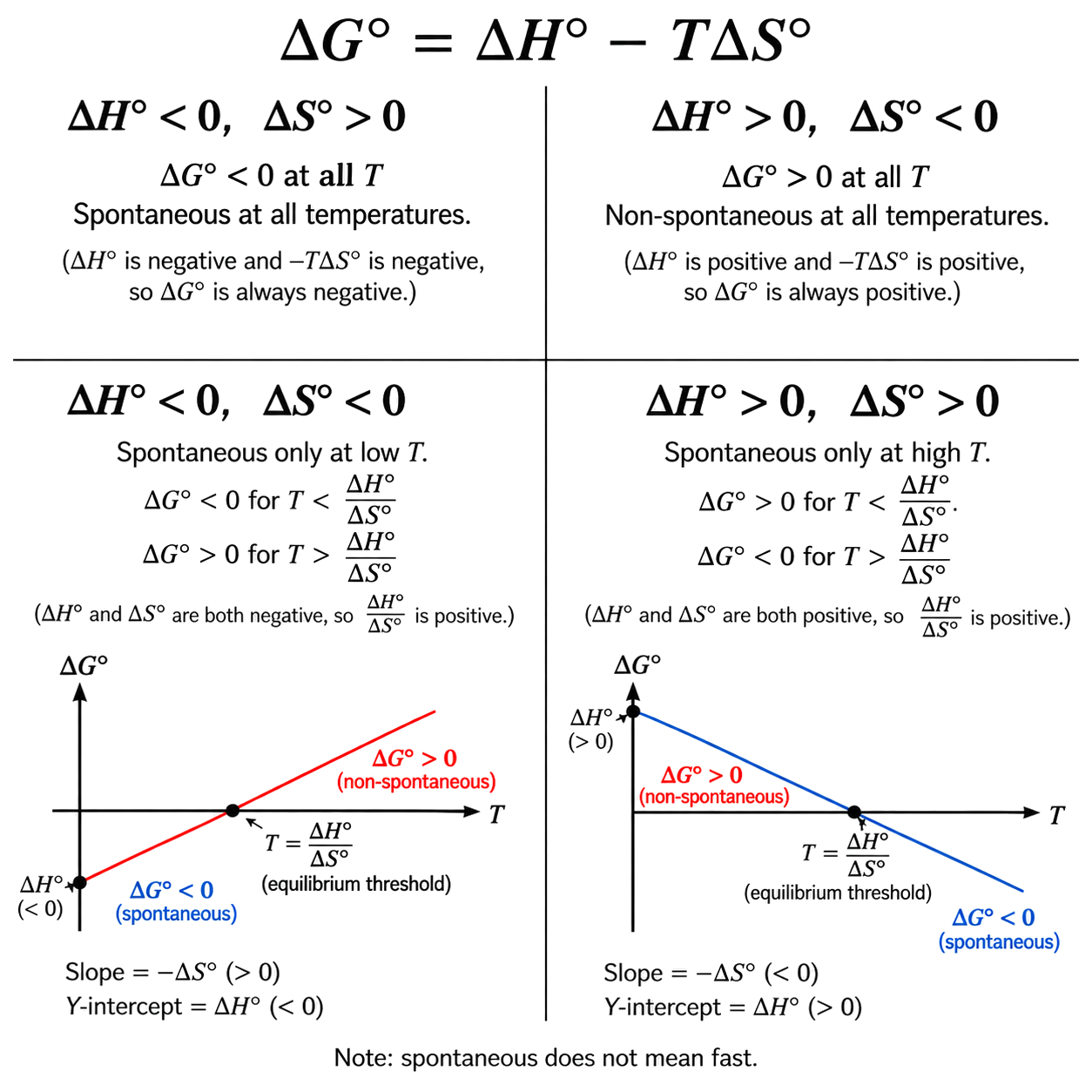
For a temperature-dependent reaction, find the boundary by setting ΔG° = 0 in ΔG° = ΔH° − TΔS°, then use the signs of ΔH° and ΔS° to decide which temperature range is spontaneous.
Use the signs before calculating: ΔH < 0 and ΔS > 0 is favourable at all temperatures, while ΔH > 0 and ΔS < 0 is not; matching signs create a temperature threshold. At T = ΔH/ΔS, first put ΔH and ΔS in consistent units, then test one temperature on each side rather than guessing the inequality.
Worked threshold example: CHX4(g)+HX2O(g)3HX2(g)+CO(g) has ΔH∘=205kJmol−1 and ΔS∘=216JK−1mol−1=0.216kJK−1mol−1. At the boundary, 0=205−T(0.216), so T=205/0.216=949K. Because both changes are positive, the forward reaction is spontaneous above 949 K and non-spontaneous below it, assuming ΔH∘ and ΔS∘ are approximately constant.
Representative question
Calculate the temperature at which this reaction is no longer spontaneous.
Use your answer to part (a)(i) and section 1 of the data booklet.
The standard entropy change of this reaction is ΔS⊖=−233JK−1 mol−1.
If you did not obtain an answer to part (a)(i) then use the value −80.0 kJ mol−1, although this is not the correct answer.
ΔSθ=−233×10−3<kJ K−1 mol−1≫ORΔHθ=−312000<J mol−1> « ΔGθ=ΔHθ−TΔSθ> « 0=(−312)−T(−233×10−3)»OR<0=(−312000)−T(−233)» T=1340 «K 0 or above»
Award [2] for correct final answer. If the alternative data is used the answer is 343 K .
Do not award ECF for M2 if the answer is a negative Kelvin temperature.
ΔG=ΔG°+RTlnQ;ΔG°=−RTlnK
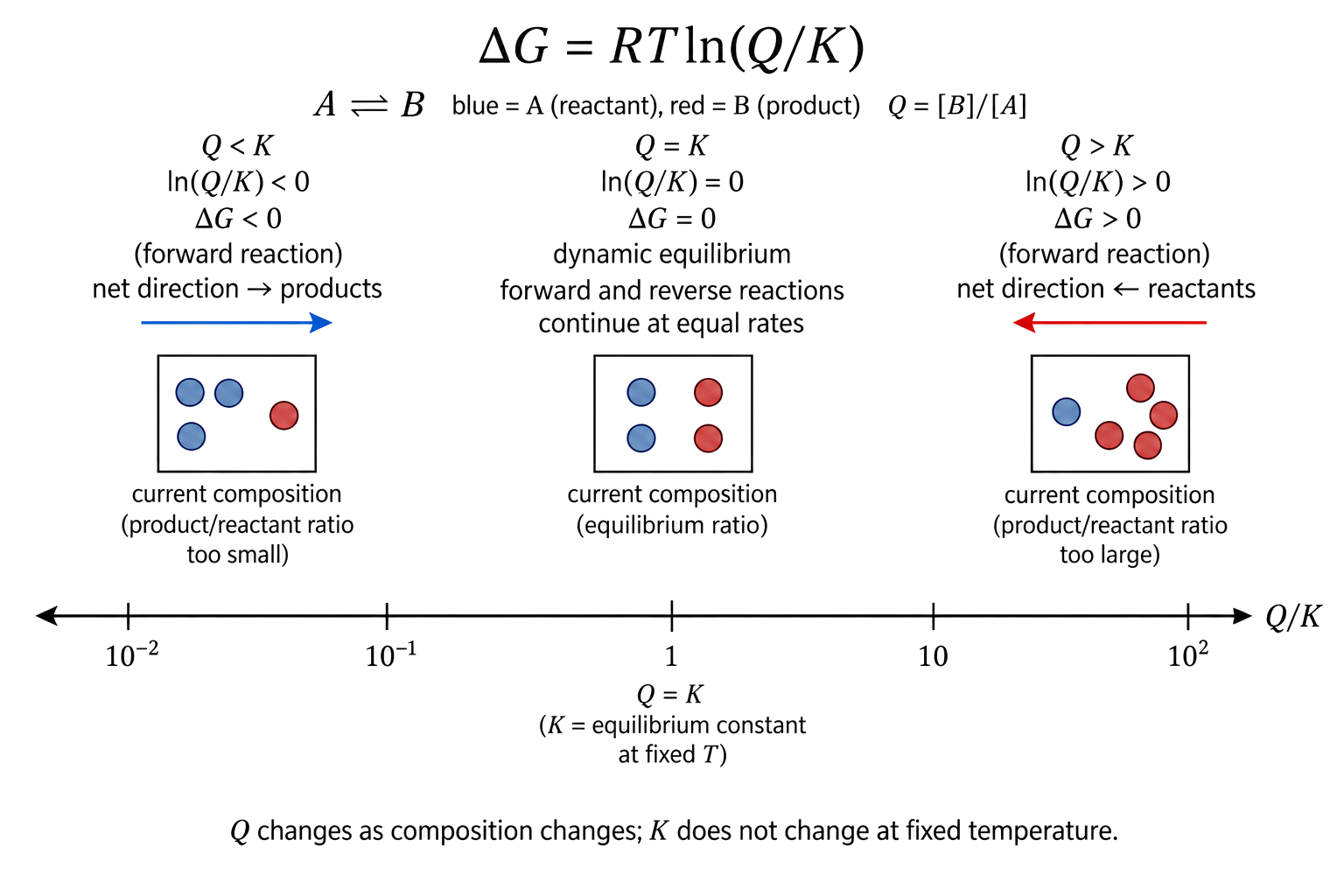
At equilibrium for the stated reaction and temperature, Q = K and the current ΔG = 0. Substitution into ΔG = ΔG° + RT ln Q shows that ΔG° is generally not zero; it equals −RT ln K. Away from equilibrium, Q < K favours the forward direction and Q > K favours the reverse. Compare Q and K only for the same balanced reaction orientation and fixed temperature.
Compare Q with K to predict the immediate direction: Q < K gives ΔG < 0 for the forward reaction, while Q > K gives ΔG > 0 and favours the reverse. Keep ΔG for the current composition distinct from ΔG°, which describes standard-state reactants and products and fixes K at that temperature.
Worked K and Q example: for ammonia synthesis at 298 K, the local course book gives ΔG∘=−31.8kJmol−1=−31800Jmol−1. From lnK=−ΔG∘/(RT), K=3.77×10⁵, so products are favoured at equilibrium. If Q=1.0×10⁶, ΔG=−31800+(8.31)(298)ln(106)=+2410Jmol−1=+2.41kJmol−1; the forward reaction is then non-spontaneous because the current mixture has Q>K.
Representative question
Calculate the Gibbs Free energy, ΔG, and the equilibrium constant K c, for the forward reaction, at 1500 K . Use sections 1 and 2 of the data booklet.
(If you were unable to obtain an answer for part (f) use 227JK−1, but this is not the correct value.)
《 ΔG=206000−(215∗1500)=>−116500 « J≫ « −116500=−8.31(1500)lnK≫ « Kc=e∧(9.35)≫1.15×10⁴
Accept ΔG=−116.5 kJ
If 227 used
M1 = -134500 « J »
M2 =4.85×10⁴
Retrieve the route: identify complete or incomplete combustion products, compare fuels and biofuels, balance fuel-cell half-equations, calculate ΔS° and ΔG°, then use ΔG, Q and K to reason about spontaneity and equilibrium.
Check products before balancing, evidence before evaluation, oxidation versus reduction, kelvin and unit consistency, the sign of ΔG, and whether Q is below, equal to, or above K.