Reactivity 2. How much, how fast and how far?

Syllabus
First assessment 2025
Section
Level
HL

Exam analysis

No tagged past-paper evidence yet

Published Concept pages under this syllabus area do not have tagged past-paper appearances in the selected level yet.

Recent 5 years

In this section

Topic 2.1

2.1 Amount of chemical change

Objectives in this topic

Balanced Chemical Equations

A balanced chemical equation conserves every element and charge. Its coefficients show the mole ratio of reactants and products.
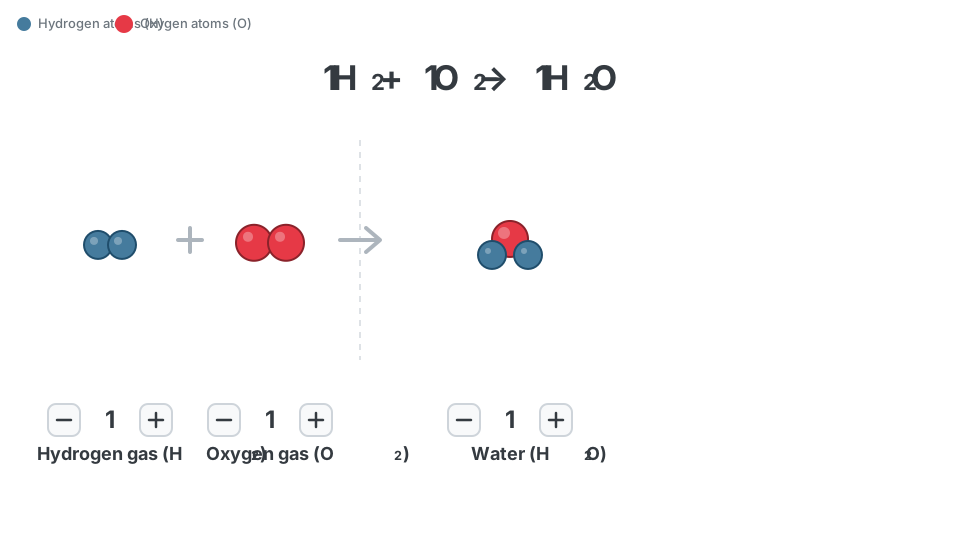
Write the products and state symbols, balance atoms with coefficients rather than changing formula subscripts, then check every element and the charge.

For Al + O₂ → Al₂O₃, preserve the formulas and choose coefficients 4Al + 3O₂ → 2Al₂O₃. Changing O₂ to O or Al₂O₃ to another subscript would change the substances rather than balance them. Add state symbols from chemical evidence or stated conditions, not from atom counting.
Balancing with State Symbols

Assessment in practice

Representative question

Question 1

[Maximum number: 2]

Write an equation for the reaction, including all state symbols.

Mole Ratios in Equations

knownamountmolescoefficientratiorequiredamountknown amount → moles → coefficient ratio → required amount

Read the required-to-known ratio from the balanced equation. For gases at fixed temperature and pressure, the same coefficient ratio applies to volumes; always finish with the requested unit.

For N₂ + 3H₂ → 2NH₃, 0.50 mol N₂ corresponds to 1.00 mol NH₃ when H₂ is sufficient. Keep the conversion chain visible—given unit to moles, coefficient ratio, then requested unit—so molar mass, concentration or gas volume is used at the correct end.

Given or requested representation Amount bridge Condition/unit checkpoint
mass n = m/M use a consistent mass unit with molar mass
solution n = cV convert volume to dm³ when c is mol dm⁻³
gas at stated T/P n = V/Vₘ, or use the given gas relation do not mix molar volumes from different conditions
particles n = N/Nₐ specify atoms, molecules, ions or formula units

Convert the known representation to moles, apply the balanced-equation coefficient ratio, then convert once to the requested representation.

Worked mass example: Mg(OH)X2+2HClMgClX2+2HX2O\ce{Mg(OH)2 + 2HCl -> MgCl2 + 2H2O}. For 1.00g1.00\,\mathrm{g} of Mg(OH)X2\ce{Mg(OH)2}, n=1.00/58.33=0.0171moln=1.00/58.33=0.0171\,\mathrm{mol}. The 1:21:2 coefficient ratio gives n(HCl)=2(0.0171)=0.0343moln(\ce{HCl})=2(0.0171)=0.0343\,\mathrm{mol}, so m(HCl)=0.0343×36.46=1.25gm(\ce{HCl})=0.0343\times36.46=1.25\,\mathrm{g}. The result is the maximum neutralized mass when magnesium hydroxide reacts completely.

Reacting-Quantity Calculations

Assessment in practice

Representative question

Question 1

[Maximum number: 3]

Calculate the volume of 2.00 moldm32.00 \mathrm{~mol} \mathrm{dm}^{-3} sulfuric acid required to react completely with 10.0 g of thallium (I) hydroxide.

Limiting and Excess Reactants

The limiting reactant is used up first and determines the maximum, or theoretical, yield. An excess reactant remains after the reaction is complete.

Convert each reactant to moles, divide by its balanced-equation coefficient, and identify the smallest normalized amount as limiting. Use that reactant's ratio to calculate product.

For 2H₂ + O₂ → 2H₂O with 3.0 mol H₂ and 2.0 mol O₂, compare n/coefficient: 1.5 for H₂ and 2.0 for O₂, so H₂ limits and forms 3.0 mol H₂O. A smaller starting mass is not necessarily limiting; the decision depends on moles relative to coefficients.

Finding the Limiting Reactant

Assessment in practice

Representative question

Question 1

[Maximum number: 2]

Deduce which reactant is limiting. Use sections 1, 4 and 7 of the data booklet.

Theoretical and Percentage Yield

percentageyield=(experimentalyield/theoreticalyield)×100%percentage yield = (experimental yield / theoretical yield) × 100\%

Find theoretical yield from the limiting reactant and stoichiometric ratio before comparing it with the measured experimental yield. Do not divide the product mass by a starting mass directly.

If stoichiometry predicts 10.0 g but 8.20 g is isolated, percentage yield is 82.0%. A value above 100% signals wet or impure product, measurement error or an incorrect theoretical yield; it is not evidence that the reaction created extra conserved matter.

Calculating Percentage Yield

Assessment in practice

Representative question

Question 1

[Maximum number: 2]

1.72 g of methyl methanoate is produced from 2.83 g of methanoic acid and excess of the other reagent. Determine the percentage yield.

Atom Economy

atomeconomy=(Mrofdesiredproduct/totalMrofreactants)×100%atom economy = (Mr of desired product / total Mr of reactants) × 100\%

Atom economy measures how much of the reactant mass is represented by the desired product. Low atom economy means more reactant mass becomes by-products and waste.

Apply stoichiometric coefficients to every formula mass before forming the ratio. Atom economy is fixed by the chosen equation and desired product, whereas percentage yield measures experimental recovery; a reaction can have high atom economy but poor yield, or the reverse.

Worked atom-economy example: 4CHX3OH+2CO+OX22(CHX3O)X2CO+2HX2O\ce{4CH3OH + 2CO + O2 -> 2(CH3O)2CO + 2H2O}, with dimethyl carbonate as the desired product. Atom economy=2(90.09)4(32.05)+2(28.01)+32.00×100=83.33%\text{Atom economy}=\frac{2(90.09)}{4(32.05)+2(28.01)+32.00}\times100=83.33\%. Coefficients multiply every molar mass. The remaining 16.67%16.67\% of reactant mass becomes the water by-product for this equation; actual percentage yield is a separate experimental measure.

Calculating Atom Economy

Assessment in practice

Representative question

Question 1

[Maximum number: 2]

Calculate the atom economy for the synthesis of ethyl ethanoate by the reaction below. Use sections 1 and 7 of the data booklet.

2C2H6( g)+Cl2( g)+32O2( g)C4H8O2(l)+2HCl(aq)+H2O(l)2 \mathrm{C}_{2} \mathrm{H}_{6}(\mathrm{~g})+\mathrm{Cl}_{2}(\mathrm{~g})+\frac{3}{2} \mathrm{O}_{2}(\mathrm{~g}) \rightarrow \mathrm{C}_{4} \mathrm{H}_{8} \mathrm{O}_{2}(\mathrm{l})+2 \mathrm{HCl}(\mathrm{aq})+\mathrm{H}_{2} \mathrm{O}(\mathrm{l})

Amount of Chemical Change Summary

Retrieve the route: balance the equation, convert through the coefficient mole ratio, identify the limiting reactant, calculate theoretical and percentage yield, then assess atom economy.

Check formula subscripts, state symbols, ratio direction, units, the smallest normalized reactant amount, the theoretical-yield denominator, and the total reactant mass used for atom economy.

Topic 2.2

2.2 Rate of chemical change

Objectives in this topic

Reaction Rate

rate=changeinconcentration/timerate = change in concentration / time

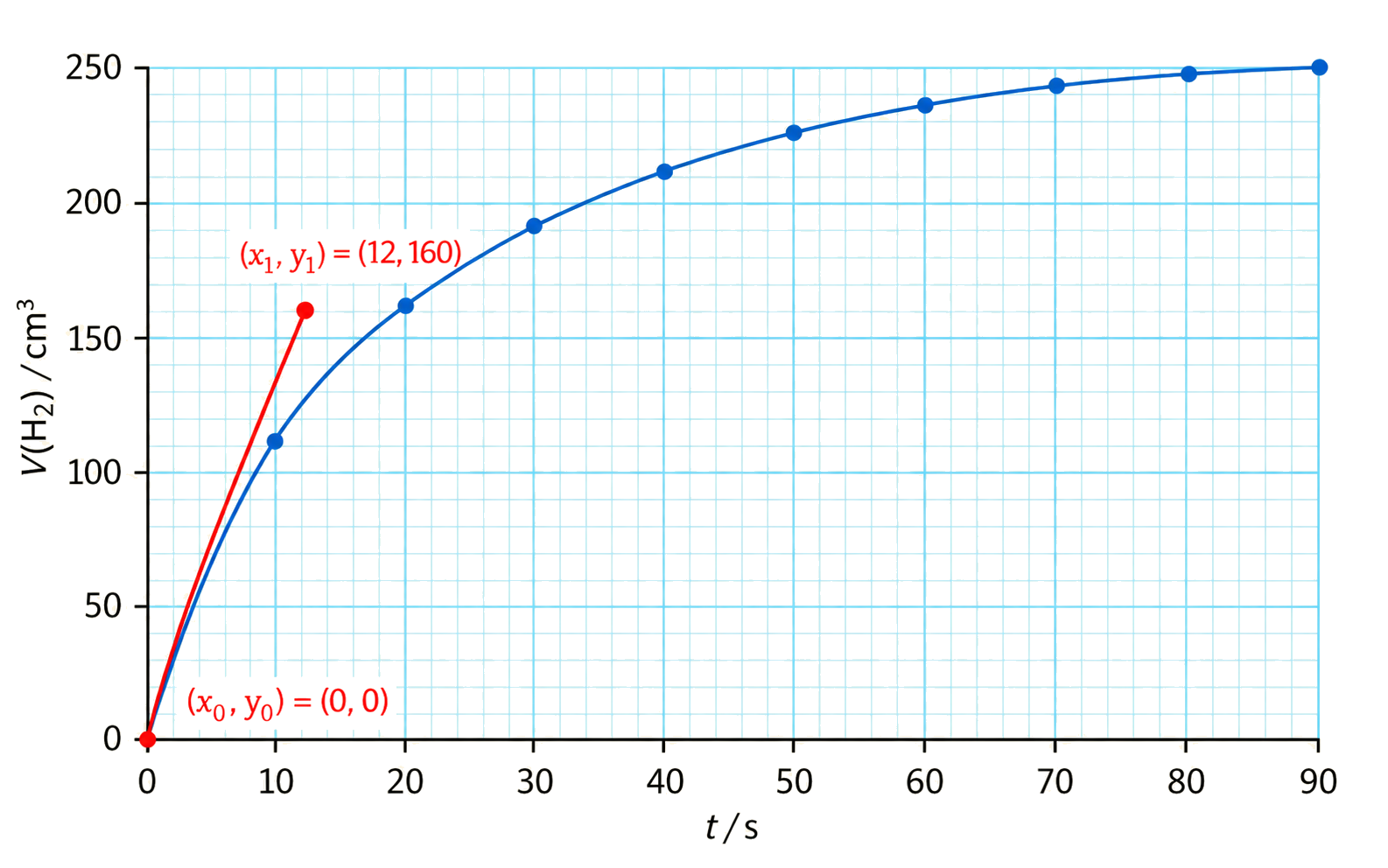
An instantaneous rate is the gradient of a tangent at the stated point on a concentration–time, volume–time or mass–time graph. Keep the units consistent.

Choose two well-separated points on the tangent, not on the curve, to calculate its gradient. A reactant concentration has a negative gradient, so report its disappearance rate as a positive magnitude unless a signed change is requested.

Requested rate Graph operation Evidence check
mean over an interval secant gradient between interval endpoints quote the interval and units
initial tangent gradient at t = 0 choose well-separated points on the tangent
instantaneous at time t tangent gradient at that time do not use two points on the curved trace

A measured mass, pressure or gas volume is a rate proxy only when its change is tied to reaction progress under the stated conditions. Preserve reactant/product slope sign or report a positive disappearance/formation magnitude as requested.

Worked tangent example: on a concentration–time graph for HCl\ce{HCl}, two points on the tangent at t=0t=0 are (0s,0.250moldm3)(0\,\mathrm{s},0.250\,\mathrm{mol\,dm^{-3}}) and (14s,0.100moldm3)(14\,\mathrm{s},0.100\,\mathrm{mol\,dm^{-3}}). The tangent gradient is (0.1000.250)/(140)=0.0107moldm3s1(0.100-0.250)/(14-0)=-0.0107\,\mathrm{mol\,dm^{-3}\,s^{-1}}. For Mg+2HClMgClX2+HX2\ce{Mg + 2HCl -> MgCl2 + H2}, divide the positive disappearance-rate magnitude by the HCl coefficient: v=0.0107/2=0.0054moldm3s1v=0.0107/2=0.0054\,\mathrm{mol\,dm^{-3}\,s^{-1}}.

Finding an Instantaneous Rate

Assessment in practice

Representative question

Question 1

[Maximum number: 3]

Determine the instantaneous rate of reaction to two significant figures when [Br2]=0.0080 moldm3\left[\mathrm{Br}_{2}\right]=0.0080 \mathrm{~mol} \mathrm{dm}^{-3}.

Collision Theory

A successful collision needs sufficient kinetic energy to overcome activation energy and a suitable orientation of the reacting particles.
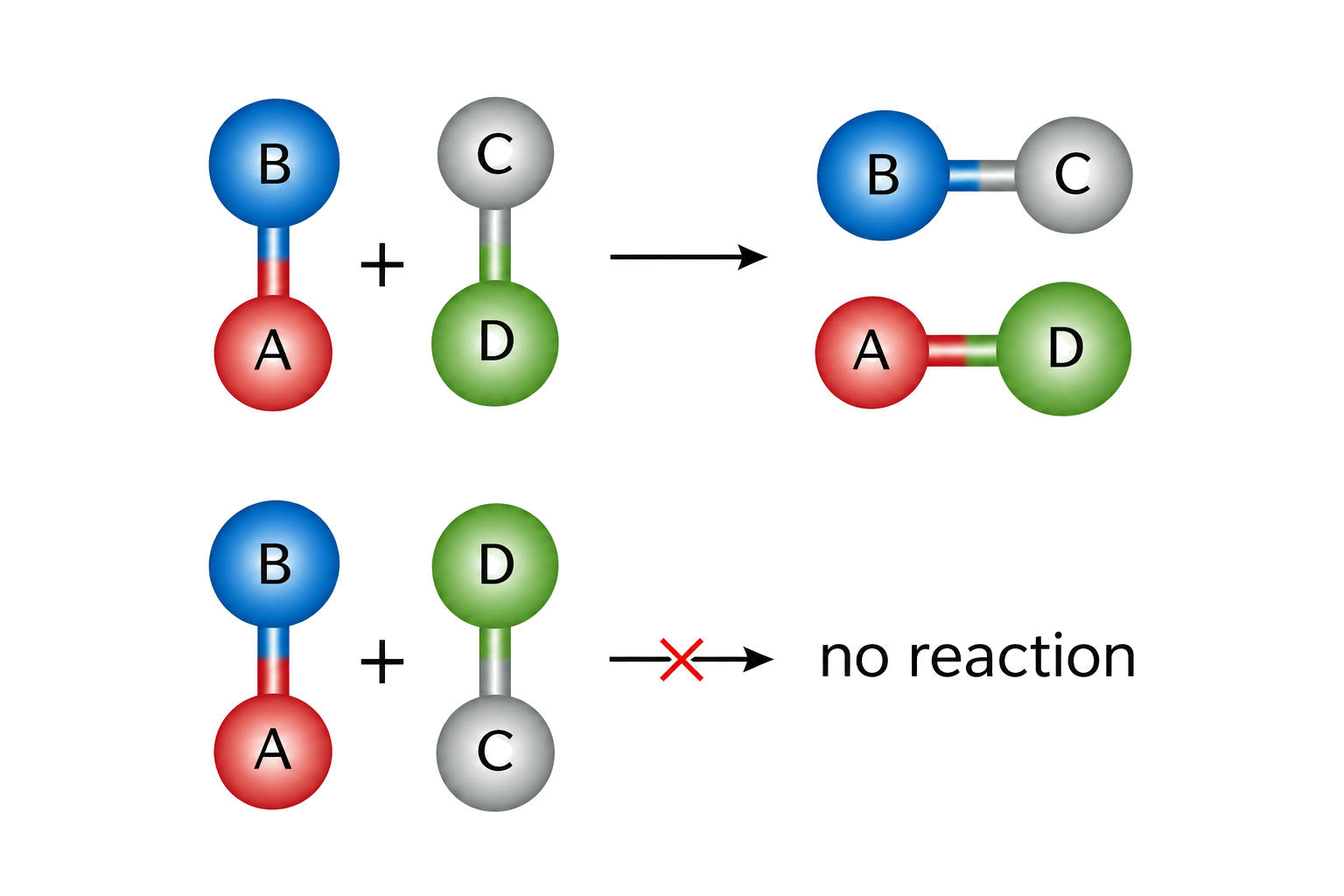
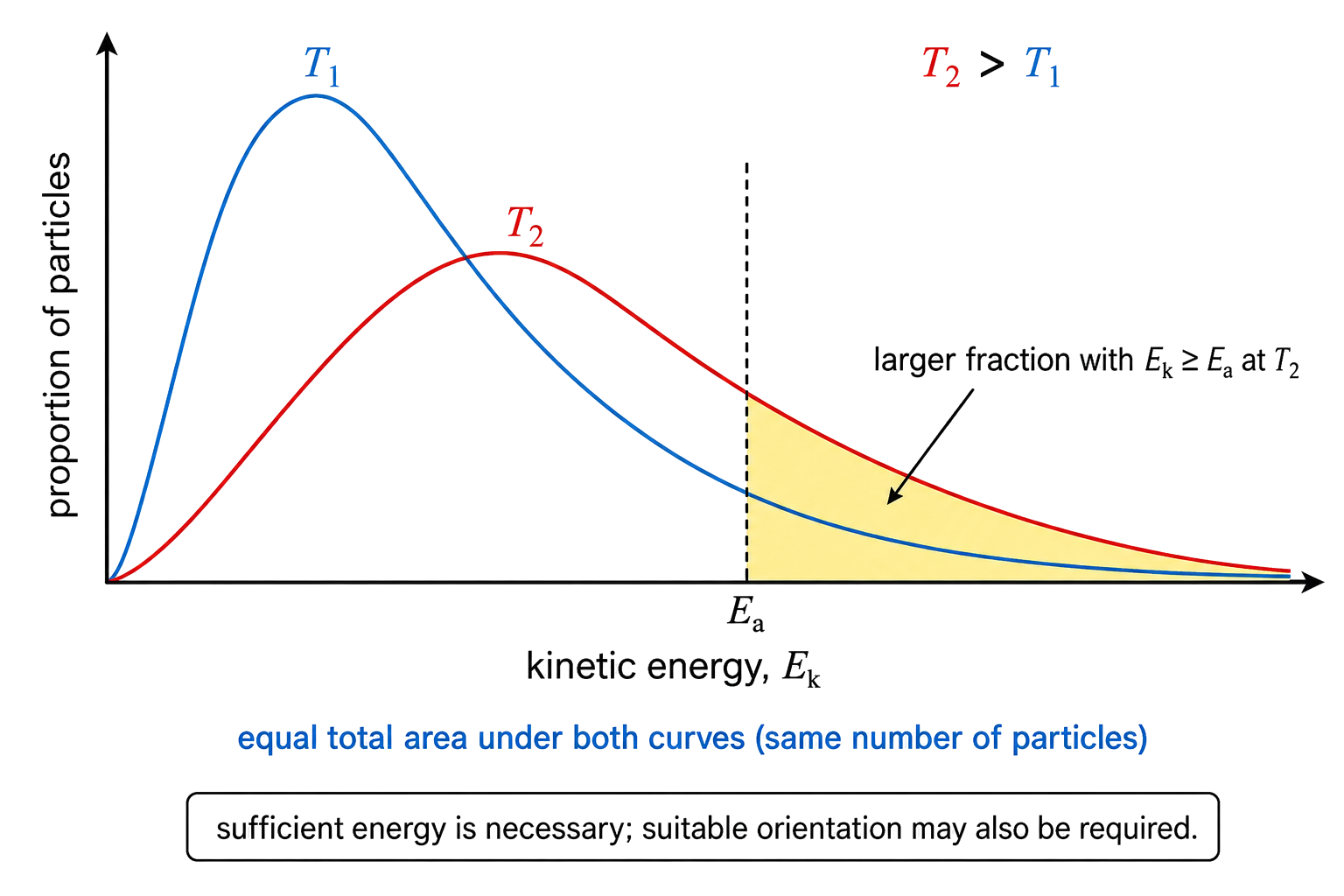
Temperature raises average kinetic energy and changes collision frequency and the fraction of particles with energy at least Ea. Collision frequency alone does not guarantee reaction.

At one temperature, only the fraction of collisions above Ea and with a productive orientation can react. Raising temperature increases that fraction, not the energy of every particle by the same amount. Use collision frequency to explain concentration or pressure effects and the energy distribution to explain the stronger temperature effect.
Explaining Rate with Collision Theory

Assessment in practice

Representative question

Question 1

[Maximum number: 3]

Explain, using collision theory, how an increase in temperature increases the reaction rate.

Factors Affecting Rate

Change Main collision consequence
concentration or pressure up more frequent collisions
surface area up more collisions at a solid surface
temperature up more frequent and more energetic collisions
catalyst alternative lower-Ea pathway

Explain a predicted rate change through collision frequency or the fraction of effective collisions, not just by saying particles move faster.

Powdered CaCO₃ reacts faster than equal-mass chips because more surface sites are exposed, not because its particles have higher kinetic energy. For each changed condition, identify exactly what changes—collision frequency, energy distribution or pathway—and hold other variables constant in a fair comparison.

Predicting Rate Changes

Assessment in practice

Representative question

Question 1

[Maximum number: 2]

The student then carried out the experiment at other acid concentrations with all other conditions remaining unchanged.

[H+]/ mol dm3\left[\mathbf{H}^{+}\right] / \mathbf{~ m o l ~ d m}^{-\mathbf{3}}Relative rate of reaction
0.050.0025
0.100.0051
0.200.0100

State and explain the relationship between the rate of reaction and the concentration of acid.

Activation Energy and Maxwell–Boltzmann Curves

Ea=minimumkineticenergyforaneffectivecollisionEa = minimum kinetic energy for an effective collision

A Maxwell–Boltzmann curve shows the distribution of particle kinetic energies. At higher temperature the peak is lower and shifts right; the area beyond Ea is larger, so more particles can react.

Two Maxwell–Boltzmann curves for the same number of particles have equal total area. At higher T the curve is broader with a lower peak and a larger area to the right of a fixed Ea line; the peak does not move to Ea and no particle count is lost.

Interpreting Maxwell–Boltzmann Distributions

Assessment in practice

Representative question

Question 1

[Maximum number: 3]

Explain why the reaction rate increases with temperature, adding annotations to the following Maxwell-Boltzmann graph to assist your explanation.

Explanation:

Catalysts and Activation Energy

A catalyst provides an alternative reaction pathway with lower activation energy. It does not change the energy levels of the reactants or products.
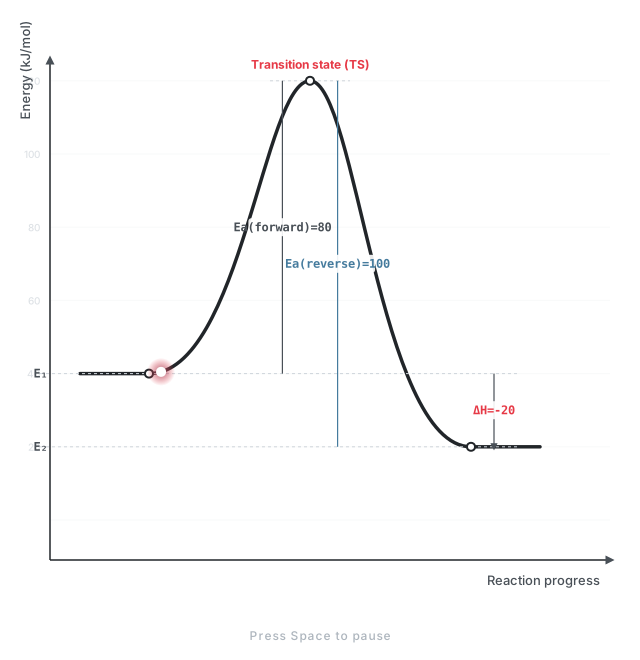
Because the catalysed Ea is lower, a larger fraction of the same distribution lies beyond the threshold. The reaction therefore has more effective collisions at the same temperature.

At fixed temperature a catalyst does not change the Maxwell–Boltzmann distribution; it moves the threshold to a lower Ea, increasing the area beyond it. On an energy profile it changes the pathway and peak, not ΔH, reactant/product energies or the equilibrium constant.

Showing a Catalyst on Energy Diagrams

Assessment in practice

Representative question

Question 1

[Maximum number: 2]

Sketch the Maxwell-Boltzmann energy distribution curve for this reaction. Label the activation energy with and without a catalyst on the diagram.

Reaction Mechanisms

HL only

A mechanism is a sequence of elementary steps. The slowest step is the rate-determining step; an intermediate is formed in one step and consumed in a later step, whereas a transition state is the high-energy configuration at a barrier.
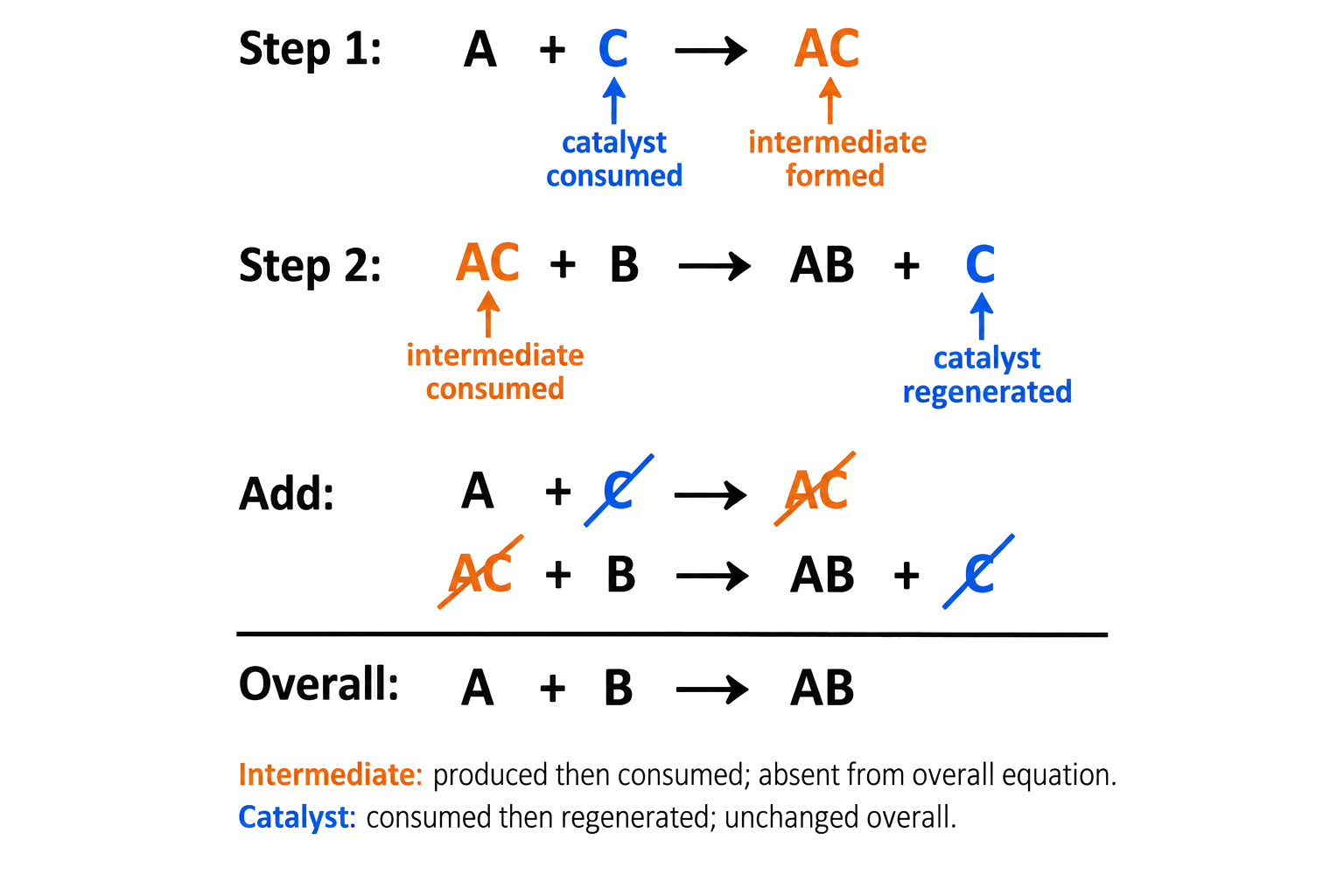
A proposed mechanism must be compared with the experimental rate equation and stoichiometry. Matching a rate equation can support a mechanism but does not prove it, because different mechanisms may give the same expression.

Add all elementary steps and cancel intermediates to recover the overall equation. Then derive the rate dependence expected from the slow step, eliminating an intermediate when necessary, and compare with experiment. A catalyst consumed early and regenerated later cancels from the overall equation but is not an intermediate.

Evaluating a Proposed Mechanism

HL only

Assessment in practice

Representative question

Question 1

[Maximum number: 1]

Suggest why experimental confirmation of the rate equation would not prove that the mechanism is correct.

Multistep Energy Profiles

HL only

In a multistep profile, peaks are transition states and valleys between peaks are intermediates. Each step has its own Ea; the largest barrier from its preceding intermediate identifies the rate-determining step.
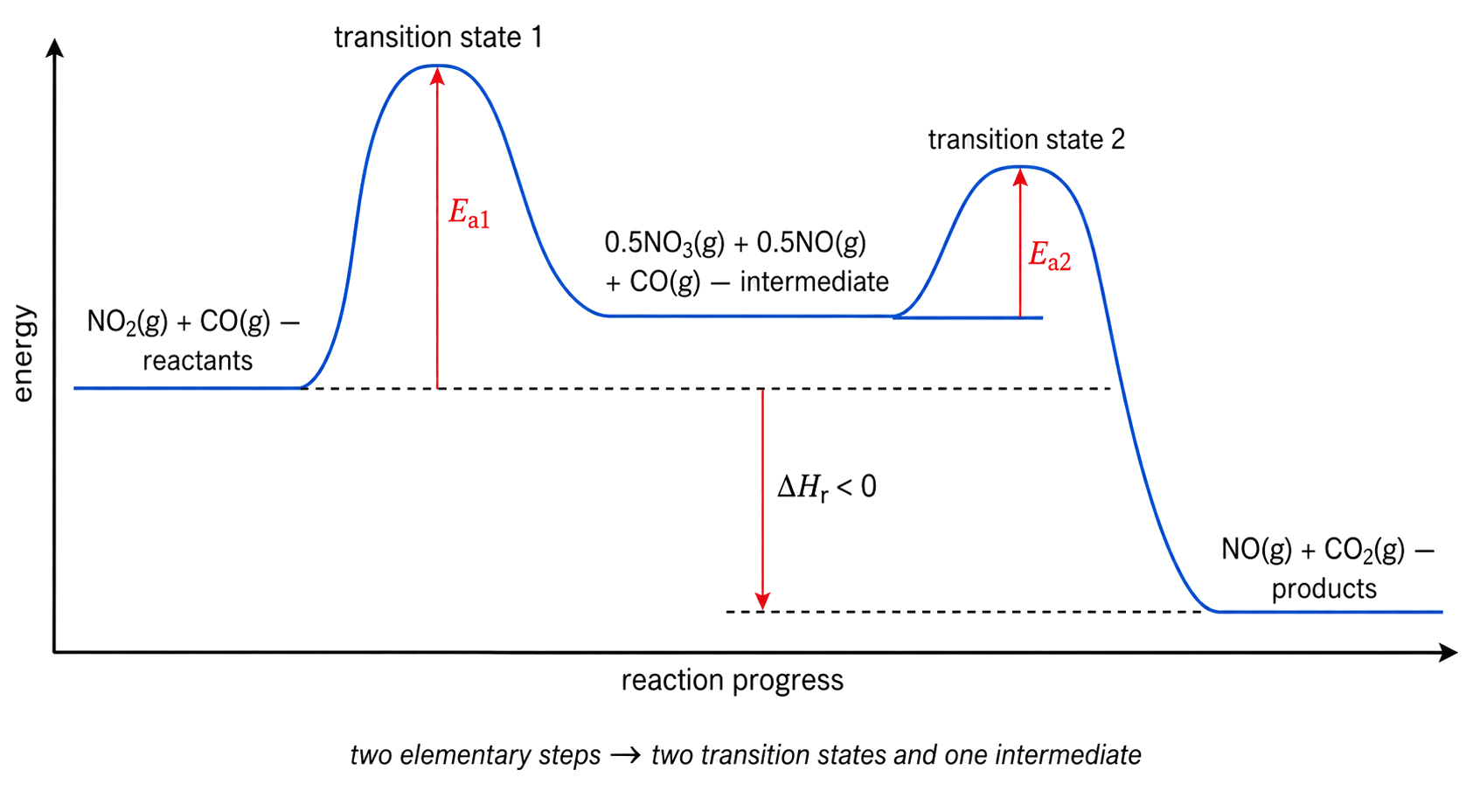
ΔH=energy(products)energy(reactants)ΔH = energy(products) − energy(reactants)

For each step, measure Ea upward from its own preceding reactant or intermediate valley to the next peak. The rate-determining barrier is the largest of those step barriers, which need not be the peak with the greatest absolute height above the page baseline.

Constructing a Two-Step Energy Profile

HL only

Assessment in practice

Representative question

Question 1

[Maximum number: 4]

Sketch an energy profile for the two-step reaction, labelling reactants, intermediate and products, activation energies, EaE_{\mathrm{a}}, and overall enthalpy change, ΔH\Delta H. Assume that the reaction is exothermic.

Molecularity of an Elementary Step

HL only

Molecularity is the number of reacting particles in one elementary step: one is unimolecular, two is bimolecular and three is termolecular.

Count particles in the individual elementary step, not coefficients in the overall reaction equation.

A step A + 2B → products is termolecular because three reacting particles meet in that elementary event. Molecularity is always a positive whole-number description of one proposed step; reaction order is experimental and can be zero, fractional or unrelated to overall stoichiometric coefficients.

Identifying Molecularity

HL only

Assessment in practice

Representative question

Question 1

[Maximum number: 1]

Identify the molecularity of the rate-determining step in this reaction.

Deducing Rate Equations

HL only

rate=k[A]x[B]yrate = k[A]^x[B]^y

Use experimental trials that vary one concentration independently. Compare the rate factor with the concentration factor to infer each exponent; the balanced overall equation alone cannot determine the rate equation.

If doubling [A] while holding [B] constant quadruples rate, the order in A is 2; if doubling [B] leaves rate unchanged, the order in B is 0, giving rate = k[A]². Choose trial pairs with only one changed concentration before combining exponents.

Worked initial-rate deduction: doubling [FeX3+][\ce{Fe^{3+}}] from 1.00×1021.00\times10^{-2} to 2.00×10²moldm32.00\times10^{-2}\,\mathrm{mol\,dm^{-3}} at constant [IX][\ce{I^-}] doubles rate, so the order in FeX3+\ce{Fe^{3+}} is 1. Doubling [IX][\ce{I^-}] at constant [FeX3+][\ce{Fe^{3+}}] increases rate from 3.24×1053.24\times10^{-5} to 1.30×10⁴moldm3s11.30\times10^{-4}\,\mathrm{mol\,dm^{-3}\,s^{-1}}, approximately fourfold, so its order is 2. Therefore v=k[FeX3+][IX]2v=k[\ce{Fe^{3+}}][\ce{I^-}]^2, third order overall.

Using Experimental Rate Data

HL only

Assessment in practice

Representative question

Question 1

[Maximum number: 2]

Two more trials ( 2 and 3 ) were carried out. The results are given below.

TrialsVolume of 0.20 mol dm3KI(aq)/cm3\mathbf{0 . 2 0 ~ m o l ~ d m}{ }^{\mathbf{- 3}} \mathbf{K I} \boldsymbol{(} \mathbf{a q} \boldsymbol{)} \boldsymbol{/} \mathbf{c m}^{\mathbf{3}}
Volume of
0.20 mol dm3\mathbf{0 . 2 0 ~ m o l ~ d m}{ }^{\mathbf{- 3}}KI(aq)/cm3\mathbf{K I} \boldsymbol{(} \mathbf{a q} \boldsymbol{)} \boldsymbol{/} \mathbf{c m}^{\mathbf{3}}
Volume of
deionised
water / cm3\mathbf{c m}^{\mathbf{3}}
Volume of 3\% H2O2(aq)/cm3\mathrm{H}_{2} \mathrm{O}_{2}(\mathrm{aq}) / \mathbf{c m}^{3}
Volume of 3\%
H2O2(aq)\mathrm{H}_{2} \mathrm{O}_{2}(\mathrm{aq})/cm3/ \mathbf{c m}^{3}
Average rate of
reaction
/cm3O2(g)s1/ \mathrm{cm}^{3} \mathbf{O}_{\mathbf{2}}(\mathrm{g}) \mathbf{s}^{-1}
110.015.05.0
210.010.010.00.0429
320.05.05.00.0451

Determine the rate equation for the reaction and its overall order, using your answer from (b)(i).

Rate equation:

Overall order:

Reaction Order

HL only

overallorder=x+yinrate=k[A]x[B]yoverall order = x + y in rate = k[A]^x[B]^y

The exponent gives order with respect to that reactant. Use rate factors to identify zero, first or second order, then match the order to the concentration–time or rate–concentration graph.

Use multiple representations as cross-checks: zero-order rate is independent of concentration and [A] falls linearly; first-order rate is proportional to [A] and gives exponential decay; second-order rate curves upward on a rate-versus-concentration plot. Do not infer order from one balanced equation.
Determining Overall Order

HL only

Assessment in practice

Representative question

Question 1

[Maximum number: 1]

Compounds P and Q were mixed together at various concentrations and the initial rate of each reaction was measured.

Experiment[P] mol dm 3{ }^{-3}[Q] mol dm 3{ }^{-3}Initial rate of reaction
(mol dm 3 s1{ }^{-3} \mathrm{~s}^{-1} )
10.200.150.50
20.100.150.25
30.200.301.00

What are the orders of reaction with respect to P and Q ?

Order with respect to P

Order with respect to Q

1

1

1

2

2

1

1

0

The Rate Constant k

HL only

k=rate/([A]x[B]y)k = rate / ([A]^x[B]^y)

The units of k depend on the overall order and must cancel the concentration and time units in the rate equation. For a particular reaction, k changes with temperature.

Derive rather than memorize the units: first-order k has units s⁻¹, while an overall second-order law written with mol dm⁻³ and seconds gives dm³ mol⁻¹ s⁻¹. Concentration changes rate but does not change k at fixed temperature.

Worked kk example: for v=k[FeX3+][IX]2v=k[\ce{Fe^{3+}}][\ce{I^-}]^2, use v=1.62×10⁵moldm3s1v=1.62\times10^{-5}\,\mathrm{mol\,dm^{-3}\,s^{-1}} and both concentrations 1.00×10²moldm31.00\times10^{-2}\,\mathrm{mol\,dm^{-3}}. k=1.62×10⁵(1.00×10²)(1.00×10²)2=16.2dm6mol2s1k=\frac{1.62\times10^{-5}}{(1.00\times10^{-2})(1.00\times10^{-2})^2}=16.2\,\mathrm{dm^6\,mol^{-2}\,s^{-1}}. Substitution returns the measured rate, and the units cancel those of a third-order concentration term.

Calculating k and Its Units

HL only

Assessment in practice

Representative question

Question 1

[Maximum number: 2]

Calculate the value of the rate constant stating its units.

The Arrhenius Equation

HL only

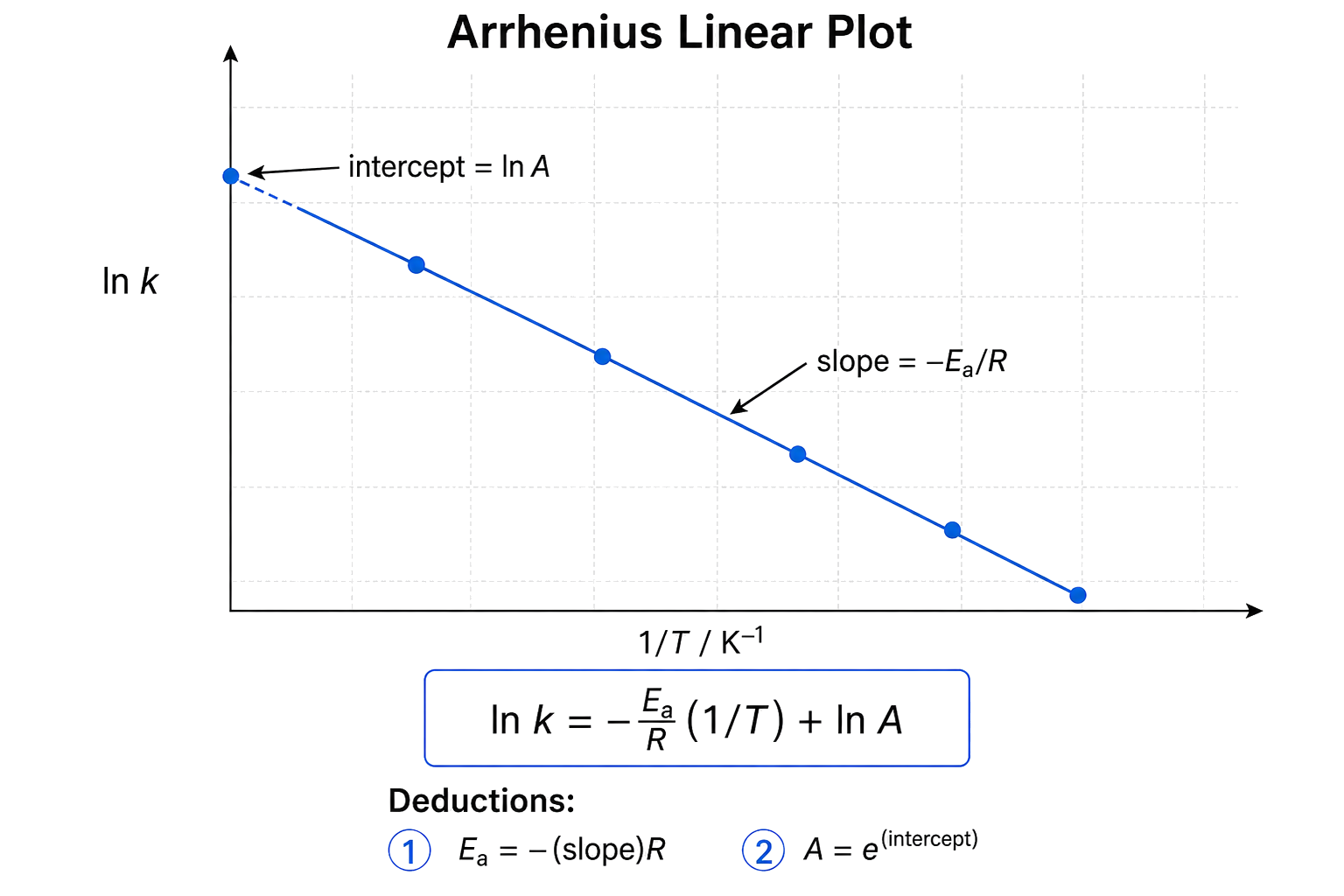
lnk=(Ea/R)(1/T)+lnAln k = (−Ea/R)(1/T) + ln A

On a plot of ln k against 1/T, gradient = −Ea/R and intercept = ln A. Use kelvin, preserve the negative gradient and convert J mol−1 to kJ mol−1 when required.

A steeper negative ln k versus 1/T gradient means a larger activation energy. When two temperatures are given, subtracting the two linear equations removes ln A and lets Ea be found without knowing the frequency factor.

ln(k2/k1)=(Ea/R)(1/T21/T1)withTinKandEainJmol1whenR=8.31Jmol1K1ln(k₂/k₁) = −(Eₐ/R)(1/T₂ − 1/T₁) with T in K and Eₐ in J mol⁻¹ when R = 8.31 J mol⁻¹ K⁻¹

Worked Arrhenius-plot example: using line points (0.00302K1,6.8)(0.00302\,\mathrm{K^{-1}},-6.8) and (0.00334K1,10.8)(0.00334\,\mathrm{K^{-1}},-10.8), the gradient is [6.8(10.8)]/(0.003020.00334)=1.25×104K[-6.8-(-10.8)]/(0.00302-0.00334)=-1.25\times10^4\,\mathrm{K}. Since gradient =Ea/R=-E_a/R, Ea=(1.25×10⁴)(8.31)=1.04×10⁵Jmol1=104kJmol1E_a=-(-1.25\times10^4)(8.31)=1.04\times10^5\,\mathrm{J\,mol^{-1}}=104\,\mathrm{kJ\,mol^{-1}}. The negative plot gradient therefore produces a positive activation energy.

Finding Ea from an Arrhenius Plot

HL only

Assessment in practice

Representative question

Question 1

[Maximum number: 2]

Determine the activation energy of the reaction, EaE_{\mathrm{a}}, in kJmol1\mathrm{kJ} \mathrm{mol}^{-1}, from the Arrhenius plot. Use sections 1 and 2 of the data booklet.

The Arrhenius Factor A

HL only

A is the frequency factor: it represents the frequency of collisions with proper orientation. In the linear Arrhenius form, the y-intercept is ln A.

Read the intercept, find A by exponentiating ln A, and keep A distinct from Ea: Ea describes the energy barrier, while A describes collision frequency and orientation.

From a fitted line, intercept b gives A = eᵇ, while gradient m gives Ea = −mR. Check the pair against k = Ae^(−Ea/RT) at one data temperature. A has the same units as k for the stated rate law; it is not an activation energy or a universal constant.

Worked intercept example: for the same first-order Arrhenius line, use lnk=6.02\ln k=-6.02, 1/T=0.00296K11/T=0.00296\,\mathrm{K^{-1}} and gradient Ea/R=12500K-E_a/R=-12500\,\mathrm{K}. From lnk=(Ea/R)(1/T)+lnA\ln k=(-E_a/R)(1/T)+\ln A, 6.02=(12500)(0.00296)+lnA-6.02=(-12500)(0.00296)+\ln A, so lnA=30.98\ln A=30.98 and A=e30.98=2.85×10¹³s1A=e^{30.98}=2.85\times10^{13}\,\mathrm{s^{-1}}. The unit is s1\mathrm{s^{-1}} because this reaction is first order and AA has the same units as kk.

Finding A from the Intercept

HL only

Assessment in practice

Representative question

Question 1

[Maximum number: 2]

Calculate the numerical value of A.

Rate and Mechanisms Summary

Retrieve the route: measure a tangent rate, explain effective collisions, map rate factors, read Ea and energy profiles, evaluate mechanisms, determine molecularity and orders, calculate k, then use Arrhenius gradient and intercept for Ea and A.

Check tangent versus average slope, energy versus orientation, barrier labels, intermediate versus transition state, one-variable trial comparisons, order-dependent units, kelvin temperature and the signs of gradient and Ea.

Topic 2.3

2.3 Extent of chemical change

Objectives in this topic

Dynamic Equilibrium

Dynamic equilibrium occurs in a closed system when the forward and reverse processes continue at equal rates. Macroscopic amounts remain constant, but reactants and products need not be equal in amount.
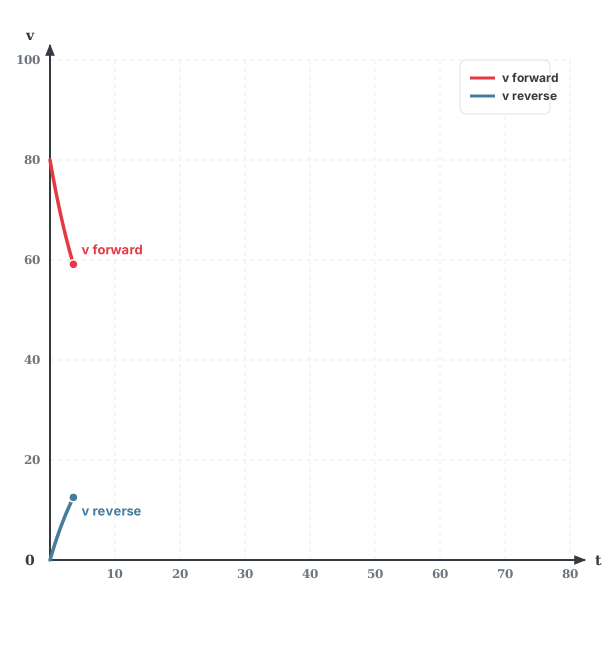
The same rate-balance idea applies to physical equilibria such as vaporization and condensation as well as to reversible chemical reactions.

In a sealed liquid–vapour system at equilibrium, molecules continue evaporating and condensing at equal rates, so pressure and amounts are constant on average. Equal rates do not mean equal concentrations, and opening the system can prevent equilibrium by allowing matter to escape.

Recognizing Dynamic Equilibrium

Assessment in practice

Representative question

Question 1

[Maximum number: 1]

Ammonia is manufactured by the Haber process.

N2( g)+3H2( g)2NH3( g)ΔHr=92.0 kJ mol1\mathrm{N}_{2}(\mathrm{~g})+3 \mathrm{H}_{2}(\mathrm{~g}) \rightleftharpoons 2 \mathrm{NH}_{3}(\mathrm{~g}) \quad \Delta H_{\mathrm{r}}^{\ominus}=-92.0 \mathrm{~kJ} \mathrm{~mol}^{-1}

Outline what is meant by dynamic equilibrium.

The Equilibrium Law

Kc=[C]r[D]s/([A]p[B]q)forpA+qBrC+sDKc = [C]^r[D]^s / ([A]^p[B]^q) for pA + qB ⇌ rC + sD

For a homogeneous reaction, place product concentrations over reactant concentrations and use each balanced-equation coefficient as the exponent.

Build the expression only after balancing the equation, and use equilibrium rather than initial concentrations. The numerical value of K changes with temperature; changing starting amounts can move the equilibrium composition without changing K.

Writing Kc Expressions

Assessment in practice

Representative question

Question 1

[Maximum number: 1]

Deduce the KcK_{\mathrm{c}} expression for the reaction in part (d)(i).

Interpreting K

K range Equilibrium tendency
K << 1 reactants strongly favoured
K < 1 reactants favoured
K = 1 comparable amounts
K > 1 products favoured
K >> 1 products strongly favoured

Kreverse=1/KforwardKreverse = 1 / Kforward

K describes a ratio, not reaction speed: a very large K can still belong to a slow reaction. Reversing the equation gives 1/K, while multiplying every coefficient by a factor raises K to that factor. Interpret 'favoured' as equilibrium composition, not complete conversion.

Worked reading: if K = 0.0665 at 100 C, K < 1, so reactants are favoured and the forward reaction has a small extent. This describes equilibrium composition, not reaction speed. At the same temperature, reversing the equation gives K = 1/0.0665.

Using K to Describe Extent

Assessment in practice

Representative question

Question 1

[Maximum number: 1]

At 100CKc100^{\circ} \mathrm{C} \mathrm{K}_{\mathrm{c}} for this reaction is 0.0665 . Outline what this indicates about the extent of this reaction.

Le Châtelier's Principle

An equilibrium shifts to partially counteract an imposed change. Pressure favours the side with fewer gaseous molecules; temperature favours the endothermic direction; concentration changes alter composition.
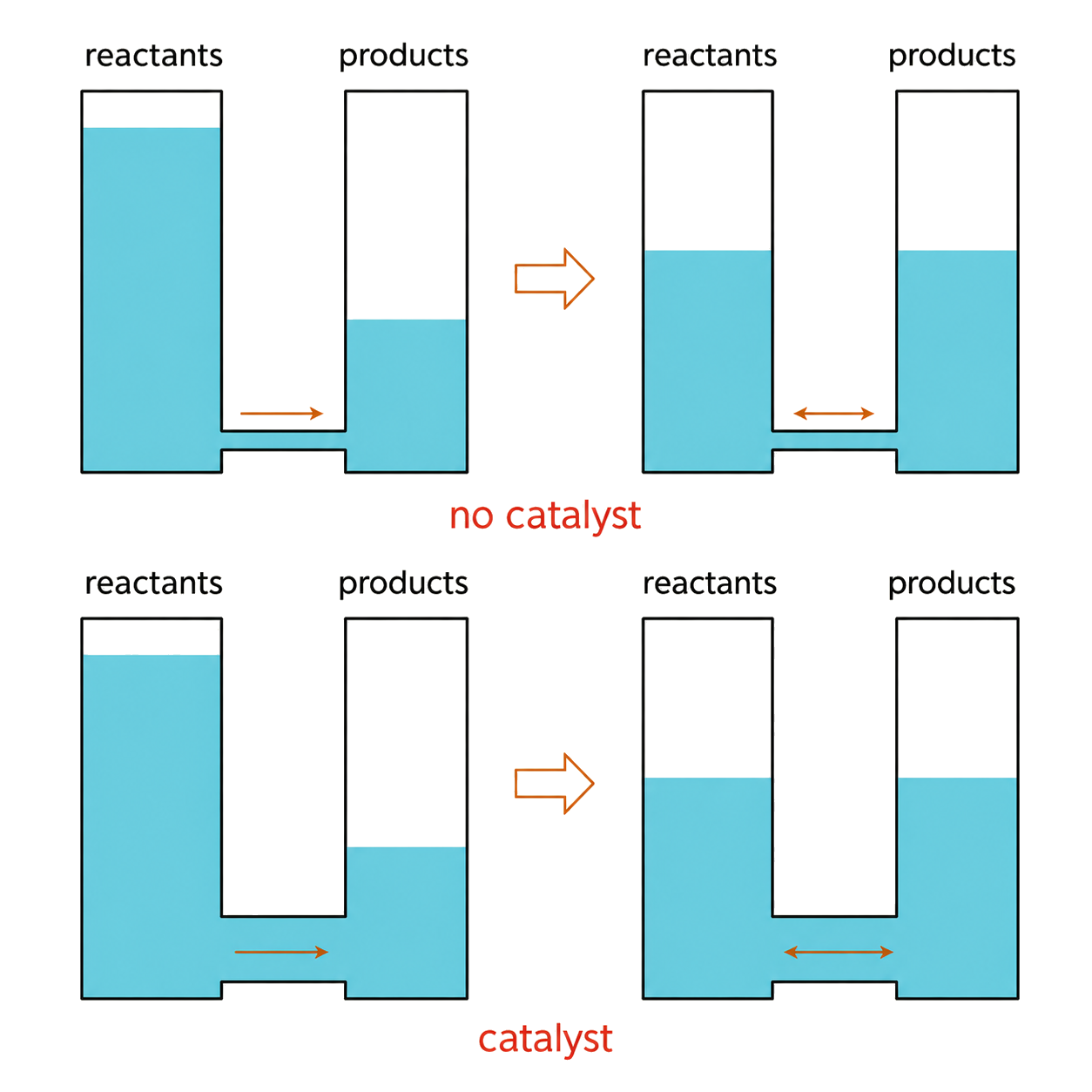
At fixed temperature, concentration and pressure changes do not change K. Temperature changes K. A catalyst changes rates in both directions and does not change equilibrium position.

For N₂(g) + 3H₂(g) ⇌ 2NH₃(g), compression favours the two-mole gas side, but K is unchanged if temperature is fixed. Heating favours the endothermic direction and changes K; a catalyst reaches the same equilibrium faster by accelerating both directions.

Disturbance Immediate evidence K at fixed/new T Direction check
concentration or pressure change Q changes before composition readjusts unchanged if T is fixed compare the new Q with K
raise temperature heat favours the endothermic direction K increases if the forward reaction is endothermic; decreases if it is exothermic use the stated forward ΔH
catalyst both forward and reverse rates increase unchanged equilibrium composition is unchanged; it is reached sooner

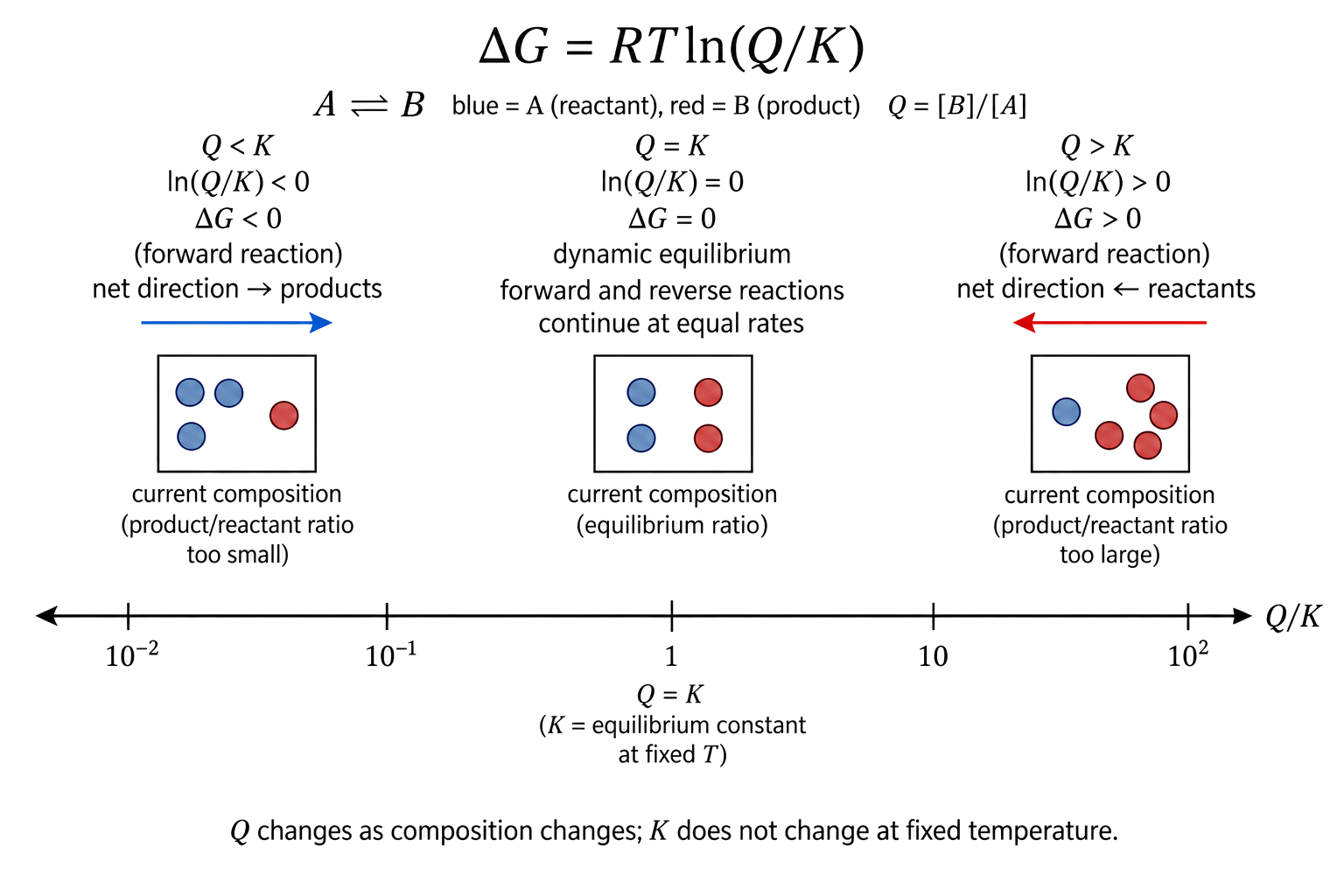
For gas pressure, count gaseous coefficients only. Use Q/K or opposing-rate evidence to justify the shift rather than the phrase “counteracts the change” alone.
Predicting Equilibrium Shifts

Assessment in practice

Representative question

Question 1

[Maximum number: 2]

Explain why an increase in pressure shifts the position of equilibrium towards the products and how this affects the value of the equilibrium constant, KcK_{\mathrm{c}}.

The Reaction Quotient Q

HL only

Q=productoverreactantconcentrationexpressionusingcurrentconcentrationsQ = product-over-reactant concentration expression using current concentrations

Q uses concentrations at any time, not necessarily equilibrium. Q < K means the forward direction is needed; Q > K means the reverse direction is needed; Q = K means equilibrium.

Calculate Q with the same expression as K but using the current concentrations. If Q = 0.20 and K = 5.0, too little product is present relative to equilibrium, so the forward direction lowers the mismatch. Recalculate after composition changes; Q is a snapshot, not a new constant.

Worked QQ example: for NX2(g)+3HX2(g)2NHX3(g)\ce{N2(g) + 3H2(g) <=> 2NH3(g)}, Q=[NHX3]2/([NX2][HX2]3)Q=[\ce{NH3}]^2/([\ce{N2}][\ce{H2}]^3). If every current concentration is 0.50moldm30.50\,\mathrm{mol\,dm^{-3}}, Q=(0.50)2/[(0.50)(0.50)3]=4.0Q=(0.50)^2/[(0.50)(0.50)^3]=4.0. At 475 K, K=0.59K=0.59, so Q>KQ>K: the mixture contains too much product relative to equilibrium and the reverse direction is favoured until Q=KQ=K.

Comparing Q with K

HL only

Assessment in practice

Representative question

Question 1

[Maximum number: 3]

0.200 mol sulfur dioxide, 0.300 mol oxygen and 0.500 mol sulfur trioxide were mixed in a 1.00dm31.00 \mathrm{dm}^{3} flask at 1000 K .

Predict the direction of the reaction showing your working.

RICE-Table Equilibrium Calculations

HL only

Write the balanced reaction, record initial concentrations, express changes as coefficient multiples of x, and substitute the equilibrium row into Kc. Use a small-K approximation when justified; quadratic equations are not expected here.

Equilibrium reactions do not use the limiting-reactant idea: both directions remain possible, so calculate the equilibrium composition instead.

After using an approximation such as C₀ − x ≈ C₀, validate it by checking that x/C₀ is small, commonly below 5% for the stated course method. If the check fails, the approximation is not justified; revise the setup rather than treating equilibrium as a limiting-reactant completion.

Worked equilibrium example: for 2SOX2(g)+OX2(g)2SOX3(g)\ce{2SO2(g) + O2(g) <=> 2SO3(g)}, K=3.0K=3.0, [SOX2]eq=0.12[\ce{SO2}]_{eq}=0.12 and [SOX3]eq=0.18moldm3[\ce{SO3}]_{eq}=0.18\,\mathrm{mol\,dm^{-3}}. From 3.0=(0.18)2/[x(0.12)2]3.0=(0.18)^2/[x(0.12)^2], x=[OX2]eq=0.75moldm3x=[\ce{O2}]_{eq}=0.75\,\mathrm{mol\,dm^{-3}}. Forming 0.18moldm30.18\,\mathrm{mol\,dm^{-3}} of SOX3\ce{SO3} consumes 0.180.18 of SOX2\ce{SO2} and 0.0900.090 of OX2\ce{O2}, so their initial concentrations were 0.300.30 and 0.84moldm30.84\,\mathrm{mol\,dm^{-3}}, respectively.

Solving for Equilibrium Composition

HL only

Assessment in practice

Representative question

Question 1

[Maximum number: 3]

The equilibrium constant, KcK_{\mathrm{c}}, for the reaction

CO( g)+H2O( g)H2( g)+CO2( g)\mathrm{CO}(\mathrm{~g})+\mathrm{H}_{2} \mathrm{O}(\mathrm{~g}) \rightleftharpoons \mathrm{H}_{2}(\mathrm{~g})+\mathrm{CO}_{2}(\mathrm{~g})

was found to be 10.0 at 420C420^{\circ} \mathrm{C}.
1.00 mol of CO(g) and 1.00 mol of H2O(g)\mathrm{H}_{2} \mathrm{O}(\mathrm{g}) are mixed in a 1.00dm31.00 \mathrm{dm}^{3} container at 420C420^{\circ} \mathrm{C}. Calculate the equilibrium concentration of each component in the mixture, showing your working.

K and Gibbs Energy

HL only

ΔG°=RTlnKΔG° = −RT ln K

K and ΔG both describe equilibrium position. K > 1 corresponds to product-favoured equilibrium and ΔG° < 0; K = 1 corresponds to ΔG° = 0 and approximately equal equilibrium tendencies.

Use a dimensionless K, T in kelvin and R = 8.31 J mol⁻¹ K⁻¹. The sign link applies to ΔG°: the actual ΔG away from standard conditions also depends on the reaction quotient.

Worked Gibbs example: for 2NO(g)NX2OX2(g)\ce{2NO(g) <=> N2O2(g)} at 298 K, local spectroscopic data give K=1.39×10⁵K=1.39\times10^{-5}. ΔG=(8.31JK1mol1)(298K)ln(1.39×10⁵)=+2.77×10⁴Jmol1=+27.7kJmol1\Delta G^\circ=-(8.31\,\mathrm{J\,K^{-1}\,mol^{-1}})(298\,\mathrm{K})\ln(1.39\times10^{-5})=+2.77\times10^4\,\mathrm{J\,mol^{-1}}=+27.7\,\mathrm{kJ\,mol^{-1}}. The positive value agrees with K<1K<1: reactants are favoured under standard conditions at this temperature.

Calculating ΔG° from K

HL only

Assessment in practice

Representative question

Question 1

[Maximum number: 2]

Determine the equilibrium constant, K , for this reaction at 25C25^{\circ} \mathrm{C}, referring to section 1 of the data booklet.

If you did not obtain an answer in (c)(iii), use ΔG=43.5 kJ mol1\Delta G=-43.5 \mathrm{~kJ} \mathrm{~mol}^{-1}, but this is not the correct answer.

Extent of Chemical Change Summary

Retrieve the route: define dynamic equilibrium, write K, interpret its magnitude, predict Le Châtelier shifts, compare Q with K, solve a RICE table, and connect K with ΔG.

Check closed-system and equal-rate language, exponents and direction, whether a change affects K, current versus equilibrium concentrations, stoichiometric x changes, and kelvin/unit consistency in ΔG calculations.