2.2.13 (HL)—Expanded octets
- Syllabus
- First assessment 2025
- Objective
- 2.2.13
- Level
- HL
Some HL species have five or six electron domains around a central atom. Draw the Lewis formula, count the domains, and apply VSEPR to assign the corresponding geometry.
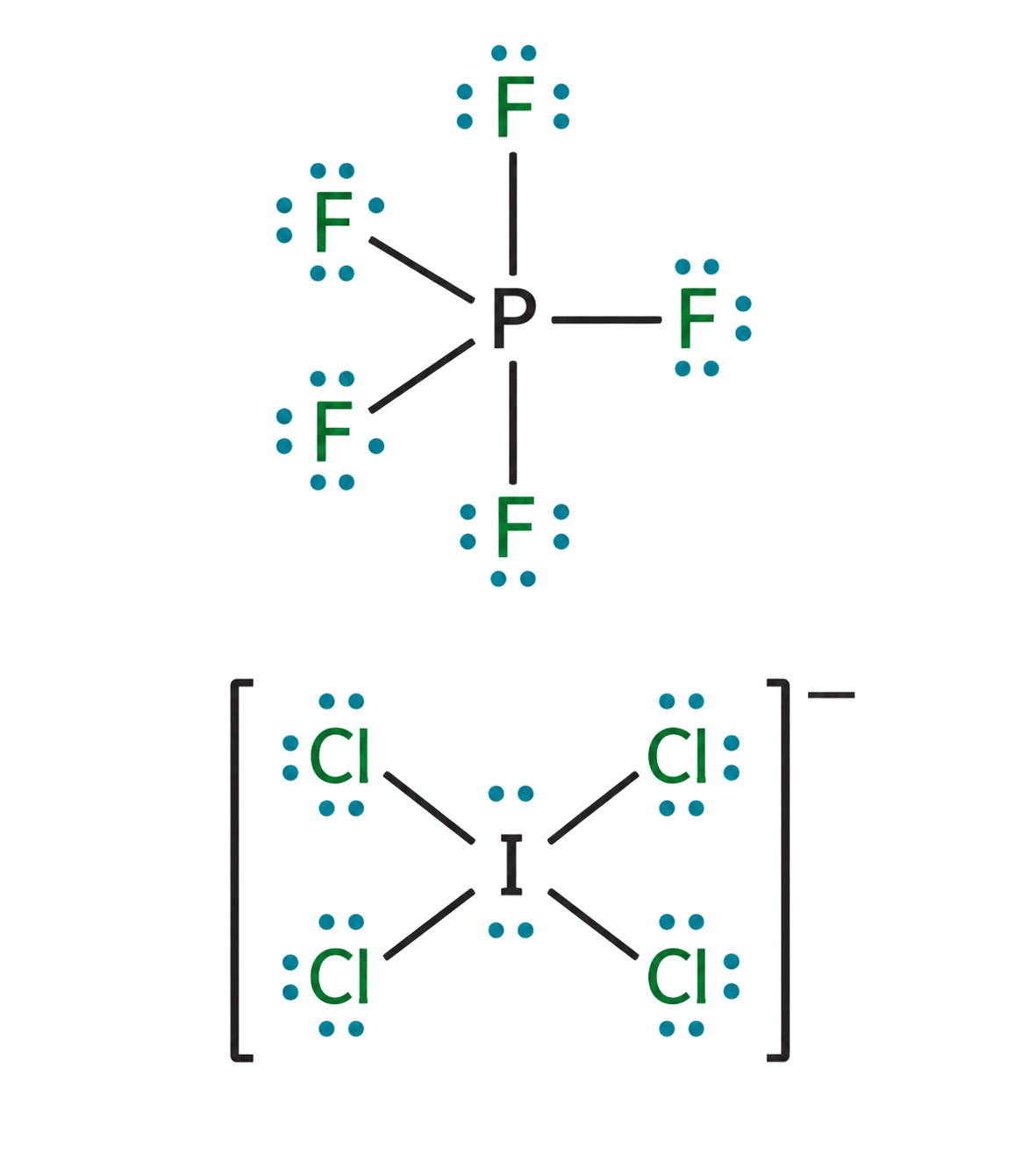
For five domains, start from trigonal-bipyramidal electron geometry; lone pairs prefer equatorial positions because that reduces 90° interactions, producing common shapes such as seesaw and T-shaped. For six domains, start from octahedral geometry; removing one or two lone-pair positions gives common square-pyramidal or square-planar molecular shapes. Name molecular shape from atom positions after the electron-domain arrangement is fixed.
Five bonding domains give trigonal-bipyramidal PCl₅ and six give octahedral SF₆. If lone pairs are present, keep the electron-domain arrangement but remove lone-pair positions when naming molecular shape, choosing positions that minimize the strongest repulsions.