2.2.10—Chromatography
- Syllabus
- First assessment 2025
- Objective
- 2.2.10
- Level
- HL
Chromatography separates components because they have different attractions to the stationary and mobile phases. A component that is more strongly attracted to the mobile phase travels farther.
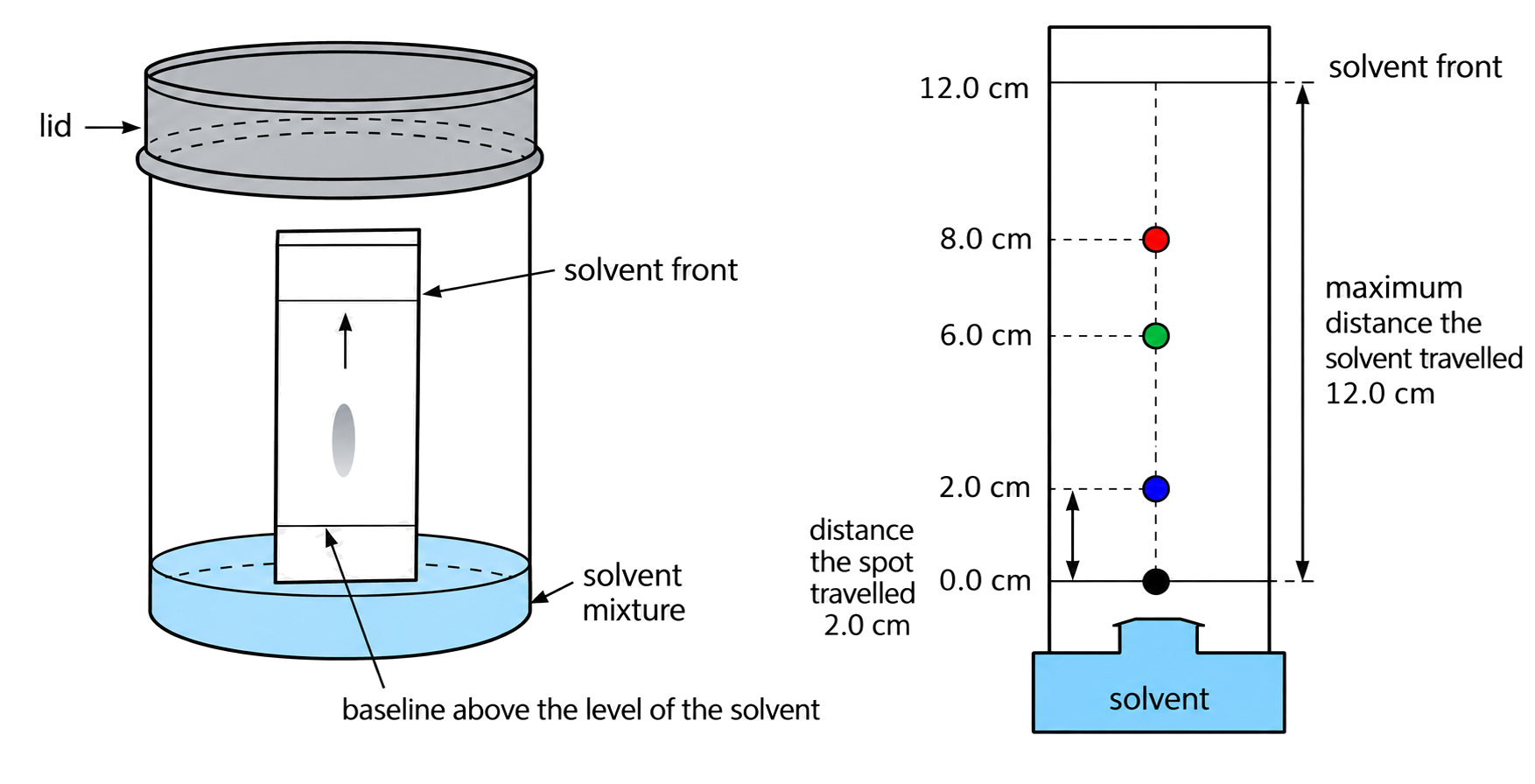
Rf is a dimensionless ratio of distances measured from the same origin under the same conditions. Because a component cannot pass the solvent front, a valid result lies from 0 to 1; a value above 1 signals a distance or origin error. Operational details beyond the separation principle are not assessed here.
If a spot moves 3.2 cm while the solvent front moves 8.0 cm, Rf = 0.40. A larger Rf means greater relative affinity for the mobile phase under those conditions, but values from different solvents, stationary phases or temperatures are not directly interchangeable.