2.2.12 (HL)—Benzene (C₆H₆)
- Syllabus
- First assessment 2025
- Objective
- 2.2.12
- Level
- HL
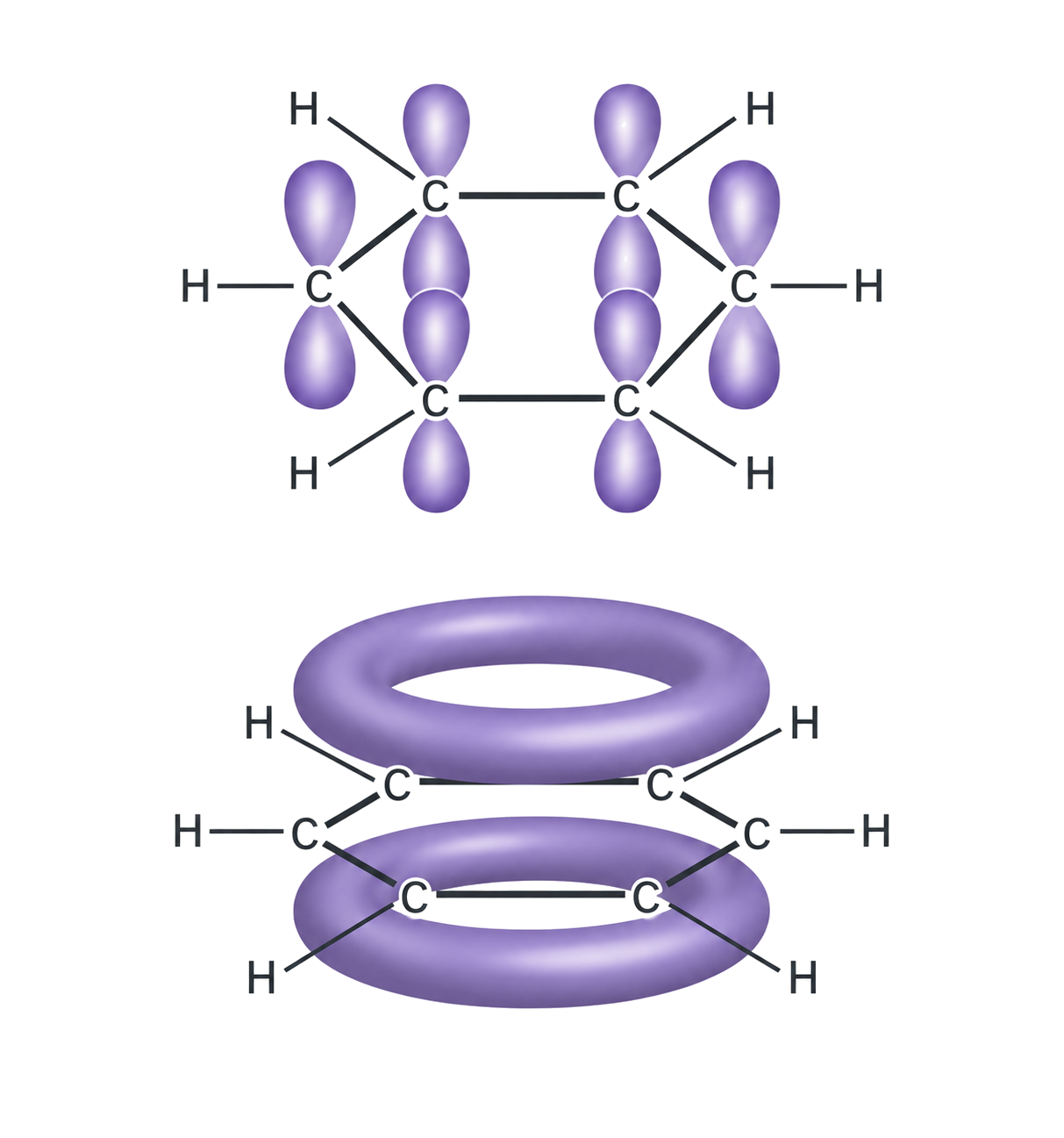
Benzene is an important resonance example: alternative ring structures place the double bonds in different positions, while the actual π electrons are delocalized across the ring.
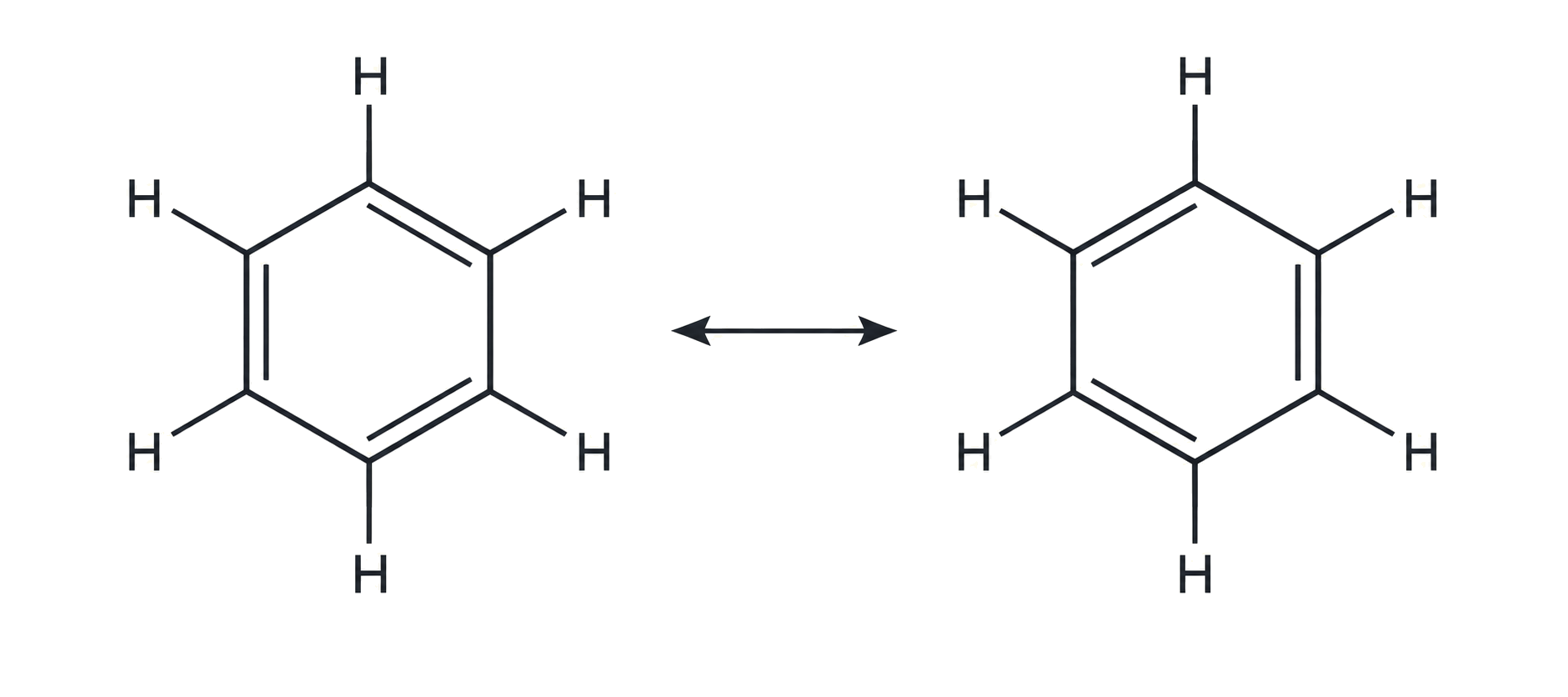
Use the resonance drawings as representations of one delocalized bonding system, not as separate rapidly changing molecular forms.
Benzene's six equal C–C bonds and greater stability than a localized triene support a delocalized π system above and below the ring. Use the two Kekulé drawings or a circle as representations of the same molecule, never as an equilibrium between two species.
Representative question
The Styrene molecule is a derivative of benzene.
State both a chemical and physical reason structure A is a better representation of benzene.
Chemical reason:
Physical reason:
Chemical reason: Any one of: does not «easily» undergo «electrophilic» addition.
OR undergoes electrophilic substitution reactions.
OR enthalpy of hydrogenation is not 3 x that of cyclohexene/ less exothermic than 3 x that of cyclohexene.
OR all «C-C» bond energies are the same.
Physical reason: Any one of: all bond lengths are the same.
OR
all bond angles are the same / molecule is planar.
Marking guidance:
Award [1 max] for each property.
Award [1 max] if properties are reversed.
Retrieve the covalent pathway: shared pairs and bond order lead to geometry, polarity and molecular polarity; structure determines network properties, IMF behaviour and chromatography; HL representations extend to resonance, formal charge, sigma/pi bonds and hybridization.
Check the representation first, then count domains, apply geometry, identify polarity or forces, and connect the structure to the requested property or HL bonding description.