Structure 1. Models of the particulate nature of matter
- Syllabus
- First assessment 2025
- Section
- —
- Level
- HL

Published Concept pages under this syllabus area do not have tagged past-paper appearances in the selected level yet.
Recent 5 years
Topic 1.1
Classify matter by asking what particles are present, whether different elements are chemically bonded, and whether the composition is fixed. An element contains one type of atom and cannot be chemically broken down. A compound contains atoms of different elements bonded in a fixed ratio, so it has its own properties. A mixture contains two or more substances in no fixed ratio; the components are not chemically bonded to one another and retain properties that can be used for separation.
| Class | Particle-level test | Composition | How components can be obtained |
|---|---|---|---|
| Element | One type of atom | Fixed identity | Cannot be chemically broken into simpler substances |
| Compound | Different elements chemically bonded | Fixed ratio | Requires a chemical change |
| Mixture | More than one substance without bonding between components | Variable ratio | Uses a physical-property difference |
Formation of a compound creates new properties: sodium and chlorine do not keep their separate properties after forming sodium chloride. Mixing substances does not have that effect. A homogeneous mixture is uniform at the scale observed; a heterogeneous mixture has distinguishable regions. Both remain mixtures.
Choose a separation method in three linked moves: identify a physical-property difference, select the operation that exploits it, then state which component is recovered where. Use magnetism for a magnetic solid; filtration for an insoluble solid suspended in a fluid; crystallization or evaporation to recover a dissolved solid; and simple distillation to recover a solvent or separate liquids with a sufficiently wide boiling-point gap. Use fractional distillation when miscible liquids have closer boiling points. Chromatography separates through different relative attractions to the mobile and stationary phases. A multi-component mixture may require a sequence of methods.
Uniform appearance is not evidence of a compound: air and salt solution are homogeneous mixtures. Also, do not justify filtration by saying only that substances have different solubilities. The separated solid must be insoluble, and the filter works because its particles do not pass through the pores.
Diagnostic check: a particle box containing two unbonded particle types represents a mixture even if it looks uniform. For an unknown mixture, complete three columns—chosen method, physical-property reason, and observable recovered fraction. Reject any proposal that changes the substances chemically or cannot state where each component goes.
Questions test classification and definition of elements, compounds, and mixtures, then apply the classification to choosing or sequencing physical separation methods; both MCQ and structured formats occur.
describe / suggest
State the defining contrast explicitly: one atom type versus different elements chemically bonded in fixed ratios, and no-fixed-ratio unbonded mixture components. For separation procedures, name each operation and connect it to the component recovered.
Confusing fixed-ratio compounds with no-fixed-ratio mixtures, or naming a separation method without linking it to the relevant component or physical property.
Representative question
Suggest a set of experimental steps required to obtain pure samples of each component of the mixture.
Any four of:
use magnet to remove iron/Fe
add «excess» water to dissolve salt/ NaCl
filter/wash sand «into saltwater filtrate»
Marking guidance:
allow/heat sand to dry
boil off/evaporate water from salt
OR
allow salt to dry overnight
Accept other reasonable orders to separations and names or formulas.
Accept references to NaCl(aq) for M 2 .
Do not accept responses that include sifting, separating with a sieve, OR by particle size.
Accept "distill off water from salt" for M5.
4 max
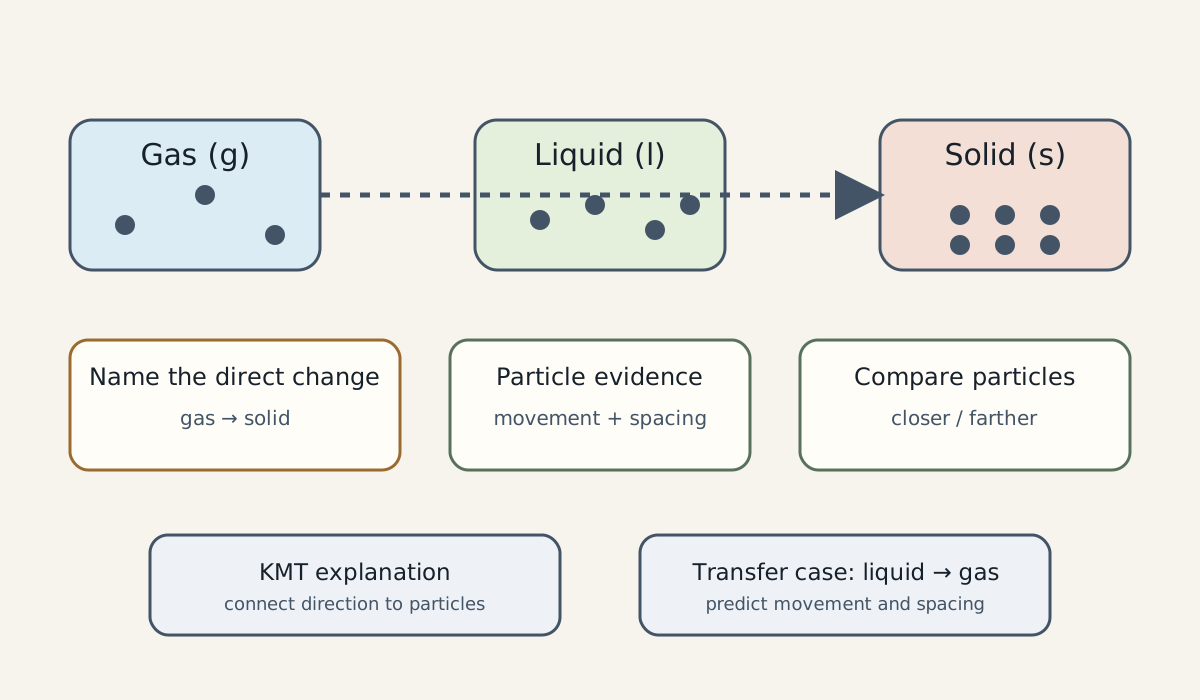
The kinetic molecular theory is a model that explains observable state properties using particle arrangement, movement, spacing, and attractions. Solid particles are closely packed and vibrate about fixed positions. Liquid particles remain close but change neighbours and flow past one another. Gas particles are far apart relative to their size and move freely, so a gas fills its container and is much more compressible.
| State | Particle model | Fixed volume? | Fixed shape? | Symbol |
|---|---|---|---|---|
| Solid | Close, ordered or fixed positions; vibrate | Yes | Yes | (s) |
| Liquid | Close, disordered; move past neighbours | Yes | No | (l) |
| Gas | Widely spaced; rapid random motion | No | No | (g) |
(aq) does not name a fourth state of pure matter. It means the stated species is dissolved in water.
| Change | Direction | Energy transfer for the substance |
|---|---|---|
| Melting | solid → liquid | absorbed |
| Freezing | liquid → solid | released |
| Vaporization | liquid → gas | absorbed |
| Condensation | gas → liquid | released |
| Sublimation | solid → gas | absorbed |
| Deposition | gas → solid | released |
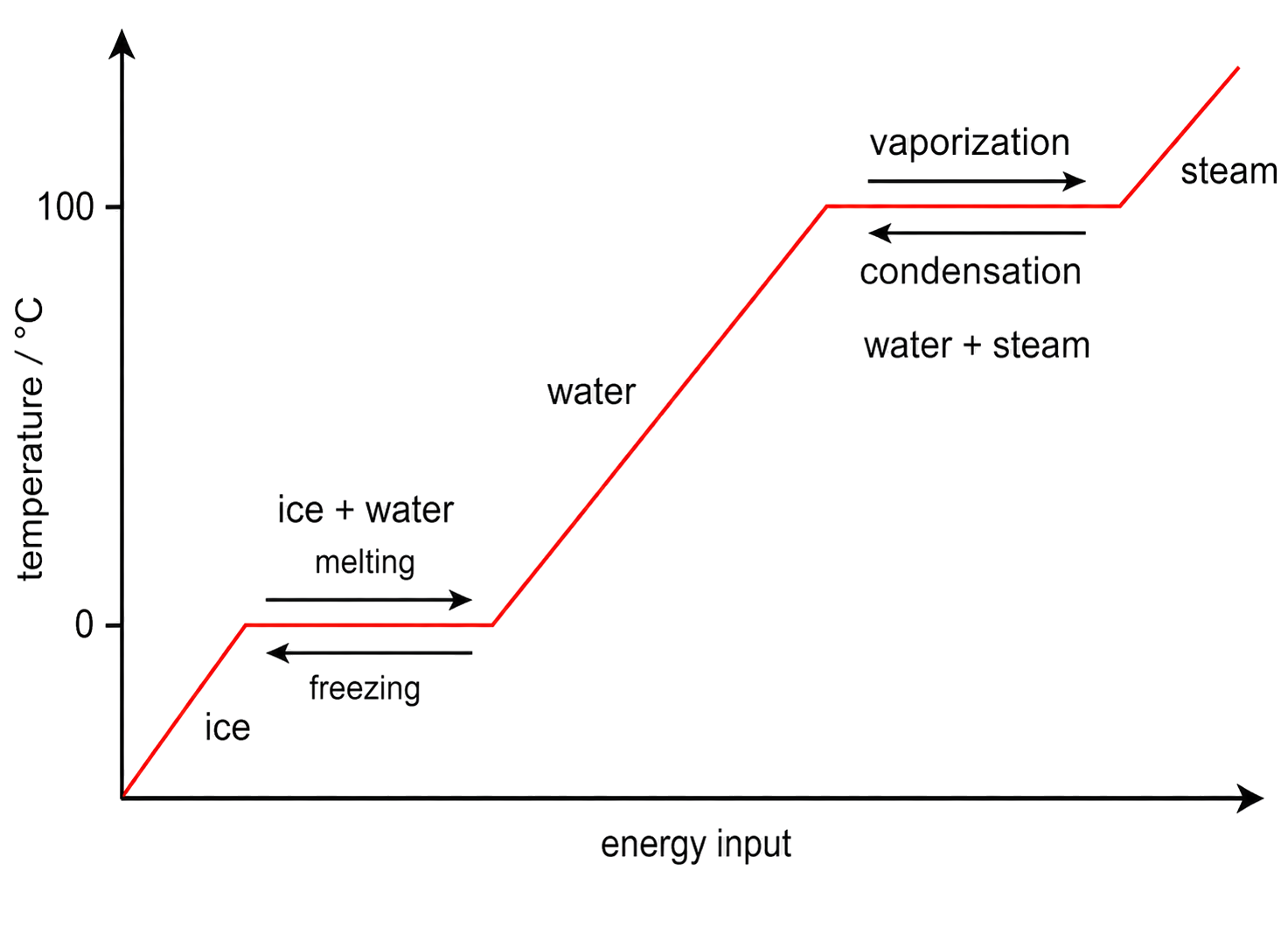
Heating increases particle motion until a transition begins. During the transition, supplied energy changes the extent of intermolecular attraction and particle arrangement; the chemical identity remains the same. Evaporation can occur at a liquid surface below the boiling point, whereas boiling occurs throughout a liquid when its vapour pressure matches the external pressure.
Do not say that particles themselves melt, expand, or become a different substance. In a physical state change, the same particles adopt different motion and arrangement. For molecular substances, the energy change is associated with intermolecular attractions; it does not generally break the covalent bonds inside each molecule.
Loading interaction assets…
Temperature on the Kelvin scale is proportional to the average translational kinetic energy of particles. At the same Kelvin temperature, samples of different gases have the same average kinetic energy, although lighter particles have a higher typical speed than heavier particles. Use absolute temperature, not degrees Celsius, when comparing kinetic energies or temperature ratios.
T/K=T/°C+273.15
Worked example — convert before interpreting
For 25.0∘C, substitute into the conversion: T=25.0+273.15=298.15K, reported as 298.2K to one decimal place. The Kelvin value is the absolute temperature used for kinetic-energy comparisons; a rise of 10K is the same temperature interval as a rise of 10∘C.
Read a heating curve by first deciding whether the substance is within one state or changing state. On a sloping section, supplied energy increases average kinetic energy, so temperature rises. On a horizontal phase-change section at constant pressure, energy is still absorbed, but it is used to overcome intermolecular attractions and change particle arrangement; temperature and average kinetic energy stay constant until that change is complete. Cooling reverses the energy flow.
A 20 K temperature interval has the same size as a 20 °C interval, but 20 °C is not an absolute temperature of 20 K. Do not infer that heavier gas particles have greater average kinetic energy at the same temperature, and do not interpret a heating-curve plateau as a period when no energy is transferred.
Questions test the Kelvin-scale relationship between temperature and average kinetic energy and require numerical conversion between Celsius and Kelvin.
Calculate
Use absolute temperature in Kelvin when reasoning about average kinetic energy, and add 273.15 to Celsius temperatures while following the accepted rounding range in the mark scheme.
Using Celsius rather than Kelvin for the kinetic-energy relationship, or treating a Celsius change as if the absolute temperature itself had been doubled.
Representative question
What happens to the average kinetic energy, KE , of the particles in a gas when the absolute temperature is doubled?
KE=21mv2
Increases by a factor of 2
Decreases by a factor of 2
Increases by a factor of 4
Decreases by a factor of 4
A
Retrieve the progression: classify matter as an element, compound, or mixture; use particle movement and spacing to explain states and state changes; then connect absolute temperature in kelvin with average kinetic energy.
When checking an answer, ask three questions: Is the composition fixed or separable physically? Which direction do the state symbols show? Am I using kelvin when the claim concerns average kinetic energy?
Topic 1.2
An atom has a dense, positively charged nucleus containing protons and neutrons. Negatively charged electrons occupy the space outside the nucleus. Protons and neutrons are nucleons.
| Quantity | Meaning | Rule |
|---|---|---|
| Atomic number, Z | Number of protons | p = Z |
| Mass number, A | Protons plus neutrons | n = A − Z |
| Ion charge | Proton charge compared with electron charge | charge = p − e |
For a neutral atom, electrons equal protons. For an ion, use the stated charge to determine the electron count.
Read Z first to obtain protons, subtract Z from A to obtain neutrons, then use the ion charge to check or calculate electrons.
Apply the symbols in a fixed order. For ³⁵₁₇Cl⁻, Z = 17 gives 17 protons, A − Z gives 18 neutrons, and the 1− charge means one more electron than protons, so there are 18 electrons. The ion charge changes electron count, never the element identity.
| Particle | Location | Relative charge | Approximate relative mass |
|---|---|---|---|
| Proton | nucleus | +1 | 1 |
| Neutron | nucleus | 0 | 1 |
| Electron | outside nucleus | −1 | about 1/1836 |
Most atomic mass is concentrated in the nucleus. Atomic number identifies the element through proton count; ion formation changes electron count, not proton count.
Questions ask learners to deduce proton, neutron, and electron counts from nuclear notation and ion charge, or construct a nuclear symbol from particle information.
deduce / determine
Use atomic number for protons, mass number minus atomic number for neutrons, and the charge relationship to determine electrons; include all requested particle counts or the complete nuclear symbol.
Using mass number as the neutron count, or treating a positive ion as having gained rather than lost electrons.
Representative question
Calculate the number of protons, neutrons and electrons in the 26Mg+ion.
Protons:
Neutrons:
Electrons:
Protons: 12
Neutrons: 14
Electrons: 11
Marking guidance:
Award [2] for three correct answers.
Award [1] for two correct answers.
Award [0] for one correct answer.
Isotopes are atoms of the same element with the same number of protons but different numbers of neutrons. They have the same electron arrangement and therefore the same chemical properties, while their different masses can give different physical properties.
Ar=∑(isotopemass×fractionalabundance)
Convert percentage abundances to fractions, multiply each isotope mass by its fractional abundance, then add the contributions. The result is a weighted mean, not an unweighted average.
For a two-isotope sample containing 75% mass 35 and 25% mass 37, the weighted mean is (35 × 0.75) + (37 × 0.25) = 35.5. An answer between the isotope masses is a useful check; simply averaging 35 and 37 would ignore abundance.
Read isotope identity from the pair of nuclear symbols: ³⁵₁₇Cl and ³⁷₁₇Cl are both chlorine because Z = 17 in each, but they contain 18 and 20 neutrons respectively because A differs. Mass number belongs to one nuclide; relative atomic mass is the abundance-weighted mean for a sample.
Questions ask learners to explain why isotopes share chemical properties but can differ in physical properties, or calculate relative atomic mass from isotope masses and abundances.
explain / calculate
State the same electron arrangement for the chemical-property explanation, name a valid physical-property difference other than mass when required, and show the abundance-weighted sum rather than substituting a data-booklet value.
Calling isotopes different elements, or replacing the abundance-weighted calculation with an unweighted mean or a memorized data-booklet value.
Representative question
Calculate the relative atomic mass of bromine from the sample, giving your answer to two decimal places.
79×50.75%+81×49.25%=79.9979×50.75%+81×49.25%
=79.99
Marking guidance:
Award [2] for correct final answer.
Do not accept 79.90, the value in the data booklet.
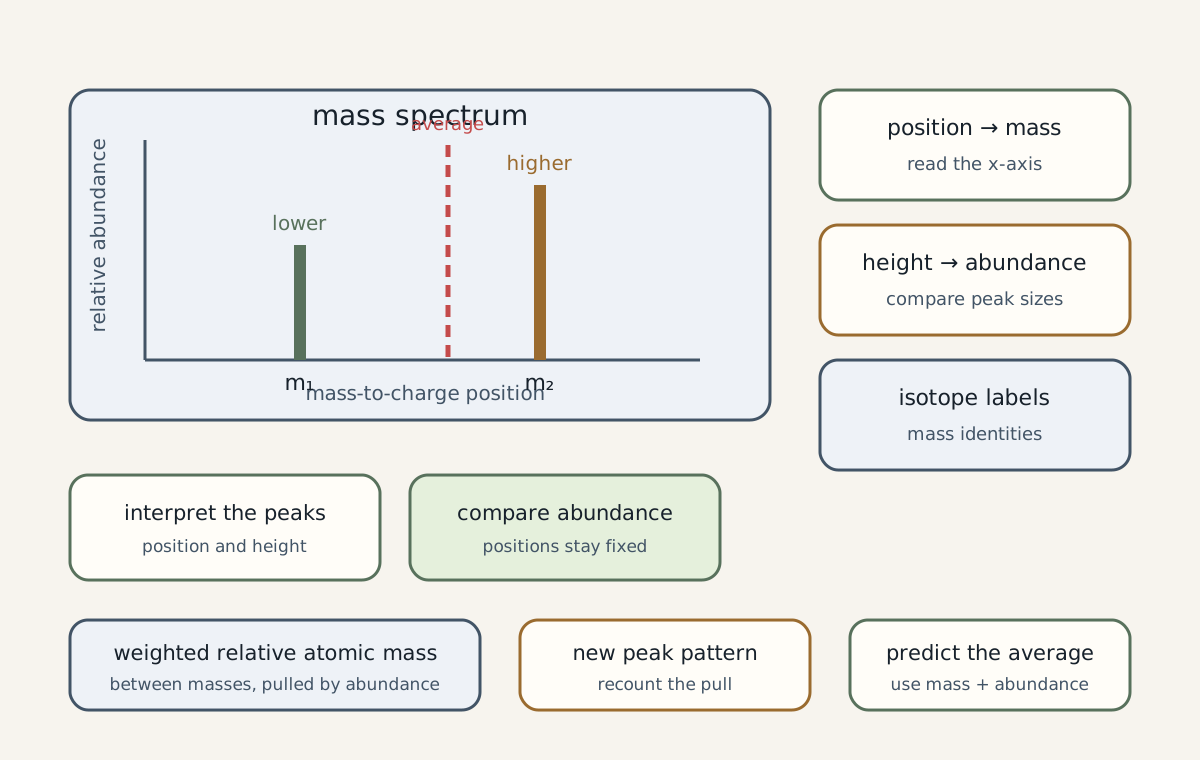
In a mass spectrum, peak position identifies an isotope's mass-to-charge value and relative peak height represents its abundance in the sample. Use those two pieces of evidence together to identify isotopes and determine relative atomic mass.
| Read | Infer | Use |
|---|---|---|
| Peak position | Isotope mass | Label the isotope |
| Relative peak height | Relative abundance | Weight that isotope's contribution |
| All peaks together | Isotopic composition | Calculate the weighted relative atomic mass |
The syllabus assesses interpretation of mass spectra, not operational details of how the spectrometer works.
Ar=(m1×f1)+(m2×f2)+…
If singly charged isotope peaks occur at m/z 35 and 37 in a 3:1 height ratio, use fractional abundances 0.75 and 0.25 to obtain Aᵣ = 35.5. First confirm the charge state: m/z is a ratio, so a multiply charged ion cannot be read as mass alone.
Retrieve the sequence: use nuclear notation to count particles, distinguish isotopes by neutron number, then read mass-spectrum positions and heights as isotope mass and abundance evidence.
When checking an answer, ask: Did I separate A, Z, and charge? Did I explain isotope properties through electron arrangement? Did I weight each isotope by its abundance?
Topic 1.3
An emission photon is released when an electron falls from a higher energy state to a lower energy state. Absorption moves an electron upward and requires photon energy.
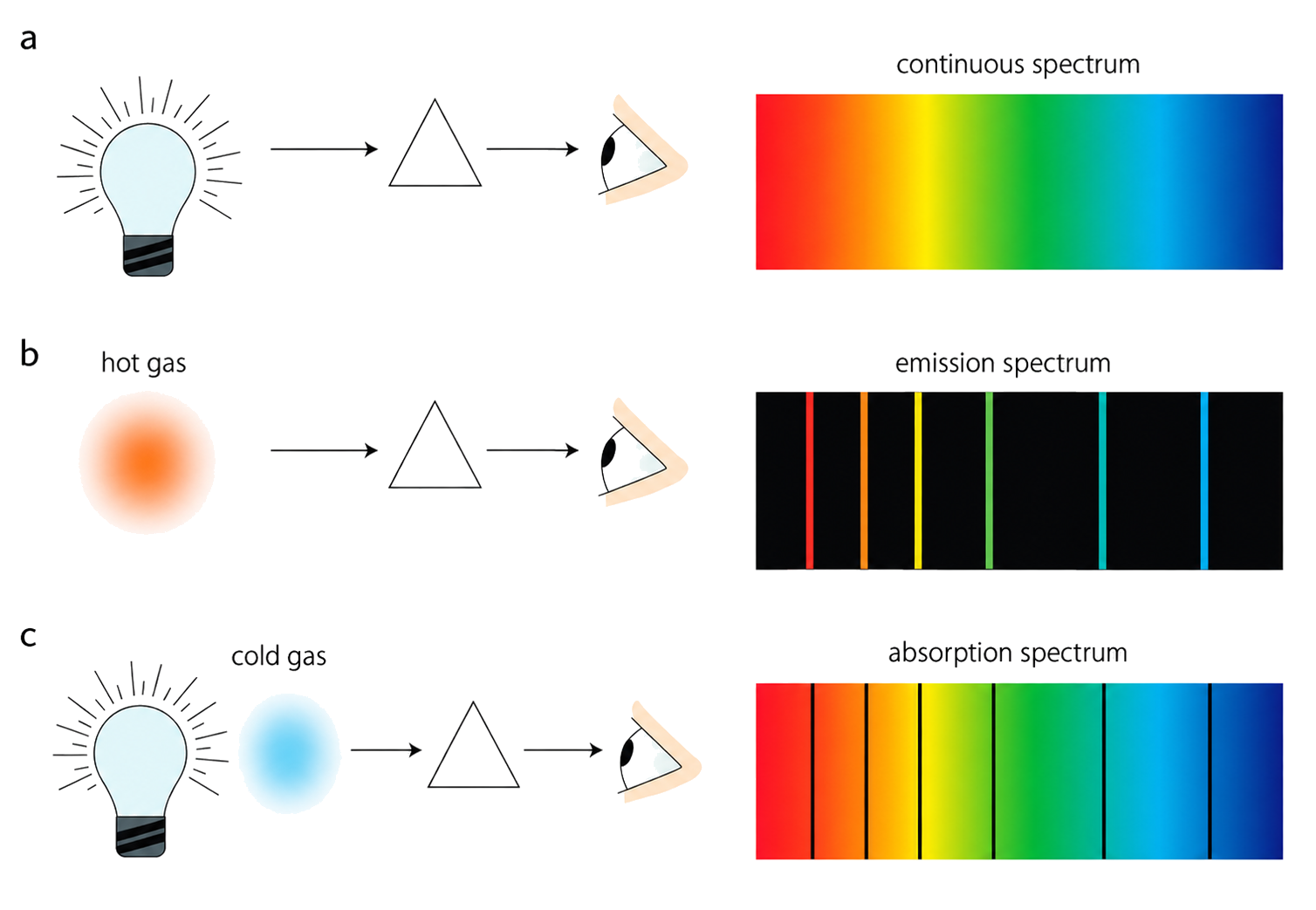
| Spectrum | What it contains | Why |
|---|---|---|
| Line spectrum | Specific wavelengths, frequencies, energies, or colours | Electrons occupy discrete energy levels, so only particular transitions occur |
| Continuous spectrum | A continuous range across the relevant values | The radiation spans the range rather than appearing as separated lines |
Across electromagnetic radiation, shorter wavelength means higher frequency, and higher frequency means higher photon energy. Explain the electron direction and photon exchange when distinguishing absorption from emission.
Read every spectral transition in two directions: absorption raises an electron by ΔE, while a downward transition emits a photon with ΔE = hf = hc/λ. A shorter-wavelength line therefore represents a larger energy gap, not a higher line intensity.
Orient the spectrum before comparing lines: radio → microwave → infrared → visible → ultraviolet → X-ray → gamma is increasing frequency and photon energy, and decreasing wavelength. Within visible light, red has longer wavelength and lower photon energy than violet.
Structured questions ask learners to distinguish absorption from emission by the direction of electron movement and photon transfer, and to distinguish continuous spectra from line spectra by their wavelength or frequency coverage.
distinguish
State the direction of the electron transition and whether a photon is absorbed or emitted, then classify a continuous spectrum as spanning the range and a line spectrum as containing only specific wavelengths, frequencies, energies, or colours.
Reversing absorption and emission, or describing a line spectrum as continuous rather than as discrete allowed wavelengths or frequencies.
Representative question
Distinguish between the processes within the atom that give rise to absorption and emission spectra.
Absorption spectra:
Emission spectra:
Absorption spectra: electrons absorb a photon/light/wavelength/frequency/energy/radiation and move to higher energy level(s);
Marking guidance:
Accept "excited state(s)" for "higher energy level(s)".
Emission spectra:
(excited) electrons move down to lower energy level(s) and release a photon/light/wavelength/frequency/energy/radiation;
Accept "state" for "level" throughout.
Award [1 max] if the movement between energy levels is described correctly but the involvement of a photon/light/wavelength/frequency/energy/radiation is omitted. Accept suitable diagrams.
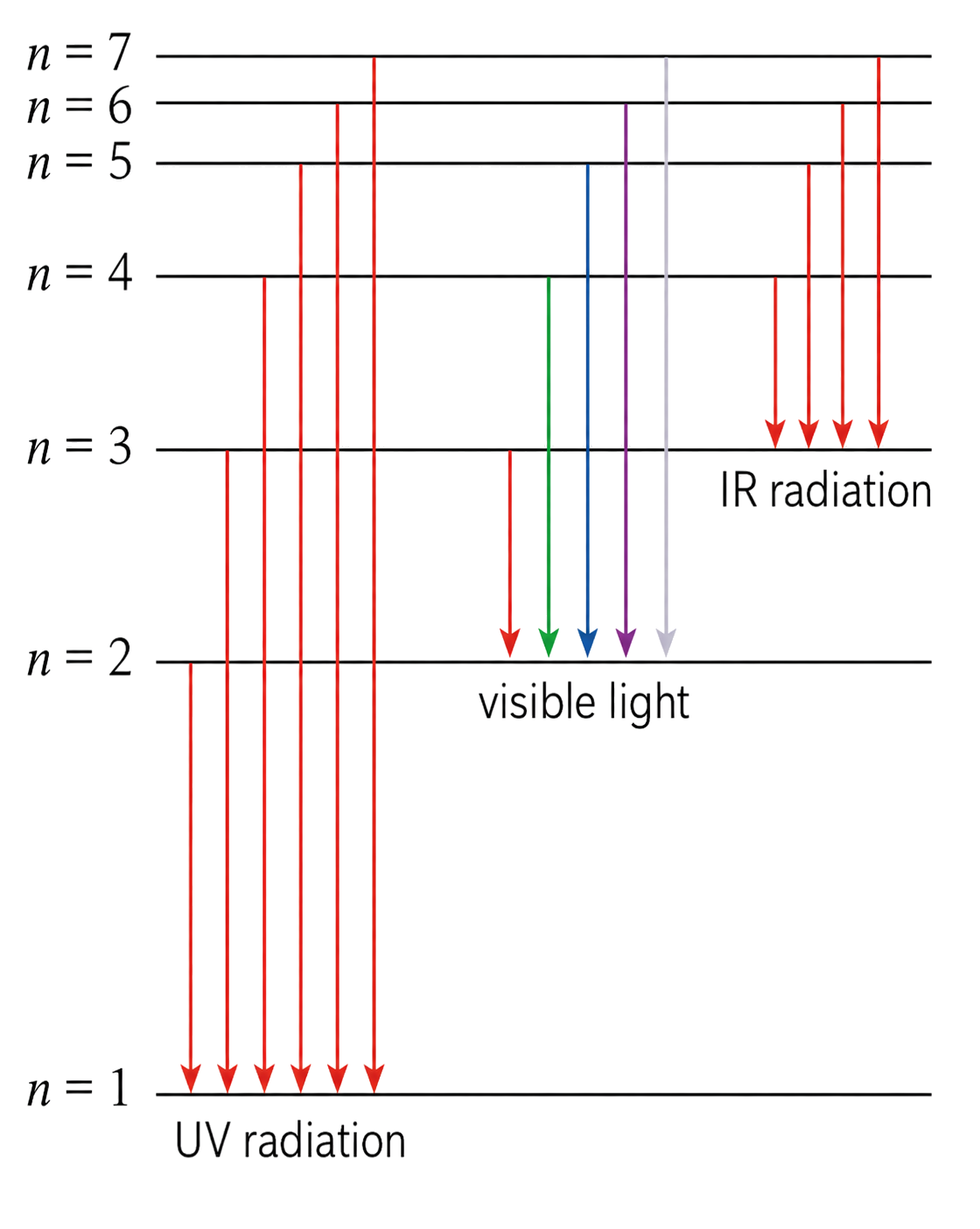
Hydrogen's emission spectrum contains discrete lines because electrons occupy discrete energy levels. Each line corresponds to a downward transition and the emitted photon's energy equals the energy difference between the levels.
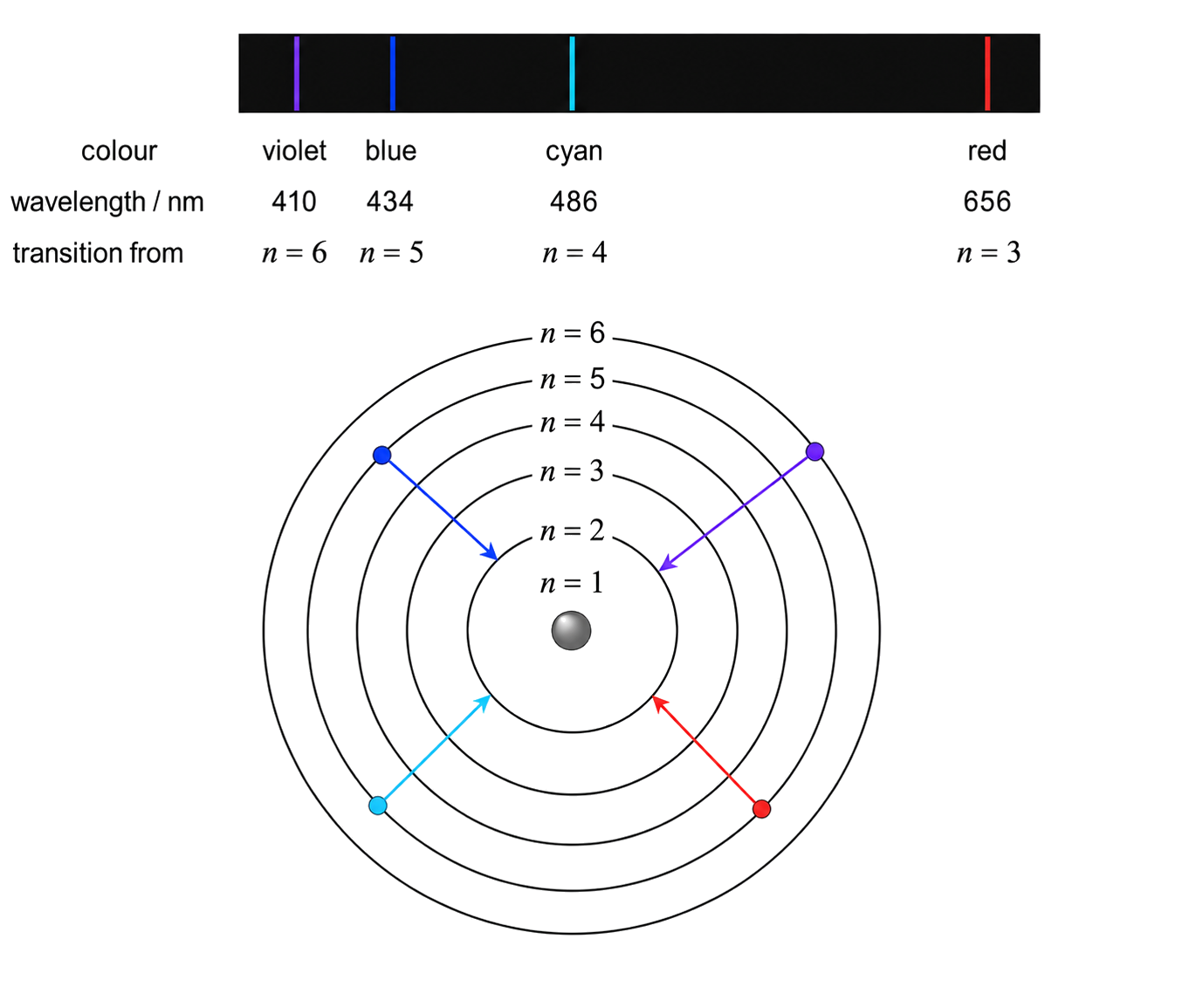
| Transition ending at | Region identified in the study guide |
|---|---|
| n = 1 | ultraviolet |
| n = 2 | visible |
| n = 3 | infrared |
At higher energy, the levels become closer together, so the lines converge. The names of the series are not required.
Use the presence of separate lines as evidence for discrete levels, and use convergence at higher energy or frequency as evidence that the level spacing becomes smaller.
Compare lines by their energy gaps. Transitions ending at n = 2 form the visible series, and lines crowd together as the starting level rises because adjacent high-n levels are closer in energy. The convergence limit represents removal of the electron, not one more bound-state transition.
Structured questions ask learners to describe hydrogen's discrete line spectrum and explain how each line corresponds to an electron energy difference and how the lines converge at higher energy.
describe / explain
Identify discrete lines or specific wavelengths/frequencies, connect each line to a downward transition and its energy difference, and state that energy levels become closer together at higher energy, producing convergence.
Calling the hydrogen spectrum continuous, reversing the downward emission transition, or placing convergence at lower rather than higher energy or frequency.
Representative question
Explain how this spectrum is related to the electron energy levels in a hydrogen atom.
each transition/line is related to energy difference /ΔE=λhf/hv/hc;
energy levels in hydrogen atom are closer/converge at higher energy;
A main energy level, or shell, is identified by the principal quantum number n = 1, 2, 3, and so on.
maximumelectrons=2n2
| n | Maximum electrons |
|---|---|
| 1 | 2 |
| 2 | 8 |
| 3 | 18 |
| 4 | 32 |
Substitute the stated n value into 2n²; do not confuse the shell number with the capacity.
For n = 3, the theoretical capacity is 2(3²) = 18 electrons. This is a capacity, not a claim that every third shell is full: the actual occupancy depends on the atom and the relative energies of available sublevels.
Short multiple-choice questions ask learners to calculate the maximum electron capacity for a stated main energy level using the 2n² rule.
state
Substitute the stated integer n into 2n² and select or state the resulting maximum electron count.
Using n² instead of 2n², or confusing a main energy level's total capacity with the capacity of one subshell or orbital.
Representative question
What is the maximum number of electrons that can occupy the n=3 main energy level?
3
8
18
28
C
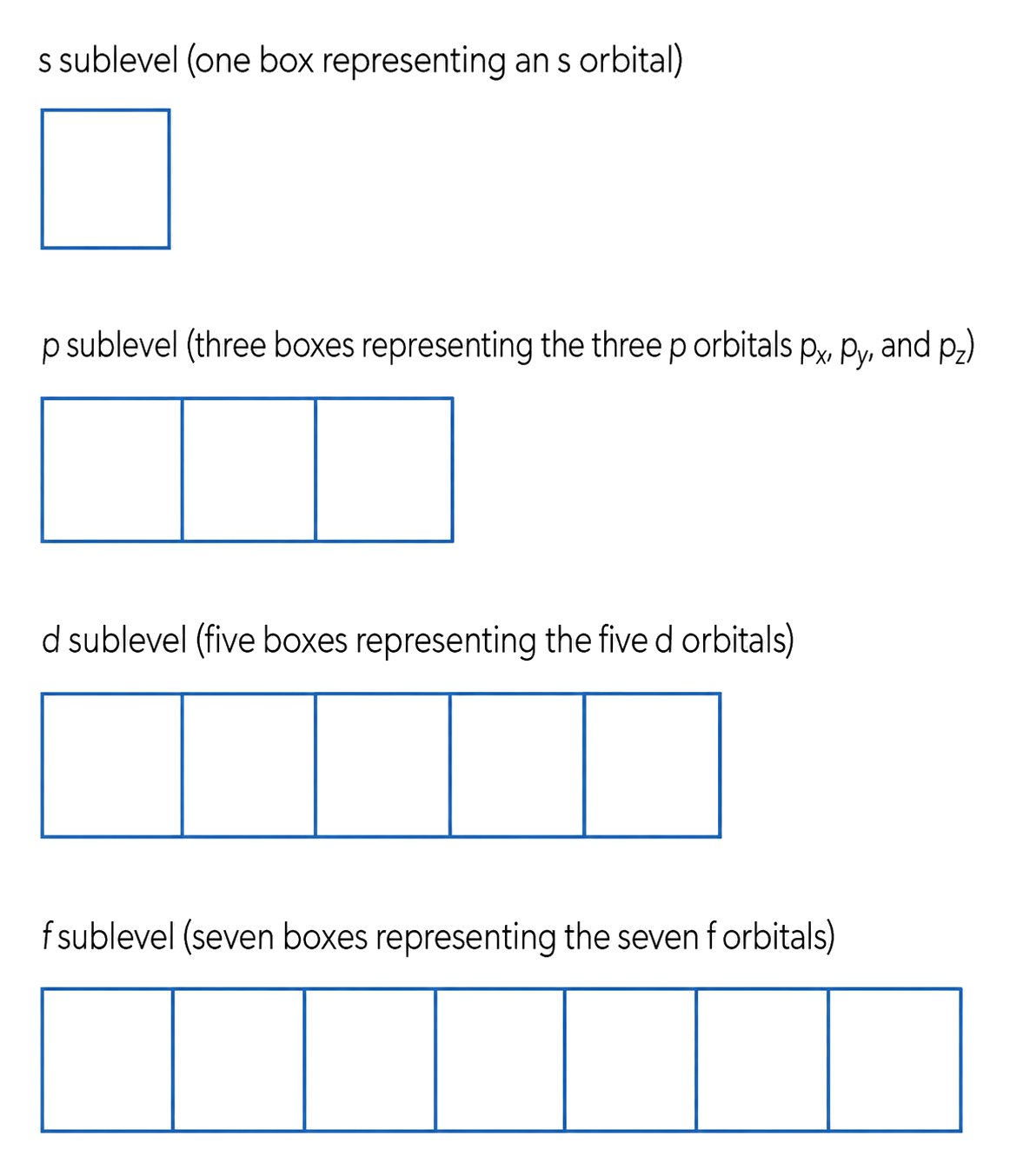
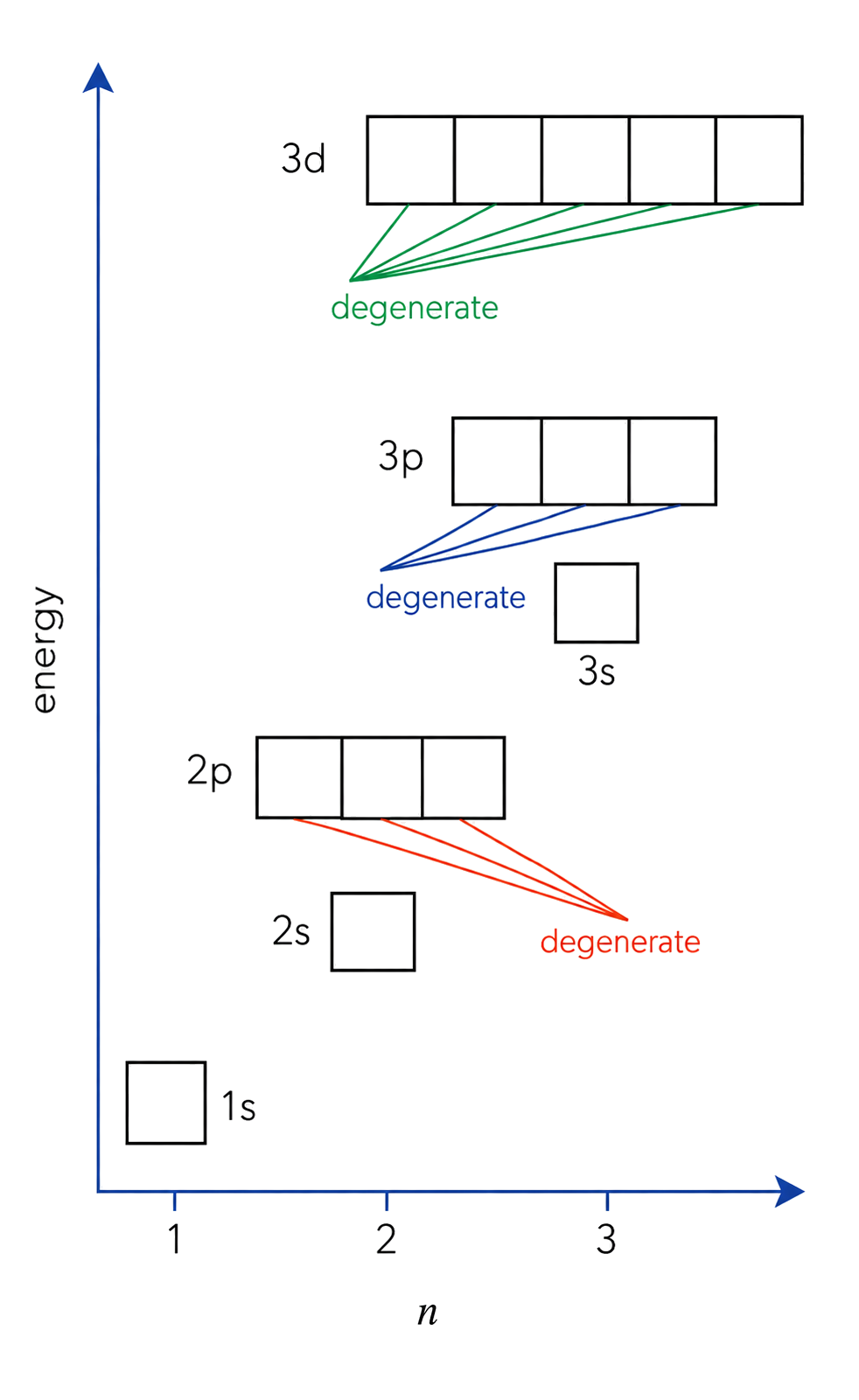
A main energy level contains only the sublevels allowed by its principal quantum number: n = 1 has s; n = 2 has s and p; n = 3 has s, p and d; and n = 4 can include s, p, d and f. Within one main level the sublevels rise in energy s < p < d < f, while the filling order across different levels can interleave, as the next card makes explicit. Each sublevel contains a fixed number of orbitals.
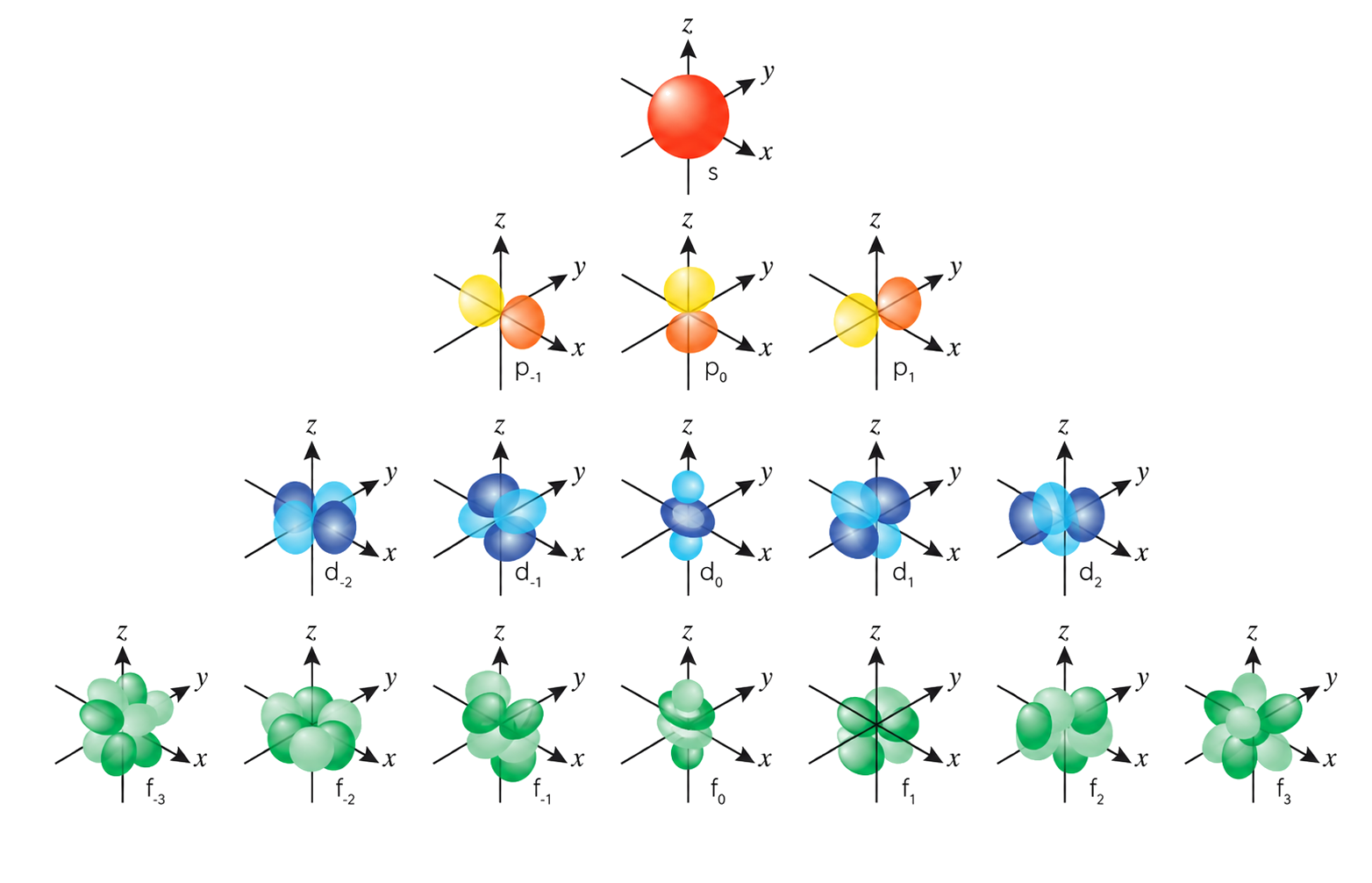
| Sublevel | Number of orbitals | Maximum electrons | Assessed shape evidence | Periodic-table block |
|---|---|---|---|---|
| s | 1 | 2 | spherical | s block |
| p | 3 | 6 | three dumbbell orbitals with different orientations | p block |
| d | 5 | 10 | shape detail not required here | d block |
| f | 7 | 14 | shape detail not required here | f block |
The block is identified by the subshell being filled; sublevel capacity is not the same as actual occupancy.
For recognition questions, keep the hierarchy clear: main energy level → sublevel → orbital. The s and p shapes are the explicitly required shape evidence here.
Use the hierarchy as a classification test: a p sublevel contains three orbitals, and each orbital can hold two electrons. An orbital describes a probability region with a characteristic shape; it is not a circular route travelled by an electron.
Questions ask students to recognize or sketch the characteristic s-orbital sphere and p-orbital dumbbell, with labels where required.
sketch
Match each orbital label to its shape and show the p-orbital lobes with the correct orientation; keep the orbital-shape model distinct from the number of orbitals in a sublevel and from the periodic-table block label.
Drawing an s orbital as a dumbbell or a p orbital as a sphere
Representative question
Sketch the shapes of two different orbital types in the second energy level and label each orbital.
s-orbital
p-orbital
correct shape AND label for each. .
The p orbital must be aligned with an axis and the node must be at or close to the origin.
Accept p-orbital aligned to any of the three axes.
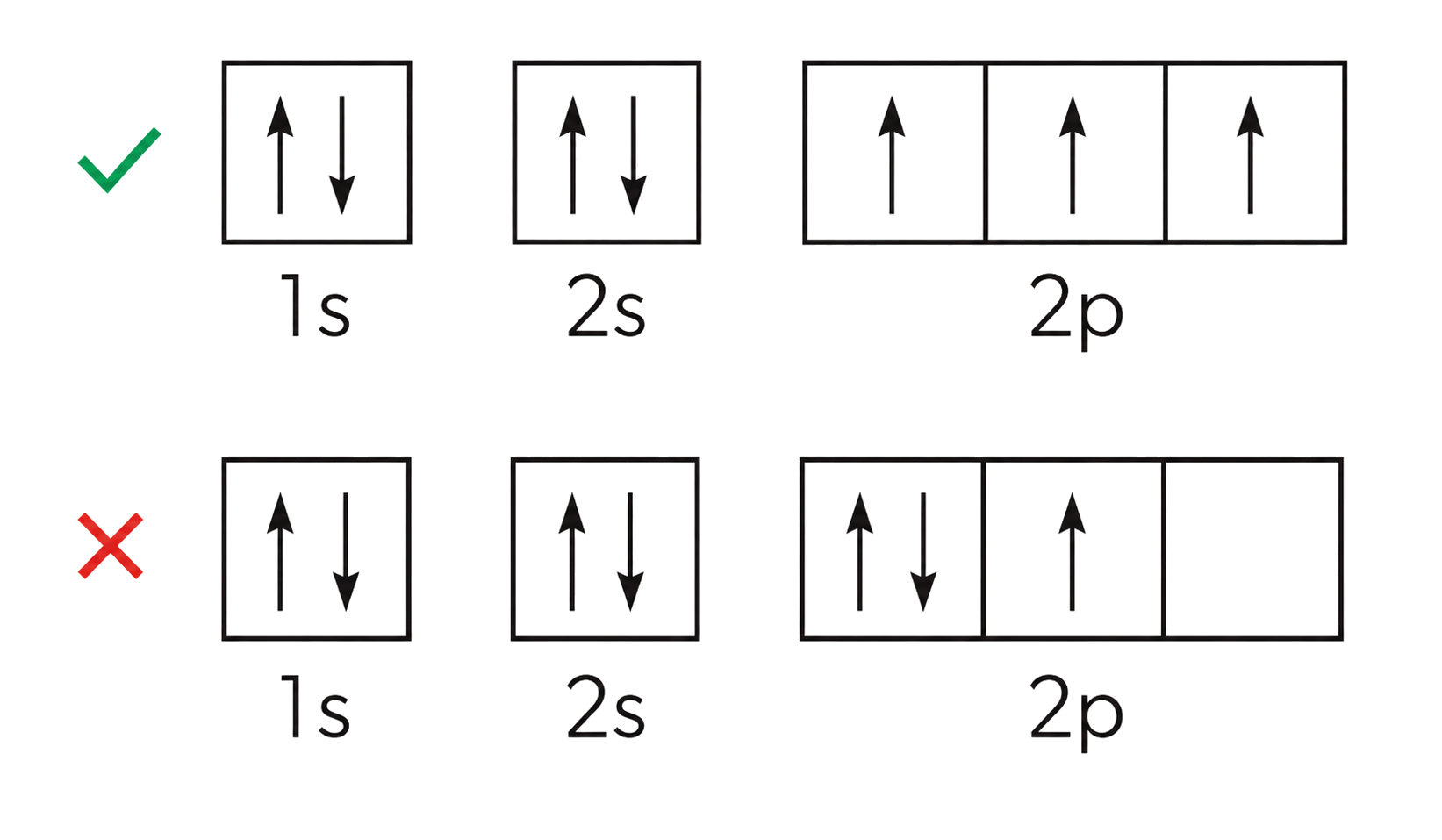
Aufbau fills lower-energy orbitals first. Pauli limits an orbital to two electrons with opposite spins. Hund's rule places electrons singly in degenerate orbitals before pairing.
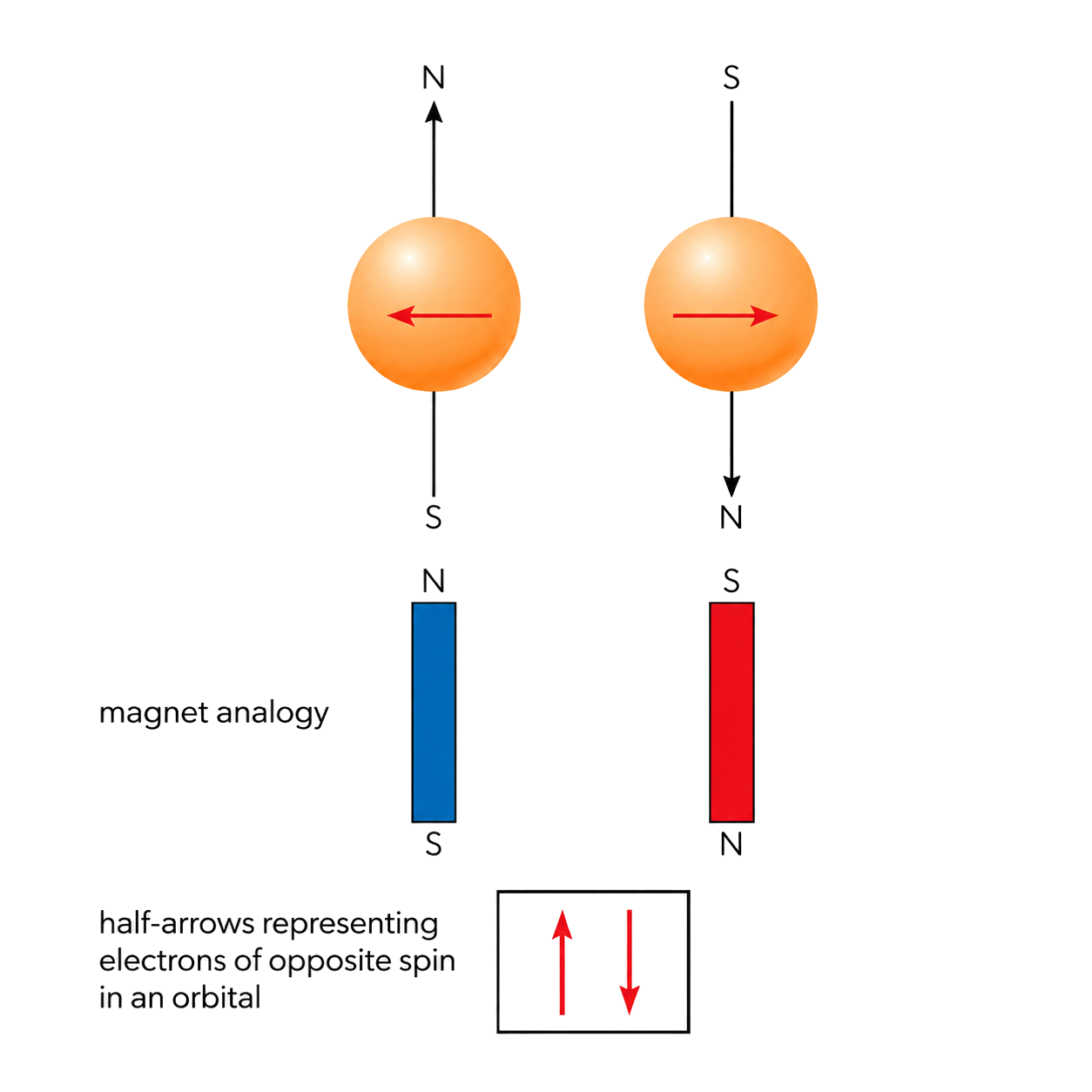
| Representation | Use |
|---|---|
| Full configuration | Show the complete filling sequence |
| Condensed configuration | Replace the inner electrons with a noble-gas core |
| Orbital-box diagram | Show orbital occupancy and opposite-spin pairing |
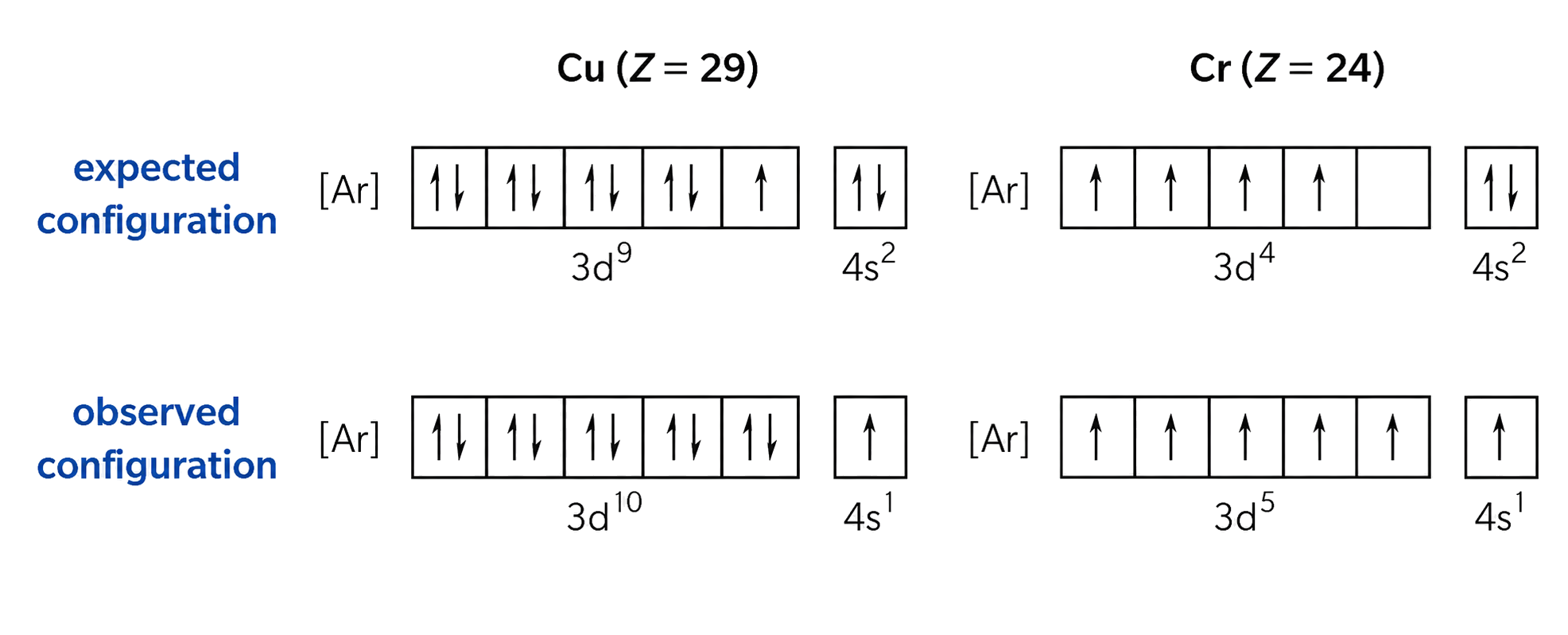
For ions, remove 4s electrons before 3d electrons. The exceptions in scope are Cr: [Ar] 4s1 3d5 and Cu: [Ar] 4s1 3d10.
Check total electrons, obey the filling order, apply Hund and Pauli in each sublevel, and treat the Cr/Cu exceptions explicitly rather than forcing the naive pattern.
Build an orbital diagram by checking electron total, energy order, single occupation of equal-energy orbitals, then opposite-spin pairing. For transition-metal ions remove 4s electrons before 3d, and verify Cr and Cu against the stated exceptions rather than forcing the simple filling pattern.
Worked ion check: Fe has 26 electrons and condensed configuration [Ar] 4s² 3d⁶. To form Fe³⁺, remove the two electrons from the highest principal level, 4s, before removing one 3d electron, giving [Ar] 3d⁵. The final superscripts total 23 electrons, matching 26 − 3.
Questions ask students to draw and label a ground-state orbital diagram or select/configure an atom using the filling rules and the Cr/Cu exceptions.
draw
Fill orbitals in the stated energy order, place one electron in each degenerate orbital before pairing, pair only opposite spins, remove 4s electrons before 3d for transition-metal ions, and use the accepted Cr/Cu exception configurations.
Pairing electrons in a p or d sublevel before singly occupying equivalent orbitals
Representative question
Draw the orbital diagram of the phosphorus atom in the ground state by adding, filling and labelling the orbitals. Use section 7 of the data booklet.
2s
1s
3p
□
1
3rd shell orbitals must be higher than
2nd shell for M2.
3s
□
2 p
2s □ 1
correct labels
correct electron configuration
First ionization energy is the energy required to remove one mole of electrons from one mole of gaseous atoms. The convergence limit in an emission spectrum corresponds to ionization.
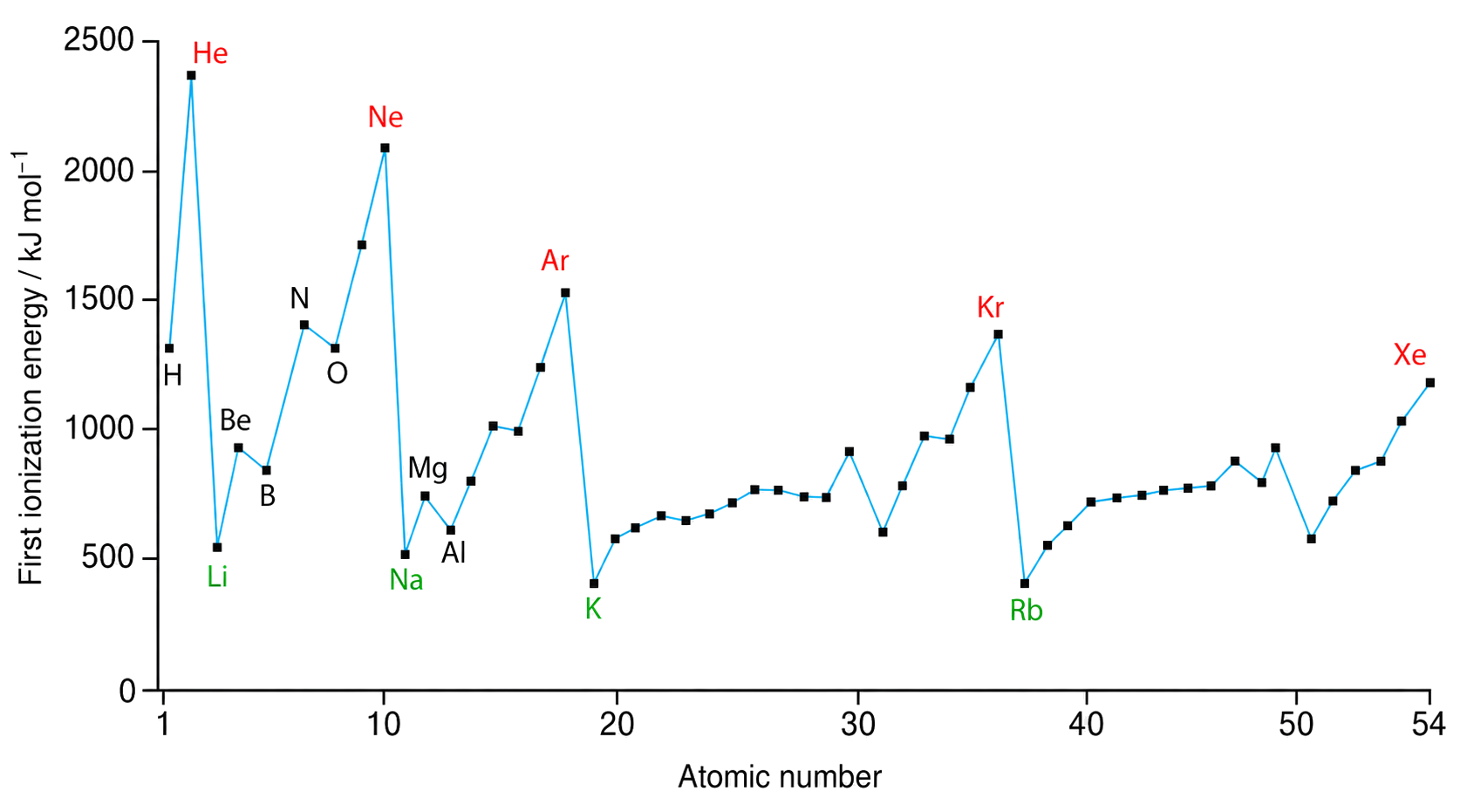
| Trend | Explanation |
|---|---|
| Across a period | Generally increases as effective nuclear charge increases |
| Down a group | Generally decreases because the outer electron occupies a higher shell |
| Be → B dip | The electron removed from B is in a higher-energy p subshell |
| N → O dip | Pairing in a p orbital makes one electron easier to remove |
E=hfandc=λf
Worked example — hydrogen convergence limit
The local course book gives λ=9.12×10⁻⁸m. First, f=c/λ=(3.00×108ms−1)/(9.12×10−8m)=3.29×1015s−1. Then Ephoton=hf=(6.63×10⁻³⁴Js)(3.29×10¹⁵s−1)=2.18×10⁻¹⁸J. Convert one-photon energy to one mole and joules to kilojoules: IE=(2.18×10⁻¹⁸)(6.02×10²³)/1000=1.31×103kJmol−1. This is the molar energy for the first ionization process H(g)→H+(g)+e−.
At the convergence limit, convert wavelength or frequency to energy per photon with E = hf, then multiply by the Avogadro constant and convert J mol⁻¹ to kJ mol⁻¹. Across-period trends are general patterns; subshell energy and electron pairing explain the named dips.
X(g)→X+(g)+e−firstionizationenergyinkJmol−1
Questions combine spectral calculations using the convergence limit with explanations of periodic first-IE trends and their sublevel-related discontinuities.
determine / explain
Convert molar ionization energy to energy per atom before using E=hf or E=hc/λ, and for trend explanations link nuclear charge, shielding, shell/sublevel energy and electron repulsion to the ease of removing the specified electron.
Using molar energy directly in E=hf without dividing by Avogadro's constant
Representative question
Determine the frequency of electromagnetic radiation, in s−1, equivalent to the first ionization energy of phosphorus. Use sections 1, 2 and 9 of the data booklet.
« 1.012×10⁶ J mol−1/6.02×1023= » 1.68×10⁻¹⁸ «J»
≪1.68×10⁻¹⁸ J/6.63×10−34 J s−1=>2.54×10¹⁵μS−1 »
Marking guidance:
Award [2] for the correct final
answer.
Successive ionization energies rise as electrons are removed. A very large increase occurs when removal crosses from the outer shell into a lower, more tightly held shell.
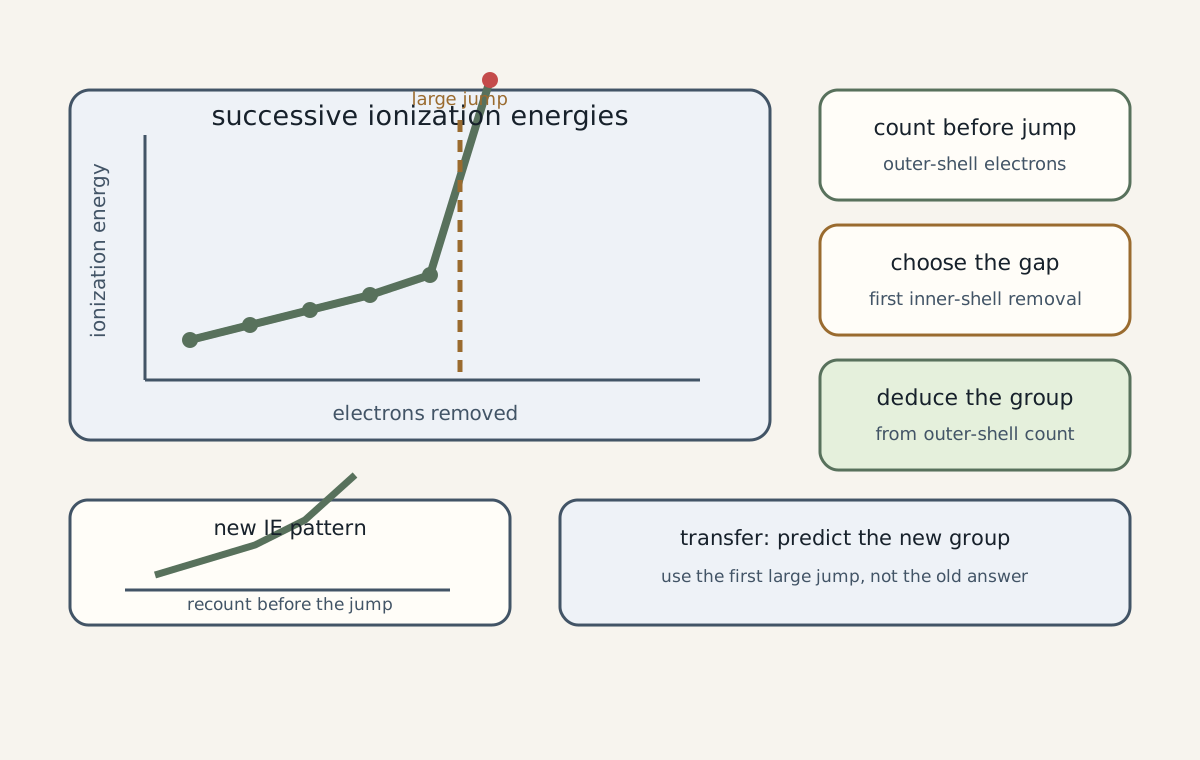
| Observation | Deduction |
|---|---|
| Small increases before the large jump | Electrons are being removed from the same outer shell |
| Large jump | The next electron is from an inner shell |
| Number removed before the jump | Outer-electron count and group pattern |
Use the position of the first large jump, not its numerical size alone, to infer the group.
A jump after three outer-electron removals is the pattern used in the study guide for a group 13 element. The same count-before-the-jump method applies to new data.
Locate the first order-of-magnitude jump before naming the group. A large jump after the second electron is removed shows two outer-shell electrons; the third electron would come from a lower shell, supporting a group 2 assignment.
Retrieve the chain: emission lines reveal discrete levels; capacities, sublevels, orbitals, and spin rules build configurations; first and successive ionization energies then reveal how electrons are held and arranged.
When checking an answer, ask: Did I link a line to a transition? Did I use 2n² and the filling rules? Did I explain an ionization trend or count electrons before a successive-IE jump?
Topic 1.4
The mole is the SI unit for amount of substance. One mole contains the Avogadro constant number of specified entities, such as atoms, molecules, ions, or electrons.
N=nNawhereNa=6.022×10²³mol−1
Identify which entity the question asks for, then multiply the amount in moles by Avogadro's constant and by the number of those entities in each formula unit or molecule when needed.
Specify the entity before calculating. One mole of H₂O contains one mole of molecules, two moles of H atoms and one mole of O atoms; multiplying by Nₐ without the formula-unit multiplier answers a different particle question.
Questions ask for the number of specified atoms or ions in a stated amount of a molecular or ionic substance.
determine
Multiply moles by the Avogadro constant and count the requested entity per molecule or formula unit before selecting or reporting the answer.
Counting formula units instead of the requested atoms or ions, or omitting the entity multiplicity in the formula.
Representative question
How many ions are present in 0.20 mol of (NH4)2SO4 ?
0.20×1×6×1023
0.20×2×6×1023
0.20×3×6×1023
0.20×7×6×1023
C
Relative atomic mass is a weighted mean relative to one twelfth of the mass of a carbon-12 atom. Relative formula mass is the sum of the relative atomic masses represented in the formula.
Mr=Σ(Ar×subscript)
Relative atomic mass and relative formula mass are ratios on the carbon-12 scale, so they have no units. Apply every subscript, including waters of crystallization or repeated ions.
For Ca(OH)₂, include both bracketed groups: Mᵣ = Aᵣ(Ca) + 2[Aᵣ(O) + Aᵣ(H)]. Keep Mᵣ dimensionless; attach g mol⁻¹ only when the same numerical total is used as a molar mass.
Questions ask for the precise carbon-12-relative definition of relative atomic mass or for a formula mass obtained by summing relative atomic masses.
define / determine
Refer to the weighted mean mass of an atom relative to the carbon-12 reference, and include every formula subscript in the mass sum without attaching units to the relative value.
Using the mass of an element instead of an atom in the definition, or omitting subscripts when summing a hydrated formula.
Representative question
Define the term relative atomic mass (Ar).
ratio of average/mean mass of an atom to the mass of C-12 isotope / average/mean mass of an atom on a scale where one atom of C-12 has a mass of 12 / sum of the weighted average/mean mass of isotopes of an element compared to C-12 / OWTTE;
Award no mark if "element" is used instead of "atom".
Molar mass is the mass of one mole of a substance, measured in g mol⁻¹. It connects mass, amount, and particle number in a conversion chain.
n=m/Mandm=nM
To reach particles from mass, divide mass by molar mass to obtain moles, then use the Avogadro conversion and count the requested entities if the formula contains more than one.
Use units to choose the direction: 9.0 g of H₂O divided by 18.0 g mol⁻¹ gives 0.50 mol. To find molecules, continue from moles to nNₐ; do not multiply mass directly by the Avogadro constant.
Questions determine molar mass from mass and amount or determine the number of specified atoms from a sample mass.
determine
Use n=m/M or m=nM with g mol⁻¹, then multiply by the Avogadro constant and the number of requested atoms per molecule when required.
Using mass divided by moles in the wrong direction, or stopping at moles when the question asks for atoms.
Representative question
Calculate the number of hydrogen atoms in 1.00 g of propan-2-ol.
《 (12.01×3+1.01×8+16.00)gmol−11.00 g= 》 0.0166 «mol CH3CH(OH)CH3 » « 0.0166 mol×6.02×1023 molecules mol−1×8 atoms molecule −1= » 8.01×10²² «atoms of hydrogen»
Marking guidance:
Accept answers in the range 7.99×10²² to 8.19×10²².
Award [2] for correct final answer.
An empirical formula gives the simplest whole-number ratio of atoms. A molecular formula gives the actual number of each atom in a molecule.
| Step | Operation |
|---|---|
| 1 | Convert each composition value to moles |
| 2 | Divide all mole values by the smallest |
| 3 | Multiply to reach the simplest whole-number ratio |
| 4 | Write the empirical formula |
| 5 | Divide molecular molar mass by empirical-formula mass and multiply every subscript by that integer |
Keep the empirical ratio simplest, and make sure the molecular-formula multiplier is a whole number consistent with the given molar mass.
A composition of 40.0% C, 6.7% H and 53.3% O gives the simplest ratio CH₂O after division by atomic masses. If the molar mass is 180 g mol⁻¹, compare it with the empirical-formula mass 30 to obtain the multiplier 6 and molecular formula C₆H₁₂O₆.
Do not round a ratio such as 1 : 1.50 : 1 to 1 : 2 : 1. Preserve the calculated values and multiply every ratio by the same small integer: ×2 converts halves, while ×3 can resolve values close to thirds such as 1.33 or 1.67. Round only after the common multiplier produces values consistent with the data precision.
Questions derive an empirical formula from composition or scale an empirical formula to the molecular formula using molar mass.
determine
Show conversion to moles, the simplest whole-number ratio, and the final formula; for molecular formula, use the integer molar-mass multiplier on every subscript.
Rounding mole ratios before reaching whole numbers, or multiplying only one subscript when converting to the molecular formula.
Representative question
4.32 g of the compound was combusted completely in oxygen and produced 9.49 g of CO2 and 5.18 g of H2O.
Determine the empirical formula of the compound, using sections 1 and 7 of the data booklet.
(a)
n(C)≪=n(CO2)=44.01 g mol−19.49 g>=0.216<mol>
AND
n(H) «2n(H2O)=2×18.02 g mol−15.18 g»=0.575<mol≫
OR
H=0.581 《g》
AND
C=2.59 «g»v 《 m(O)=4.32−(m(C)+m(H))=4.32−(2.59+0.581)=1.15 g∥n(O)=16.00 g mol−11.15 g
/ 0.0718 «mol»
<n(C):n(H):n(O)=0.216:0.575:0.0718=3:8:1>C3H8O
M2 for finding mass of oxygen
M3 for finding empirical formula Award[3]for correct final answer.
Molar concentration is the amount of solute in moles per cubic decimetre of solution. Square brackets can denote molar concentration.
n=VCthereforeC=n/V
Use V in dm³ when calculating C in mol dm⁻³. Rearrange the same relationship to find amount or volume, and keep the solution volume distinct from the solute mass.
Convert volume before substitution: 500 cm³ = 0.500 dm³, so 0.250 mol in that solution gives C = 0.500 mol dm⁻³. The denominator is the final solution volume, not the volume or mass of solute alone.
Fordilutionwithnosolutelossorreaction:nbefore=nafter,soc1V1=c2V2
Adding solvent increases the final solution volume while the amount of solute stays constant, so concentration decreases. Use the final solution volume—not the solvent volume added—and do not apply c₁V₁ = c₂V₂ when solute reacts or is removed.
Questions calculate concentration from solute amount and solution volume, including a titration context.
calculate
Obtain moles when needed, divide by the stated equivalence or solution volume in dm³, and report mol dm⁻³ with the correct significant figures.
Using cm³ without conversion to dm³, or dividing by solute mass instead of solution volume.
Representative question
Calculate the molar concentration of the resulting solution of lithium hydroxide.
n(Li)=6.94 g mol−10.200 g=0.0288 moln(LiOH)=n(Li)=0.0288 mol[LiOH]=0.5000 dm30.0288 mol=0.0576 mol dm−3
Award [2] for the correct final answer.
At the same temperature and pressure, equal volumes of gases contain equal numbers of molecules. Under the same conditions, gas-volume ratios follow mole ratios.
Vgas=nVm
Balance the equation, identify the limiting gas amount when needed, apply the coefficient ratio to gas volumes at the same temperature and pressure, then convert to the requested volume units.
For N₂ + 3H₂ → 2NH₃ at one temperature and pressure, one gas volume of N₂ requires three equal gas volumes of H₂ and forms two of NH₃. This direct volume ratio works because the gases share conditions; otherwise convert through moles.
Questions apply balanced-equation mole ratios to gas volumes at fixed conditions or convert a reaction amount to gas volume at STP.
determine / calculate
Identify the limiting reactant where relevant, preserve the balanced-equation ratio, and use the stated molar volume or gas equation with consistent units.
Using a mass ratio instead of the balanced gas-volume ratio, or ignoring the limiting gas before calculating product volume.
Representative question
140.0 cm3 of ethyne are reacted with 160.0 cm3 of hydrogen in a container at 420 K and 1.00×10⁵ Pa. Ethane is the only product.
Determine the maximum possible volume of ethane formed under these conditions of temperature and pressure.
hydrogen is the limiting reactant OR2H2:1C2H6∨80.0 cm3 V
Marking guidance:
Award [2] for correct final answer.
Accept answers expressed in dm3.
Retrieve the quantitative chain: count entities with mN_A, sum relative masses from formulae, convert mass with n=m/M, derive formula ratios, use n=VC for solutions, and apply gas-volume ratios at the same temperature and pressure.
Before finalising, check the requested entity, formula subscripts, units, dm³ conversion, balanced-equation coefficients, and any limiting reactant.
Topic 1.5
| Assumption | Ideal-gas statement |
|---|---|
| Particle motion | Particles move continuously |
| Particle volume | Particle volume is negligible compared with the gas volume |
| Intermolecular forces | Forces between particles are negligible |
| Collisions | Collisions are elastic |
An ideal gas is a simplified particle model. Use its assumptions as a checklist before deciding whether PV=nRT is a suitable description of a real sample.
Use the assumptions to make predictions: compressing a gas until particle volume is no longer negligible weakens the model, while raising temperature usually reduces the relative importance of attractions. Ideal particles still move and collide; only the collisions are treated as elastic.
Gas pressure arises from particle collisions with the container walls and the associated momentum transfer. At a higher Kelvin temperature, the greater average kinetic energy established in Structure 1.1.3 changes the collision behaviour; this does not replace the separate assumptions that particle volume and intermolecular attractions are negligible.
Real gases deviate most from ideal behaviour at low temperature and high pressure. Low temperature reduces particle kinetic energy, while high pressure brings particles close together.
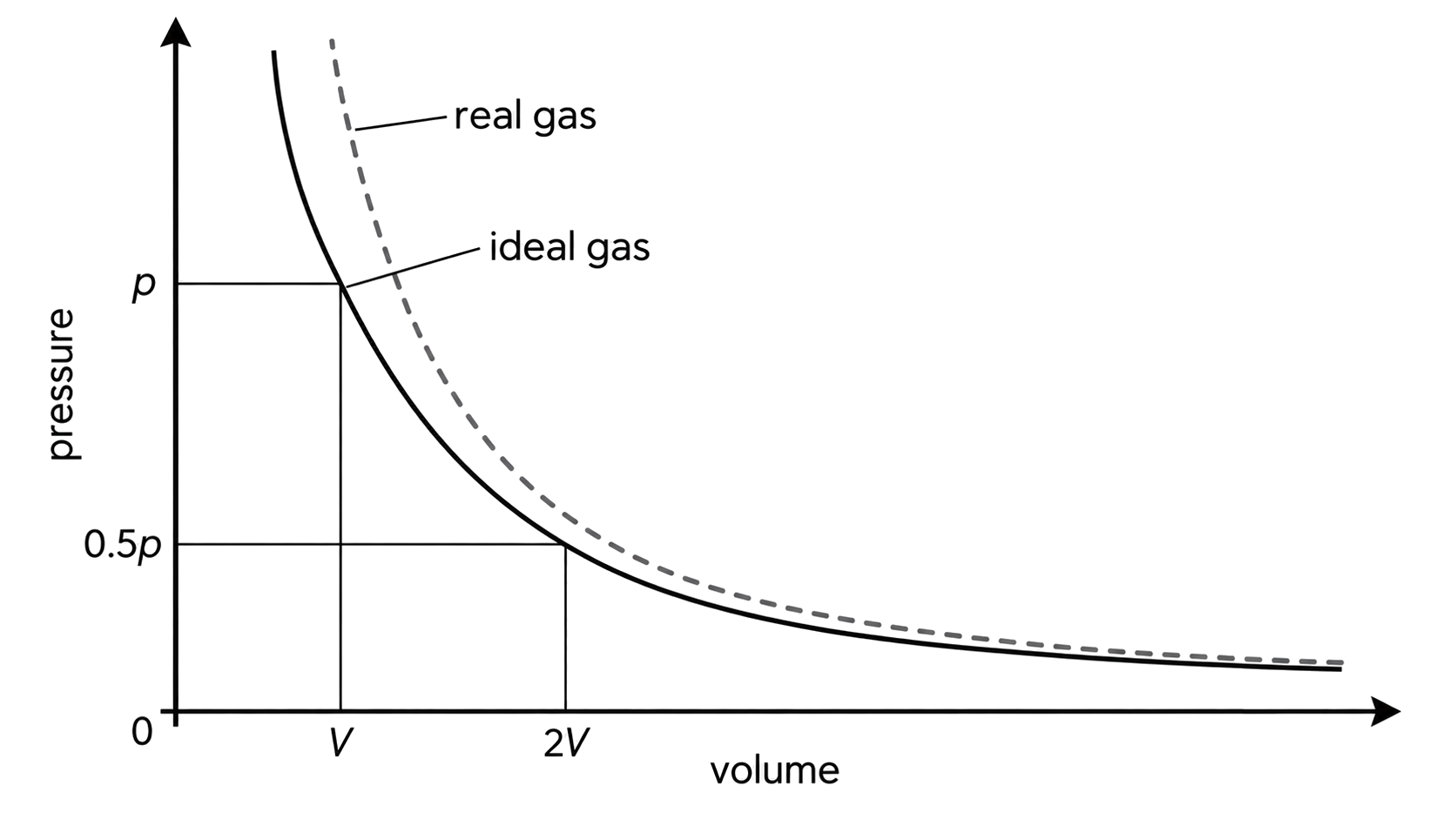
| Ideal assumption that fails | Real-gas consequence |
|---|---|
| Intermolecular forces are negligible | Attractions matter when particles have low kinetic energy and are close |
| Particle volume is negligible | Finite molecular volume matters at very high pressure |
A strong explanation names the condition, identifies the failed ideal assumption, and links it to the observed deviation.
Diagnose the cause from the condition. Cooling makes attractive forces more important because particle kinetic energy is lower; strong compression exposes both attractions and finite particle volume. Name the failed ideal assumption rather than stating only that the gas is 'non-ideal'.
Questions ask why a real-gas volume or behaviour differs from the ideal-gas prediction at high pressure or under low-temperature/high-pressure conditions.
explain
Identify real-gas behaviour and link the deviation to finite molecular volume or intermolecular attractions overcoming the ideal assumptions.
Naming high pressure or low temperature without identifying the failed ideal assumption and its particle-level consequence.
Representative question
Outline why the volume occupied by propane(g) at very high pressure is higher than the value calculated using PV=nRT.
not behaving as an ideal gas «at very high pressure»
ideal gas molecules have no volume
OR
volume of «propane» molecules is not negligible
Marking guidance:
Accept propane is a real gas for M1.
Molar volume is the volume occupied by one mole of gas at a specified temperature and pressure. At STP as used by the current IB data context (273.15 K and 100 kPa), Vₘ is approximately 22.7 dm³ mol⁻¹; a different condition requires its own value.
Forfixedamountandtemperature:P∝1/V
Read pressure–volume graphs as an inverse relationship, not simply as one quantity increasing while the other decreases. At STP, use the stated molar volume with the balanced-equation mole ratio.
Attach conditions to every molar volume. Once Vₘ is valid for the stated temperature and pressure, convert gas volume to moles, apply the balanced-equation ratio, then convert back if needed. Do not carry one tabulated Vₘ into a different set of conditions.
| Fixed amount of gas; held constant | Relationship | Graph/interpretation check |
|---|---|---|
| temperature | P ∝ 1/V | P–V is inverse, not a straight decreasing line |
| pressure | V ∝ T | V–T is linear only with T in kelvin |
| volume | P ∝ T | P–T is linear only with T in kelvin |
State the fixed variable and use absolute temperature before interpreting a gas graph.
Questions calculate a gas volume from amount at STP or deduce the pressure–volume relationship for a fixed gas sample.
determine / deduce
Use the stated molar volume and reaction ratio for the calculation, or state inverse proportionality explicitly for the graph relationship.
Calling the pressure–volume relationship merely negative rather than inverse, or using the wrong molar-volume condition.
Representative question
Deduce the relationship between the pressure and volume of the sample of carbon dioxide gas.
inversely proportional / V αp1/Pα V1;
Marking guidance:
Accept inverse/negative correlation/relationship.
Do not accept V=p1,P= V1 or descriptions like "one goes up as other goes down" / OWTTE.
PV=nRT
P1V1/T1=P2V2/T2
Worked example — amount and molar mass from gas data
The local course book gives P=101.3kPa, V=1.91dm3, m=3.30g and T=150∘C=423.15K. Because kPadm3=J, use R=8.31Jmol−1K−1: n=PV/(RT)=(101.3×1.91)/(8.31×423.15)=0.0550mol. Then M=m/n=3.30g/0.0550mol=60.0gmol−1. The final value is the mass of one mole of the vaporized compound under the stated ideal-gas model.
Convert Celsius to kelvin before substitution, and make pressure and volume units consistent with the chosen gas constant. Rearrange the equation only after the known quantities and units are identified.
Before solving, write a unit line beside P, V and T. With R = 8.31 J mol⁻¹ K⁻¹, use pressure in Pa, volume in m³ and temperature in K; using kPa with dm³ is also consistent because kPa·dm³ equals J. Judge model suitability before trusting the numerical result.
Questions use mass, pressure, volume, and temperature data to determine amount or volume with the ideal gas equation.
determine / calculate
Convert temperature to kelvin and volume/pressure units as required, substitute into PV=nRT, and report the amount or volume with a consistent unit and appropriate precision.
Substituting Celsius in place of kelvin or mixing cm³ and m³ without conversion.
Representative question
0.108 g of the vaporized compound was found to have a volume of 55.7 cm3 at 100∘C and a pressure of 1.00×10⁵ Pa.
Calculate the amount, in moles, of the compound. Use sections 1, 2 and 4 of the data booklet.
T=373 K AND V=5.57×10⁻⁵ m3 OR T=373 K AND 0.0557dm3 and 1×10²kPa<n=RTPV=8.31 J K−1 mol−1×373 K1.00×105 Pa×5.57×10−5 m3>n=0.00180 «mol»
Award [2] for correct final
answer.
Retrieve the model: ideal particles have negligible volume and forces with elastic collisions; low temperature and high pressure expose real-gas limits; molar volume and PV=nRT then connect amount, pressure, volume, and temperature.
Before calculating, check whether the question uses STP molar volume or PV=nRT, identify the fixed conditions, convert temperature to kelvin, and align pressure and volume units.