C1.3.4—Photosynthetic pigment separation

Chromatography separates photosynthetic pigments because solvent movement carries pigments different distances according to their solubility and interactions with the stationary phase.

Syllabus
First assessment 2025
Objective
C1.3.4
Level
SL

Exam analysis

Chance of appearing4%of analysed past papers
Latest appearanceNovember 2024
Most common paperPaper3
Typical marks1–2

Common command terms

  • Identify
  • State
  • Outline
  • Describe
  • Explain

Recent exam appearances

November 2024Paper3 ["SL"] · TZ23(c)[ 1 ]C1.3.4—Photosynthetic pigment separation
November 2024Paper3 ["SL"] · TZ23(b)[ 3 ]C1.3.4—Photosynthetic pigment separation
November 2024Paper3 ["SL"] · TZ23(a)[ 1 ]C1.3.4—Photosynthetic pigment separation
November 2023Paper1 ["SL"] · TZ213[ 1 ]C1.3.4—Photosynthetic pigment separation
May 2021Paper1 ["SL"] · TZ212[ 1 ]C1.3.4—Photosynthetic pigment separation
Practice this objective

Coverage 2017–2024 · Updated 15 Jul 2026

Pigments Separate by Solubility and Polarity

Photosynthetic pigments can be separated and identified because they differ in solubility in the mobile solvent and attraction to the stationary phase.

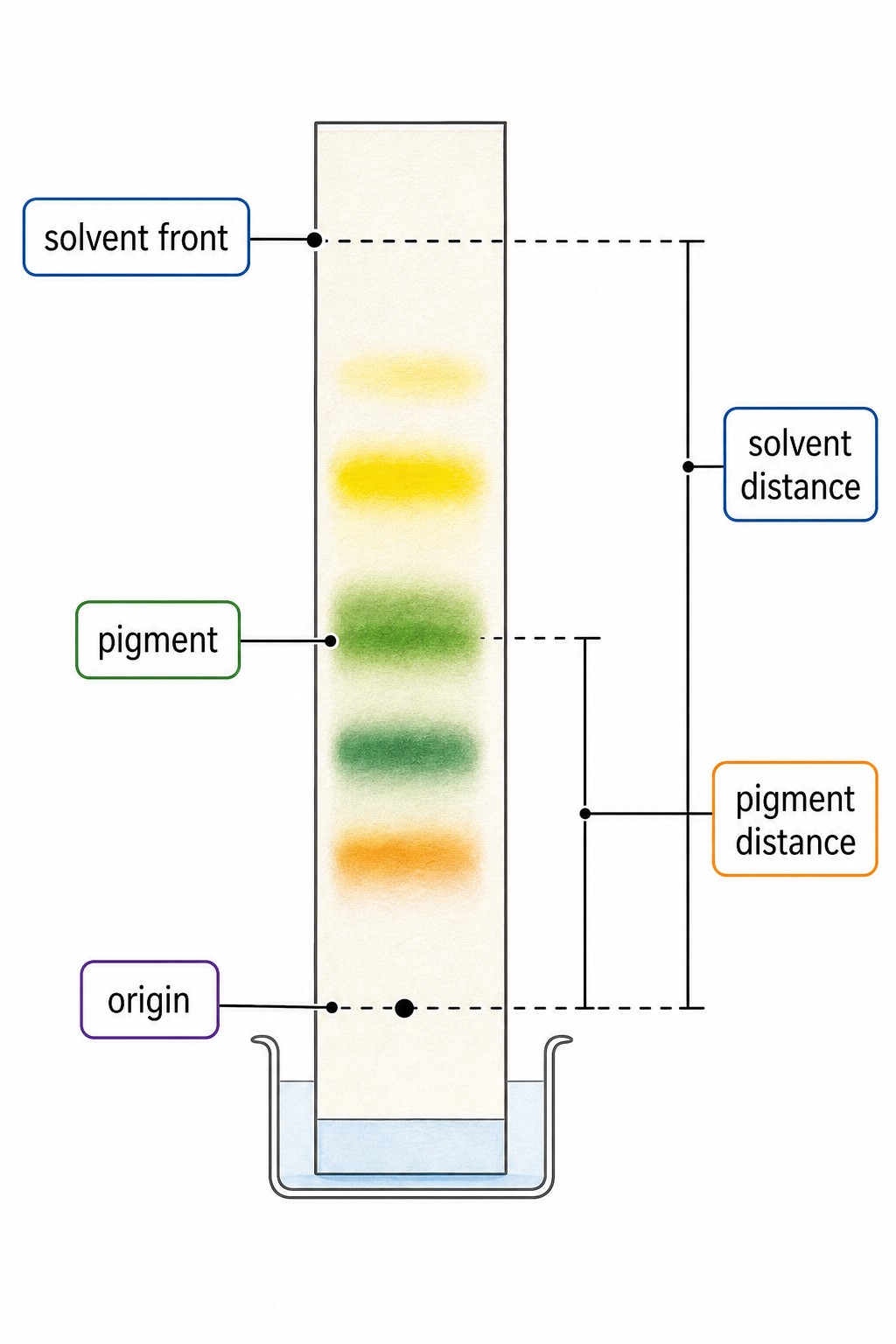
Extract pigments, place a small concentrated spot on paper or a thin-layer plate, keep the spot above the solvent, allow the solvent front to rise, then mark the solvent front immediately and observe the separated bands.

Rf=distancetravelledbypigment÷distancetravelledbysolventfrontRf = distance travelled by pigment ÷ distance travelled by solvent front

If a pigment travels 4.2 cm while the solvent front travels 6.0 cm, Rf = 4.2 ÷ 6.0 = 0.70. Identify a pigment using both its colour and an Rf reference obtained with the same solvent and stationary phase.

Rf has no unit and normally lies between 0 and 1. It depends on the solvent and stationary phase, so an Rf from different conditions is not a secure identification; band distance alone is not pigment abundance.

Photosynthetic pigment separation

Assessment in practice

1–2 marks
How it is assessed

This objective is assessed through structured response, commonly using Identify / State / Outline.

Command terms

Identify / State / Outline / Describe / Explain

What earns marks

Build the answer around this relationship: Chromatography separates pigments because they move different distances with the solvent.

Representative question

Question 1

[Maximum number: 3]

Describe the process used to obtain this chromatogram.

SL Transfer: Explain Core Photosynthesis

Photosynthesis converts light energy into chemical energy in carbon compounds. Carbon dioxide is reduced to carbohydrate using hydrogen from water, glucose is the main stored product, and released oxygen comes from photolysis of water. Pigment evidence is tested with chromatography and Rf, spectra questions separate absorption from action, and rate/evidence questions use limiting factors, controls, and CO2 enrichment context.

  • Light becomes chemical energy in carbon compounds through chlorophyll-containing photoautotrophs.
  • Carbon in carbohydrate comes from CO2; released oxygen comes from photolysis of water.
  • Chromatography separates pigments using Rf; absorption spectra and action spectra measure different things.
  • Limiting-factor and CO2 enrichment questions require variables, controls, and realistic interpretation.

Concept essentials

  • Chromatography separates pigments because they move different distances with the solvent.
  • Rf equals pigment distance from the origin divided by solvent-front distance from the origin.
  • Known Rf values and colours help identify separated pigments.
  • Organic solvents extract photosynthetic pigments from leaf or algal tissue.