IB Biology SL Form and Function Concepts

Form and Function connects biological structures to the processes they enable, from molecules and membranes to tissues, organs, transport systems and ecological adaptations.

Syllabus
First assessment 2025
Section
Level
SL

Exam analysis

Published Concept evidence in Form and Function repeatedly asks students to connect structure with function across molecules, membranes, cells and exchange systems. The strongest pattern is explaining how specific features enable transport, support, movement, regulation or adaptation.

Most tested topics

Practice this section

Recent 5 years · Updated 22 Jul 2026

In this section

Topic B1.1

B1.1 Carbohydrates and lipids

Carbohydrates and lipids connect carbon chemistry, condensation and hydrolysis reactions, molecular structure, solubility, membrane formation, and energy storage functions in organisms.

46% of analysed papers 65 papers · 87 questions

Objectives in this topic

Carbon's Four Bonds Create Biological Variety

Carbon is central to biological molecules because one carbon atom can form four covalent bonds, allowing stable chains, branches and rings.

Its four outer-shell electrons can be shared with carbon, hydrogen, oxygen, nitrogen or sulfur. Changing the carbon skeleton or attached groups changes shape and chemical behaviour, so structure can produce different biological functions.

Useful consequences:

  • carbon atoms link into chains, branches and rings
  • single and double bonds change shape and reactivity
  • large molecules can contain many different carbon arrangements

Glycogen and cellulose both contain glucose units, but their bonding arrangement gives glycogen a compact storage form and cellulose strong fibres.

Four bonds explain carbon's versatility; they do not make every carbon compound chemically identical. Always connect the particular structure to the claimed function.

Carbon atom properties

Assessment in practice

1–4 marks
How it is assessed

This objective is assessed through structured response, commonly using Outline / Identify.

Command terms

Outline / Identify

What earns marks

Build the answer around this relationship: Carbon can form four covalent bonds with carbon and other non-metal elements.

Representative question

Question 1

[Maximum number: 4]

Outline the chemical properties of carbon that allow it to form diverse compounds.

Condensation Builds Macromolecules

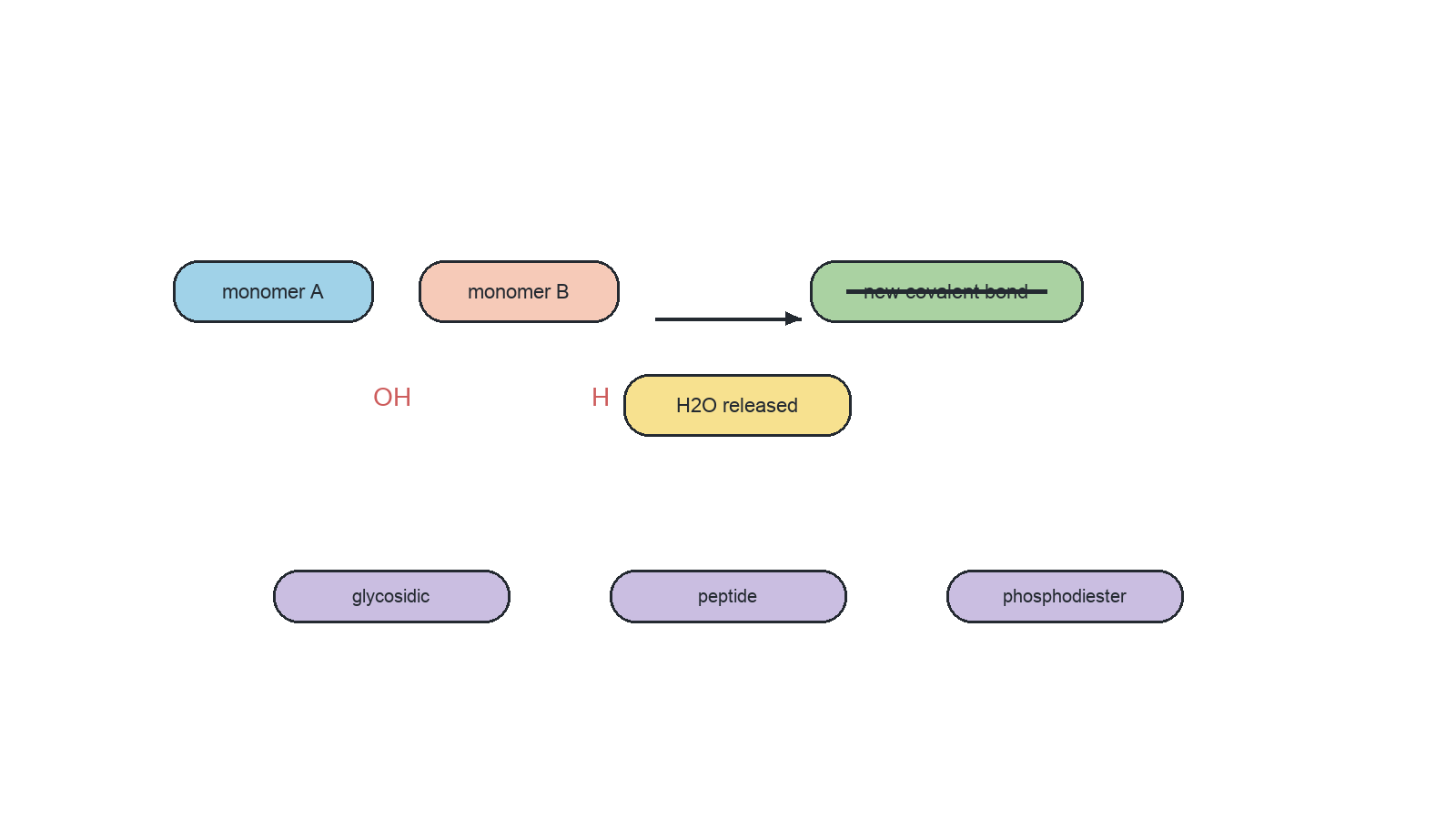
A condensation reaction links monomers with a new covalent bond while an H and an OH are removed to form water.

Repeating condensation builds macromolecules: monosaccharides form polysaccharides through glycosidic bonds, amino acids form polypeptides through peptide bonds, and nucleotides form nucleic acids through phosphodiester bonds.

For each step identify the two reacting groups, the new covalent bond and the water released. Polymerization repeats the same bond-forming logic many times, although not every biological macromolecule is a polymer.

When two monosaccharides condense, one supplies H and the other OH; water is released and the remaining atoms are joined by a glycosidic bond.

Condensation is not merely mixing monomers. A covalent bond must form and water must be produced; hydrolysis is the reverse bond-breaking reaction.

Macromolecules by condensation

Assessment in practice

1 marks
How it is assessed

This objective is assessed through structured response, commonly using Outline / State / Identify.

Command terms

Outline / State / Identify

What earns marks

Build the answer around this relationship: Condensation reactions build larger molecules from smaller subunits.

Watch for

Reversing condensation and hydrolysis in reaction equations.

Representative question

Question 1

[Maximum number: 5]

Outline the production of a dipeptide by a condensation reaction, showing the structure of a generalized dipeptide.

Hydrolysis Splits Biological Polymers

Hydrolysis breaks a covalent bond in a larger biological molecule by using water.

The water molecule separates into H and OH, which attach to the two products. This reverses the bond-forming logic of condensation and lets digestive enzymes release absorbable smaller molecules.

Trace the reaction as:

  • water enters the reaction
  • a polymer bond is cleaved
  • H and OH cap the two products

Hydrolysing a disaccharide produces two monosaccharides: one receives H and the other OH. The products are smaller than the starting molecule and can be transported for metabolism.

Hydrolysis is not the same as physically dissolving a food. It changes a covalent bond; water alone may be present, but enzymes usually control the biological rate.

Digestion by hydrolysis

Assessment in practice

1–3 marks
How it is assessed

This objective is assessed through structured response, commonly using State / Outline / Describe.

Command terms

State / Outline / Describe / Explain / Identify

What earns marks

Build the answer around this relationship: Hydrolysis breaks covalent bonds by adding water.

Watch for

Confusing hydrolysis with condensation when identifying reaction type.

Representative question

Question 1

[Maximum number: 6]

Describe the importance of hydrolysis in digestion.

Recognize Monosaccharides and Explain Glucose Function

Monosaccharides are single sugar units. Pentoses such as ribose have five carbon atoms, whereas hexoses such as glucose have six; both can be recognized in ring-form molecular diagrams.

Glucose is polar enough to dissolve in water, so it can be transported in blood or plant sap. It is chemically stable enough for transport yet can be oxidized directly in respiration to release usable energy.

Alpha- and beta-glucose have the same formula but differ in the orientation of the hydroxyl group at carbon 1. That small structural difference determines which glycosidic bonds and polysaccharide shapes they can form.

A glucose molecule can move in an aqueous transport fluid and then enter respiratory pathways; many alpha-glucose units can also be condensed into starch or glycogen for storage.

Do not identify a monosaccharide from the word 'sugar' alone. Use carbon number and ring structure, and do not assume molecules with the same formula have the same arrangement or role.

Form and function of monosaccharides

Assessment in practice

1–3 marks
How it is assessed

This objective is assessed through structured response, commonly using State / Draw / Identify.

Command terms

State / Draw / Identify / Outline

What earns marks

Build the answer around this relationship: Glucose, fructose, galactose and ribose are monosaccharides.

Watch for

Classifying disaccharides or polysaccharides as monosaccharides.

Representative question

Question 1

[Maximum number: 5]

Outline how the properties of glucose are linked to their uses in organisms.

Polysaccharides Store Glucose Compactly

Starch stores alpha-glucose in plants, while glycogen stores alpha-glucose in animals and fungi. Their large, compact molecules are relatively insoluble and therefore have little osmotic effect.

Starch contains coiled amylose and branched amylopectin; glycogen is more highly branched. Coiling and branching make the stores compact, and branch ends provide many sites where glucose can be added by condensation or removed by hydrolysis.

Feature Starch Glycogen
Main location Plants Animals and fungi
Organization Amylose coils plus branched amylopectin More highly branched polymer
Shared advantage Compact, relatively insoluble and readily mobilized alpha-glucose store Compact, relatively insoluble and readily mobilized alpha-glucose store

Between meals, enzymes can hydrolyze glucose units from many glycogen branch ends at once, allowing rapid mobilization without storing a large pool of osmotically active free glucose.

Cellulose is also a glucose polymer but uses beta-glucose and forms structural fibres; monomer identity alone does not determine function.

Polysaccharides as energy storage

Assessment in practice

1–3 marks
How it is assessed

This objective is assessed through structured response, commonly using Outline / Describe / Distinguish.

Command terms

Outline / Describe / Distinguish / Compare

What earns marks

Build the answer around this relationship: Starch stores glucose energy in plants as amylose and amylopectin.

Watch for

Confusing glycogen with glucagon or glucose.

Representative question

Question 1

[Maximum number: 4]

Outline how and where energy is stored in plants.

Cellulose Fibres Gain Strength from Parallel Chains

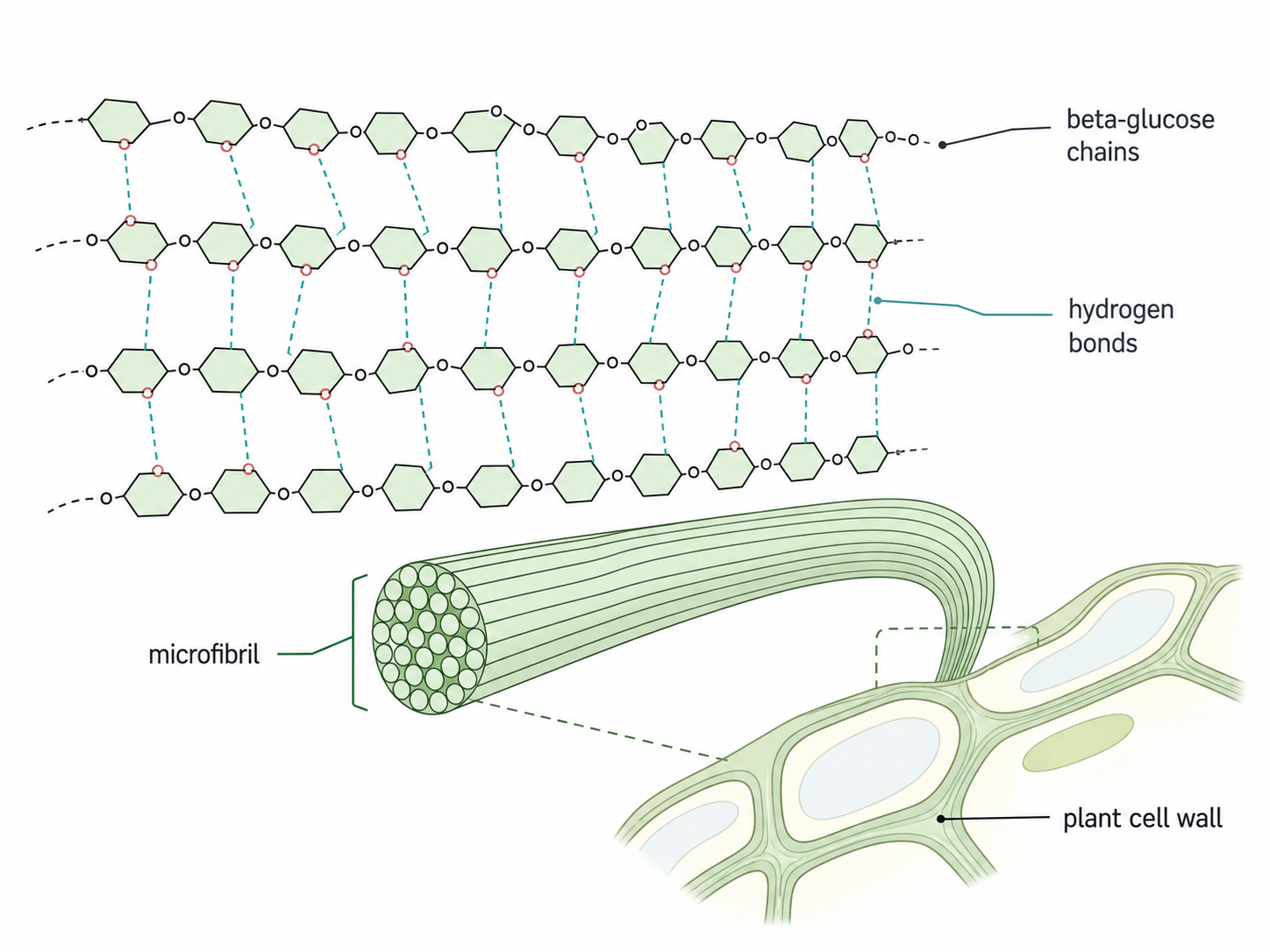
Cellulose is a structural polysaccharide made from beta-glucose joined by beta-1,4 glycosidic bonds. Alternate monomers are inverted, producing straight, unbranched chains.

Straight chains align in parallel. Many hydrogen bonds form between hydroxyl groups on neighbouring chains, cross-linking them into microfibrils and larger fibres with high tensile strength.

Structure-to-function chain: beta-glucose → alternating orientation → straight chains → parallel bundles → many interchain hydrogen bonds → strong plant cell walls.

When water enters a plant cell, the cellulose wall resists stretching, helping prevent excessive expansion while still allowing the cell to remain turgid.

The chains themselves contain covalent glycosidic bonds, but neighbouring cellulose chains are not covalently joined; their collective strength comes largely from many hydrogen bonds.

Cellulose structure and function

Assessment in practice

1–2 marks
How it is assessed

This objective is assessed through structured response, commonly using Label / Describe / Outline.

Command terms

Label / Describe / Outline / Identify

What earns marks

Build the answer around this relationship: Cellulose is made from beta-glucose monomers joined by 1,4 glycosidic bonds.

Watch for

Describing cellulose as branched or made from alpha-glucose.

Representative question

Question 1

[Maximum number: 3]

Describe how cellulose is formed from monosaccharides.

Glycoproteins make cell identity readable

Glycoproteins are membrane proteins with exposed carbohydrate chains whose shapes act as cell-surface identity and recognition markers.

A receptor, antibody or neighbouring cell can bind a matching carbohydrate pattern. This supports self/non-self recognition, cell adhesion and signalling; the membrane anchor presents the marker in the correct location.

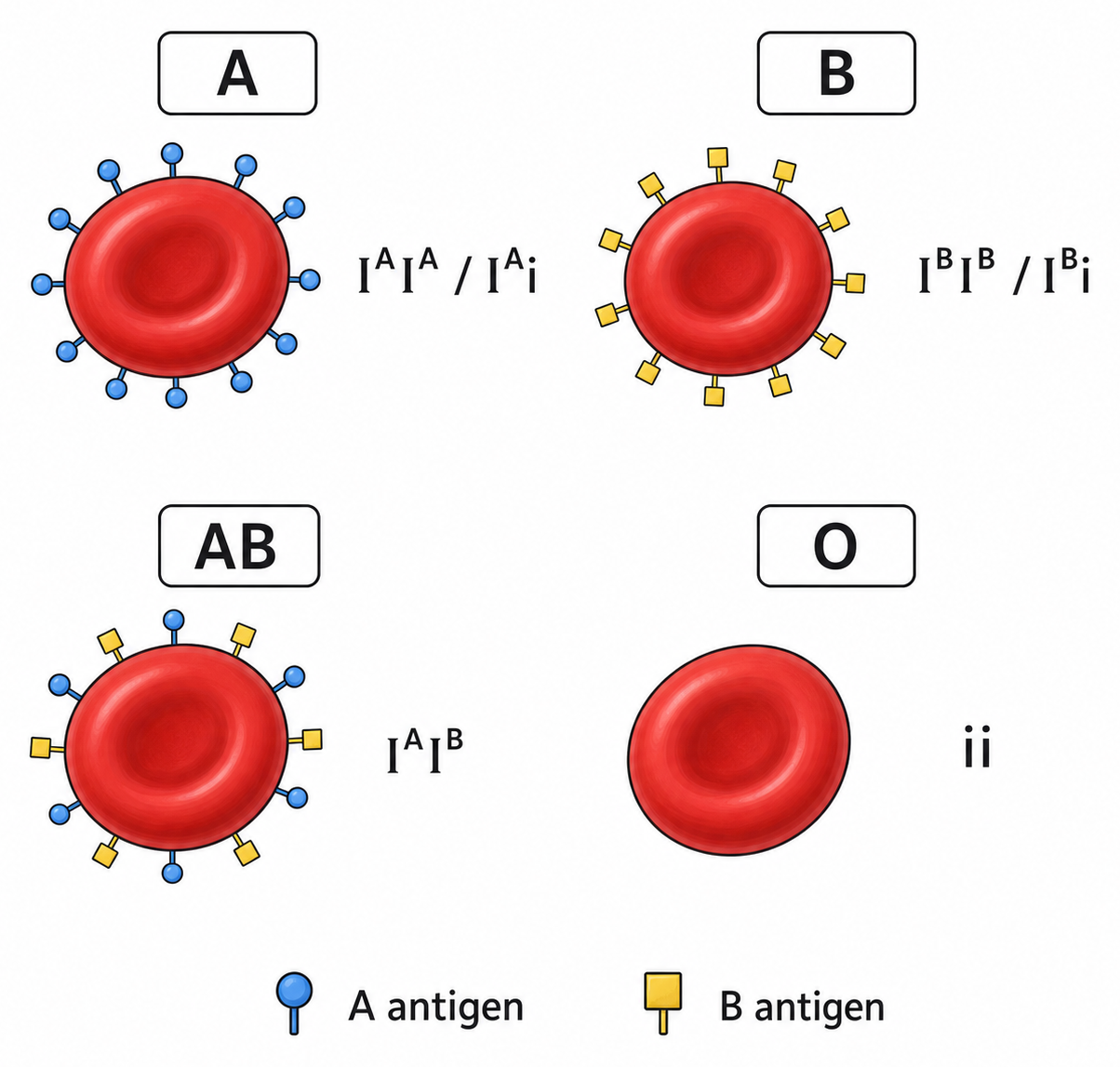
ABO blood-group antigens are cell-surface carbohydrate patterns carried on glycoproteins and glycolipids. Type A and B cells display different terminal sugars; type O lacks those A/B additions, affecting antibody compatibility.

If red cells bearing an unfamiliar A or B antigen meet matching antibodies in incompatible plasma, antibody cross-linking can cause agglutination.

Recognition is specific to molecular shape and a compatible binding partner. Do not describe ABO identity as a free sugar floating outside the cell or as the protein sequence alone.

Non-Polar Lipids Avoid Water

Lipids are hydrophobic substances that dissolve in non-polar solvents but are only sparingly soluble in aqueous solvents.

Their structures contain large non-polar hydrocarbon regions that cannot form favourable interactions with water, so lipids cluster away from water or form separate phases.

Fats, oils, waxes, phospholipids and steroids are lipid examples. Lipids are grouped by solubility and hydrophobic behaviour rather than as one true polymer family built from repeating identical monomers.

Oil forms a separate layer on water but dissolves in a non-polar solvent because substances mix most readily when their intermolecular interactions are compatible.

Hydrophobic does not mean 'contains no oxygen' or 'is repelled by every substance'. Judge the whole molecule's polarity and its interaction with water.

Hydrophobic properties of lipids

Assessment in practice

1–4 marks
How it is assessed

This objective is assessed through multiple choice, commonly using Explain.

Command terms

Explain

What earns marks

Build the answer around this relationship: Lipids are generally hydrophobic because large parts of their molecules are non-polar.

Watch for

Calling oils insoluble without linking this to non-polar hydrocarbon chains and lack of hydrogen bonding.

Representative question

Question 1

[Maximum number: 1]

Which substance must be transported in the blood by lipoprotein complexes?

A

Cholesterol

B

Oxygen

C

Sodium chloride

D

Amino acids

Ester Bonds Assemble Triglycerides and Phospholipids

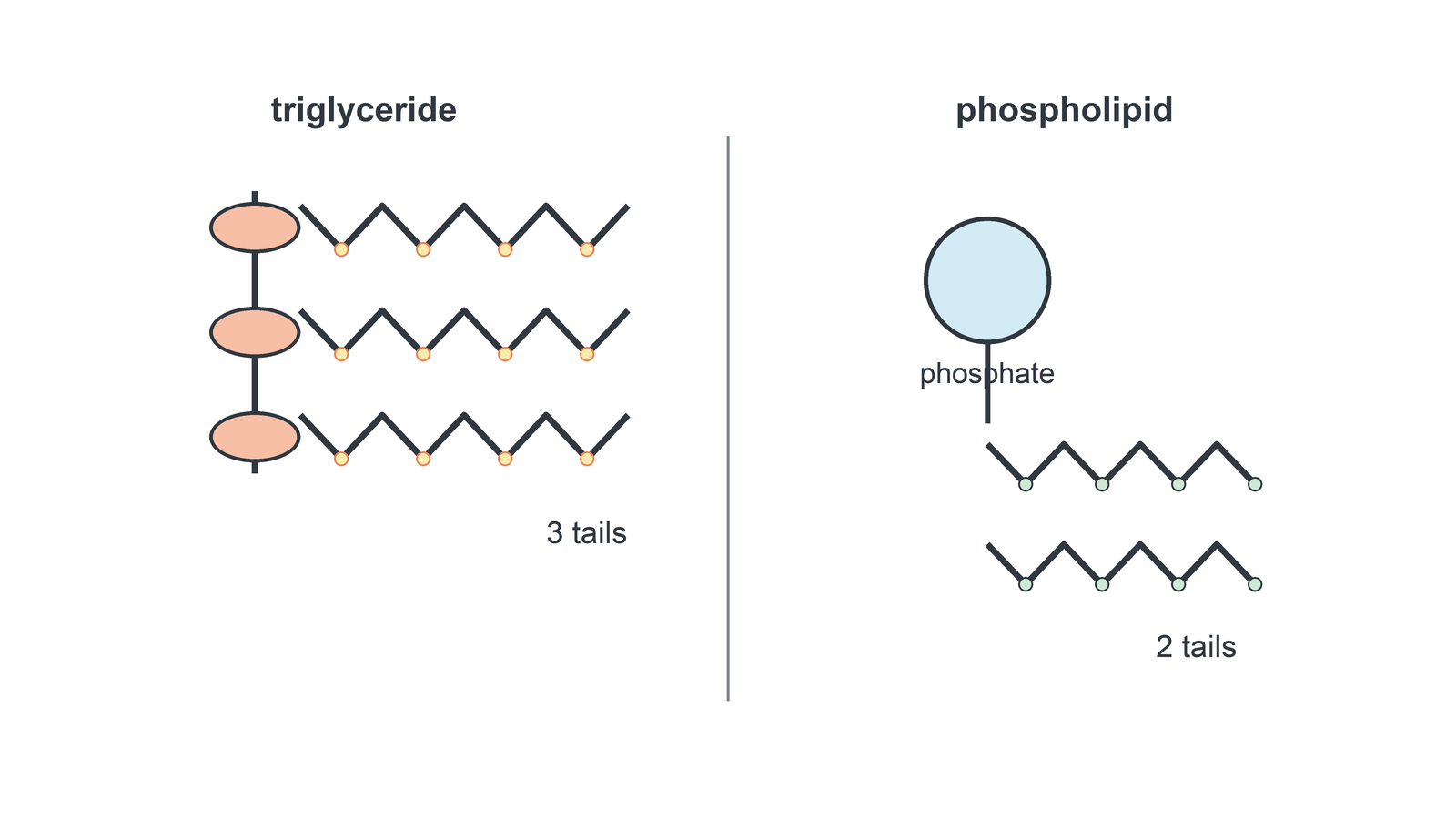
Triglycerides and phospholipids form when glycerol reacts with fatty acids in condensation reactions that create ester bonds.

Each ester bond joins a hydroxyl group of glycerol to a carboxyl group of a fatty acid and releases water. The number and type of attached groups then determine whether the molecule is mainly for storage or membrane structure.

For a synthesis diagram, count:

  • glycerol backbone
  • fatty-acid tails attached
  • ester bonds and water molecules released

Attaching three fatty acids to glycerol forms a triglyceride and releases three water molecules; replacing one tail with a phosphate-containing group gives a phospholipid.

A phospholipid is not simply a triglyceride with fewer tails. Its phosphate-containing head changes polarity and therefore its behaviour in water.

Formation of triglycerides and phospholipids

Assessment in practice

1 marks
How it is assessed

This objective is assessed through structured response, commonly using State / Identify / Describe.

Command terms

State / Identify / Describe

What earns marks

Build the answer around this relationship: Triglycerides contain glycerol joined to three fatty acids.

Watch for

Naming hydrolysis instead of condensation when fatty acids join glycerol.

Representative question

Question 1

[Maximum number: 1]

Identify the molecule that was used to form part Y of the triglyceride.

Fatty-Acid Double Bonds Change Chain Shape

A saturated fatty acid has no carbon-carbon double bonds, a monounsaturated fatty acid has one, and a polyunsaturated fatty acid has more than one.

Cis double bonds introduce bends that prevent close packing and weaken intermolecular attractions, generally lowering melting point. Straight saturated chains pack more tightly and tend to melt at higher temperatures.

Type C=C bonds Packing and usual state
Saturated 0 Straighter, tighter packing; common in solid fats
Monounsaturated 1 One cis kink; lower melting point
Polyunsaturated 2 or more Multiple kinks; often liquid oils

Plants commonly store energy in oils rich in unsaturated fatty acids, which remain fluid at typical plant temperatures; endotherms can store more saturated fats while maintaining body temperature.

Double-bond number is important but not the only influence: chain length and cis/trans geometry also affect packing and melting point.

Fatty acids

Assessment in practice

1–2 marks
How it is assessed

This objective is assessed through structured response, commonly using Outline / State / Draw.

Command terms

Outline / State / Draw / Distinguish / Compare / Identify

What earns marks

Build the answer around this relationship: Saturated fatty acids have no carbon-carbon double bonds in the hydrocarbon chain.

Watch for

Calling saturated fatty acids unsaturated because they contain a carboxyl group.

Representative question

Question 1

[Maximum number: 4]

Distinguish between the structures of the different types of fatty acids in food.

Triglycerides Store Energy Efficiently

Triglycerides in adipose tissue provide concentrated long-term energy storage and thermal insulation.

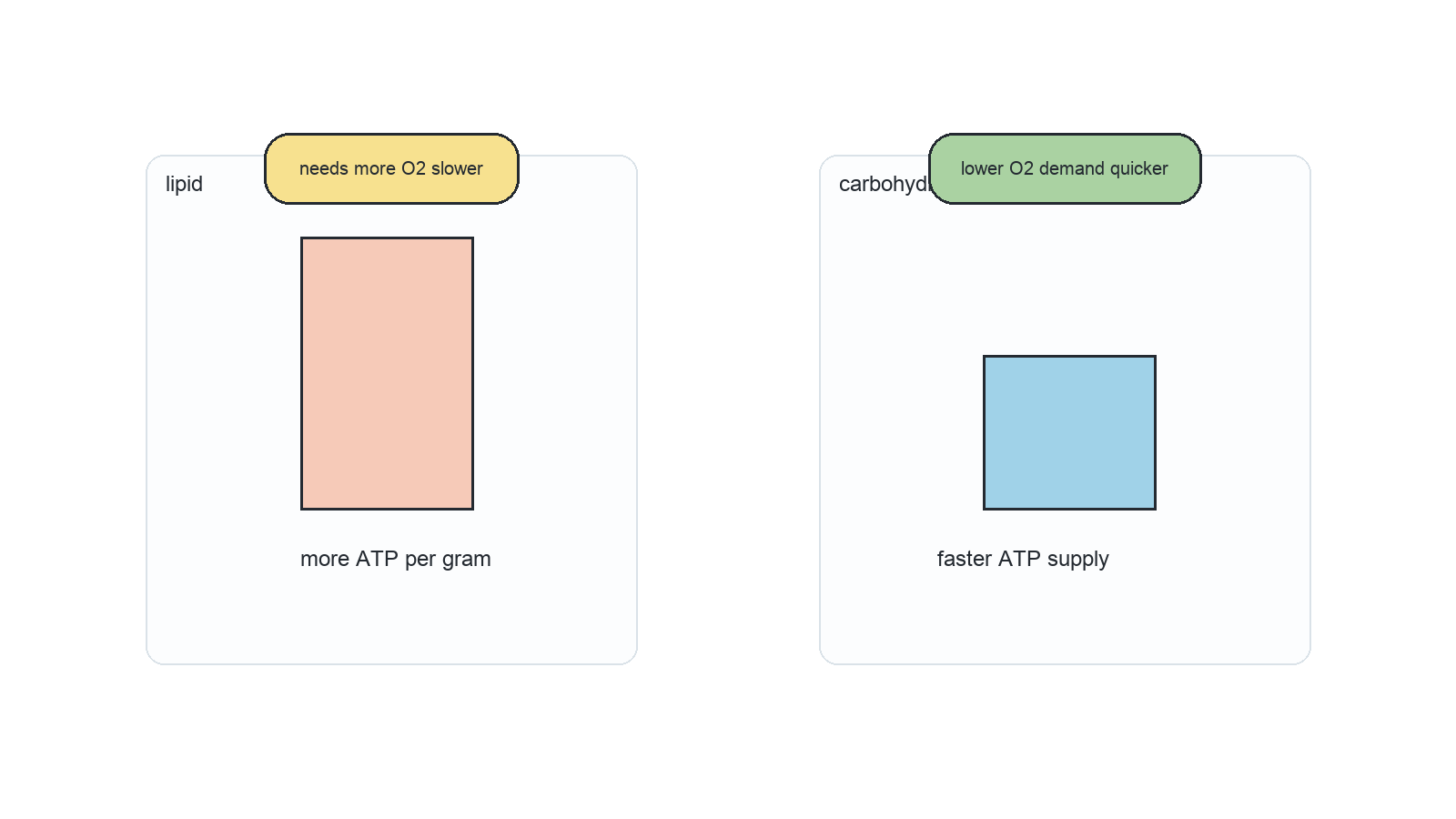
Their many reduced C–H bonds yield more energy per unit mass than carbohydrate when oxidized. Hydrophobic triglycerides are stored without a large hydration shell and have little osmotic effect; oxidation also produces metabolic water.

Adipose tissue beneath the skin slows heat transfer, helping an endotherm maintain a stable body temperature. Thick fat layers are especially useful in cold or aquatic habitats and can also cushion organs or aid buoyancy.

A marine mammal can carry a compact energy reserve in blubber while the same adipose layer reduces heat loss to cold water.

Triglycerides form storage droplets, not bilayers: three hydrophobic tails and no strongly polar phosphate head make them unsuitable as the basic membrane sheet.

Triglycerides functions

Assessment in practice

1–2 marks
How it is assessed

This objective is assessed through structured response, commonly using Explain / Outline / State.

Command terms

Explain / Outline / State

What earns marks

Build the answer around this relationship: Triglycerides store more energy per gram than carbohydrates.

Watch for

Saying lipids are more efficient because they are easier to transport than carbohydrates.

Representative question

Question 1

[Maximum number: 4]

Outline the use of lipids to store energy in humans.

Phospholipids Self-Assemble into Bilayers

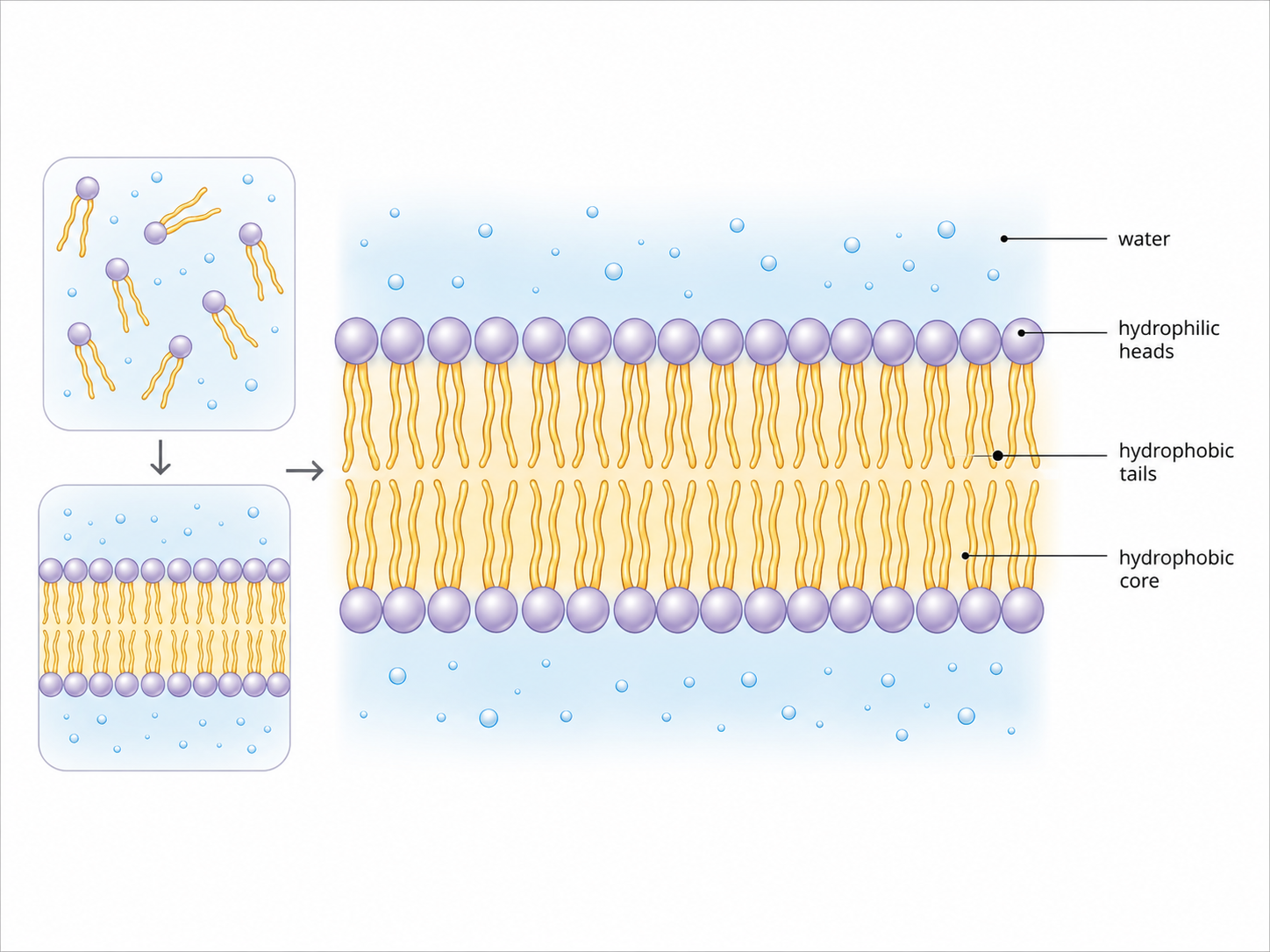
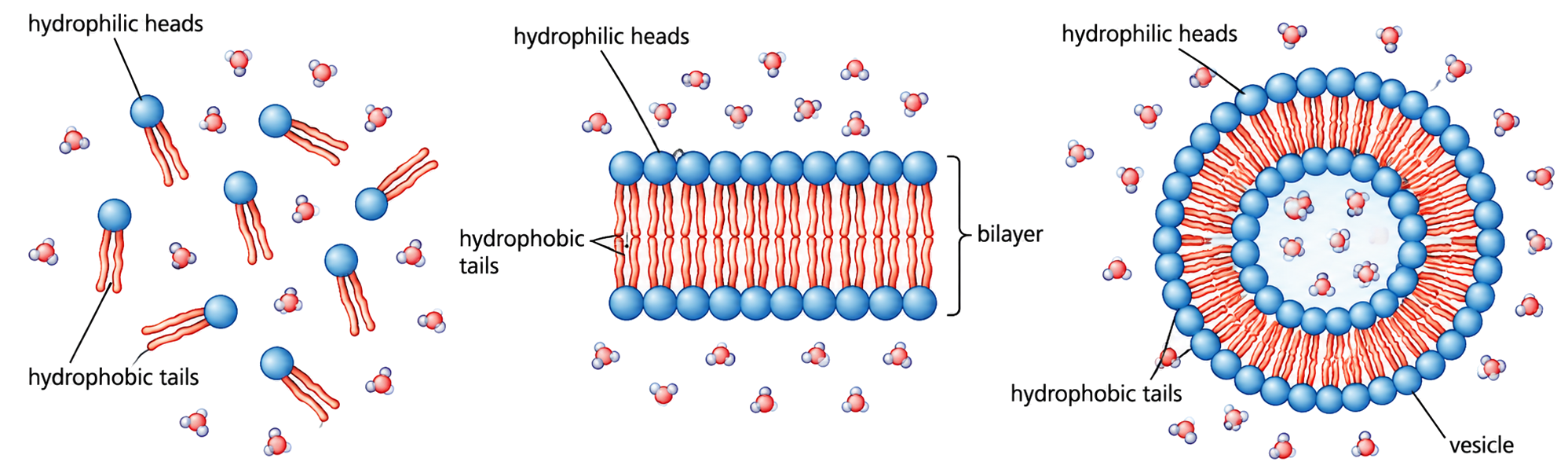
Phospholipids are amphipathic: a polar phosphate-containing head interacts with water while non-polar tails avoid it, so they self-assemble into bilayers.

In water, heads face the aqueous environments and tails pack away from water in the interior. This arrangement creates a flexible hydrophobic barrier that separates compartments while allowing selected molecules to cross.

A bilayer requires:

  • hydrophilic heads facing water
  • hydrophobic tails facing inward
  • a continuous, dynamic sheet rather than a solid wall

In a cell membrane, water contacts both outer and inner head surfaces, while the tail core makes it difficult for many ions and polar molecules to pass without transport proteins.

The bilayer is not formed with tails facing water. Reversing the orientation would expose the least water-compatible part and would not create a stable membrane barrier.

Phospholipid bilayers

Assessment in practice

1–2 marks
How it is assessed

This objective is assessed through structured response, commonly using Outline / Annotate.

Command terms

Outline / Annotate

What earns marks

Build the answer around this relationship: Phospholipid heads are hydrophilic and phosphate-containing.

Watch for

Reversing the hydrophilic phosphate head and hydrophobic fatty-acid tails.

Representative question

Question 1

[Maximum number: 2]

Annotate the diagram to illustrate the amphipathic nature of phospholipids.

Steroids Have a Non-Polar Hydrocarbon Core

Steroids have four fused carbon rings. Mostly non-polar steroids can dissolve in the hydrophobic core of a phospholipid bilayer and diffuse through it.

The fused-ring skeleton is dominated by C–C and C–H bonds, so it interacts more favourably with lipid tails than with water. Attached polar groups modify, but do not necessarily remove, this lipid solubility.

Oestradiol and testosterone are steroid hormones derived from cholesterol. Their bilayer permeability allows them to enter target cells, where their receptors are intracellular rather than exposed only on the cell surface.

A testosterone molecule can partition into the membrane's hydrophobic core, cross the bilayer and bind an intracellular receptor that changes cell activity.

Steroid identifies a four-ring structural family. Not every steroid is completely non-polar, and membrane passage does not mean diffusion is equally rapid for every attached functional group.

Non-polar steroids

Assessment in practice

1 marks
How it is assessed

This objective is assessed through multiple choice, commonly using Identify.

Command terms

Identify

What earns marks

Build the answer around this relationship: Steroids are lipids with four fused carbon rings.

Representative question

Question 1

[Maximum number: 1]

Testosterone is a hormone that is important for male reproductive development.

To which group of compounds does testosterone belong?

A

Nucleotides

B

Carbohydrates

C

Lipids

D

Amino acids

Structure To Function

B1.1 becomes easy when every answer follows structure -> property -> function. Carbon skeletons and functional groups create molecular diversity. Condensation builds larger molecules and hydrolysis breaks them. Alpha-glucose stores energy as starch and glycogen; beta-glucose forms strong cellulose. Surface carbohydrates enable recognition. Lipids are hydrophobic, triglycerides store energy, phospholipids self-assemble into bilayers, and steroids cross membranes because they are mostly non-polar.

  • Carbon bonding and functional groups explain molecular diversity.
  • Condensation releases water; hydrolysis uses water.
  • Carbohydrates can store energy, build cell walls, and mark cell surfaces.
  • Lipids are hydrophobic and not true polymers.
  • Triglycerides store energy; phospholipids form membranes; steroids signal across membranes.

Topic B1.2

B1.2 Proteins

Proteins connect amino acid structure, peptide-bond formation, dietary requirements, folding levels, R-group chemistry, denaturation, and functional protein shapes in cells.

30% of analysed papers 42 papers · 50 questions

Objectives in this topic

One Amino Acid Pattern, Three Functional Parts

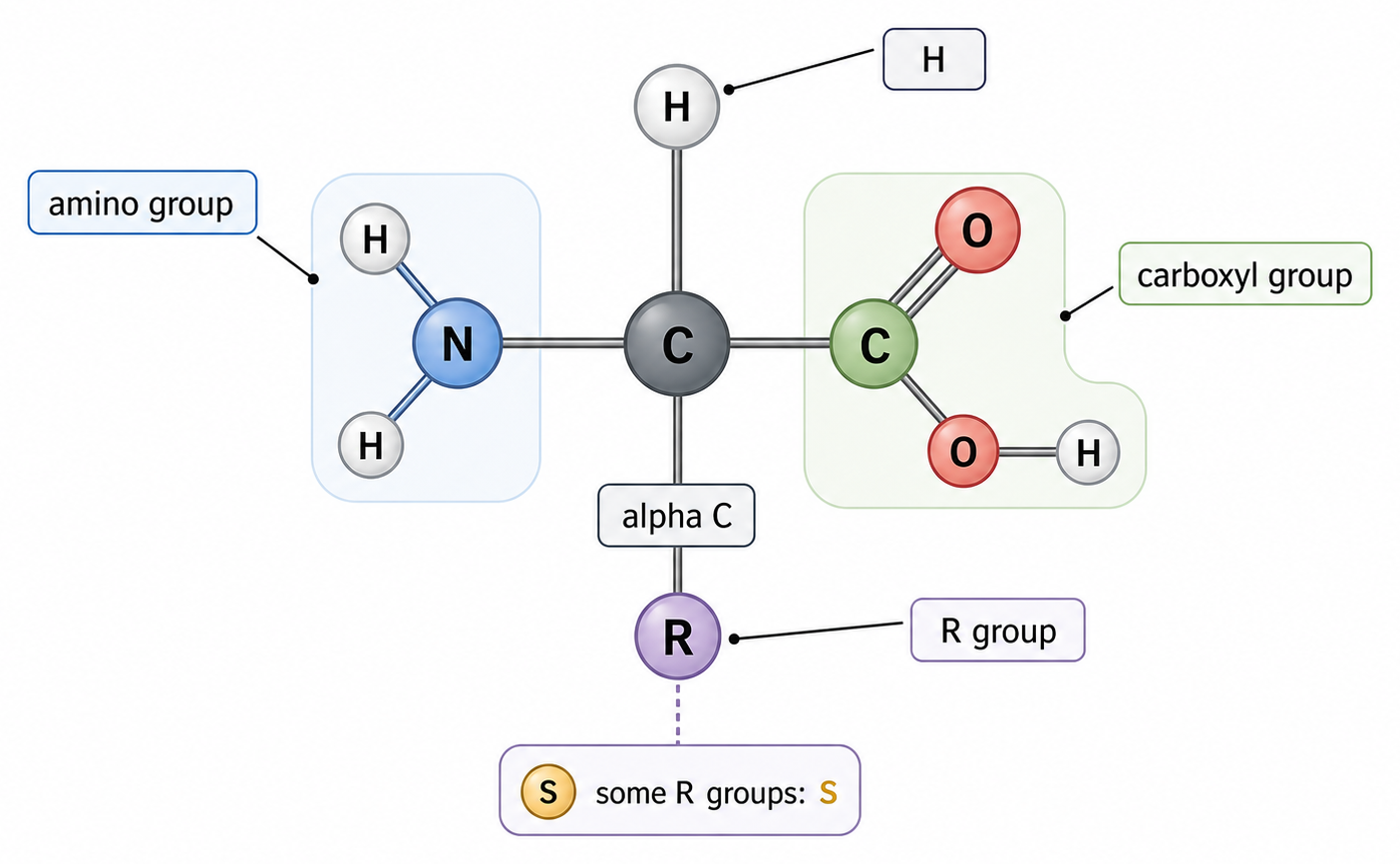
Every amino acid has an alpha carbon bonded to four groups: an amine group, a carboxyl group, a hydrogen atom and a variable R-group.

H2NCH(R)COOH\mathrm{H_2N-CH(R)-COOH}

The amine and carboxyl groups provide the shared chemistry for peptide-bond formation. The R-group varies among amino acids and changes charge, polarity, size and reactivity, thereby influencing protein folding and function.

In two amino-acid diagrams, the backbone groups can be identical while one R-group is non-polar and another charged; both form peptide bonds but interact differently after joining a chain.

The hydrogen on the alpha carbon is part of the generalized structure, and R is not an optional label: it represents the side chain that distinguishes amino acids.

Generalized amino acid structure

Assessment in practice

1 marks
How it is assessed

This objective is assessed through experimental design, commonly using Draw / Identify.

Command terms

Draw / Identify

What earns marks

Build the answer around this relationship: All amino acids have a central alpha carbon bonded to amine, carboxyl, hydrogen and R-group attachments.

Watch for

Omitting either the amine group or carboxyl group when drawing a generalized amino acid.

Representative question

Question 1

[Maximum number: 3]

The molecules of all amino acids include an amine group, a carboxyl group and an R-group. Draw a diagram to show the structure of an amino acid molecule.

Peptide Bonds Join Amino Acids

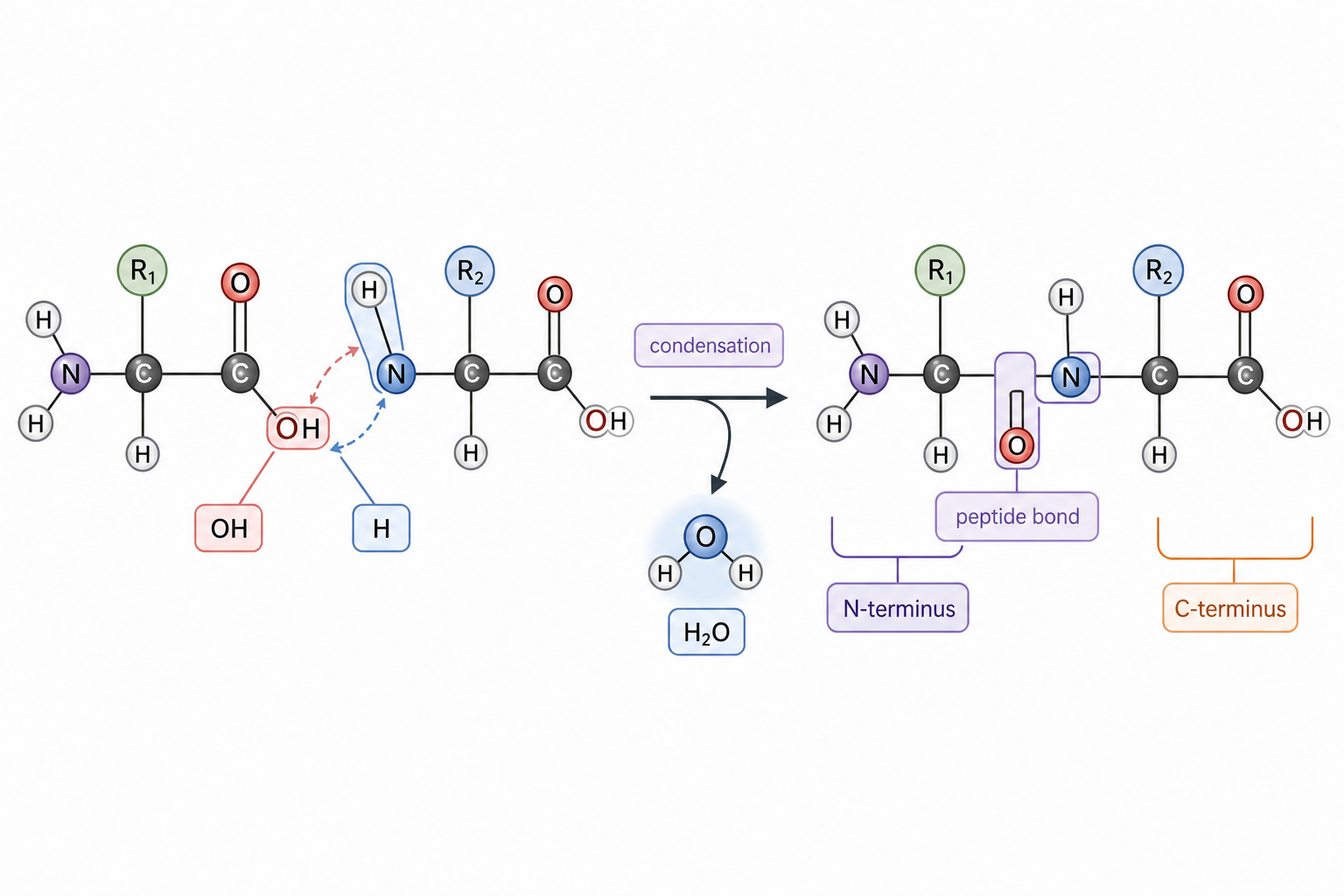
A peptide bond forms when the carboxyl group of one amino acid condenses with the amine group of another, releasing water and creating a covalent C–N link.

amino acid+amino aciddipeptide+water\text{amino acid}+\text{amino acid}\rightarrow\text{dipeptide}+\text{water}

OH is removed from the carboxyl group and H from the amine group. Repeating condensation extends the polypeptide from its amino (N) terminus toward its carboxyl (C) terminus.

Two amino acids produce one peptide bond and one water molecule; adding a third amino acid produces a tripeptide with two peptide bonds and releases a second water molecule.

A peptide bond is the covalent link in the backbone, not a hydrogen bond. Hydrogen bonds stabilize later folding levels.

Condensation reactions

Assessment in practice

1–3 marks
How it is assessed

This objective is assessed through experimental design, commonly using Draw / Label / Annotate.

Command terms

Draw / Label / Annotate / State / Identify

What earns marks

Build the answer around this relationship: Peptide bonds form by condensation between carboxyl and amine groups.

Watch for

Calling peptide-bond formation hydrolysis instead of condensation.

Representative question

Question 1

[Maximum number: 4]

Draw molecular diagrams to show the condensation reaction between two amino acids to form a dipeptide.

Diet Supplies Some Amino Acids

Essential amino acids cannot be synthesized in sufficient amounts and must be obtained from food; non-essential amino acids can be synthesized from other molecules in the body.

Protein synthesis requires every amino acid specified by the sequence. If one essential amino acid is unavailable, translation of that protein is limited even if all other amino acids are abundant.

A well-planned vegan diet can supply all essential amino acids by including sufficient amounts and a suitable variety of plant proteins. The syllabus does not require memorizing lists of essential amino acids.

If a diet supplies too little of one essential amino acid, that amino acid becomes limiting for synthesis of proteins that require it; consuming more of the other amino acids does not remove the limit.

Non-essential means synthesizable, not biologically unimportant. 'Essential' describes dietary supply, not whether the amino acid has a special position in every protein.

Dietary amino acids

Assessment in practice

1–2 marks
How it is assessed

This objective is assessed through structured response, commonly using Outline / Define / Distinguish.

Command terms

Outline / Define / Distinguish / State / Deduce / Evaluate

What earns marks

Build the answer around this relationship: Essential amino acids must be obtained from the diet.

Watch for

Saying non-essential amino acids are not used by the body.

Representative question

Question 1

[Maximum number: 2]

Some of the twenty amino acids that are linked together to make polypeptides in human cells are essential in the diet and others are not. Distinguish between essential and non-essential amino acids.

Sequence Creates Protein Variety

The genetic code specifies 20 common amino acids, and peptide chains can contain from a few to thousands of residues in any order, creating an immense variety of possible sequences.

At each position there can be many amino-acid choices, so the number of possible sequences grows exponentially with chain length. Genes specify particular orders; different cells express different sets of proteins, forming their proteomes.

Protein variety depends on amino-acid type, number and order. Sequence positions place different R-group chemistries together during folding, helping determine the final three-dimensional form and function.

Two chains with the same numbers of alanine and glycine can have different primary structures—and potentially different folds—when those residues occur in different orders.

A possible sequence is not automatically a stable functional protein, and a sequence change matters only through its effect on folding, stability, interactions or a functional site.

Infinite variety of peptide chains

Assessment in practice

2–7 marks
How it is assessed

This objective is assessed through structured response, commonly using Explain / Describe.

Command terms

Explain / Describe

What earns marks

Build the answer around this relationship: Protein primary structure depends on amino-acid number, type and order.

Representative question

Question 1

[Maximum number: 7]

Cells produce a large variety of proteins with different sequences of amino acids. Explain how this is done.

Protein Shape Depends on Conditions

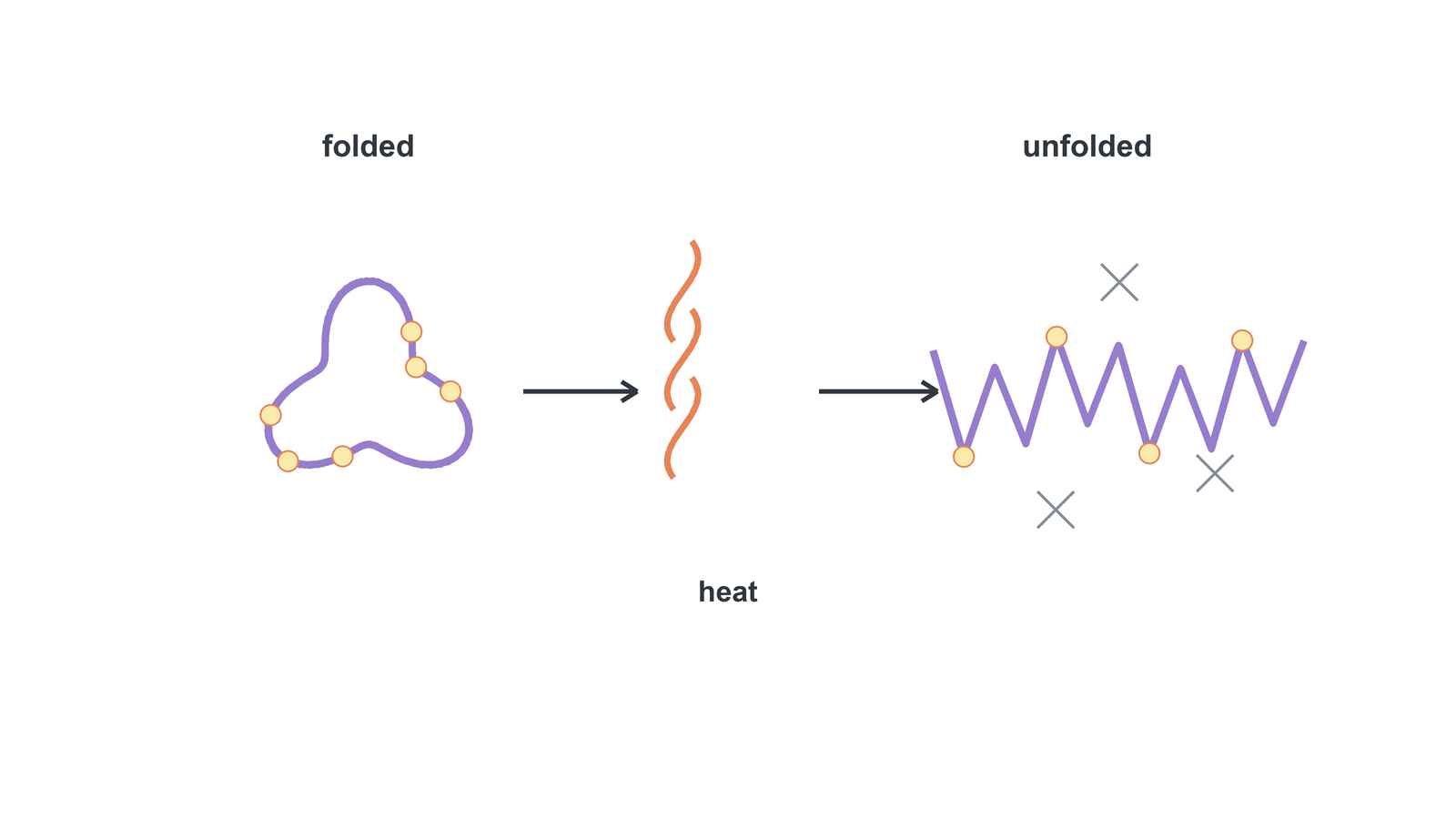
Protein shape is maintained by weak interactions that can be disrupted by extreme pH or temperature, causing denaturation and loss of function.

Heating increases molecular motion and extreme pH changes charges on R-groups. These changes disturb hydrogen bonds, ionic attractions and other interactions holding the folded chain in its working shape.

Predict a condition effect by asking:

  • which interaction is disturbed
  • whether the chain unfolds or changes active-site shape
  • whether the change is reversible under the conditions

An enzyme may work faster as temperature rises to its optimum, then lose activity sharply when heating disrupts the shape of its active site.

Denaturation changes conformation, not necessarily the amino-acid sequence. Do not treat every loss of activity as peptide-bond hydrolysis.

Effect of pH and temperature

Assessment in practice

1–2 marks
How it is assessed

This objective is assessed through structured response, commonly using Outline / Explain / Identify.

Command terms

Outline / Explain / Identify

What earns marks

Build the answer around this relationship: Denaturation changes protein conformation and can remove biological function.

Watch for

Claiming denaturation changes the amino-acid sequence.

Representative question

Question 1

[Maximum number: 4]

Outline the process of protein denaturation.

Build And Use Proteins

The core protein story is build -> vary -> function. Amino acids share a backbone but differ in R-groups. Peptide bonds form by condensation between carboxyl and amine groups. Some amino acids must come from diet, or protein synthesis is limited. Twenty coded amino acids create many sequences by type, number, and order. Finally, shape determines function, so denaturation changes performance.

  • Amino acids share an alpha-carbon backbone and vary in R-groups.
  • Peptide bonds form by condensation and release water.
  • Essential amino acids must be obtained from dietary protein.
  • Protein diversity depends on amino acid type, number, and order.
  • Protein shape determines function; denaturation changes shape and function.

Topic B2.1

B2.1 Membranes and membrane transport

Membranes and membrane transport link bilayer structure, membrane proteins, selective permeability, gradients, and vesicle movement to cellular control; Students connect membrane structure to transport mechanisms across cellular boundaries.

36% of analysed papers 51 papers · 69 questions

Objectives in this topic

Bilayers Put a Water-Resistant Core Between Compartments

A lipid bilayer forms because amphipathic phospholipids place water-compatible heads toward water and hydrocarbon tails away from it.

In water, this arrangement lowers unfavorable tail–water contact. The two leaflets therefore create a flexible sheet with a non-polar interior, allowing a cell to separate its inside from its surroundings.

A membrane has water on both sides: heads face each aqueous side while tails meet in the middle, forming one continuous barrier.

When phospholipids are placed in water, their hydrophilic heads remain in contact with water while their hydrophobic tails cluster away from it; a closed bilayer can therefore form without leaving exposed tails at its edge.

The bilayer is a consequence of amphipathic structure in an aqueous environment; it is not a rigid wall, and its hydrophobic core still permits some small non-polar molecules to cross.

Lipid bilayers as basis

Assessment in practice

1–3 marks
How it is assessed

This objective is assessed through structured response, commonly using Identify / Explain / State.

Command terms

Identify / Explain / State / Outline / Draw / Label

What earns marks

Build the answer around this relationship: Phospholipids have hydrophilic phosphate heads and hydrophobic fatty acid tails.

Watch for

Saying phospholipids are only hydrophobic or only hydrophilic instead of amphipathic.

Representative question

Question 1

[Maximum number: 8]

Cell membranes separate aqueous environments in cells. Explain how the properties of phospholipids help to maintain the structure of cell membranes.

The Bilayer Is a Selective Barrier

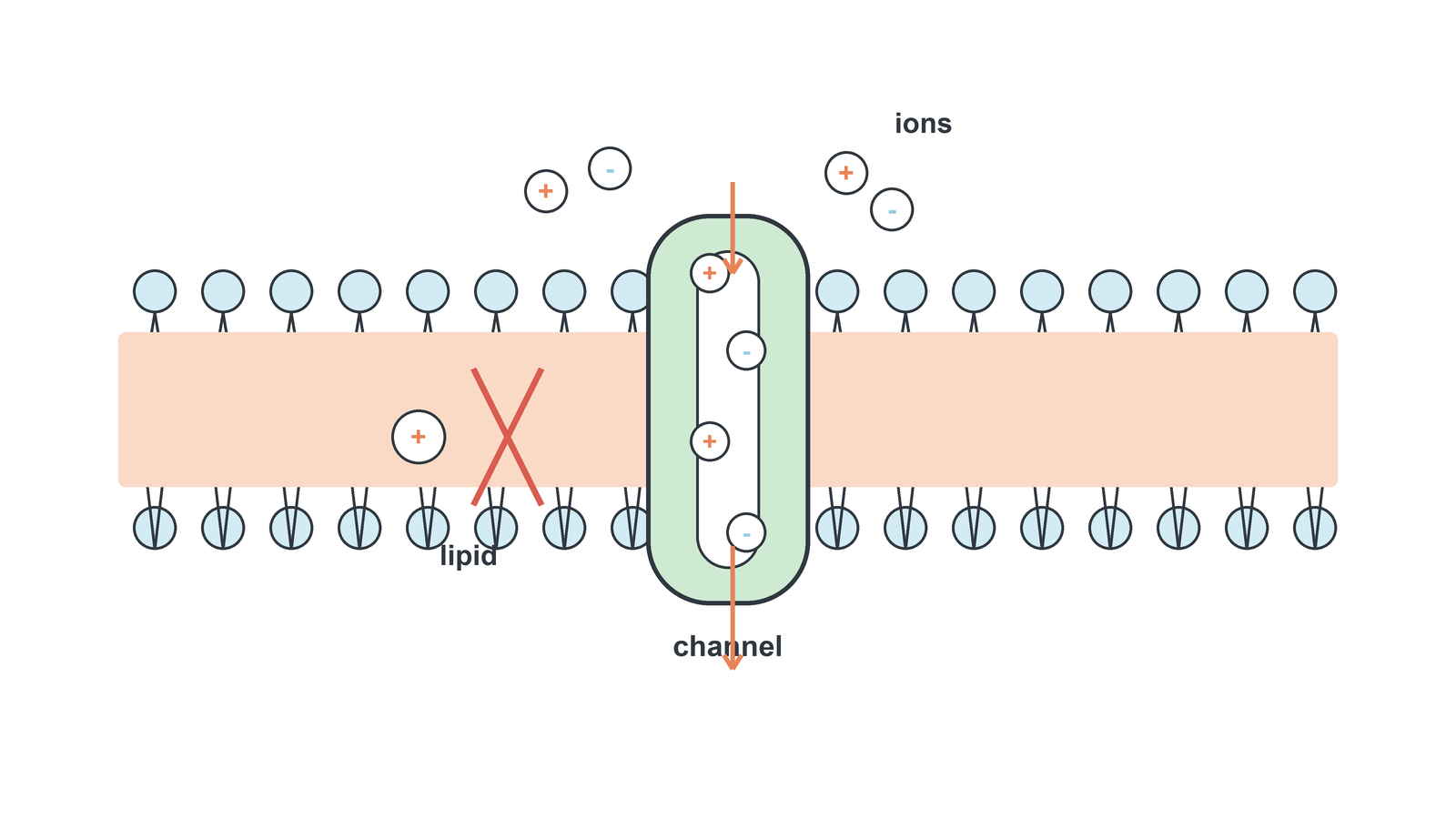
The bilayer’s hydrophobic interior slows ions and most polar molecules, while small non-polar molecules cross more readily.

Crossing depends on how well a solute interacts with the tail region and on its size. The membrane can therefore separate concentration gradients without blocking every substance equally.

Use three checks: charge/polarity, size, and whether a transport protein is available. A matching pathway can change the prediction.

Oxygen can diffuse through the tail core, but a sodium ion needs a channel or carrier because its charge is incompatible with the hydrophobic interior.

‘Barrier’ does not mean ‘impermeable’. Selectivity comes from different crossing rates, not from stopping all movement.

Bilayers as barriers

Assessment in practice

1 marks
How it is assessed

This objective is assessed through multiple choice, commonly using Identify.

Command terms

Identify

What earns marks

Build the answer around this relationship: The bilayer core is hydrophobic because fatty acid tails point inward.

Watch for

Treating polar glucose as able to pass directly through the phospholipid core.

Representative question

Question 1

[Maximum number: 1]

Neural pathways in living brains can now be mapped by tracking the movement of water molecules inside axons. What keeps water molecules inside axons?

A

Plasma membrane

B

Hydrogen bonding

C

Pump proteins

D

Synapse

Simple Diffusion Runs Down a Gradient

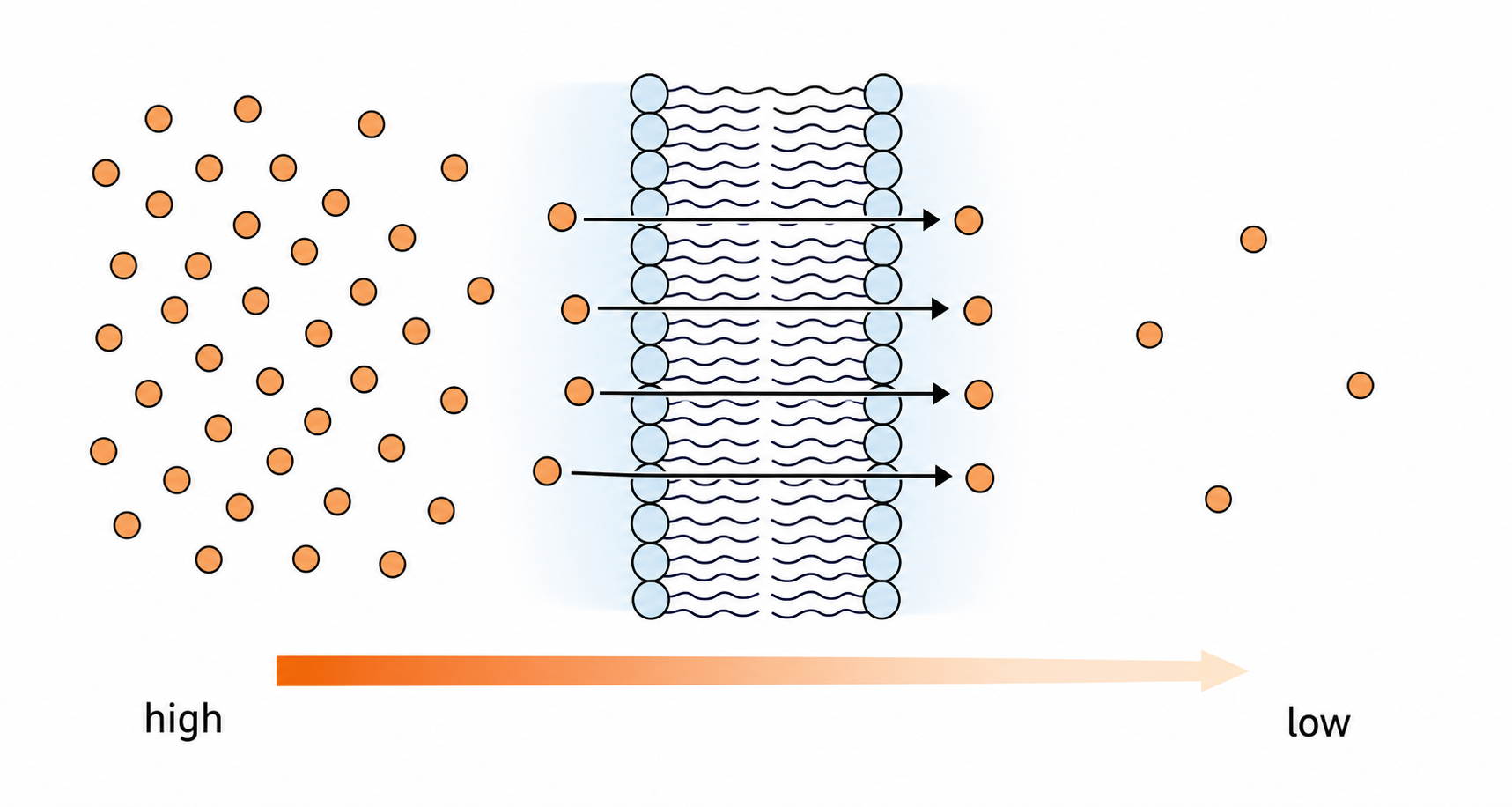
Simple diffusion is passive net movement down a concentration gradient directly between phospholipids, without ATP or a transport protein.

Particles move randomly in both directions, but more leave the higher-concentration side, producing net movement until dynamic equilibrium is approached. Small non-polar oxygen and carbon dioxide dissolve in the lipid core and cross readily.

Diffusion is faster with a steeper gradient, larger surface area, shorter diffusion distance and greater particle motion at higher temperature, provided the molecule can enter the bilayer.

Oxygen can diffuse into a respiring cell while carbon dioxide diffuses out when their respective concentration gradients point in those directions.

The cell does not direct diffusion toward need. Each gas moves according to its own gradient, and movement continues both ways even when net movement is zero.

Simple diffusion

Assessment in practice

1–3 marks
How it is assessed

This objective is assessed through structured response, commonly using Compare / Outline / Explain.

Command terms

Compare / Outline / Explain / Identify

What earns marks

Build the answer around this relationship: Simple diffusion is passive movement from higher to lower concentration.

Watch for

Adding channel proteins or ATP to simple diffusion when the row requires direct passive movement.

Representative question

Question 1

[Maximum number: 3]

Explain how the rate of diffusion of oxygen into a cell is affected by the concentration of oxygen outside of the cell.

Membrane Proteins Sit in Different Places

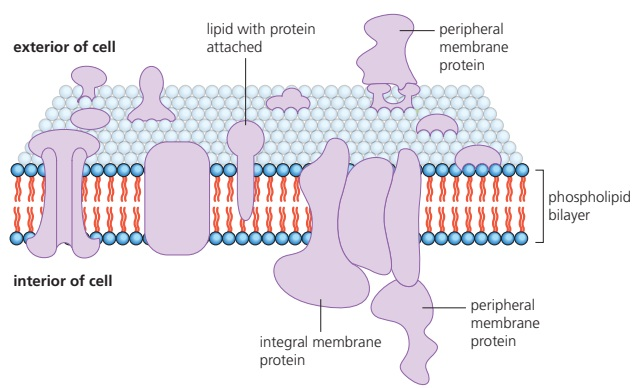
Integral proteins are embedded in one or both lipid layers and may span the membrane; peripheral proteins attach to one surface or to another membrane protein.

Hydrophobic amino-acid regions of integral proteins interact with lipid tails, while hydrophilic regions face water or form pores. Peripheral proteins remain surface-associated and can detach without crossing the hydrophobic core.

Location Typical functions
Integral Channels, carriers, pumps, receptors, enzymes and cell-recognition proteins
Peripheral Cytoskeletal anchors, scaffolds, enzymes and signalling partners on a membrane surface

A channel spanning the bilayer is integral, while a cytoskeletal protein attached to its cytoplasmic face is peripheral.

Function alone does not determine the category. Classify a protein by whether it enters the hydrophobic bilayer core or remains surface-associated.

Integral and peripheral proteins

Assessment in practice

1–4 marks
How it is assessed

This objective is assessed through structured response, commonly using State / Identify / Outline.

Command terms

State / Identify / Outline / Describe / Explain / Label

What earns marks

Build the answer around this relationship: Integral proteins are embedded in the bilayer and may span it completely.

Watch for

Listing non-membrane processes such as DNA replication or glycolysis as membrane protein functions.

Representative question

Question 1

[Maximum number: 4]

Describe the functions of proteins in cell membranes.

Osmosis Is Water Movement Through a Selective Membrane

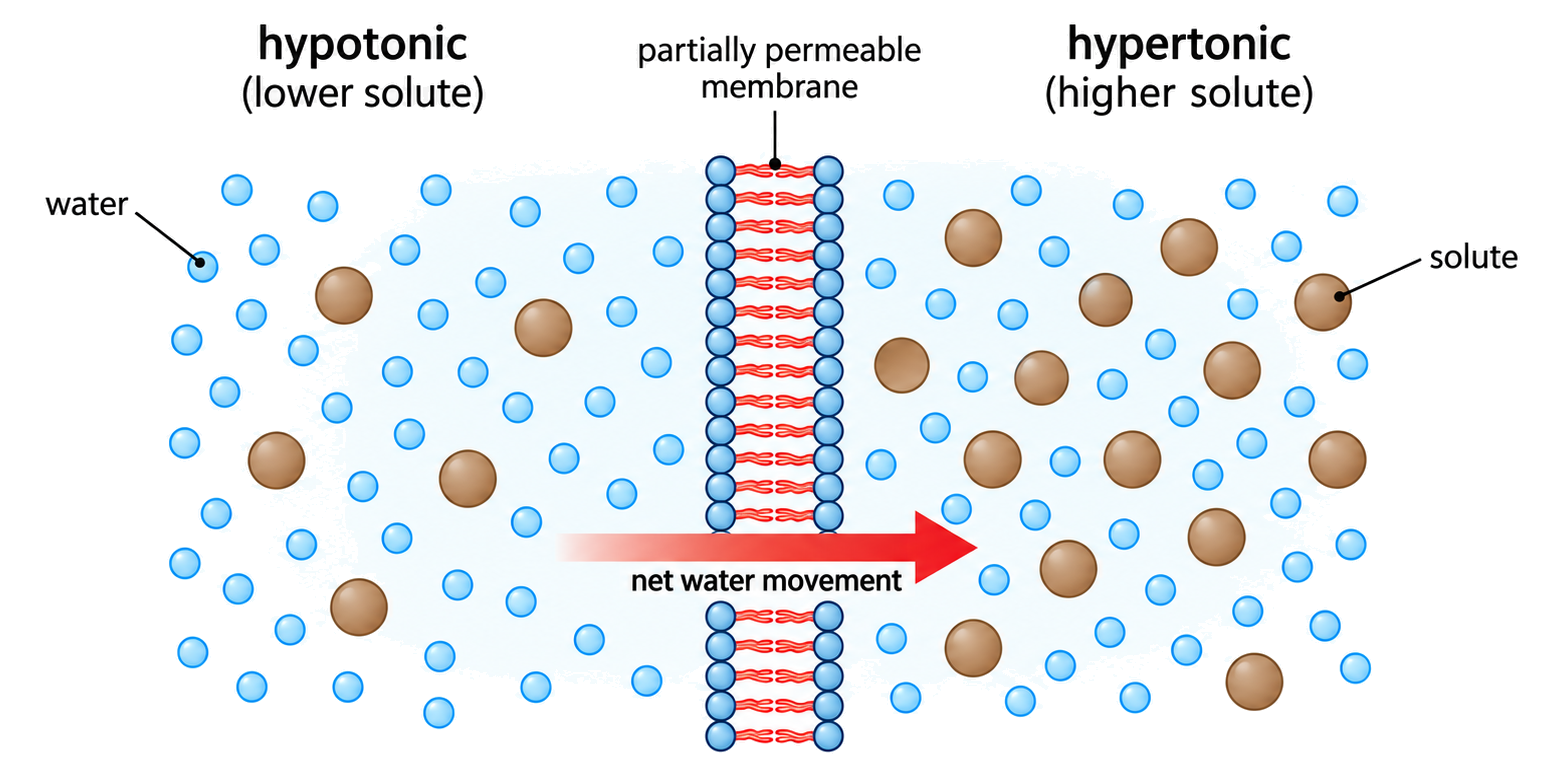
Osmosis is passive net movement of water across a membrane that is permeable to water but not freely permeable to the solutes involved.

Water molecules move randomly both ways. A difference in solute concentration creates a difference in water potential, so net water movement is from the lower-solute, higher-water-potential side toward the higher-solute, lower-water-potential side.

Aquaporins are selective protein pores that greatly increase water permeability. They change the rate of osmosis, not the direction set by the water-potential difference.

A cell in a solution with higher solute concentration than its cytoplasm loses water and shrinks; aquaporins allow that volume change to occur faster.

Do not state only that 'water follows solute'. Identify the selectively permeable membrane, compare the two solutions and distinguish net movement from random movement in both directions.

Osmosis and aquaporins

Assessment in practice

1–2 marks
How it is assessed

This objective is assessed through structured response, commonly using Describe / Identify / Define.

Command terms

Describe / Identify / Define / State / Explain / Distinguish

What earns marks

Build the answer around this relationship: Osmosis is passive net movement of water across a selectively permeable membrane.

Watch for

Describing movement of solute instead of net movement of water.

Representative question

Question 1

[Maximum number: 4]

Describe transport across cell membranes by osmosis.

Channels Give Certain Solutes a Hydrophilic Route

Channel proteins form selective hydrophilic pores through the bilayer, allowing particular ions or polar molecules to cross down an electrochemical gradient.

The pore exposes a compatible interior while the surrounding lipid tails remain excluded. Size, charge and binding sites determine which solutes pass; channels do not normally supply the energy for uphill movement.

For a channel claim, name the solute, pore selectivity and gradient direction.

An ion channel can let potassium move rapidly down its gradient while excluding a larger or differently charged ion.

A channel is not automatically an active pump. If movement is against a gradient, another energy-coupled mechanism is required.

Channel proteins

Assessment in practice

1 marks
How it is assessed

This objective is assessed through structured response, commonly using Identify / Explain / Describe.

Command terms

Identify / Explain / Describe / Outline

What earns marks

Build the answer around this relationship: Channel proteins form hydrophilic pathways through the membrane.

Watch for

Adding ATP to facilitated diffusion even when the movement is passive.

Representative question

Question 1

[Maximum number: 3]

Explain facilitated diffusion.

Pump Proteins Use Energy to Move Uphill

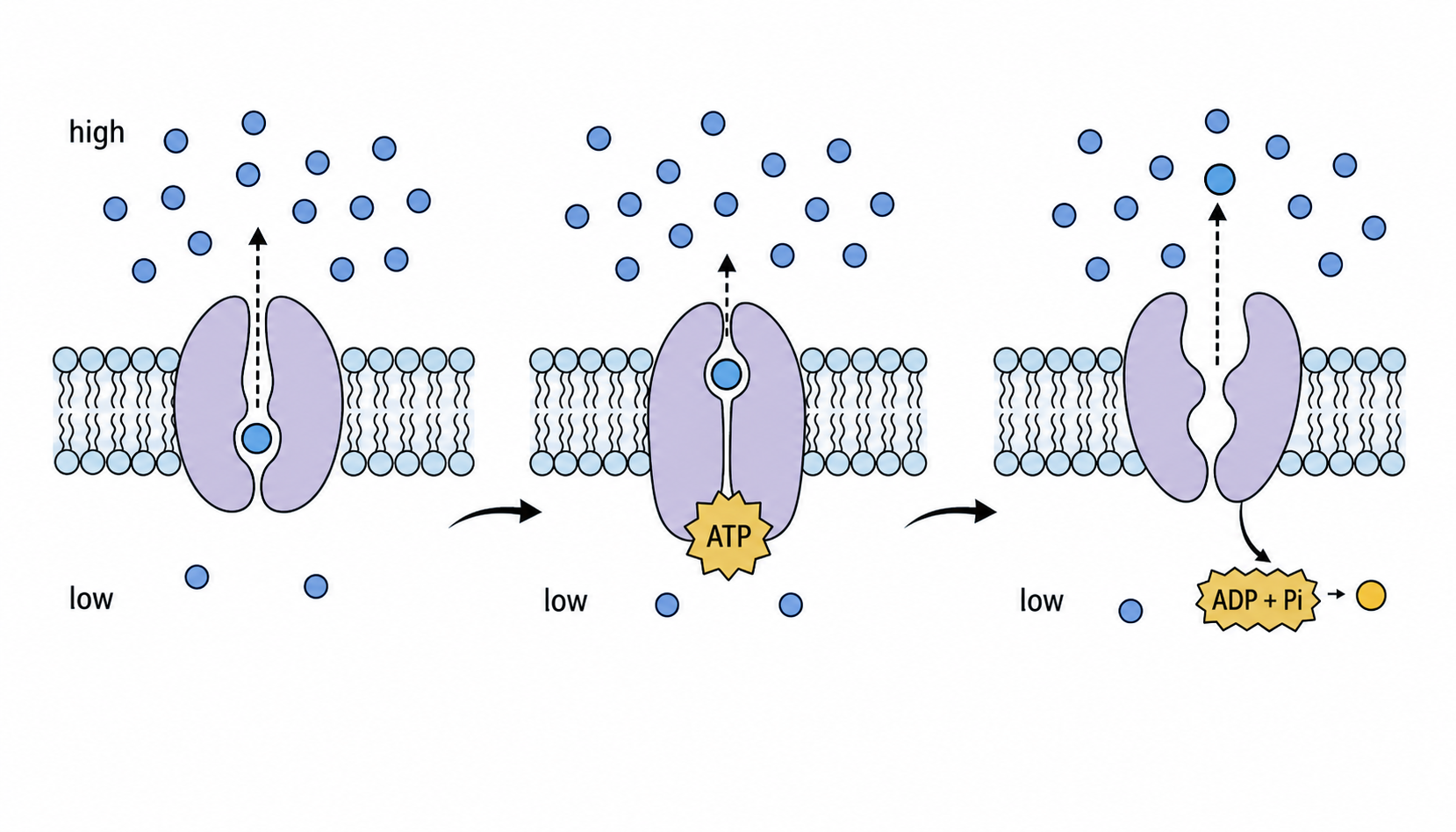
Pump proteins use energy, commonly from ATP hydrolysis, to move selected substances against their concentration or electrochemical gradient.

A pump changes conformation when energy is supplied, alternately exposing a binding site to each side of the membrane. This couples an unfavorable transport step to a favorable energy-releasing reaction.

Trace: bind solute → energy changes protein shape → release solute on the opposite side → reset.

An ATP-driven pump can keep sodium higher outside a cell even though diffusion would tend to move sodium inward.

A protein moving a solute is not enough to identify active transport; look for uphill movement and an energy source.

Pump proteins

Assessment in practice

1–3 marks
How it is assessed

This objective is assessed through structured response, commonly using Explain / Identify / Deduce.

Command terms

Explain / Identify / Deduce

What earns marks

Build the answer around this relationship: Pump proteins use ATP to move substances across membranes.

Watch for

Calling pump proteins channels when the mark scheme rejects channels for active transport.

Representative question

Question 1

[Maximum number: 3]

Calcium is absorbed from food in the human gut by both active and passive processes. Outline active transport, including the benefits of the process.

Permeability Selects by Chemistry and Pathway

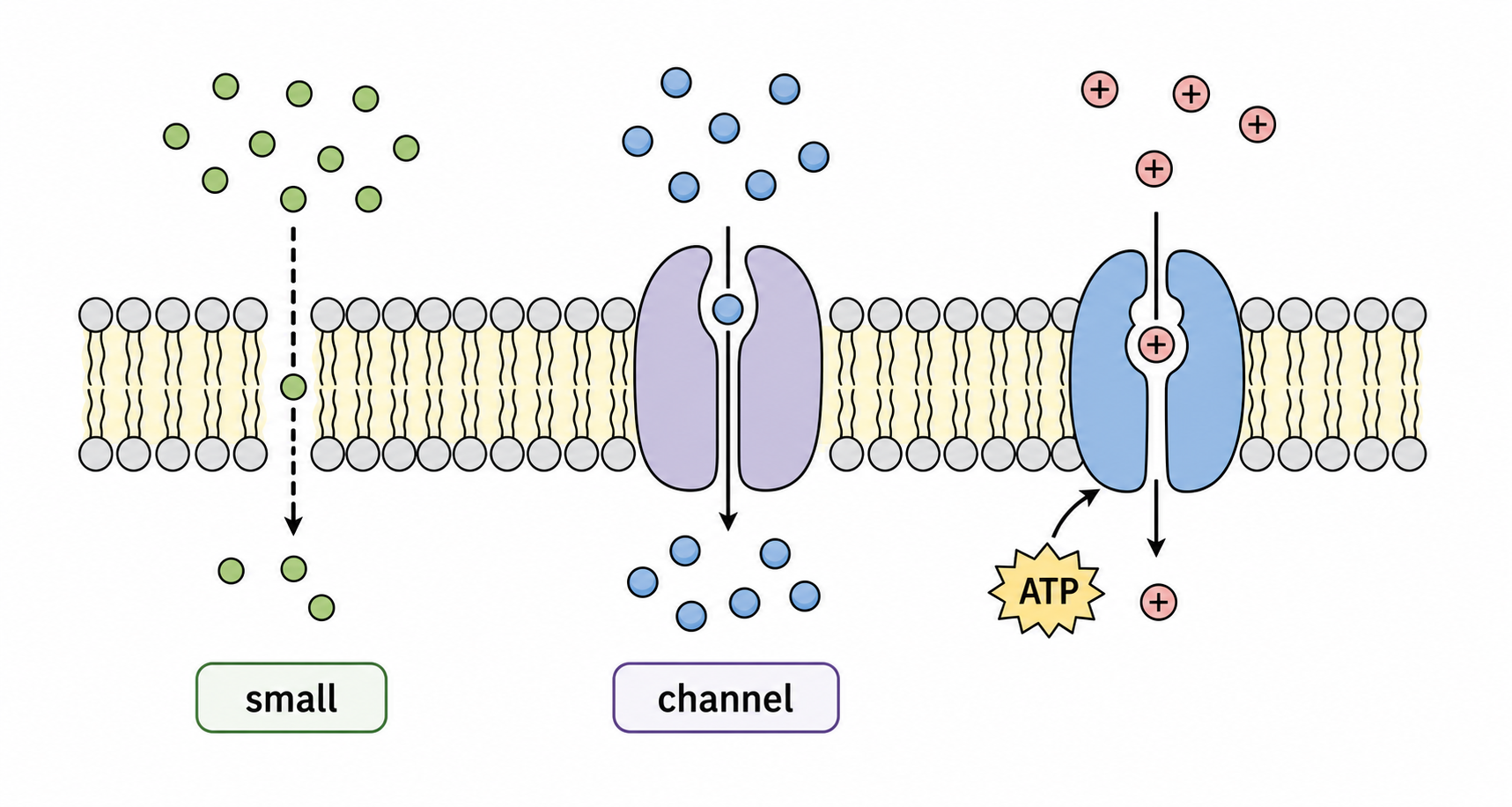
Membrane permeability depends on both the lipid bilayer and transport proteins. Simple diffusion is not protein-selective; facilitated diffusion and active transport are selective because specific proteins recognize particular particles.

For simple diffusion, crossing rate follows physical properties such as particle size and hydrophobicity. Channels, carriers and pumps add binding sites or pores that admit selected ions or molecules under defined gradient and energy conditions.

Pathway Main selectivity basis Energy/direction
Simple diffusion Size and hydrophobic/hydrophilic properties Passive, down gradient
Facilitated diffusion Specific channel or carrier structure Passive, down electrochemical gradient
Active transport Specific pump/carrier binding and coupling Can move against gradient using energy

A small non-polar gas crosses the lipid core, whereas glucose usually requires a specific carrier and sodium requires a selective channel or pump.

Selective permeability is not biological intention. It emerges from molecular interactions and the transport proteins present in that membrane.

Selectivity in permeability

Assessment in practice

1 marks
How it is assessed

This objective is assessed through multiple choice, commonly using Identify.

Command terms

Identify

What earns marks

Build the answer around this relationship: Selective permeability depends on both solute properties and membrane components.

Watch for

Saying facilitated diffusion requires ATP because it uses a protein.

Representative question

Question 1

[Maximum number: 1]

Which molecule is paired with the component of the cell membrane that allows it to pass through the membrane?

Molecule

Component of the
cell membrane

insulin

aquaporin

glycogen

channel protein

oestradiol

phospholipid bilayer

carbon dioxide

pump protein

Carbohydrate Labels Help Cells Recognize One Another

Glycoproteins and glycolipids are membrane proteins or lipids with short carbohydrate chains exposed only on the extracellular surface.

Together the outward carbohydrate chains form much of the glycocalyx. Their three-dimensional patterns bind complementary molecules, supporting cell recognition, cell-cell adhesion and signalling at the aqueous surface.

Read the structure as three linked parts: protein or lipid anchors the molecule; carbohydrate projects outside; a specific receptor, antibody or neighbouring-cell molecule binds the pattern.

Different red-cell carbohydrate antigens can be distinguished by antibodies, while adhesion glycoproteins can bind matching partners on an adjacent cell.

Membrane carbohydrates are asymmetric: they face the extracellular side, not both surfaces. Recognition and adhesion require a compatible binding partner.

Glycoproteins and glycolipids

Assessment in practice

1 marks
How it is assessed

This objective is assessed through multiple choice, commonly using Identify.

Command terms

Identify

What earns marks

The retained evidence for this node is narrow but clear: a membrane diagram asks which labelled part allows cell recognition, and the answer points to the carbohydrate-bearing surface component.

Representative question

Question 1

[Maximum number: 1]

Which part of the membrane allows cell recognition?

The Fluid Mosaic Model Combines Movement and Variety

The fluid mosaic model describes a dynamic phospholipid bilayer containing laterally mobile lipids and a mosaic of integral and peripheral proteins, glycoproteins and cholesterol.

Hydrophilic heads face aqueous solutions and hydrophobic tails form the core. Integral proteins enter or cross that core, peripheral proteins attach at surfaces, carbohydrates project extracellularly, and cholesterol fits among animal-cell phospholipids.

A correct two-dimensional drawing labels: two phospholipid layers; hydrophilic heads; hydrophobic tails; an integral protein; a peripheral protein; a glycoprotein with outward carbohydrate; and cholesterol between tails.

A receptor can diffuse laterally while maintaining its extracellular binding domain and hydrophobic membrane-spanning region, illustrating both fluidity and mosaic organization.

Fluidity mainly describes lateral movement and flexibility; it does not imply that components freely flip between leaflets or that every membrane contains identical proportions.

Fluid mosaic model

Assessment in practice

1–4 marks
How it is assessed

This objective is assessed through experimental design, commonly using Draw / Identify / Distinguish.

Command terms

Draw / Identify / Distinguish / State / Outline

What earns marks

Build the answer around this relationship: The fluid mosaic model contains a phospholipid bilayer with mobile lipids and proteins.

Watch for

Drawing proteins only as external layers rather than embedded within the bilayer.

Representative question

Question 1

[Maximum number: 6]

Draw and label a diagram to show the structure of membranes.

SL Transfer: Choose The Transport Route

The SL membrane model is a decision system. The bilayer forms because phospholipids are amphipathic, and the hydrophobic core creates selective permeability. Small non-polar molecules diffuse directly; water moves by osmosis and often through aquaporins; ions and polar molecules use channels or transporters; pumps use ATP for movement against gradients. Proteins and glycocalyx components add transport, recognition, and model evidence.

  • Bilayers self-assemble from amphipathic phospholipids.
  • The hydrophobic core blocks ions and large or hydrophilic molecules.
  • Simple diffusion, osmosis, facilitated diffusion, and active transport are chosen by molecule type and gradient.
  • Integral/peripheral proteins and the glycocalyx add transport and recognition roles.
  • The fluid mosaic model explains mobile mixed membrane components.

Topic B2.2

B2.2 Organelles and compartmentalization

Organelles and compartmentalization explain how eukaryotic cells divide work among specialized structures, controlled internal spaces, and directed vesicle transport routes.

21% of analysed papers 29 papers · 35 questions

Objectives in this topic

Organelles as functional compartments

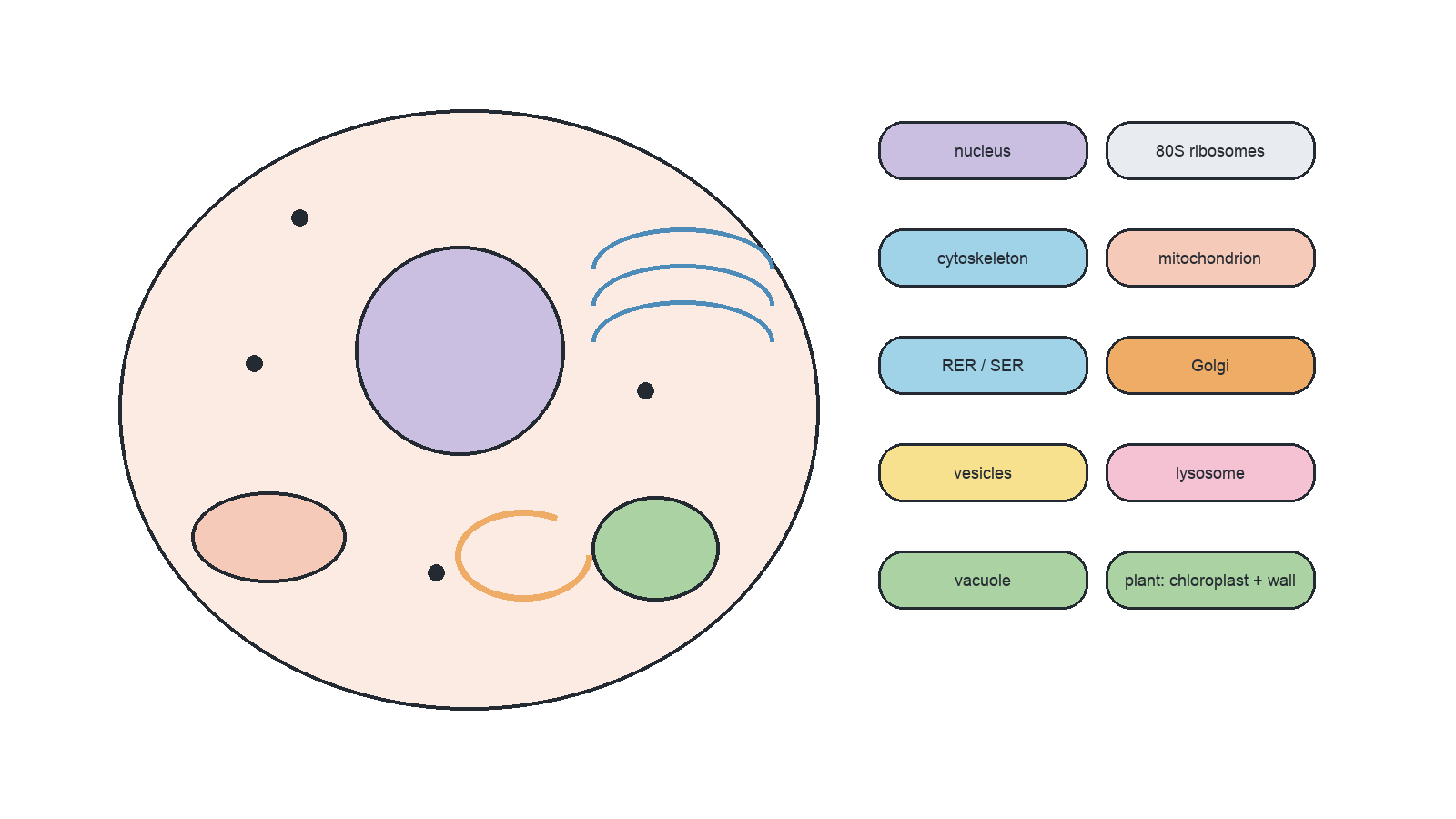
Cell compartment overview.

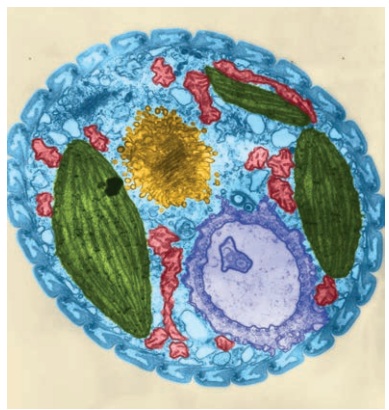
An organelle is a discrete cell subunit adapted for a specific function. In this syllabus, nuclei, chloroplasts, mitochondria, endoplasmic reticulum, Golgi apparatus, vesicles, ribosomes and the plasma membrane count as organelles; cell wall, cytoskeleton and cytoplasm do not.

Compartmentalization concentrates enzymes, substrates and metabolites, maintains conditions such as a suitable pH, and separates biochemical processes that would interfere with one another.

Lysosomes keep acidic hydrolytic enzymes separated from cytoplasm. A phagocytic vacuole can fuse with a lysosome so engulfed material is digested inside a controlled compartment rather than throughout the cell.

Cell fractionation followed by ultracentrifugation separates organelles by physical properties, allowing their structures and functions to be investigated independently.

A useful cell structure is not automatically an organelle under the IB convention. State the compartment, the concentrated or separated process, and the functional advantage.

Organelles as discrete subunits

Assessment in practice

1–2 marks
How it is assessed

This objective is assessed through structured response, commonly using Identify / State / Describe.

Command terms

Identify / State / Describe

What earns marks

Build the answer around this relationship: Organelles are discrete cell subunits adapted for specific functions.

Watch for

Giving an unqualified name such as Golgi when the evidence requires Golgi apparatus, complex, or body.

Representative question

Question 1

[Maximum number: 7]

Describe the organelles and other structures in animal cells that are visible in electron micrographs.

The Nucleus Separates Gene Expression Stages

The nuclear envelope separates transcription from cytoplasmic translation, so RNA can be processed after transcription and before it reaches ribosomes.

DNA remains in the nucleus. Pre-mRNA can be capped, polyadenylated and spliced to remove introns; mature mRNA is then exported through nuclear pores for translation.

Route in a eukaryote: DNA transcription in nucleus → post-transcriptional mRNA modification → selective pore export → translation on cytoplasmic ribosomes.

An intron can be removed from pre-mRNA before the mature transcript meets a ribosome, preventing the intron sequence from being translated.

Prokaryotes lack a nuclear compartment, so a newly made mRNA can meet ribosomes and begin translation immediately; this spatial processing interval is not available.

Advantages of compartmentalization

Assessment in practice

4 marks
How it is assessed

This objective is assessed through essay response, commonly using Discuss.

Command terms

Discuss

What earns marks

Build the answer around this relationship: Internal membranes divide eukaryotic cells into functional compartments.

Representative question

Question 1

[Maximum number: 4]

Discuss the use of membranes for compartmentalization in eukaryotic cells.

SL Transfer: Explain Why Compartments Matter

A strong answer does not say only “organelles make cells efficient.” It gives a concrete reason: compartments concentrate enzymes and substrates, maintain suitable pH, separate incompatible reactions, and let the nucleus process RNA before translation.

  • For compartmentalization, name the controlled condition or separated process.
  • For the nucleus, say transcription and RNA processing happen before cytoplasmic translation.
  • For organelle classification, use discrete functional subunit.

Topic B2.3

B2.3 Cell specialization

Cell specialization links selective gene expression, stem cell potency, cell size, exchange surfaces, and specialized tissues to biological function in multicellular organisms.

31% of analysed papers 43 papers · 49 questions

Objectives in this topic

Differentiation and stem-cell potential

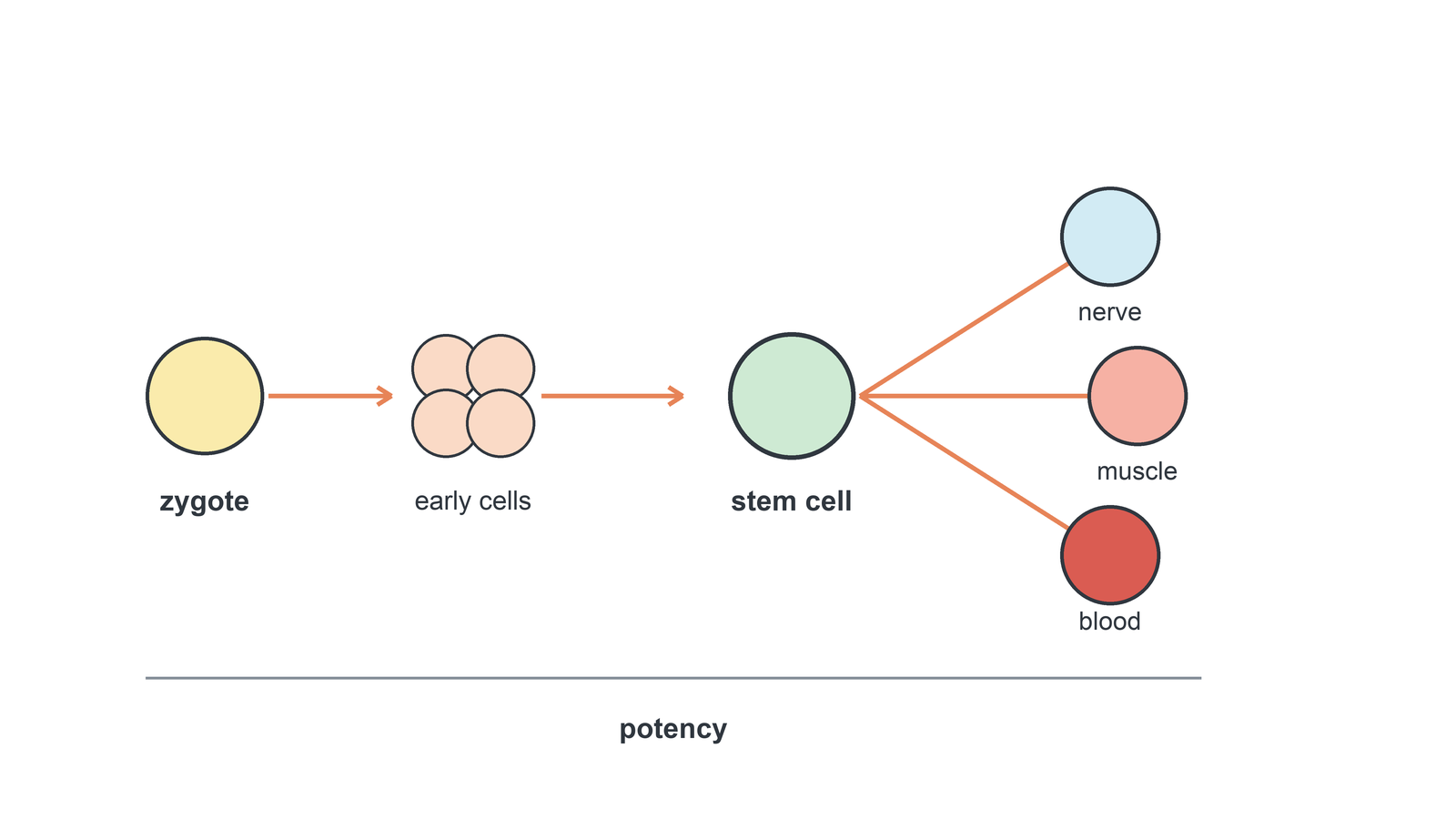
Differentiation is the process in which cells with the same genome activate different sets of genes, make different proteins, and become specialised for particular functions.

A developing embryo can use morphogen concentration gradients as positional information: different concentrations activate different gene-regulatory pathways and produce different cell fates.

Causal chain: same genome → signal or morphogen concentration → selective gene activation → different proteins → specialised cell structure and function. Stem cells self-renew by mitosis and retain the capacity to differentiate along more than one pathway.

Differentiation changes gene expression, not the chromosome set. Self-renewal is the ability to keep dividing; potency is the range of specialised cell types a stem cell can produce.

Differentiation after fertilization

Assessment in practice

1 marks
How it is assessed

This objective is assessed through multiple choice, commonly using Identify / Explain.

Command terms

Identify / Explain

What earns marks

Build the answer around this relationship: Differentiated cells usually retain the same genome as other body cells.

Watch for

Saying differentiated cells contain different chromosomes or lose unused genes.

Representative question

Question 1

[Maximum number: 1]

The micrograph of a section through a plant stem shows at least ten different types of cells.

What explains the differences between these cells?

A

Only one gene is expressed in each cell type.

B

Different genes are expressed in each cell type.

C

Only useful genes remain in the DNA of each cell type.

D

Changes in the DNA sequence take place when these cells develop.

Properties of stem cells

Assessment in practice

1–2 marks
How it is assessed

This objective is assessed through structured response, commonly using State / Identify / Describe.

Command terms

State / Identify / Describe / Outline

What earns marks

Build the answer around this relationship: Stem cells can divide while remaining undifferentiated.

Watch for

Calling stem cells already specialized rather than undifferentiated.

Representative question

Question 1

[Maximum number: 5]

Describe the characteristics of stem cells that make them potentially useful in medicine.

Compare Niches And Potency Levels

A two-part diagram with a potency ladder from totipotent to pluripotent to multipotent, plus small labeled sketches of a bone marrow niche and a hair follicle bulge niche.

A stem-cell niche is a local tissue environment whose signals can keep adult stem cells undifferentiated or trigger their proliferation and differentiation. Potency describes how many different cell fates a stem cell can produce.

Bone marrow niches regulate blood-forming stem cells, while the bulge region of hair follicles contains stem cells that maintain and regenerate follicle tissues. Changes in local signals switch cells between maintenance, division and differentiation.

Totipotent cells in the earliest embryo can form all embryonic cell types and extra-embryonic tissues. Cells soon become pluripotent, able to form all body cell types but not a whole organism. Adult stem cells such as those in bone marrow are multipotent and form a restricted family of related cells.

A blood-forming stem cell in bone marrow can self-renew or produce multiple blood-cell lineages, but it does not normally produce neurons; this is multipotency rather than pluripotency.

Potency is the range of possible differentiated descendants, not the rate of division. A niche is also more than a location: its surrounding cells and signals regulate stem-cell behaviour.

Types of stem cells

Assessment in practice

1 marks
How it is assessed

This objective is assessed through multiple choice, commonly using Identify.

Command terms

Identify

What earns marks

Build the answer around this relationship: Totipotent cells have the broadest developmental potential.

Watch for

Calling bone marrow stem cells totipotent instead of multipotent.

Representative question

Question 1

[Maximum number: 1]

Which is a description of stem cells?

A

Hair follicle stem cells are pluripotent.

B

Stem cells in bone marrow are multipotent.

C

Very early embryo stem cells are pluripotent.

D

Late embryo stem cells are totipotent.

Cell Size Balances Exchange and Internal Demand

Cell size is itself an adaptation: each specialized human cell balances the volume needed for its task with exchange distance, transport and structural demands.

Human cells span a wide range. Sperm are very small and streamlined; eggs are much larger and contain cytoplasm for early development. Red blood cells are small and thin for gas exchange, while white blood cells are larger because they contain organelles for immune activity.

Some neurons extend axons over long distances to transmit signals, and striated skeletal muscle fibres can be extremely long because many precursor cells fuse into one contractile fibre. Length and volume therefore reflect different specialized functions.

A human egg has a much larger volume than a sperm cell, whereas a red blood cell stays small and biconcave so most haemoglobin is close to the plasma membrane for rapid oxygen exchange.

Large does not mean less specialized. The important explanation links a cell's particular dimensions and shape to its function; surface area-to-volume ratio is one constraint among several.

Cell size as specialization

Assessment in practice

1 marks
How it is assessed

This objective is assessed through multiple choice, commonly using Identify.

Command terms

Identify

What earns marks

Build the answer around this relationship: Cell size can be an adaptation to specialized function.

Representative question

Question 1

[Maximum number: 1]

Which specialized cell has the largest volume?

A

Egg cell

B

Sperm cell

C

Red blood cell

D

White blood cell

Surface Area-to-Volume Ratio Predicts Exchange Capacity

Surface area-to-volume ratio (SA:V) compares the cell boundary available for exchange with the cell volume that consumes resources and produces waste.

For similar shapes, surface area increases with length squared but volume increases with length cubed. As a cell grows, its exchange surface therefore becomes smaller relative to its metabolic demand and diffusion distances increase.

ForacubeofsidelengthL:surfacearea=6L2,volume=L3,soSA:V=6L2/L3=6/L.IfLismeasuredinmm,SAisinmm2,volumeinmm3andSA/Vhasunitsmm1.For a cube of side length L: surface area = 6L², volume = L³, so SA:V = 6L²/L³ = 6/L. If L is measured in mm, SA is in mm², volume in mm³ and SA/V has units mm⁻¹.

For L = 1 mm: SA = 6(1²) = 6 mm² and V = 1³ = 1 mm³, so SA:V = 6 mm⁻¹. For L = 2 mm: SA = 24 mm² and V = 8 mm³, so SA:V = 3 mm⁻¹. Doubling length halves the ratio, leaving less exchange area per unit volume.

SA:V predicts a geometric constraint, not an exact exchange rate. Concentration gradient, membrane permeability, transport proteins and cell shape also affect movement across the surface.

Surface area-to-volume ratios

Assessment in practice

1–2 marks
How it is assessed

This objective is assessed through structured response, commonly using Identify / Explain / Outline.

Command terms

Identify / Explain / Outline / State

What earns marks

Build the answer around this relationship: Surface area affects the rate of exchange across the cell boundary.

Watch for

Saying surface area-to-volume ratio increases as a cell grows.

Representative question

Question 1

[Maximum number: 7]

Explain the importance of surface area to volume ratio as a factor limiting cell size.

Cell Specialization and Size Limits

Cell specialization comes from differential gene expression after a zygote divides, stem cells provide self-renewing cells with different potencies, and cell size is constrained by surface area-to-volume ratio because exchange depends on surface area while demand depends on volume.

  • Differentiation: same genome, different active genes, different proteins.
  • Stem cells: self-renewal plus potency; specify totipotent, pluripotent, or multipotent when needed.
  • SA:V: as cells grow, exchange becomes less efficient because volume increases faster than surface area.

Topic B3.1

B3.1 Gas exchange

Gas exchange links animal ventilation, alveolar diffusion, leaf stomata, transpiration and haemoglobin affinity to oxygen supply and carbon dioxide removal.

37% of analysed papers 52 papers · 71 questions

Objectives in this topic

Gas Exchange Supplies Cells and Removes Waste

Gas exchange is the passive diffusion of respiratory gases between an organism and its environment: oxygen is acquired for aerobic respiration and carbon dioxide is removed.

A small unicellular organism has a high surface area-to-volume ratio and every part is close to its surface, so diffusion across its membrane can meet demand. As organism size increases, SA:V decreases and the distance from interior cells to the exterior increases.

Large multicellular organisms therefore need specialized exchange surfaces plus transport systems. The exchange surface shortens the diffusion path; ventilation and circulation maintain gradients and connect the surface to internal cells.

Oxygen can diffuse directly into a small unicellular eukaryote, but in a mammal it first crosses an alveolar surface and is then carried by blood to cells far from the exterior.

Gas exchange is the crossing of a surface. Ventilation moves air, circulation transports gases inside the organism, and cell respiration consumes oxygen and produces carbon dioxide.

Gas exchange as vital function

Assessment in practice

1–3 marks
How it is assessed

This objective is assessed through structured response, commonly using Describe / Distinguish / Explain.

Command terms

Describe / Distinguish / Explain / Outline

What earns marks

Build the answer around this relationship: Aerobic cell respiration requires oxygen and produces carbon dioxide that must be removed.

Watch for

Confusing ventilation with gas exchange or with cell respiration rather than separating air movement, diffusion and energy release.

Representative question

Question 1

[Maximum number: 3]

Outline the process of gas exchange necessary for aerobic respiration in a unicellular eukaryotic organism.

Effective Gas-Exchange Surfaces Are Thin, Large and Wet

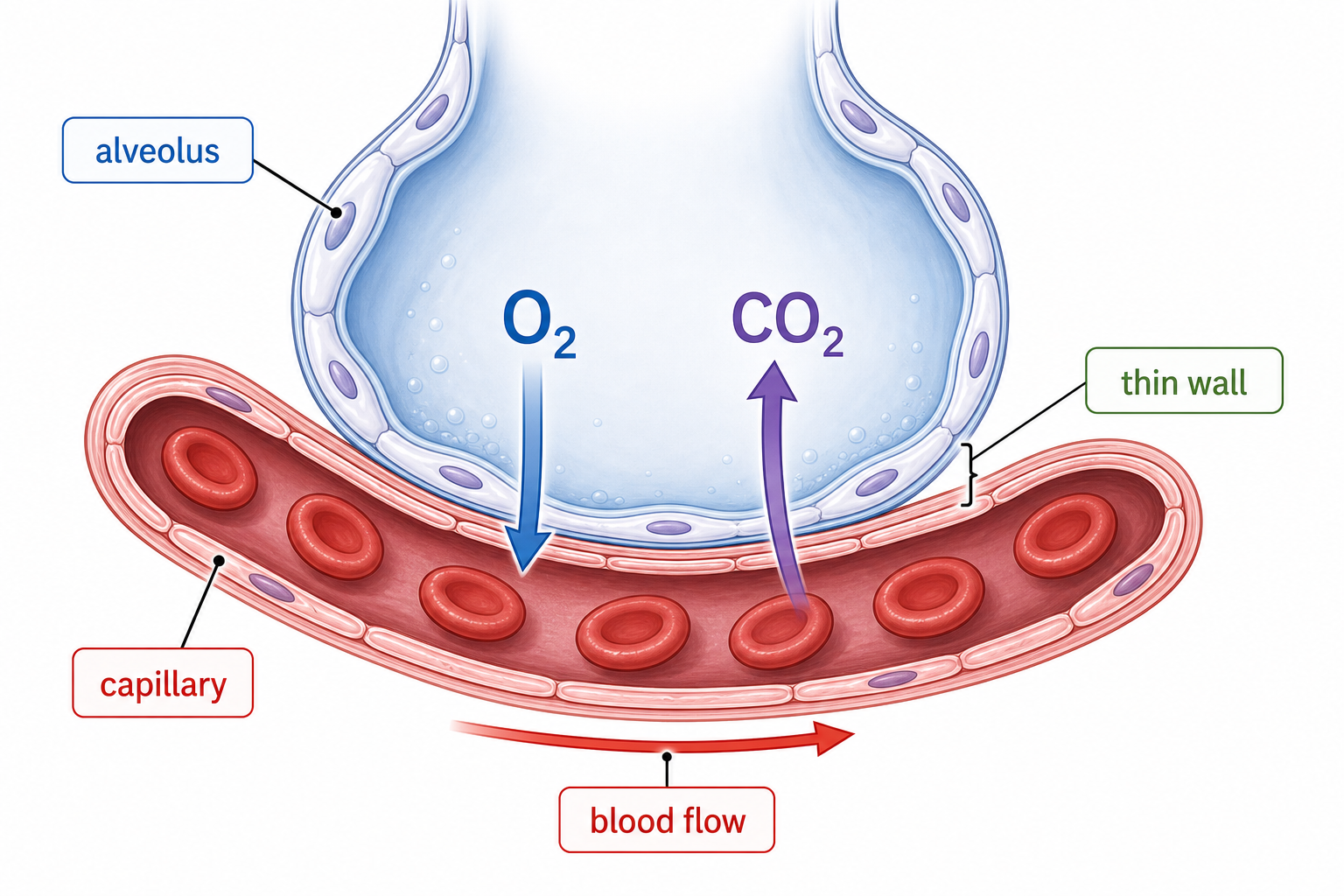
A good gas-exchange surface has a large area, a short diffusion distance and a moist barrier that gases can dissolve in.

A large area provides more parallel routes, thinness shortens travel time and moisture allows gas molecules to enter solution before crossing cells. Maintaining a gradient completes the design.

Evaluate a surface using: area; thickness; moisture; permeability; and gradient maintenance.

Alveoli combine a huge surface, one-cell-thick epithelium and moist lining, so oxygen can diffuse rapidly into nearby capillaries.

Large area alone is insufficient if the barrier is thick or the gradient is lost.

Properties of gas-exchange surfaces

Assessment in practice

1–4 marks
How it is assessed

This objective is assessed through structured response, commonly using State / Describe / Explain.

Command terms

State / Describe / Explain

What earns marks

Build the answer around this relationship: Large surface area increases the amount of gas that can diffuse at once.

Watch for

Listing alveolar features without linking each feature to faster diffusion.

Representative question

Question 1

[Maximum number: 7]

Explain the process of gas exchange taking place in the alveoli.

Gradients Keep Diffusion Moving

Animal gas-exchange surfaces maintain steep concentration gradients by continuously renewing the external medium and transporting gases away or toward the internal side.

Dense networks of blood vessels give a large contact area, and continuous blood flow brings oxygen-poor blood to the surface while carrying oxygenated blood away. This prevents the two sides from approaching equilibrium.

Ventilation renews air over lung surfaces and water over gill surfaces. Together, ventilation and circulation keep oxygen higher in the environment than in incoming blood and carbon dioxide higher in incoming blood than in the environment.

Fresh alveolar air has a higher oxygen partial pressure than venous blood arriving in adjacent capillaries; continuous airflow and blood flow preserve this difference while oxygen diffuses.

Diffusion follows a gradient but does not maintain it. Without ventilation and continuous flow, net exchange slows as concentrations approach equilibrium.

Maintaining concentration gradients

Assessment in practice

2–3 marks
How it is assessed

This objective is assessed through structured response, commonly using Explain / Describe.

Command terms

Explain / Describe

What earns marks

Build the answer around this relationship: Ventilation refreshes alveolar air so oxygen remains high and carbon dioxide remains low.

Watch for

Referring only to oxygen concentration at altitude instead of oxygen partial pressure.

Representative question

Question 1

[Maximum number: 4]

Describe how a concentration gradient of oxygen is maintained between the lungs and blood capillaries.

Mammalian Lungs Build a Short, Well-Supplied Path

Mammalian lungs use branching airways, many alveoli, thin epithelium and dense capillaries to maximize gas exchange.

Branching distributes air, alveoli create area, the thin alveolar-capillary barrier shortens diffusion distance and blood flow carries gases away. Elastic tissue and surfactant support repeated ventilation.

Link adaptation to function: bronchioles distribute; alveoli add area; thin walls shorten distance; capillaries maintain gradients.

A red blood cell passing through an alveolar capillary encounters oxygen-rich air across a very thin moist barrier.

Lung adaptations work together; naming one feature without its mechanism does not explain efficient exchange.

Mammalian lung adaptations

Assessment in practice

1–4 marks
How it is assessed

This objective is assessed through structured response, commonly using Describe / Explain / Outline.

Command terms

Describe / Explain / Outline / Identify / Predict

What earns marks

Build the answer around this relationship: Many alveoli create a large surface area for diffusion.

Watch for

Treating alveoli as muscular structures rather than thin exchange surfaces supported by ventilation and elastic recoil.

Representative question

Question 1

[Maximum number: 6]

A supply of oxygen is needed for aerobic respiration in mitochondria. Describe the features of alveoli in human lungs that adapt them for efficient absorption of oxygen.

Ventilation Replaces Air at the Gas-Exchange Surface

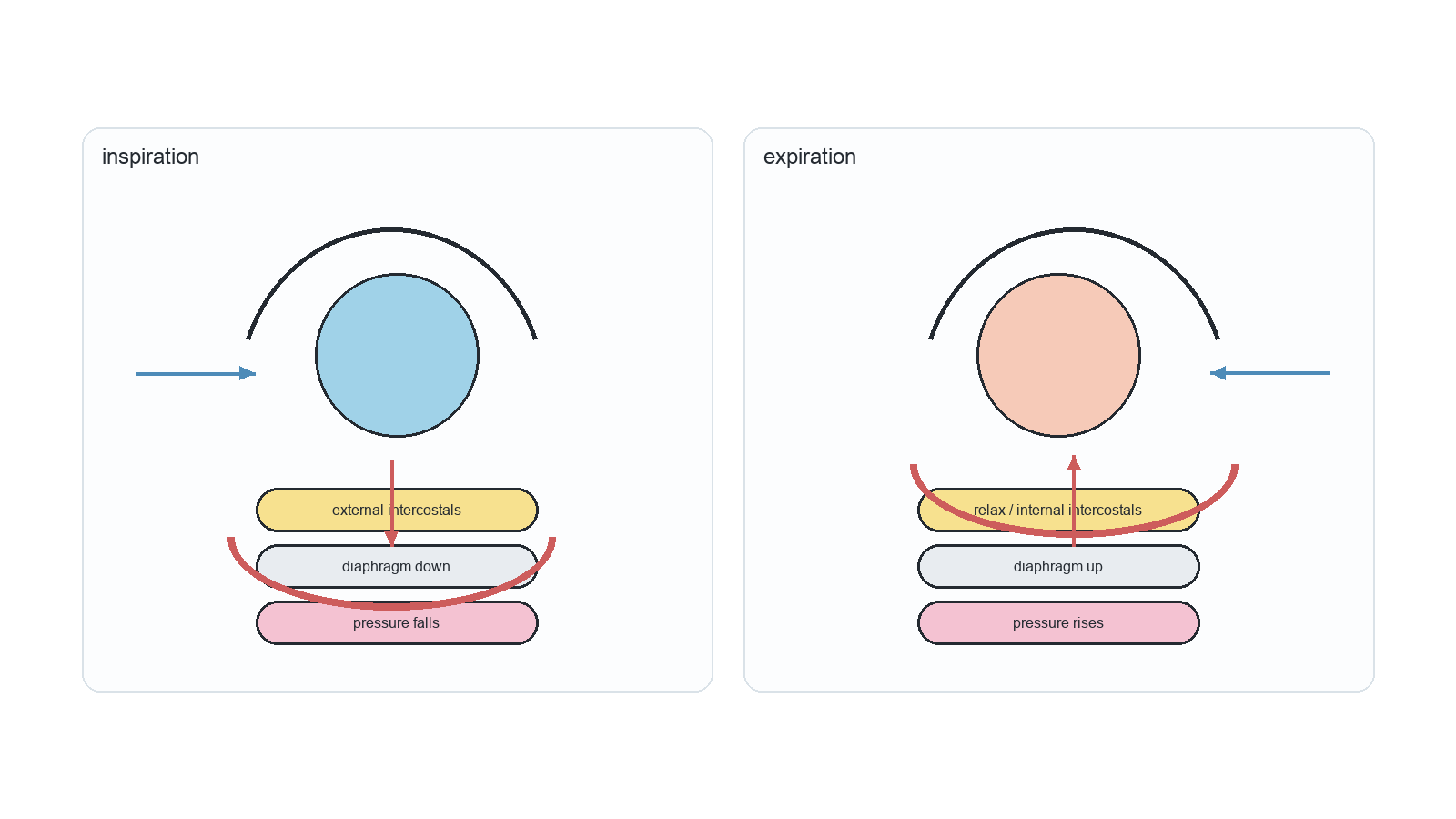
Lung ventilation results from muscles changing thoracic volume, which changes pressure relative to the atmosphere and causes air to flow.

During inspiration, the diaphragm contracts and flattens while external intercostal muscles contract, moving the ribs up and out. Thoracic volume increases, pressure falls below atmospheric pressure and air enters.

During quiet expiration these muscles relax and elastic recoil lowers thoracic volume, raising pressure so air leaves. During forced expiration, internal intercostals pull the ribs down and in while abdominal muscles push the diaphragm upward.

Sequence for inhalation: diaphragm contracts + ribs move up/out → thoracic volume increases → intrapulmonary pressure decreases → air flows into the lungs down the pressure gradient.

The diaphragm does not pull air directly. It changes thoracic volume; the resulting pressure difference moves air. Abdominal muscles are especially important in forced, not quiet, expiration.

Lung ventilation

Assessment in practice

1–4 marks
How it is assessed

This objective is assessed through structured response, commonly using Explain / Outline / Identify.

Command terms

Explain / Outline / Identify / Describe / State

What earns marks

Build the answer around this relationship: Inhalation occurs when diaphragm and external intercostal contraction increases thoracic volume.

Watch for

Reversing the pressure change during inhalation by saying contraction raises thoracic pressure.

Representative question

Question 1

[Maximum number: 9]

Explain the mechanism of ventilation in the lungs in order to promote gas exchange for cell respiration.

Spirometry Measures Air Volumes, Not Every Lung Volume

A spirometer records air volume moved over time. Tidal volume is the air moved in a normal breath; inspiratory and expiratory reserve volumes are the additional amounts moved by maximal inspiration or expiration.

On a trace, vertical differences represent volume and the horizontal axis represents time. Identify the normal peak-to-trough change for tidal volume, then measure from a normal limit to the corresponding maximal limit for each reserve.

Vitalcapacity=inspiratoryreservevolume+tidalvolume+expiratoryreservevolume.Useoneconsistentvolumeunit,suchasdm3orL.Vital capacity = inspiratory reserve volume + tidal volume + expiratory reserve volume. Use one consistent volume unit, such as dm³ or L.

Measure the vertical distance from maximal inspiration to maximal expiration to obtain vital capacity; it should equal the sum of the three component volumes measured from the same calibrated trace.

Simple spirometry cannot directly measure residual volume because that air never leaves the lungs. Do not confuse a spirometer with a respirometer, which measures aspects of respiration rather than lung ventilation.

Lung volume measurements

Assessment in practice

1–2 marks
How it is assessed

This objective is assessed through structured response, commonly using Define / State / Calculate.

Command terms

Define / State / Calculate / Compare / Describe / Outline

What earns marks

Build the answer around this relationship: Tidal volume is the volume of air moved during one normal breath.

Watch for

Giving a ventilation-rate number without breaths per minute or another valid time unit.

Representative question

Question 1

[Maximum number: 2]

Outline how ventilation rate could have been monitored in this study.

Leaves Exchange Gases While Limiting Water Loss

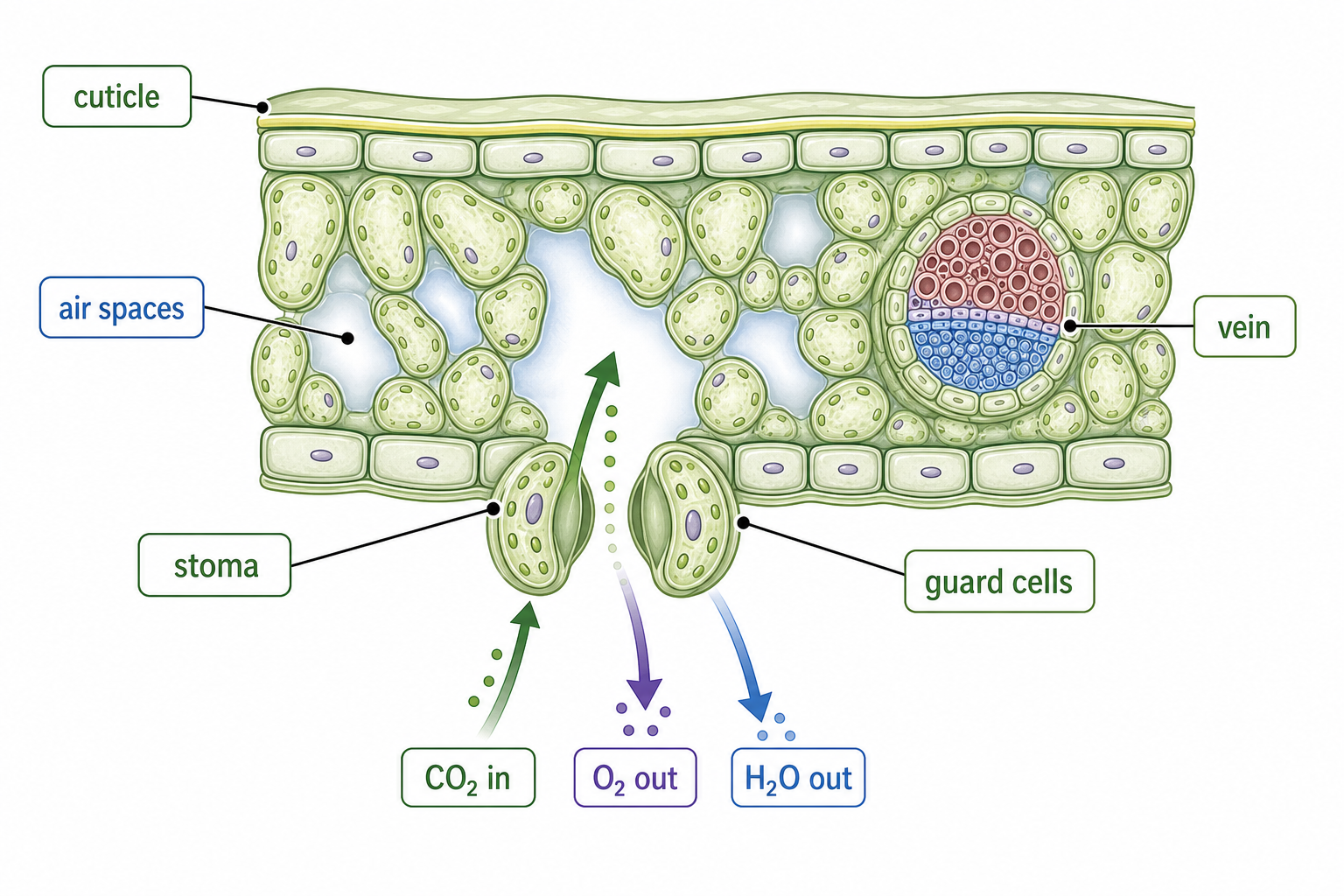
A leaf provides short internal routes for carbon dioxide and oxygen while limiting uncontrolled water loss through its exposed surface.

The transparent epidermis protects the leaf, and its waxy cuticle reduces evaporation. Stomata form adjustable pores; guard-cell turgor changes their aperture to balance carbon-dioxide entry with water-vapour loss.

Spongy mesophyll contains connected air spaces that expose large moist cell surfaces to gases. Veins deliver water needed by mesophyll cells and transport products away, while stomata connect the internal air spaces to the atmosphere.

When guard cells open a stoma in light, carbon dioxide diffuses through the pore and air spaces to photosynthesizing mesophyll, but water vapour can diffuse out along the same route.

The cuticle is a barrier that reduces water loss rather than the main gas-entry route. Stomatal opening is regulated, so leaves do not maximize gas exchange continuously.

Leaf gas exchange adaptations

Assessment in practice

1–2 marks
How it is assessed

This objective is assessed through structured response, commonly using Identify / Explain.

Command terms

Identify / Explain

What earns marks

Build the answer around this relationship: Stomata allow carbon dioxide, oxygen and water vapour to diffuse through the epidermis.

Watch for

Calling any pore a stoma without identifying the guard-cell opening through the epidermis.

Representative question

Question 1

[Maximum number: 2]

Explain the roles of two leaf structures that help with the process of gas exchange in the leaf.

Leaf Tissues Place Exchange Routes Close to Photosynthetic Cells

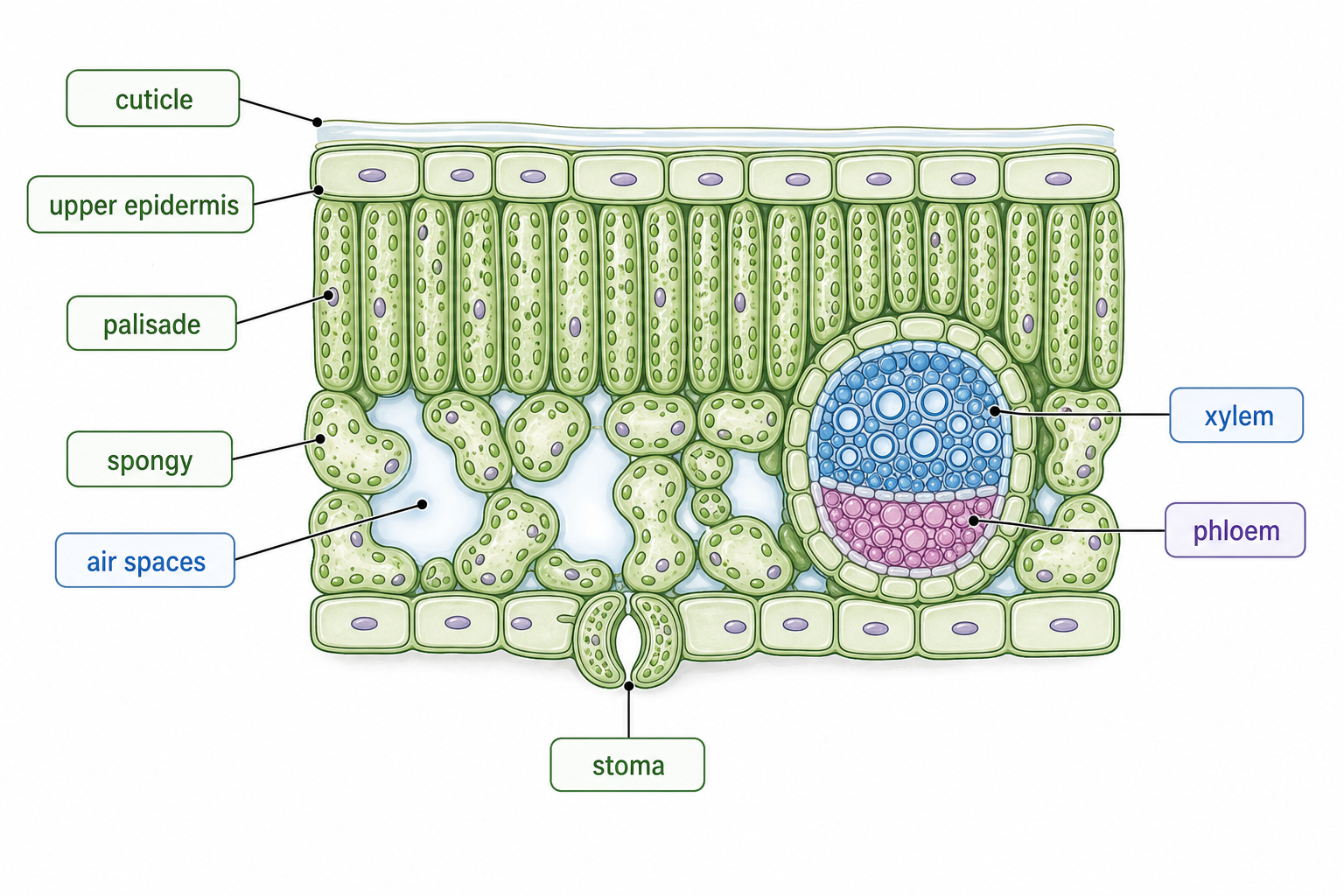
A plan diagram of a dicot leaf transverse section shows the relative distribution of tissues from upper to lower surface, without drawing individual cells.

The usual sequence is cuticle and upper epidermis → palisade mesophyll → spongy mesophyll with air spaces → lower epidermis with stomata. Vascular bundles lie within the mesophyll, with xylem generally nearer the upper surface and phloem nearer the lower.

Use clear single lines, preserve relative layer thickness and label tissue regions. Include cuticle, upper and lower epidermis, palisade and spongy mesophyll, air spaces, a vascular bundle with xylem and phloem, and stomata/guard cells in the epidermis.

Carbon dioxide entering a lower-surface stoma follows connected spongy-mesophyll air spaces to photosynthetic cells, while xylem in a nearby vein supplies water.

A plan diagram records tissue distribution, not fine cellular detail: do not shade, sketch every chloroplast or replace relative positions with a list of structures.

Leaf tissue distribution

Assessment in practice

1–5 marks
How it is assessed

This objective is assessed through structured response, commonly using Draw / Explain.

Command terms

Draw / Explain

What earns marks

Build the answer around this relationship: Palisade mesophyll lies near the upper leaf surface and is rich in chloroplasts.

Watch for

Drawing individual cell detail when a plan diagram should show tissue distribution and relative positions.

Representative question

Question 1

[Maximum number: 8]

Explain how the distribution of tissues in the leaf of a dicotyledonous plant is adapted to production and distribution of products of photosynthesis.

Transpiration Pulls Water Through Leaves

Transpiration is water loss from a plant: water evaporates from moist mesophyll cell walls and the vapour diffuses through leaf air spaces and out through stomata.

Gas exchange exposes moist internal surfaces to the atmosphere, so stomatal opening for carbon dioxide entry also permits water-vapour loss. A steeper water-vapour gradient or more open stomata increases the rate.

Higher temperature increases evaporation; lower humidity steepens the vapour gradient; wind removes the humid boundary layer; light commonly promotes stomatal opening. Water stress can close stomata and reduce transpiration.

A warm, dry, windy leaf usually transpires faster than a cool leaf in still, humid air because evaporation is faster and the external boundary layer is continually replaced.

A potometer measures water uptake as an estimate, not transpiration directly; water may also be used in growth or photosynthesis. State which factor changes evaporation, gradient or stomatal aperture.

Transpiration exam focus

Assessment in practice

1–2 marks
How it is assessed

This objective is assessed through structured response, commonly using Explain / Outline / Suggest.

Command terms

Explain / Outline / Suggest / Define / Compare

What earns marks

Build the answer around this relationship: Transpiration involves evaporation from leaf surfaces followed by diffusion through stomata.

Watch for

Assuming a potometer directly measures water lost rather than estimating it from water uptake.

Representative question

Question 1

[Maximum number: 8]

Explain how abiotic factors affect the rate of transpiration in terrestrial plants.

Stomatal Density Changes Potential Gas Exchange

Stomatal density is the number of stomata per unit leaf area, determined from a micrograph or a leaf-surface cast with a calibrated field of view.

Count only stomata within a known sampled area and divide by that area. Use a consistent boundary rule so stomata touching an edge are not counted twice across adjoining fields.

Stomataldensity=numberofstomatacounted÷sampledarea;report,forexample,instomatamm2.Stomatal density = number of stomata counted ÷ sampled area; report, for example, in stomata mm⁻².

Repeat counts in several randomly or systematically selected fields from the same leaf surface, calculate each density and report a mean; repeat across leaves when comparing plants.

One field may not represent a biologically variable leaf. Replication increases reliability, while magnification alone is insufficient unless the real field area has been calibrated.

Stomatal density

Assessment in practice

1 marks
How it is assessed

This objective is assessed through structured response, commonly using Outline.

Command terms

Outline

What earns marks

Build the answer around this relationship: Stomatal density is calculated as the number of stomata divided by leaf area observed.

Representative question

Question 1

[Maximum number: 1]

Outline how stomatal density in busy Lizzie leaves can be estimated within a known field of view.

Gas Exchange Across Animals And Leaves

Core gas-exchange answers link exchange surfaces to diffusion gradients. For animals, exchange surfaces are explained by diffusion properties, ventilation, and blood flow. For plants, leaves allow carbon dioxide entry and oxygen/water vapour exit while controlling water loss through stomata. Spirometry, transpiration, and stomatal density data provide evidence of gradient and surface-area effects.

  • Core animal answer: large, thin, moist, permeable surface plus ventilation and blood flow.
  • Core plant answer: stomata, guard cells, mesophyll air spaces, cuticle, and transpiration factors.
  • Data questions usually test rate, gradient, volume, or density per area.

Topic B3.2

B3.2 Transport

Transport systems move materials through animal blood vessels, plant xylem and phloem, and heart-driven circuits using specialised structures and pressure gradients.

42% of analysed papers 59 papers · 69 questions

Objectives in this topic

Capillaries Trade Speed for Exchange

Capillaries are narrow, highly branched exchange vessels whose structure maximizes contact with tissues while minimizing diffusion distance.

Branching produces a very large total surface area. A lumen only slightly wider than a red blood cell brings blood close to the wall, and a one-cell-thick endothelium provides a short path for diffusion.

Some capillaries have fenestrations—small pores through endothelial cells—where especially rapid fluid or solute exchange is required. Their narrow diameter also slows individual red cells and increases exchange time.

In an alveolar capillary, oxygen crosses thin alveolar and capillary layers into a red blood cell; in a fenestrated capillary, pores permit faster movement of water and small dissolved substances.

Thin walls suit exchange, not high-pressure transport. Fenestrations occur in some capillary beds, not every capillary, and blood cells plus most large proteins normally remain inside.

Capillary adaptations

Assessment in practice

1–2 marks
How it is assessed

This objective is assessed through structured response, commonly using Identify / Describe / Explain.

Command terms

Identify / Describe / Explain

What earns marks

Build the answer around this relationship: Capillary walls are one cell thick, giving a short diffusion path.

Watch for

Describing capillary walls as thin membranes instead of one-cell-thick endothelial walls.

Representative question

Question 1

[Maximum number: 3]

Explain how the structure of capillaries relates to their functions.

Arteries and Veins Handle Different Pressures

Arteries carry blood away from the heart under higher pressure; veins return blood at lower pressure and need valves and muscle assistance.

Thick elastic and muscular artery walls absorb pulse pressure. Veins have wider lumens, thinner walls and valves that prevent backflow as surrounding muscles compress them.

Trace direction and pressure first; then use wall thickness, lumen and valves to explain the vessel’s job.

During walking, leg muscles squeeze veins and push blood past valves toward the heart; the artery on the same route carries blood away under pulse pressure.

‘Away from the heart’ defines an artery, not oxygen content; the pulmonary artery carries deoxygenated blood.

Artery and vein structure

Assessment in practice

1–3 marks
How it is assessed

This objective is assessed through structured response, commonly using Identify / Label / Describe.

Command terms

Identify / Label / Describe / Explain / Distinguish

What earns marks

Build the answer around this relationship: Arteries have thicker walls and smaller lumens than veins.

Watch for

Using non-visible features such as valves when a micrograph question asks for visible artery-vein differences.

Representative question

Question 1

[Maximum number: 8]

Explain the structures and functions of arteries and veins.

Artery Walls Withstand Pulse Pressure

Arteries have thick muscular and elastic walls that maintain a lumen and smooth pressure pulses from the heart.

Elastic recoil helps keep blood moving between heartbeats, while smooth muscle adjusts diameter and resistance. The wall must withstand higher pressure than a vein.

Separate pulse smoothing from resistance control: which wall feature does each job?

A constricted arteriole raises resistance and can redirect blood flow, whereas elastic recoil in a large artery smooths the pulse.

A thick wall does not mean blood always flows faster; diameter, resistance and downstream demand also matter.

Artery adaptations

Assessment in practice

1–3 marks
How it is assessed

This objective is assessed through structured response, commonly using Identify / Explain.

Command terms

Identify / Explain

What earns marks

Build the answer around this relationship: Thick collagen-rich artery walls resist rupture under high pressure.

Watch for

Saying arteries pump blood by themselves rather than explaining elastic recoil after ventricular contraction.

Representative question

Question 1

[Maximum number: 5]

Explain how the structure of an artery allows it to carry out its function efficiently.

Pulse Rate Is a Repeated Pressure Signal

Pulse rate is the number of arterial pressure waves per minute, normally corresponding to ventricular contractions.

Place fingertips—not the thumb—lightly over the radial artery at the wrist or the carotid artery in the neck. Count waves for a known interval while the subject is still and use a full minute when maximum accuracy is needed.

Pulserate(beatsmin1)=pulsecount×(60s÷countingintervalins).Pulse rate (beats min⁻¹) = pulse count × (60 s ÷ counting interval in s).

Counting 18 pulses in 15 s gives 18 × (60/15) = 72 beats min⁻¹. Repeat after recovery and compare with a digital heart-rate sensor recorded over the same interval.

Short counts magnify counting error, and pulse rate is not cardiac output: cardiac output also depends on stroke volume. Record posture, activity and method when comparing results.

Pulse rate measurement

Assessment in practice

2 marks
How it is assessed

This objective is assessed through structured response, commonly using Outline.

Command terms

Outline

What earns marks

Build the answer around this relationship: Pulse is an arterial pressure wave produced by ventricular contraction.

Representative question

Question 1

[Maximum number: 2]

Outline one method that the researchers could have used to measure heart rate in this study.

Veins Return Blood at Low Pressure

Veins use large lumens, valves and skeletal-muscle contractions to return blood to the heart despite low pressure.

A wide lumen reduces resistance, valves stop reverse flow and muscle compression raises local pressure. Breathing movements can also help draw venous blood toward the chest.

Follow one bolus of venous blood upward and identify how valves and muscle compression prevent reversal.

When calf muscles contract, a valve below the compressed region closes while the valve above opens, pushing blood upward.

Valves do not create the original pressure; they make one-way assistance effective.

Vein adaptations

Assessment in practice

1–2 marks
How it is assessed

This objective is assessed through structured response, commonly using Identify / State / Explain.

Command terms

Identify / State / Explain / Deduce

What earns marks

Build the answer around this relationship: Vein valves keep blood moving toward the heart.

Watch for

Explaining venous flow without mentioning valves that prevent backflow.

Representative question

Question 1

[Maximum number: 2]

Deduce what the experiment demonstrated about the circulation of blood.

Coronary Occlusion Starves Heart Muscle

Coronary artery occlusion interrupts oxygen delivery to cardiac muscle and can cause myocardial infarction: irreversible death of part of the heart muscle.

Endothelial damage can allow lipid-rich atheroma to develop beneath the artery lining. A plaque narrows the lumen, and rupture can activate platelets and fibrin formation, producing a thrombus that partly or completely blocks flow.

Reduced coronary flow causes ischaemia: aerobic ATP production falls while cardiac muscle continues to demand energy. Prolonged complete occlusion damages and kills the supplied tissue, impairing contraction.

Epidemiological data may show a positive correlation between a proposed risk factor and coronary disease. A correlation coefficient quantifies direction and strength, but confounding variables and study design must be considered.

Even a strong correlation does not by itself prove that one variable causes coronary occlusion. Distinguish gradual plaque narrowing from an acute thrombus after plaque rupture.

Coronary artery occlusion

Assessment in practice

1–2 marks
How it is assessed

This objective is assessed through structured response, commonly using Outline.

Command terms

Outline

What earns marks

Build the answer around this relationship: Coronary arteries supply oxygen to cardiac muscle.

Watch for

Treating cholesterol correlation data as proof of direct causation.

Representative question

Question 1

[Maximum number: 2]

Outline the causes and consequences of blood clot formation in coronary arteries.

Roots and Xylem Form a Continuous Water Path

Transpiration creates tension—a negative pressure potential—that pulls a continuous water column from roots to leaves through xylem.

Water evaporating from moist mesophyll cell walls draws replacement water through the wall by capillary action and out of nearby xylem. This lowers pressure in the leaf xylem and transmits tension down the vessel.

Cohesion from hydrogen bonding keeps water molecules joined so the pull is transmitted through an unbroken column. Adhesion to hydrophilic xylem walls assists capillary movement and helps stabilize the column.

When stomata open and evaporation increases, the leaf water potential becomes more negative, increasing tension in xylem and drawing water upward from roots.

The main long-distance force is tension generated at transpiring leaves, not an active pump in xylem. Cohesion transmits the pull; it does not create the initial gradient.

Water transport in plants

Assessment in practice

2–7 marks
How it is assessed

This objective is assessed through structured response, commonly using Identify / Describe / Explain.

Command terms

Identify / Describe / Explain / Predict

What earns marks

Build the answer around this relationship: Transpiration pull creates tension that draws water upward through xylem.

Watch for

Explaining water movement as active transport through xylem rather than passive tension-driven flow.

Representative question

Question 1

[Maximum number: 8]

Explain the process of water uptake and transport by plants.

Xylem Tubes Carry Water Efficiently

Mature xylem vessel elements form dead, hollow, lignified tubes adapted to carry water under tension with little resistance.

Loss of cytoplasm and organelles leaves an open lumen. End walls are absent or perforated, so aligned elements form a continuous route rather than forcing water across repeated membranes.

Lignin thickens and waterproofs the wall and prevents collapse under negative pressure. Unlignified pits allow water to enter or leave laterally, bypass a blockage, and move between xylem and surrounding tissue.

If air blocks one vessel, water can pass through pits into an adjacent vessel while lignified walls keep both tubes open under transpiration tension.

Xylem vessel elements are dead at maturity and do not actively pump water. Pits are thin wall regions for lateral movement, not open ends of the vessel.

Xylem vessel adaptations

Assessment in practice

2–3 marks
How it is assessed

This objective is assessed through structured response, commonly using Identify / Outline.

Command terms

Identify / Outline

What earns marks

Build the answer around this relationship: Xylem vessels lack cell contents, so water flow is less obstructed.

Watch for

Saying xylem is dead without explaining how lack of contents reduces resistance.

Representative question

Question 1

[Maximum number: 3]

Joints are part of the musculoskeletal system of animals, which provides support and movement to the body. Xylem provides support in plants and also transports water and minerals. Explain the adaptations of xylem for its functions.

Stem Tissues Place Transport in Separate Paths

A transverse section of a young dicot stem has an outer epidermis, cortex beneath it, vascular bundles arranged in a ring and a central pith.

Within each vascular bundle, phloem lies toward the outside, xylem toward the centre and cambium between them. The ring links transport around the stem while lignified xylem and supporting fibres add strength.

For a plan diagram, draw tissue boundaries with clear single lines and correct relative positions; do not draw individual cells. Label epidermis, cortex, vascular bundles, phloem, cambium, xylem and pith, then annotate their main functions.

Annotate xylem as water/mineral transport and support, phloem as translocation of assimilates, cortex as storage/support and epidermis as the protective outer boundary.

A plan diagram shows distribution and proportion, not cellular detail or shading. In each dicot stem bundle, xylem is inner and phloem outer; do not reverse them.

Stem tissue distribution

Assessment in practice

1 marks
How it is assessed

This objective is assessed through structured response, commonly using Identify / Label / Describe.

Command terms

Identify / Label / Describe

What earns marks

Build the answer around this relationship: Dicot stem vascular bundles are arranged in a ring.

Watch for

Confusing xylem and phloem positions within a dicot stem vascular bundle.

Representative question

Question 1

[Maximum number: 2]

Describe the distribution of vascular tissues in the stem of dicotyledonous plants.

Roots Combine Absorption with Selective Entry

A transverse section of a young dicot root has an outer epidermis, a broad cortex and a central vascular cylinder containing xylem and phloem.

Root hairs extend from epidermal cells to increase absorption area. The endodermis forms the inner boundary of the cortex, surrounding the central vascular tissue and controlling entry to xylem.

In the centre, xylem commonly forms a star or cross; phloem occurs in groups between its arms. Draw these tissue regions in their correct relative positions with clear outlines rather than individual cells.

A suitable plan diagram runs epidermis/root hairs → cortex → endodermis → central xylem cross with phloem between the arms, with annotations for uptake and transport.

Root vascular tissue is central rather than arranged as a ring of separate bundles like a young dicot stem. A plan diagram records tissue distribution, not detailed cell anatomy.

Root tissue distribution

Assessment in practice

1–2 marks
How it is assessed

This objective is assessed through structured response, commonly using Label.

Command terms

Label

What earns marks

Build the answer around this relationship: Dicot roots have central vascular tissue rather than a ring of separate bundles.

Watch for

Confusing the central root xylem arrangement with the ring of vascular bundles in stems.

Representative question

Question 1

[Maximum number: 2]

Label tissues X and Y .

Link Transport Structure To Function

Animal and plant transport answers should link structure to function. In animals, capillaries exchange, arteries maintain high-pressure flow, veins return low-pressure blood, pulse measures arterial pressure waves, and coronary occlusion blocks oxygen delivery to heart muscle. In plants, xylem transports water by transpiration tension and cohesion, while stem and root tissue plans show where xylem and phloem are arranged.

  • Blood vessel answers need structure plus pressure or exchange function.
  • Xylem answers need transpiration pull, cohesion, adhesion, lignin, pits, and hollow vessels when relevant.
  • Plant diagrams should identify tissue distribution: stem vascular bundles in a ring, root xylem cross with phloem between arms.

Topic B4.1

B4.1 Adaptation to environment

Adaptation to environment explains how abiotic conditions, tolerance ranges, habitats and biomes shape organism survival, distribution and specialised traits over time.

21% of analysed papers 29 papers · 47 questions

Objectives in this topic

A Habitat Is Where an Organism Lives

A habitat is the physical and biological environment in which an organism lives, including the resources and conditions it experiences.

Temperature, water, light, shelter, competitors, predators and food all shape whether a population can persist. A habitat is therefore more than a named place; it is the set of conditions and interactions there.

Describe a habitat by naming location plus key abiotic conditions, resources and interactions.

A pond habitat includes water chemistry, light, dissolved oxygen, plants, prey, predators and seasonal temperature—not just the word ‘pond’.

Habitat is not the same as niche: habitat is the place and conditions; niche includes how the organism uses them.

Habitat definition

Assessment in practice

1 marks
How it is assessed

This objective is assessed through structured response, commonly using Define.

Command terms

Define

What earns marks

Build the answer around this relationship: A habitat is the place where an organism, population, species or community lives.

Representative question

Question 1

[Maximum number: 1]

Define habitat.

Adaptations Match Organisms to Conditions

An adaptation is an inherited feature that improves survival or reproduction under the abiotic conditions of a species' habitat.

Marram grass on sand dunes faces wind, shifting substrate and limited available water. Rolled leaves, sunken stomata surrounded by hairs and a thick cuticle trap humid air and reduce the water-vapour gradient; extensive roots anchor the plant and reach water.

Mangrove trees live in saline, waterlogged, oxygen-poor mud. Depending on species, aerial roots or pneumatophores permit gas exchange, roots exclude much salt, and leaf salt glands can excrete salt; these mechanisms maintain water and ion balance.

A rolled marram leaf reduces exposed stomatal area in dry wind, whereas a mangrove pneumatophore projects above anoxic mud so oxygen can diffuse into root tissues.

No single feature belongs to every mangrove species, and individuals do not acquire inherited adaptations because they need them. State the abiotic challenge, the feature and its functional effect.

Adaptations to abiotic environment

Assessment in practice

1–2 marks
How it is assessed

This objective is assessed through structured response, multiple choice, commonly using Outline / Identify / Suggest.

Command terms

Outline / Identify / Suggest / Explain / Describe / Compare

What earns marks

Build the answer around this relationship: Xerophyte leaves reduce transpiration by lowering exposed surface area or trapping humid air.

Watch for

Giving an adaptation without explaining how it reduces water loss, salt stress or heat stress.

Representative question

Question 1

[Maximum number: 2]

Explain one feature of tree roots that help trees to survive in mangrove swamps.

Abiotic Variables Set Species Distribution

Abiotic variables restrict species distribution when their values fall outside the range in which individuals can survive, grow and reproduce.

Relevant variables include temperature, rainfall or water availability, humidity, light, salinity, pH, dissolved oxygen, mineral availability, wind or wave exposure and the physical substratum.

For a plant, light may limit photosynthesis and soil pH may alter mineral availability. For an animal, water temperature can alter metabolism, salinity affects osmoregulation and dissolved oxygen can constrain aerobic activity.

A freshwater animal may be absent from a saline estuary because salinity exceeds its tolerance even when food is abundant; a shade-intolerant plant may be absent beneath a dense canopy because light is below its requirement.

A mapped association does not prove one abiotic variable causes the distribution. Biotic interactions, dispersal history and covarying environmental factors may also explain abundance.

Abiotic variables affecting distribution

Assessment in practice

1–2 marks
How it is assessed

This objective is assessed through essay response, structured response, commonly using Outline / Describe / State.

Command terms

Outline / Describe / State / Suggest / Discuss / Identify / Distinguish

What earns marks

Build the answer around this relationship: Abiotic factors are non-living conditions that affect organisms.

Watch for

Listing abiotic factors without giving a biological reason for their effect.

Representative question

Question 1

[Maximum number: 4]

Discuss how abiotic factors can affect the distribution of species in an ecosystem.

Tolerance Range Has an Optimum and Limits

A tolerance range extends from a critical minimum to a critical maximum for one limiting factor, with an optimum zone between zones of physiological stress.

Near the optimum, survival, growth, reproduction or abundance is highest. Toward either limit, stress lowers performance; beyond the limits the species is absent because it cannot persist.

Along a belt or line transect, record species abundance at regular positions and measure the chosen abiotic variable—such as temperature, light intensity or soil pH—with calibrated sensors. Replicate measurements and keep sampling effort consistent.

Plot abundance against the measured factor, look for an optimum and declining abundance toward both extremes, then report the direction and strength of any correlation rather than assuming causation.

Tolerance to one factor does not guarantee presence because another factor may be limiting. The optimum for growth may also differ from the optimum for reproduction.

Range of tolerance of limiting factor

Assessment in practice

1–2 marks
How it is assessed

This objective is assessed through structured response, commonly using Evaluate / Deduce / Outline.

Command terms

Evaluate / Deduce / Outline / Identify / Calculate / Analyse / Predict

What earns marks

Build the answer around this relationship: Organisms have ranges of tolerance for abiotic factors.

Watch for

Treating a weak correlation or captive study as conclusive proof of distribution in the wild.

Representative question

Question 1

[Maximum number: 2]

Using the data in the graphs, discuss whether species in Group 1 or Group 2 are more likely to be adversely affected by increases in soil temperature due to global warming.

Coral Reefs Need Several Conditions at Once

Coral reef formation requires warm, shallow, clear, well-lit marine conditions that support photosynthetic symbionts and calcium-carbonate skeletons.

Light reaches shallow water for symbiotic algae, while suitable temperature, salinity and carbonate chemistry support coral metabolism and calcification. A severe change in one condition can limit reef growth.

Evaluate a reef site by checking: light; temperature; salinity; water clarity; carbonate supply; and disturbance.

A warm, clear tropical shelf can support reef-building corals, whereas deep turbid water limits light even if temperature is suitable.

‘Tropical’ alone does not guarantee a reef; local depth, sediment, nutrients and chemistry also matter.

Coral reef formation conditions

Assessment in practice

1–2 marks
How it is assessed

This objective is assessed through structured response, commonly using Outline / Describe / State.

Command terms

Outline / Describe / State

What earns marks

Build the answer around this relationship: Reef-building corals need light because their zooxanthellae photosynthesise.

Watch for

Saying higher temperature alone proves coral decline without acknowledging correlation limits.

Representative question

Question 1

[Maximum number: 2]

Outline one way in which reef-building corals are affected by increasing atmospheric carbon dioxide.

Predict A Biome From Climate

Simplified climograph and named biome examples.

Terrestrial biome distribution can be predicted mainly from temperature and rainfall; seasonality and insolation refine the prediction because they change water availability and photosynthetic productivity.

Biome Typical climate
Tropical forest Warm year-round; very high rainfall
Temperate forest Moderate rainfall; warm summers and cold winters
Taiga Long cold winters; short cool summers; moderate precipitation, often snow
Grassland Moderate or strongly seasonal rainfall, insufficient for closed forest
Tundra Very cold; low precipitation; very short growing season
Hot desert Very low rainfall; high insolation and hot days

High temperature plus year-round high rainfall supports tropical forest, whereas high temperature plus very low rainfall predicts hot desert. Similar abiotic conditions on different continents can favour convergent body forms and communities.

A biome is a group of ecosystems with similar communities and climate, not one ecosystem or a fixed political region. Local soil, altitude, disturbance and seasonality can shift the realized boundary.

Terrestrial biome distribution

Assessment in practice

1–3 marks
How it is assessed

This objective is assessed through structured response, commonly using Outline / Identify / Suggest.

Command terms

Outline / Identify / Suggest / State

What earns marks

Build the answer around this relationship: Temperature and rainfall are major predictors of terrestrial biomes.

Watch for

Identifying a biome from one climate variable while ignoring rainfall-temperature combinations.

Representative question

Question 1

[Maximum number: 3]

Outline how the type of stable ecosystem that will develop in an area can be predicted based on climate.

Biomes exam focus

Assessment in practice

1–2 marks
How it is assessed

This objective is assessed through structured response, commonly using Outline / Distinguish / Identify.

Command terms

Outline / Distinguish / Identify / State

What earns marks

Build the answer around this relationship: Biomes are groups of ecosystems with similar communities and abiotic conditions.

Watch for

Defining the biosphere instead of a biome, or failing to distinguish the two.

Representative question

Question 1

[Maximum number: 2]

State what a biome is.

Desert and Rainforest Species Solve Different Challenges

Hot-desert species conserve water and avoid damaging heat, while tropical-rainforest species are adapted to intense competition, layered habitats and often nutrient-poor soils.

Habitat and species Adaptation → benefit
Hot desert cactus Succulent photosynthetic stem stores water; spines reduce leaf area and deter herbivores
Kangaroo rat Nocturnal burrowing, concentrated urine and metabolic water reduce drinking and water loss
Camel Fat stored in the hump and water-conserving physiology support long dry intervals; the hump is not a water tank
Scorpion Nocturnal activity, burrowing and a low-permeability exoskeleton limit heat exposure and water loss
Rainforest pitcher plant Modified leaves trap animals, supplying mineral nutrients where soil is poor
Gibbon Long arms and mobile shoulders enable brachiation through the canopy
Flying lizard Skin membranes allow gliding between trees
Orchid mantis Flower-like camouflage aids concealment and prey capture

Each feature must be linked to a particular selective challenge: water balance and heat in deserts; access to light, nutrients, prey or movement through vertical forest layers in rainforest.

A cactus and kangaroo rat solve the same water-scarcity problem through different plant and animal mechanisms, while a pitcher plant obtains limiting minerals by capturing prey rather than by increasing soil uptake alone.

Do not treat every desert or rainforest species as having the same adaptation. An adaptation is evaluated in relation to its species, habitat challenge and trade-offs.

Adaptations to hot deserts and tropical

Assessment in practice

1–7 marks
How it is assessed

This objective is assessed through structured response, commonly using Explain / Suggest / Describe.

Command terms

Explain / Suggest / Describe

What earns marks

Build the answer around this relationship: Reduced leaves, spines and waxy cuticles reduce water loss in desert plants.

Watch for

Listing desert adaptations without linking them to reduced transpiration, water storage or heat avoidance.

Representative question

Question 1

[Maximum number: 7]

Describe adaptations that are typical of plants growing in hot deserts throughout the world.

Environment, Limits, And Adaptation

A strong answer defines the place as a habitat or microhabitat, names the abiotic factor, and shows how it limits distribution through a tolerance range. Named examples then secure the marks: coral reefs require specific light, temperature, salinity, pH, and clear shallow water; biomes are predicted from temperature, rainfall, and insolation; desert and rainforest organisms show adaptations matched to their environmental pressures.

  • Definition answers must be exact: habitat is where an organism, population, species, or community lives.
  • Distribution answers should name the abiotic variable and explain survival, growth, reproduction, or abundance.
  • Adaptation answers need feature plus advantage under a specific pressure.
  • Biome answers need climate plus vegetation/community pattern, not just a label.

Topic B4.2

B4.2 Ecological niches

Ecological niches connect species roles, nutrition modes, adaptations and competition to how organisms use resources and interact within communities over time.

21% of analysed papers 30 papers · 40 questions

Objectives in this topic

A Niche Describes How a Species Makes a Living

An ecological niche is the full role of a species: the conditions it tolerates, resources it uses and interactions that affect its survival and reproduction.

A niche includes both abiotic requirements and biotic relationships such as competition, predation and mutualism. Two species can share a habitat yet occupy different niches.

Describe a niche with: physical limits; food or resource use; timing or location; interactions with other species.

Two birds may nest in the same forest but feed at different heights and times, reducing direct competition.

Niche is not just habitat. Habitat is where a species lives; niche explains how it lives there.

Ecological niche

Assessment in practice

2–3 marks
How it is assessed

This objective is assessed through structured response, commonly using Explain / Identify.

Command terms

Explain / Identify

What earns marks

Build the answer around this relationship: A niche is the ecological role or mode of existence of a species.

Watch for

Treating niche as only the place where an organism lives.

Representative question

Question 1

[Maximum number: 3]

Explain the niche concept.

Oxygen Tolerance Separates Microbial Niches

Oxygen tolerance divides organisms into obligate aerobes, obligate anaerobes and facultative anaerobes according to whether oxygen must be present, must be absent or may vary.

Obligate aerobes require oxygen and cannot grow without it. Obligate anaerobes are harmed or killed by oxygen and occupy anoxic environments. Facultative anaerobes grow with or without oxygen, changing metabolic pathway as conditions change.

Examples: Mycobacterium tuberculosis is an obligate aerobe; many strict anaerobes grow only in oxygen-free sediments or tissues; Escherichia coli is facultative and can tolerate both oxic and anoxic conditions.

Across a sediment gradient, an obligate aerobe is restricted to the oxygenated surface, an obligate anaerobe to deeper anoxic layers, and a facultative anaerobe may occur in both.

Anaerobe does not automatically mean killed by oxygen: that describes an obligate anaerobe. Facultative anaerobes tolerate oxygen absence but often grow differently when oxygen is available.

Oxygen tolerance

Assessment in practice

1 marks
How it is assessed

This objective is assessed through structured response.

What earns marks

Build the answer around this relationship: Obligate aerobes require oxygen for survival.

Representative question

Question 1

[Maximum number: 1]

Seaweeds are obligate aerobes. Describe an environmental condition required for seaweed survival.

Photosynthesis Uses Light as an Energy Input

Photosynthetic nutrition uses light energy to build organic molecules from carbon dioxide in plants, algae and several groups of photosynthetic prokaryotes.

Photosynthetic pigments absorb light and drive energy conversion; the resulting chemical energy supports carbon fixation into organic compounds used for growth and respiration.

Plants and algae are major eukaryotic photoautotrophs. Cyanobacteria are photosynthetic prokaryotes whose oxygen-producing photosynthesis contributed to the rise of atmospheric oxygen; detailed prokaryotic pathway types are outside this objective.

A cyanobacterium and a green plant both use light as the energy source and carbon dioxide as a carbon source, even though one is prokaryotic and the other is eukaryotic.

Photosynthesis is not 'feeding on sunlight': light supplies energy, while carbon atoms come from inorganic carbon. Do not add detailed prokaryotic photosynthesis pathways beyond the syllabus.

Photosynthesis as nutrition mode

Assessment in practice

3 marks
How it is assessed

This objective is assessed through structured response.

What earns marks

Build the answer around this relationship: Photoautotrophs use light energy to produce organic compounds from carbon dioxide.

Representative question

Question 1

[Maximum number: 3]

There is evidence that prokaryotes were responsible for changes in the atmospheric gases 3.5 billion years ago. Outline the role of bacteria in producing an oxygen-rich atmosphere.

Holozoic Nutrition Ingests and Digests Food

All animals are heterotrophs, and holozoic nutrition obtains organic matter by ingestion followed by internal digestion, absorption and assimilation.

Food is taken into the body, mechanically and chemically broken into small soluble molecules, moved across the gut wall and incorporated into tissues or used in metabolism.

Sequence: ingestion → internal digestion → absorption → assimilation; indigestible material is egested. Herbivores, carnivores and omnivores differ in food sources but all use this holozoic sequence.

A mammal ingests starch, hydrolyses it to glucose, absorbs glucose into blood and assimilates it by respiration, glycogen synthesis or construction of other molecules.

Ingestion alone is not the complete mode, and egestion is removal of undigested material rather than excretion of metabolic wastes.

Holozoic nutrition

Assessment in practice

1 marks
How it is assessed

This objective is assessed through structured response, multiple choice, commonly using Identify / Outline.

Command terms

Identify / Outline

What earns marks

Build the answer around this relationship: Holozoic organisms ingest organic matter.

Watch for

Calling an organism heterotrophic without explaining that it feeds on organic matter.

Representative question

Question 1

[Maximum number: 1]

Outline the method of nutrition carried out by P. caudatum.

Mixotrophs Switch Between Nutritional Modes

A mixotroph combines autotrophic and heterotrophic nutrition. Some mixotrophs require both modes, while facultative mixotrophs can shift their balance with conditions.

Euglena is a freshwater protist with photosynthetic chloroplasts that can also obtain organic carbon heterotrophically. Many oceanic plankton combine photosynthesis with uptake or ingestion of organic material.

Obligate mixotrophy requires contributions from both modes to meet nutritional needs; facultative mixotrophy permits a switch when light, inorganic nutrients or prey availability changes.

A facultative planktonic mixotroph may rely more on photosynthesis in bright, nutrient-rich surface water and increase heterotrophic feeding when light becomes limiting.

Mixotrophic does not mean every mode is used equally or simultaneously. State the carbon and energy source under the particular condition.

Mixotrophic nutrition

Assessment in practice

1 marks
How it is assessed

This objective is assessed through structured response, multiple choice, commonly using Outline / Identify.

Command terms

Outline / Identify

What earns marks

Build the answer around this relationship: Mixotrophs combine autotrophic and heterotrophic nutrition.

Watch for

Calling mixotrophs only autotrophs because they photosynthesise.

Representative question

Question 1

[Maximum number: 1]

Outline the reason that some species of protists are classified as mixotrophs.

Saprotrophs Digest Food Outside the Body

Saprotrophic fungi and bacteria are heterotrophic decomposers that digest dead organic matter externally and absorb the soluble products.

They secrete hydrolytic enzymes onto a substrate; polymers are converted into small soluble molecules that cross the fungal hypha or bacterial cell surface.

Sequence: dead material → extracellular enzyme secretion → hydrolysis → absorption → assimilation or respiration. This returns inorganic nutrients to ecosystems while chemical energy is transferred and some is released as heat.

A fungus growing through leaf litter secretes enzymes that release sugars and amino acids, then absorbs them for growth and respiration.

Saprotrophs do not ingest intact pieces like animals, and they are distinct from detritivores that consume dead material and digest it internally.

Saprotrophic nutrition

Assessment in practice

1 marks
How it is assessed

This objective is assessed through multiple choice, commonly using Identify.

Command terms

Identify

What earns marks

Build the answer around this relationship: Saprotrophs secrete enzymes onto dead organic matter.

Watch for

Confusing saprotrophs with detritivores that ingest dead material.

Representative question

Question 1

[Maximum number: 1]

Which organism can best be described as a saprotroph?

A

A fungus that digests its food externally and absorbs the products of digestion

B

A beetle that feeds by ingesting the dung of other animal species and digesting its food internally

C

A single-celled eukaryote that is able to photosynthesize and consumes smaller organisms by endocytosis

D

A giraffe that feeds by ingesting leaves from an acacia tree

Archaea Occupy Diverse Chemical Niches

Archaea are one of the three domains of life and are metabolically diverse: different species use light, inorganic chemicals or carbon compounds to supply energy for ATP production.

A light-driven archaeon captures light energy without necessarily carrying out plant-like oxygenic photosynthesis. Chemolithotrophic archaea oxidize inorganic substances, while heterotrophic archaea oxidize organic carbon compounds.

These energy strategies allow archaea to occupy saline, hot, acidic, oxygen-poor and ordinary environments. Methanogens are one anaerobic example, but named examples are not required for this objective.

Two archaeal species may share the same domain yet occupy different niches because one uses light-driven energy capture and another obtains ATP by oxidizing an inorganic chemical.

Not all archaea are extremophiles or methanogens, and archaeal light use should not automatically be labelled oxygen-producing photosynthesis.

Diversity in archaea

Assessment in practice

1–2 marks
How it is assessed

This objective is assessed through data analysis, multiple choice, commonly using State / Identify.

Command terms

State / Identify

What earns marks

Build the answer around this relationship: Halophilic archaea live in high-salt environments.

Watch for

Using bacteria or fungi as the methane-producing group when archaea are required.

Representative question

Question 1

[Maximum number: 3]

Using the table, distinguish between chemoautotrophs, photoheterotrophs and chemoheterotrophs.

Energy sourcesCarbon sources
chemoautotrophs____\_\_\_\_____\_\_\_\_____\_\_\_\_____\_\_\_\_____\_\_\_\_____\_\_\_\_
____\_\_\_\_____\_\_\_\_
photoheterotrophs____\_\_\_\_____\_\_\_\_
____\_\_\_\_____\_\_\_\_
chemoheterotrophs____\_\_\_\_____\_\_\_\_
____\_\_\_\_

Dentition Reveals Hominid Diet and Processing

Hominid tooth and jaw form can be used to infer the mechanical demands of an omnivorous or herbivorous diet, while recognizing that skull evidence is indirect.

Feature More herbivorous/robust pattern Omnivorous human pattern
Incisors and canines Less emphasis on tearing; canines vary Incisors cut varied foods; relatively small canines
Premolars and molars Large grinding surfaces for tough or abrasive vegetation Smaller generalized grinding teeth
Jaw and chewing muscles Robust jaw and large muscle attachments More gracile jaw and skull
Example Paranthropus robustus Homo sapiens

Examine physical models or digital skull collections for tooth size and shape, enamel wear, jaw robustness and muscle-attachment areas, then connect each observation to cutting, tearing or grinding.

Large post-canine teeth and a robust jaw in Paranthropus robustus support repeated grinding of resistant plant foods; the more generalized human dentition is consistent with an omnivorous diet.

Dentition constrains plausible diets but cannot reveal every food eaten. Food processing, wear, ancestry and convergent form mean the inference should be stated as evidence, not certainty.

Herbivores and Plants Coevolve Defensive Traits

Herbivores have structures and physiology for obtaining plant food, while plants resist herbivory through physical barriers and toxic secondary compounds.

Leaf-eating insects may use chewing mandibles to remove tissue or piercing mouthparts and stylets to reach sap. Vertebrate herbivores may have grinding teeth, long digestive tracts or microbial partners that help process cellulose.

Plants use thorns, spines, stinging hairs and tough tissues as physical defences. Toxic compounds in leaves or seeds reduce feeding; some herbivores counter them with detoxifying enzymes or symbiotic gut microbes.

An aphid stylet bypasses outer tissue to reach phloem sap, whereas cactus spines deter larger grazers; a specialist herbivore may still feed if its metabolism detoxifies the plant compound.

A defence reduces the probability or benefit of feeding rather than making a plant invulnerable. Distinguish an herbivore feeding adaptation from the plant counter-adaptation it addresses.

Herbivore and plant adaptations

Assessment in practice

1–4 marks
How it is assessed

This objective is assessed through structured response, commonly using State / Outline / Suggest.

Command terms

State / Outline / Suggest

What earns marks

Build the answer around this relationship: Herbivores can have specialised mouthparts or teeth for feeding on plants.

Watch for

Listing plant defences when asked specifically for herbivore feeding adaptations.

Representative question

Question 1

[Maximum number: 4]

Outline adaptations of animals to herbivory and ways in which plants are adapted to resist herbivores.

Predator and Prey Traits Form an Arms Race

Predators use chemical, physical and behavioural adaptations to find, catch and kill prey; prey use the same categories to avoid detection, capture or consumption.

Interaction stage Predator adaptation Prey adaptation
Find/avoid detection Binocular vision, acute smell or echolocation Camouflage, mimicry, wide field of view
Catch/escape Speed, stealth, coordinated hunting Rapid escape, erratic movement, grouping
Kill/resist handling Venom, claws, powerful jaws Armour, spines, toxins, aposematic colour

Peregrine-falcon speed increases capture success, while a hedgehog's spines reduce handling success. Poison-dart-frog warning colours advertise chemical defence, and harmless coral-snake mimics can deter attack.

A chameleon combines visual detection and a rapidly projected tongue to capture prey; the prey's camouflage changes the detection stage rather than its ability to survive after capture.

A conspicuous signal is not necessarily poor camouflage—it may be aposematic. Classify the trait by the interaction stage and mechanism, not only by appearance.

Predator and prey adaptations

Assessment in practice

1–2 marks
How it is assessed

This objective is assessed through data analysis, commonly using Suggest.

Command terms

Suggest

What earns marks

Build the answer around this relationship: Predator adaptations improve finding, capturing or killing prey.

Representative question

Question 1

[Maximum number: 2]

The graph shows that distasteful butterflies tend to have a lower ability to escape from predators than palatable butterflies. Suggest reasons for this trend.

Plant Form Helps Capture Uneven Light

Forest plants occupy vertical light strata using different forms to reach strong light or tolerate shade beneath the canopy.

Forest form Light-harvesting strategy
Canopy tree Invests in a tall self-supporting trunk to place leaves above competitors
Liana Climbs a host and invests less in its own support tissue
Epiphyte Grows on branches for elevated light without rooting in soil
Strangler epiphyte/fig Starts above ground and sends roots downward while expanding around the host
Shade-tolerant shrub or herb Persists on the forest floor with leaves and pigments suited to weak diffuse light

Each strategy trades access to photons against costs of support, water supply, nutrient capture and dependence on other plants. Epiphytes use hosts for position, not nutrition.

A liana reaches canopy light by climbing a tree, whereas a shade-tolerant herb remains near the ground and captures low light rather than investing in a tall trunk.

More leaf area or height does not guarantee higher photosynthesis when water, nutrients or carbon dioxide limit growth. Do not label an epiphyte a parasite unless it extracts resources from the host.

Fundamental and Realized Niches Differ by Competition

A fundamental niche is the full range of conditions a species could use without biotic restrictions; its realized niche is the narrower range it occupies with competitors, predators or mutualists present.

Biotic interactions exclude some otherwise suitable conditions. Removing a competitor can therefore expand where a species is found without changing its abiotic tolerance.

Compare niches by holding abiotic conditions constant, then add or remove the named interaction.

A barnacle may survive across a broad tidal zone alone but occupy only the upper zone when a stronger competitor excludes it from lower levels.

A realized niche is not always smaller in every dimension; mutualists can expand access to resources.

Fundamental vs. realized niche

Assessment in practice

1–2 marks
How it is assessed

This objective is assessed through structured response, commonly using Distinguish / Define / Suggest.

Command terms

Distinguish / Define / Suggest / Outline / Explain / Compare

What earns marks

Build the answer around this relationship: The fundamental niche is the potential niche a species could occupy.

Watch for

Reversing potential and actual when defining fundamental and realized niches.

Representative question

Question 1

[Maximum number: 3]

Suggest how this experiment shows that pigeon droppings represent a realized ecological niche for C. neoformans and a fundamental (but not a realized) niche for C. gattii.

Competitive Exclusion Limits Complete Niche Overlap

Competitive exclusion occurs when species with very similar niches compete for the same limiting resource strongly enough that stable complete overlap cannot persist.

One possible outcome is elimination of the weaker competitor from the habitat. Another is restriction of both species to different parts of their fundamental niches through resource, spatial or temporal partitioning.

Gause's mixed cultures illustrate the principle: Paramecium aurelia outcompeted P. caudatum under shared conditions, whereas reduced niche overlap can allow coexistence.

If two bird species use the same limiting prey in the same place and time, one may decline; feeding at different heights can reduce overlap and restrict each realized niche rather than eliminate either.

Coexistence does not prove absence of competition, and competitive exclusion requires a limiting shared resource—not merely two species living in the same habitat.

Competitive exclusion

Assessment in practice

2–3 marks
How it is assessed

This objective is assessed through multiple choice, structured response, commonly using Explain / Outline / Describe.

Command terms

Explain / Outline / Describe

What earns marks

Build the answer around this relationship: Two species cannot occupy identical niches indefinitely when resources are limiting.

Watch for

Saying competitive exclusion always means worldwide extinction rather than local exclusion from a niche.

Representative question

Question 1

[Maximum number: 1]

Paramecium aurelia and Paramecium caudatum are two species of paramecium that grow well individually. Scientists grew these two species of paramecium together, and the result is shown in the graph.

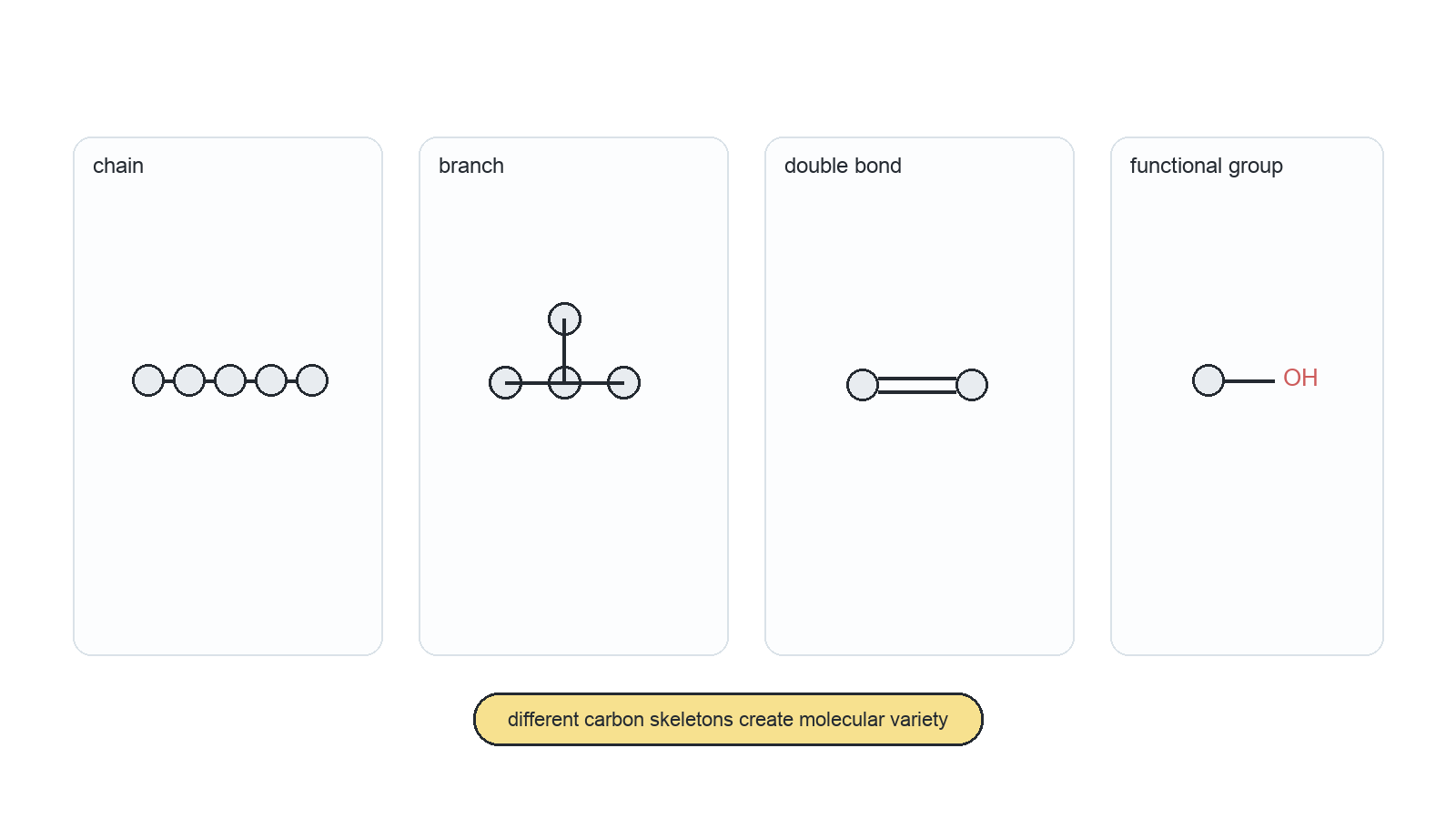
What could be deduced from this data?

A

Predation results in P. caudatum consuming P. aurelia.
B

Allelopathy results in P. caudatum outcompeting P. aurelia.

C

Interspecific competition results in P. aurelia outcompeting P. caudatum.

D

Intraspecific competition results in P. aurelia eliminating P. caudatum.

Niches, Nutrition, And Competition

A niche is the role of a species in a community, including habitat, abiotic tolerances, nutrition, activity, reproduction, and interactions. The evidence should match the question: nutrition mode, oxygen tolerance, feeding adaptation, predator-prey interaction, plant light strategy, fundamental versus realized niche, or competitive exclusion.

  • Definition answers should include role plus habitat/resources/interactions, not only place.
  • Nutrition modes explain how organisms obtain carbon, energy, or organic matter.
  • Adaptation examples should be linked to feeding, defence, light harvesting, or competition.
  • Fundamental versus realized niche and competitive exclusion are tested together because interactions narrow where species actually live.