Q BankQuestion BankDocsDocuments

C3.2 Defence against disease

Defence against disease combines physical barriers, clotting, phagocytes, lymphocyte specificity, vaccination, antibiotics and evolutionary responses to pathogens across human populations.

Syllabus
First assessment 2025
Topic
C3.2
Level
SL

Pathogens cause disease by entering and damaging a host

Pathogens cause disease by entering and damaging a host.

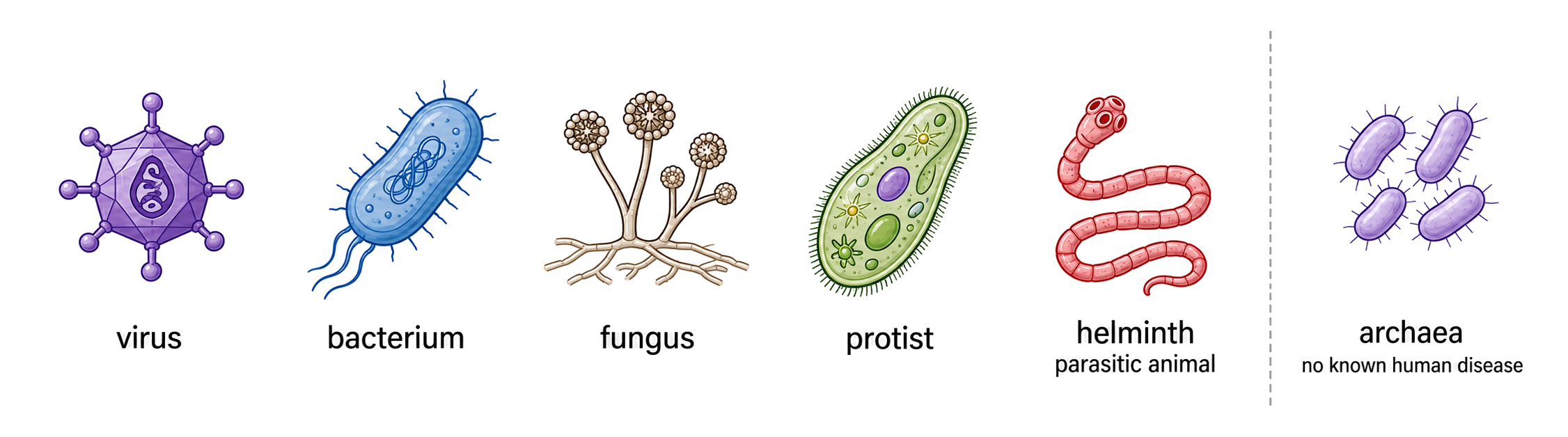
A pathogen is a disease-causing organism or particle. Bacteria, viruses, fungi and protists reproduce or use host cells in ways that disrupt tissues, release toxins or trigger damaging inflammation.

classify the pathogen; route of entry/transmission; host process disrupted; resulting signs.

A respiratory virus enters droplets, infects airway cells and spreads before the immune response clears it.

Pathogen presence is not identical to symptoms: dose, host susceptibility and immune response also affect disease.

Pathogens cause infectious diseases

Assessment in practice

2–3 marks
How it is assessed

This objective is assessed through structured response, commonly using Describe / Distinguish / Outline.

Command terms

Describe / Distinguish / Outline / Define / State / Explain

What earns marks

Mark schemes repeatedly reward named details, correct sequence and clear distinctions between similar processes.

Watch for

Naming symptoms without linking them to the causative pathogen or transmission route.

Representative question

Question 1

[Maximum number: 6]

Describe the cause, transmission and effects of malaria.

Skin and mucous membranes block entry

Skin and mucous membranes block entry.

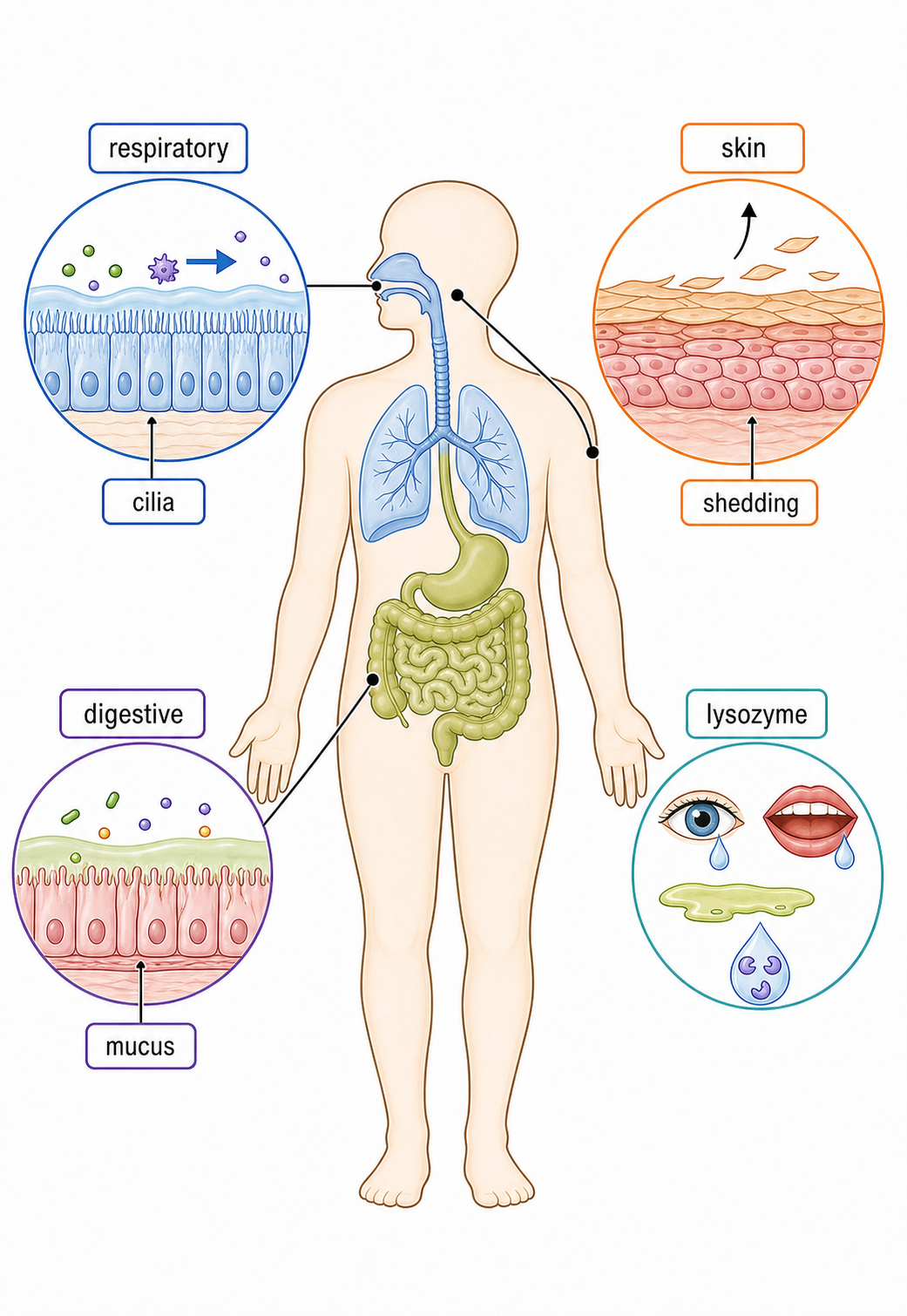
Keratinised skin forms a physical barrier, while mucus traps particles and cilia move them away. Secretions such as lysozyme, tears and stomach acid add chemical protection.

barrier; trapped or killed agent; route out; limitation if the barrier is breached.

Mucus in an airway traps microbes and cilia move the mucus toward the throat, reducing access to lung tissue.

These are first-line defences, not antigen-specific memory responses.

Skin and mucous membranes

Assessment in practice

1–3 marks
How it is assessed

This objective is assessed through structured response, commonly using State / Describe.

Command terms

State / Describe

What earns marks

Mark schemes repeatedly reward named details, correct sequence and clear distinctions between similar processes.

Watch for

Naming symptoms without linking them to the causative pathogen or transmission route.

Representative question

Question 1

[Maximum number: 3]

Describe how disease-causing bacteria are prevented from entering the body.

Clotting seals a damaged blood vessel

Clotting seals a damaged blood vessel.

Platelets adhere to exposed tissue and release signals that activate clotting factors. A cascade converts fibrinogen to insoluble fibrin, forming a mesh that traps cells and limits blood loss.

damage → platelet plug → clotting cascade → fibrin mesh → repair/scab.

A cut exposes collagen; platelets accumulate, fibrin stabilises the plug and the sealed surface can begin to heal.

Clotting protects a wound but can be harmful if a clot forms inside an undamaged vessel.

Blood clotting

Assessment in practice

1–2 marks
How it is assessed

This objective is assessed through structured response, commonly using Identify / Describe / State.

Command terms

Identify / Describe / State / Explain / Outline

What earns marks

Mark schemes repeatedly reward named details, correct sequence and clear distinctions between similar processes.

Watch for

Reversing fibrinogen and fibrin in the clotting sequence.

Representative question

Question 1

[Maximum number: 7]

Explain how blood clotting occurs and the consequence for a person who has hemophilia.

Innate and adaptive immunity solve different problems

Innate and adaptive immunity solve different problems.

Innate defences respond quickly using barriers, inflammation and phagocytes without tailoring receptors to one antigen. Adaptive immunity is slower initially but uses specific lymphocytes and memory.

compare speed; specificity; principal cells; memory; response on re-exposure.

A first infection may activate both systems, but a later exposure is controlled faster by memory lymphocytes.

Innate does not mean weak and adaptive does not mean immediate; the systems cooperate.

Innate vs. adaptive immune system

Assessment in practice

1 marks
How it is assessed

This objective is assessed through structured response, commonly using Identify / Distinguish.

Command terms

Identify / Distinguish

What earns marks

Mark schemes repeatedly reward named details, correct sequence and clear distinctions between similar processes.

Watch for

Calling phagocytosis specific immunity instead of a broad innate response.

Representative question

Question 1

[Maximum number: 1]

Distinguish between innate and adaptive immune response.

The graph shows the magnitude of the immune response after infection or after vaccination over time.

Phagocytes remove invaders by engulfing them

Phagocytes remove invaders by engulfing them.

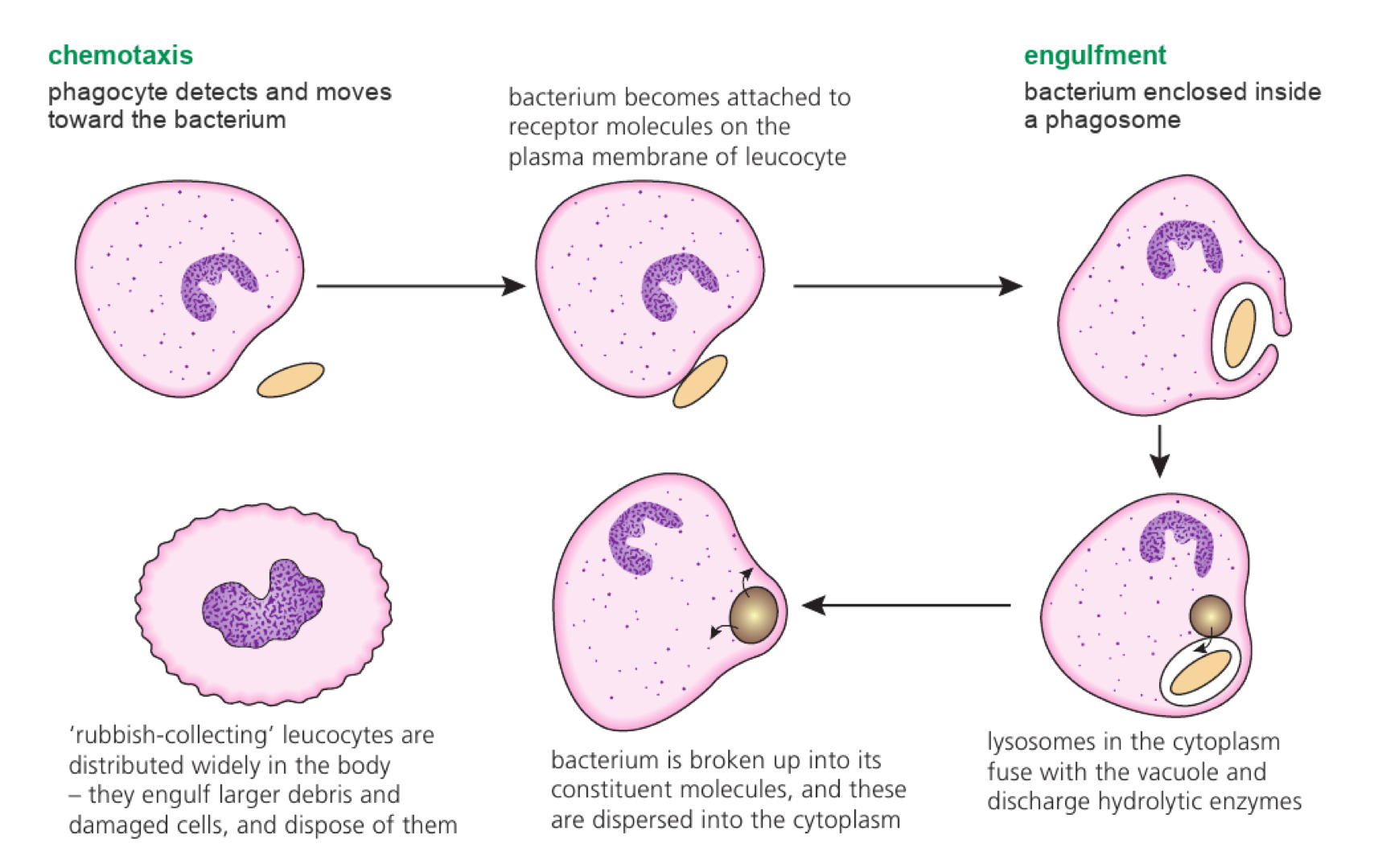
Phagocytes follow chemical signals, bind a particle and enclose it in a vesicle. Lysosomes fuse with the vesicle, releasing enzymes and toxic chemicals that digest the contents.

chemotaxis → recognition → engulfment → phagosome/lysosome fusion → digestion.

A neutrophil surrounds a bacterium and destroys it inside a phagolysosome rather than releasing it back into tissue.

Phagocytosis is not the same as antibody production; it is a cellular innate response.

Phagocytes exam focus

Assessment in practice

1–4 marks
How it is assessed

This objective is assessed through structured response, commonly using Describe / Outline / Identify.

Command terms

Describe / Outline / Identify

What earns marks

Mark schemes repeatedly reward named details, correct sequence and clear distinctions between similar processes.

Watch for

Naming symptoms without linking them to the causative pathogen or transmission route.

Representative question

Question 1

[Maximum number: 4]

Describe how phagocytic leucocytes may act as a defence against disease.

Lymphocytes provide specific immune recognition

Lymphocytes provide specific immune recognition.

B and T lymphocytes carry receptors with particular complementary shapes. B cells can make antibodies; T cells coordinate responses or kill infected cells after activation.

antigen recognition; activation signal; B/T role; effector and memory outcome.

A T helper cell can activate a B cell whose receptor recognises the same pathogen antigen.

A lymphocyte is not activated merely because it is present; receptor match and co-signals matter.

Lymphocytes exam focus

Assessment in practice

1–7 marks
How it is assessed

This objective is assessed through structured response, commonly using Explain / Outline / Identify.

Command terms

Explain / Outline / Identify

What earns marks

Mark schemes repeatedly reward named details, correct sequence and clear distinctions between similar processes.

Watch for

Confusing plasma cells, memory cells and helper T-cells in the activation sequence.

Representative question

Question 1

[Maximum number: 7]

Explain how cells in the bloodstream cause a specific immune response.

An antigen is the feature an immune receptor recognises

An antigen is the feature an immune receptor recognises.

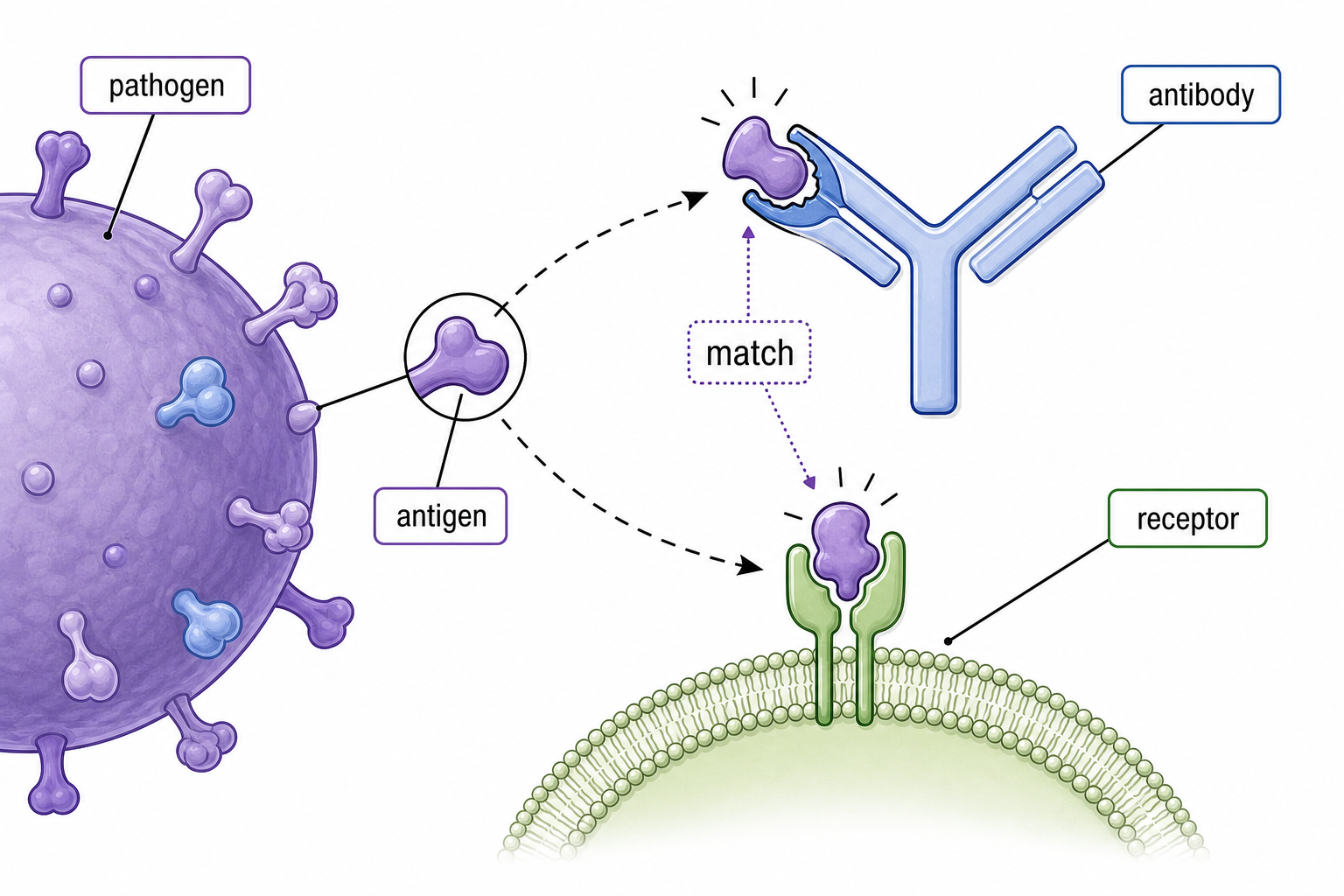
An antigen is a molecule or molecular region that can bind a specific antibody or lymphocyte receptor. Different pathogens display many antigens, so one response may not cover all variants.

identify the molecular target; receptor match; response triggered; distinguish antigen from whole pathogen.

A viral surface protein can act as an antigen even though the virus itself contains many other molecules.

Antigen does not mean ‘foreign organism’ as a whole; it is a recognisable molecular feature.

Antigens exam focus

Assessment in practice

1 marks
How it is assessed

This objective is assessed through multiple choice, commonly using Identify.

Command terms

Identify

What earns marks

Mark schemes repeatedly reward named details, correct sequence and clear distinctions between similar processes.

Watch for

Naming symptoms without linking them to the causative pathogen or transmission route.

Representative question

Question 1

[Maximum number: 1]

What is a characteristic of antigens?

A

They recognize foreign substances

B

They are produced in bone marrow

C

They cause disease in humans

D

They stimulate the production of antibodies

B cells activate only after antigen-specific signals

B cells activate only after antigen-specific signals.
A B cell binds a matching antigen through its receptor and normally receives help from a T helper cell. These signals start clonal expansion and antibody production.

B-cell receptor binding; helper signal; clonal expansion; effector/memory branches.
Only the B-cell clone whose receptor fits a viral antigen expands, limiting antibody production to relevant targets.
Antigen binding alone is not a complete guarantee of activation; context and helper signals regulate the response.

B-lymphocyte activation

Assessment in practice

1–7 marks
How it is assessed

This objective is assessed through structured response, commonly using Identify / Describe / Explain.

Command terms

Identify / Describe / Explain / Outline

What earns marks

Mark schemes repeatedly reward named details, correct sequence and clear distinctions between similar processes.

Watch for

Confusing plasma cells, memory cells and helper T-cells in the activation sequence.

Representative question

Question 1

[Maximum number: 7]

Explain the production of antibodies when a patient is infected with the TB bacterium.

Plasma cells are antibody factories made by clonal selection

Plasma cells are antibody factories made by clonal selection.

Activated B cells divide into clones. Plasma cells secrete large amounts of antibody, while some daughter cells become long-lived memory cells.

selection by receptor match → clonal expansion → plasma cells → antibodies; retain memory branch.

A plasma cell releases antibodies that bind repeated surface epitopes on the infecting bacterium.

Antibodies are secreted by plasma cells, not by every B cell before activation.

Clones of plasma cells

Assessment in practice

1 marks
How it is assessed

This objective is assessed through multiple choice, commonly using Identify / State.

Command terms

Identify / State

What earns marks

Mark schemes repeatedly reward named details, correct sequence and clear distinctions between similar processes.

Watch for

Confusing plasma cells, memory cells and helper T-cells in the activation sequence.

Representative question

Question 1

[Maximum number: 1]

What is a role of activated B cells?

A

Secrete antibiotics in response to specific antigens

B

Activate T cells in the immune response

C

Release histamine in response to allergens

D

Multiply to form clones of plasma cells

Memory cells accelerate a second response

Memory cells accelerate a second response.

Some activated B and T cells persist as memory cells. On re-exposure they respond more rapidly and strongly, often preventing noticeable disease.

primary exposure; memory formation; secondary exposure; faster/larger response.

A booster vaccine re-stimulates memory cells, producing protective antibody levels sooner than the first dose.

Memory is antigen-specific and can weaken; it does not make a person immune to every pathogen.

Immunity from memory cells

Assessment in practice

1–3 marks
How it is assessed

This objective is assessed through structured response, commonly using State / Suggest / Identify.

Command terms

State / Suggest / Identify / Explain

What earns marks

Mark schemes repeatedly reward named details, correct sequence and clear distinctions between similar processes.

Watch for

Confusing plasma cells, memory cells and helper T-cells in the activation sequence.

Representative question

Question 1

[Maximum number: 3]

Suggest possible reasons for the observed pattern of presence of antibodies in vaccinated mice.

The summer after vaccination, the prevalence of B. burgdorferi infection in tick nymphs collected on mice from the two sites was measured.

\begin{tabular}{|l|c|c|c|c|}
\cline { 2 - 5 } \multicolumn{1}{c|}{} & \multicolumn{4}{c|}{ State of infection of tick nymphs with B. burgdorferi } \\
\cline { 2 - 5 } \multicolumn{1}{c|}{} & \multicolumn{2}{c|}{ Site 1 } & \multicolumn{2}{c|}{ Site 2 } \\
\hline \multicolumn{1}{c|}{ Host mice } & Infected & Not infected & Infected & Not infected \\
\hline Control mice & 90 & 315 & 57 & 89 \\
\hline Vaccinated mice & 87 & 288 & 49 & 121 \\
\hline
\end{tabular}

HIV spreads through particular body-fluid routes

HIV spreads through particular body-fluid routes.

HIV transmission requires infected blood, semen, vaginal fluids or breast milk to reach susceptible tissue. It is not spread by casual contact, food sharing or intact skin.

source fluid; route of exposure; susceptible tissue; prevention barrier.

Sharing a contaminated needle can transfer infected blood directly into circulation, whereas a handshake cannot.

Transmission risk depends on exposure and viral load; a positive test does not identify the route by itself.

HIV transmission

Assessment in practice

1 marks
How it is assessed

This objective is assessed through multiple choice, commonly using Explain.

Command terms

Explain

What earns marks

Mark schemes repeatedly reward named details, correct sequence and clear distinctions between similar processes.

Representative question

Question 1

[Maximum number: 1]

How has the transmission of HIV been reduced?

A

Delaying the progression of HIV to AIDS

B

Single use of disposable needles

C

Treatment with antibiotics

D

Vaccination

HIV can cause AIDS by reducing CD4 T cells

HIV can cause AIDS by reducing CD4 T cells.

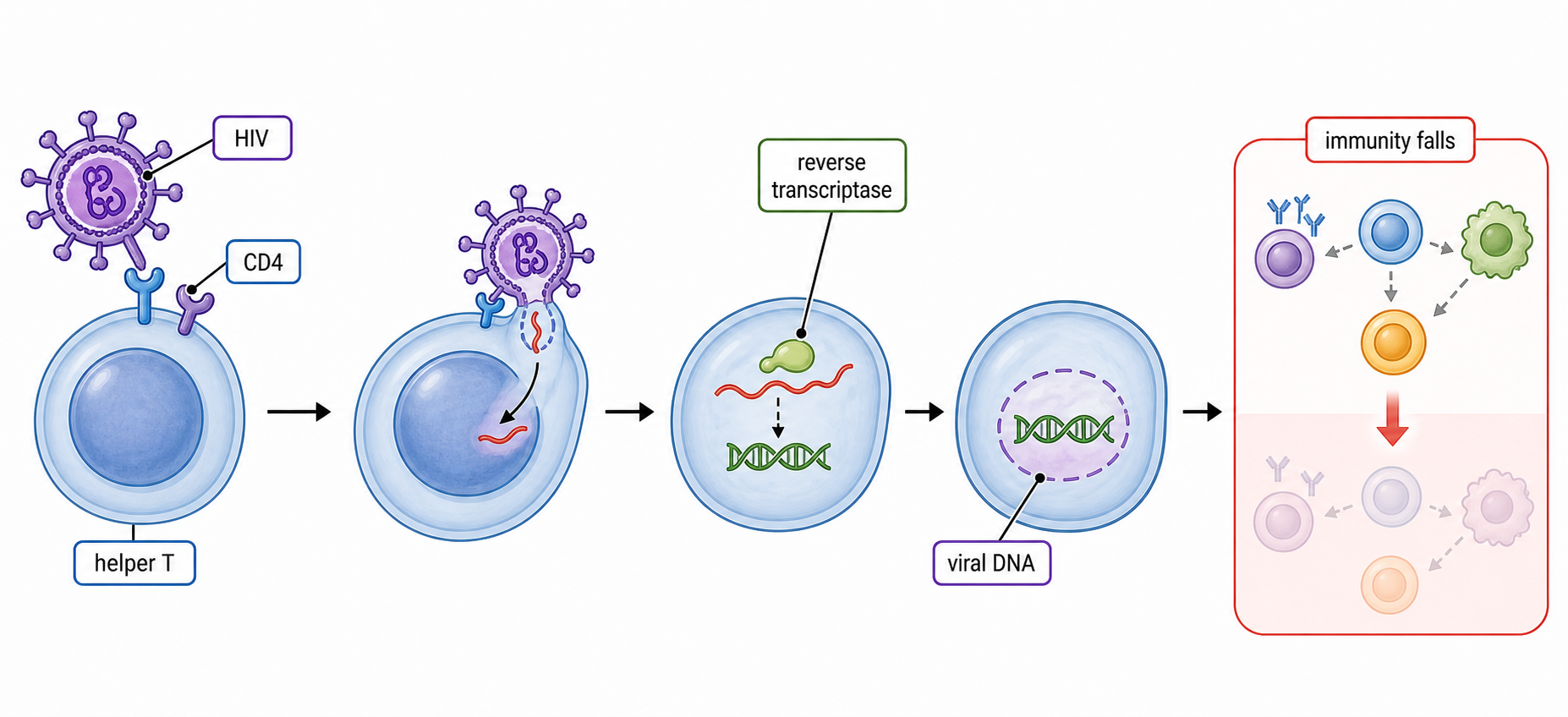
HIV infects and progressively destroys CD4 helper T cells. As immune coordination falls, opportunistic infections and cancers become more likely; this clinical state is AIDS.

HIV entry/replication; CD4 decline; loss of coordination; opportunistic disease.

A person with low CD4 counts may develop an infection that a healthy immune system would normally control.

HIV infection and AIDS are not synonyms: treatment can delay or prevent progression to AIDS.

HIV infection and AIDS

Assessment in practice

1 marks
How it is assessed

This objective is assessed through structured response, commonly using Identify / Explain / Discuss.

Command terms

Identify / Explain / Discuss

What earns marks

Mark schemes repeatedly reward named details, correct sequence and clear distinctions between similar processes.

Watch for

Confusing plasma cells, memory cells and helper T-cells in the activation sequence.

Representative question

Question 1

[Maximum number: 4]

Discuss the consequences of infection with HIV.

Antibiotics target bacterial processes

Antibiotics target bacterial processes.

Antibiotics inhibit bacterial structures or pathways such as cell-wall synthesis or ribosomes. They work only when the illness is caused by susceptible bacteria.

identify bacterial target; drug action; selective toxicity; treatment limit.

A cell-wall antibiotic can kill dividing bacteria while leaving human cells without bacterial walls largely unaffected.

Antibiotics do not cure viral infections and should not be judged by whether a fever has another cause.

Antibiotics exam focus

Assessment in practice

1–2 marks
How it is assessed

This objective is assessed through structured response, commonly using Explain / Outline / Identify.

Command terms

Explain / Outline / Identify / Distinguish / Suggest

What earns marks

Mark schemes repeatedly reward named details, correct sequence and clear distinctions between similar processes.

Watch for

Explaining antibiotic action as antibody stimulation instead of inhibition of bacterial processes.

Representative question

Question 1

[Maximum number: 3]

(i) Estimate the diameter of the zone of inhibition of chloramphenicol.
(ii) Distinguish between the action of tetracycline and penicillin on B. subtilis.
(iii) Suggest a reason for the result with disc X .

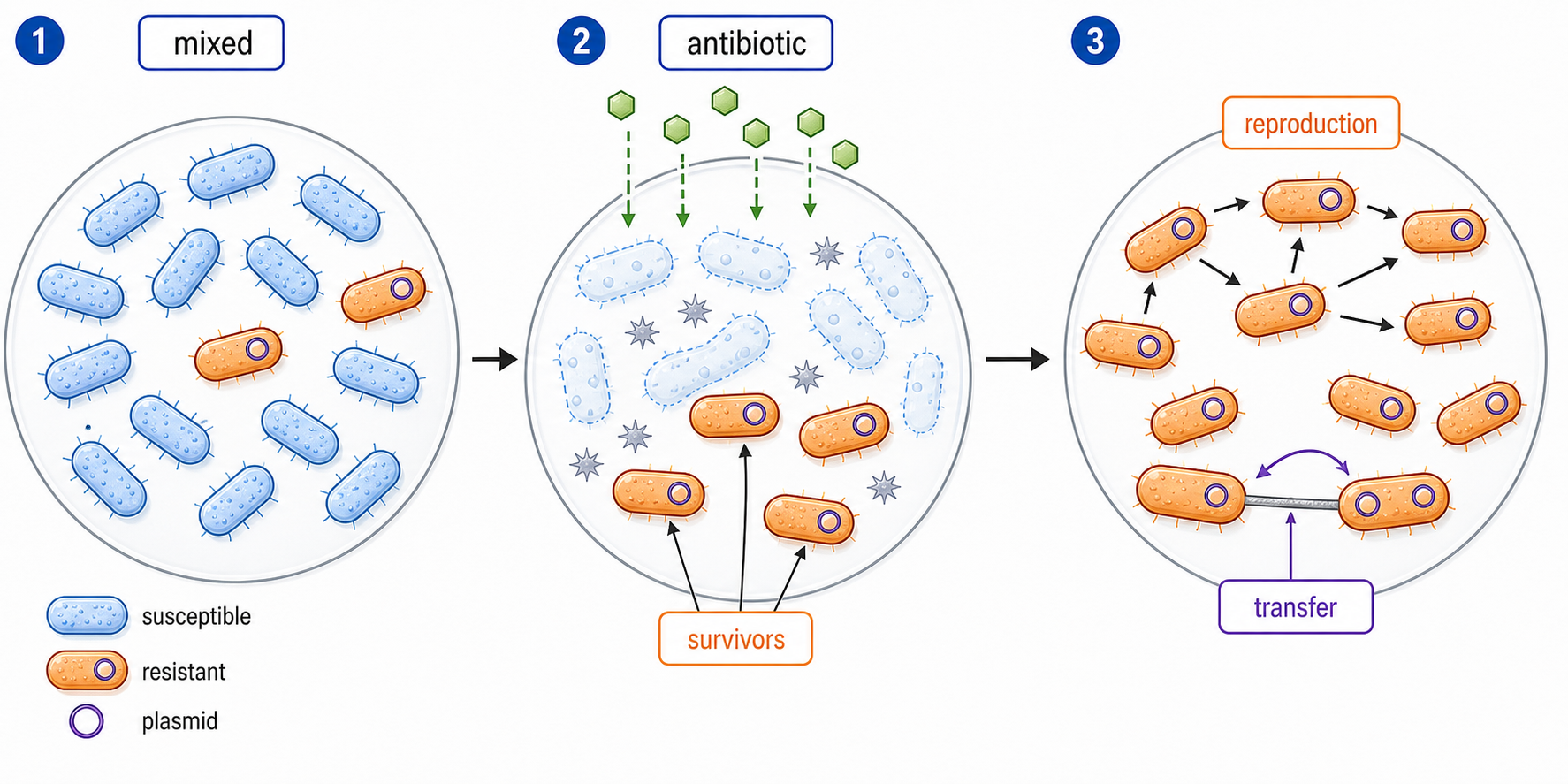
Resistance spreads when antibiotics select variants

Resistance spreads when antibiotics select variants.

A resistant bacterium survives a drug exposure, reproduces and passes resistance genes to descendants or other bacteria. Unnecessary or incomplete treatment increases selection pressure.

variation/gene; antibiotic exposure; survival; reproduction or transfer; population shift.

After a course removes susceptible bacteria, a resistant clone can multiply and dominate the remaining population.

The antibiotic does not ‘teach’ an individual bacterium to mutate; selection changes frequencies in the population.

Antibiotic resistance evolution

Assessment in practice

1–4 marks
How it is assessed

This objective is assessed through structured response, commonly using Explain / Compare / Discuss.

Command terms

Explain / Compare / Discuss / Suggest / Identify / Describe / State / Outline

What earns marks

Mark schemes repeatedly reward named details, correct sequence and clear distinctions between similar processes.

Watch for

Saying antibiotics cause directed mutations instead of selecting pre-existing or transferred resistance.

Representative question

Question 1

[Maximum number: 9]

Explain how natural selection can lead to evolution using antibiotic resistance in bacteria as an example.

Zoonoses cross from animal reservoirs into people

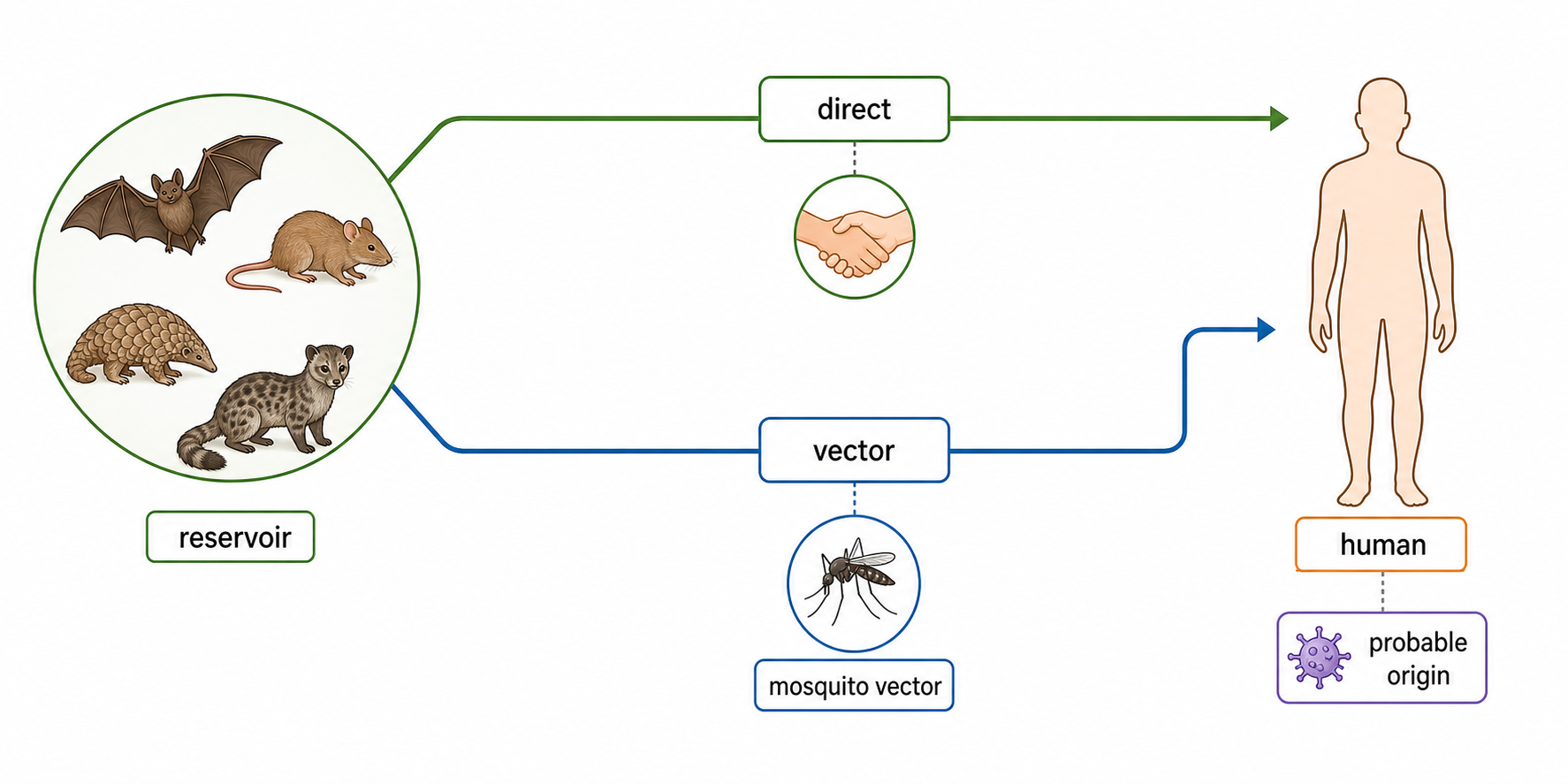
Zoonoses cross from animal reservoirs into people.

A zoonosis is an infection naturally maintained in animals that reaches humans through contact, vectors, food or environmental spillover. Risk changes with ecology and behaviour.

reservoir; interface; transmission route; host jump; conditions increasing contact.

Deforestation can increase wildlife–livestock contact, creating more opportunities for a pathogen to reach people.

Animal origin alone does not prove a disease will spread efficiently between humans.

Zoonoses exam focus

Assessment in practice

1 marks
How it is assessed

This objective is assessed through structured response, commonly using State / Identify / Explain.

Command terms

State / Identify / Explain

What earns marks

Mark schemes repeatedly reward named details, correct sequence and clear distinctions between similar processes.

Watch for

Defining zoonoses as diseases from zoos rather than transfer from other animal species.

Representative question

Question 1

[Maximum number: 1]

State the term used for an infectious disease that can transfer from other species to humans.

Vaccines create immune memory without the full disease

Vaccines create immune memory without the full disease.

A vaccine presents a safe form or component of an antigen, activating adaptive immunity and memory. Later exposure triggers a faster protective response.

antigen source; innate/adaptive activation; memory; later protection.

A booster raises antibody levels by reactivating memory cells rather than by causing the original infection.

Vaccination lowers risk and transmission but protection varies with pathogen, dose and population coverage.

Vaccines and immunization

Assessment in practice

1–2 marks
How it is assessed

This objective is assessed through structured response, commonly using Identify / Explain / Calculate.

Command terms

Identify / Explain / Calculate / Outline / Suggest / Sketch

What earns marks

Mark schemes repeatedly reward named details, correct sequence and clear distinctions between similar processes.

Watch for

Confusing plasma cells, memory cells and helper T-cells in the activation sequence.

Representative question

Question 1

[Maximum number: 8]

Some prokaryotes cause infectious disease in humans. Explain the principles of vaccination.

Herd immunity protects some people indirectly

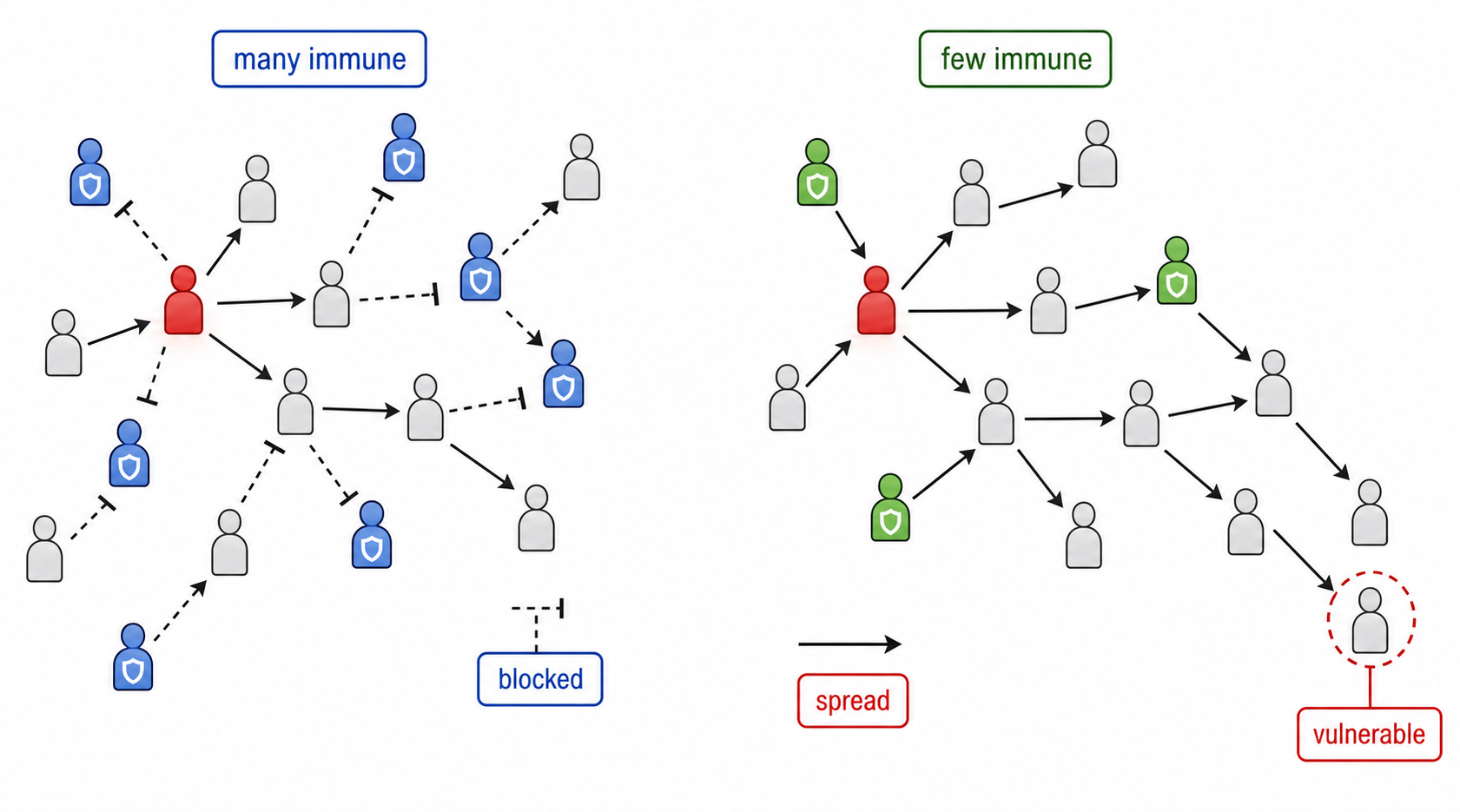
Herd immunity protects some people indirectly.

When enough people are immune, an infectious case has fewer susceptible contacts and transmission chains are interrupted. The required coverage depends on pathogen transmissibility and mixing.

immune fraction; contact network; effective reproduction; vulnerable people left unprotected.

High measles vaccination coverage can prevent an imported case from reaching many susceptible people.

A simple percentage threshold is not universal; immunity may wane and coverage can be clustered unevenly.

Pandemic data need denominators and context

Pandemic data need denominators and context.

Rates, case definitions, testing effort and time windows determine what disease data mean. Trends should be compared using consistent denominators and interpreted with uncertainty and confounders.

define numerator/denominator; check testing and reporting; compare like with like; separate correlation from cause.

More reported cases after testing expands may reflect detection as well as transmission, so positivity and hospitalisation add context.

A graph alone cannot establish causation or compare regions fairly if surveillance differs.

Defence Against Disease

  • Skin, mucus, cilia, lysozyme and clotting form primary barriers against pathogens.
  • Innate immunity is rapid and broad: phagocytes recognize, engulf and digest pathogens. Adaptive immunity is antigen-specific and forms memory.
  • Helper T-cells coordinate responses; activated B-cells undergo clonal selection, producing antibody-secreting plasma cells and memory cells. A second exposure therefore triggers a faster, stronger response.
  • HIV infects CD4 helper T-cells; their loss weakens immune coordination and can lead to AIDS.
  • Antibiotics target bacterial processes, not viruses. Antibiotic exposure selects resistant variants, which can spread by reproduction or plasmid transfer.
  • Vaccination creates active artificial immunity; high population immunity can indirectly protect susceptible people.
  • Evaluate disease and vaccine claims using reliable sources, trends, controlled comparisons, incidence and efficacy—not raw totals alone.
ConceptIB Biology SL