C1.1 Enzymes and metabolism
Enzymes and metabolism explain how catalysts, active sites, reaction conditions and pathway regulation control cellular chemical reactions in living systems.
- Syllabus
- First assessment 2025
- Topic
- C1.1
- Level
- SL
Enzymes and metabolism explain how catalysts, active sites, reaction conditions and pathway regulation control cellular chemical reactions in living systems.
An enzyme is a biological catalyst. Most are proteins, although some RNA molecules also catalyse reactions. A small amount can act repeatedly because the enzyme emerges unchanged after products are released.

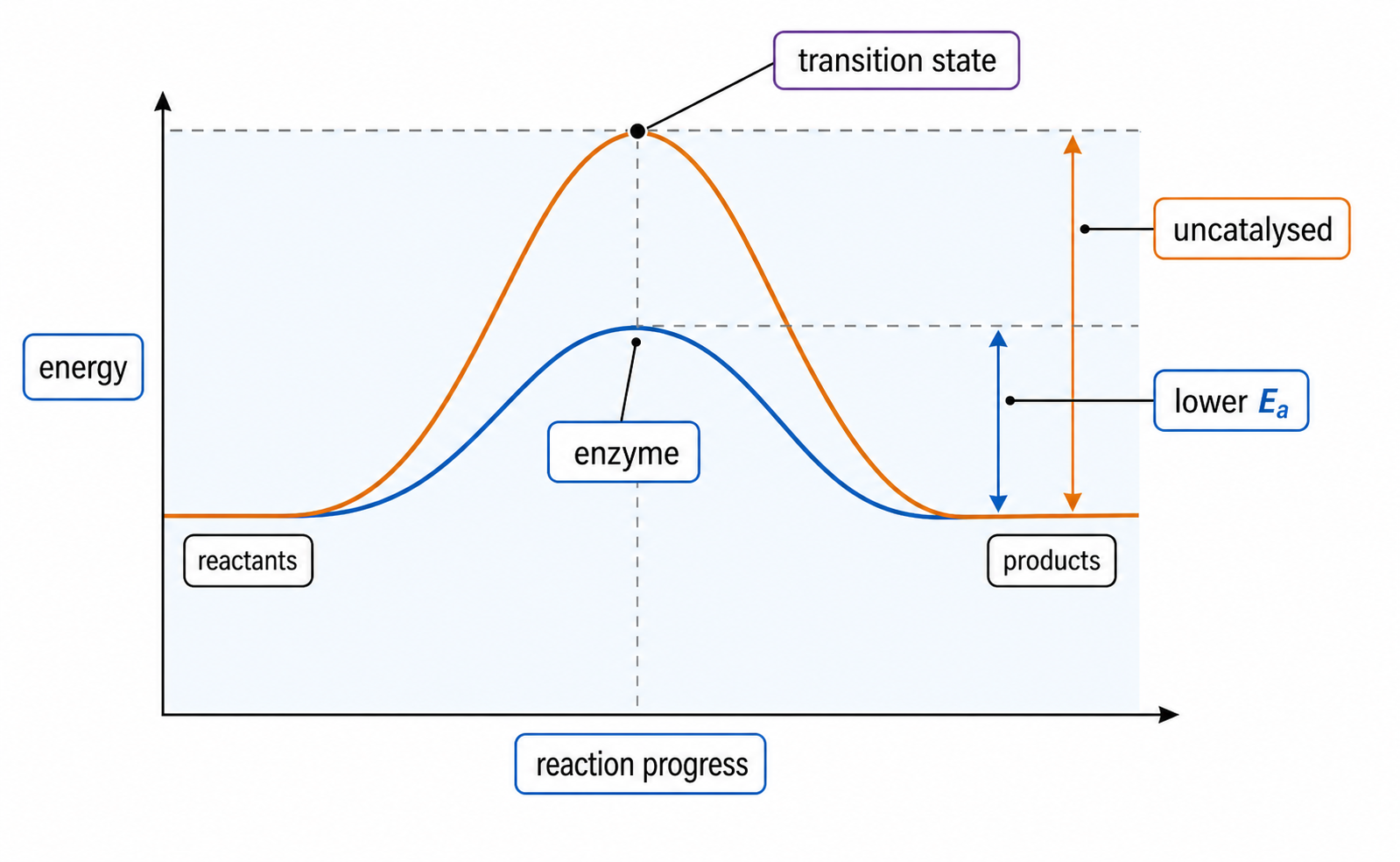
The enzyme provides an alternative pathway with lower activation energy, so more collisions can reach the transition state at the same temperature. It does not change the reactants, products or overall free-energy difference, and it does not remove the barrier completely.
Metabolism is the complete set of enzyme-controlled reactions in a cell or organism. Because each step needs a particular enzyme, cells regulate which routes operate by controlling enzyme amount, activity and location.
| Route | Change in matter | Typical chemistry | Energy relationship |
|---|---|---|---|
| anabolism | smaller units → larger, more complex molecules | condensation and reduction | requires an energy input |
| catabolism | complex molecules → smaller products | hydrolysis and oxidation | releases usable energy |
The two routes are coupled: catabolic reactions release energy and provide small molecules; anabolic reactions use both to build cell components. Respiration is mainly catabolic, while protein synthesis is anabolic.
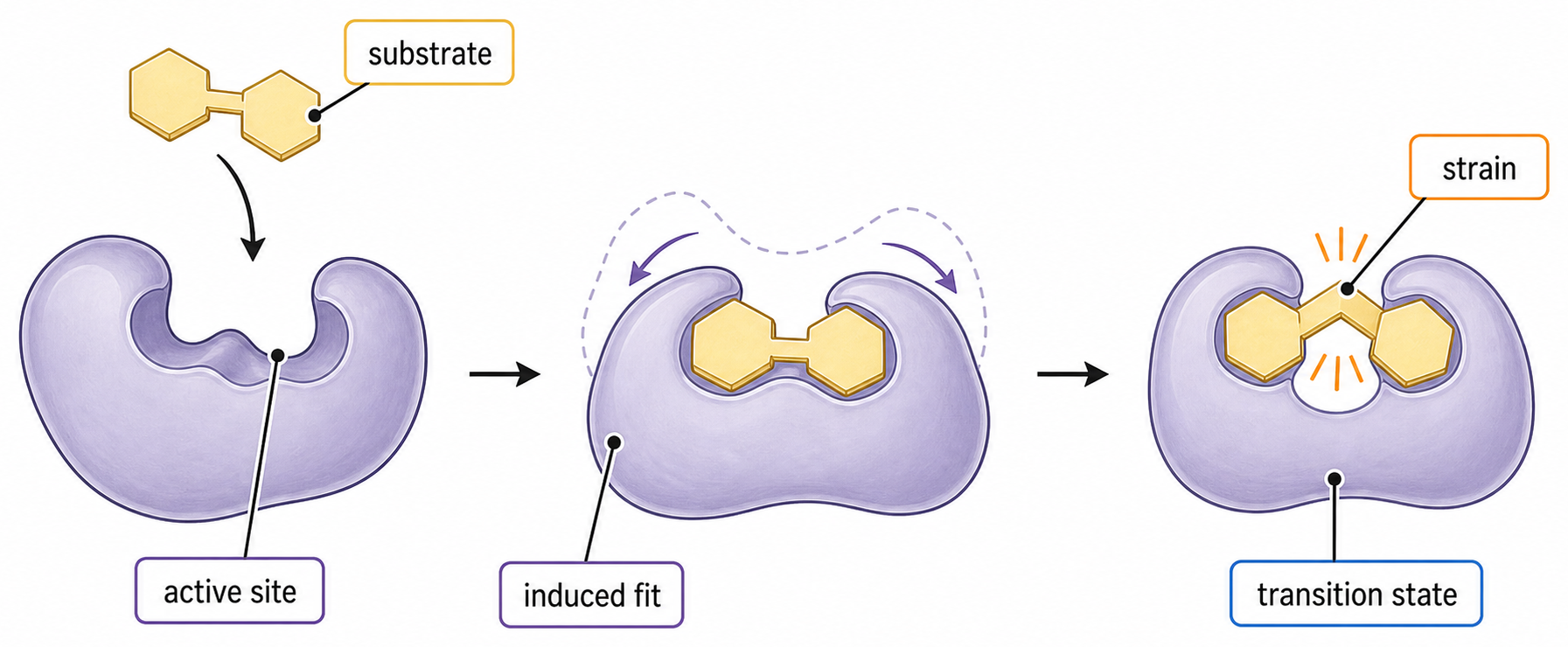
A typical enzyme is a globular protein. Folding brings particular amino-acid side chains together to form a small active-site pocket; most of the protein maintains the three-dimensional environment that makes this pocket work.

Substrate collides with and binds to the active site.
A short-lived enzyme–substrate complex forms and catalysis occurs.
Products no longer fit in the same way, so they leave; the enzyme can bind another substrate.
The active site is flexible, not a rigid lock. Initial contact with the correct substrate changes the conformation of both enzyme and substrate: this is induced fit.

Induced fit can:
These effects lower the activation energy; complementary shape alone does not explain catalysis.

| Curve feature | Molecular explanation |
|---|---|
| temperature rises toward an optimum | faster molecular motion gives more frequent energetic substrate–active-site collisions |
| temperature falls beyond the optimum | heat increasingly disrupts the enzyme's tertiary structure and active sites are lost |
| pH has an optimum range | changing H⁺ concentration alters charges and bonding that maintain active-site shape |
| substrate curve reaches a plateau | nearly all active sites are occupied; enzyme concentration now limits turnover |
An optimum is the condition giving the highest measured rate for that enzyme under that experiment. It is not a universal temperature or pH shared by all enzymes.
An enzyme is specific because the active site's three-dimensional arrangement of shape, charge and chemical groups permits productive binding of only particular substrate molecules.
High temperature or extreme pH can disrupt hydrogen bonds, ionic interactions and other weak forces that maintain tertiary structure. The active site changes shape or charge, so the substrate no longer binds productively: the enzyme is denatured.
Denaturation does not normally hydrolyse the peptide bonds of the primary structure. Moderate pH effects may be reversible when the original bonding pattern reforms; severe heating commonly causes irreversible aggregation or misfolding.
| Substrate concentration | Active-site occupancy | Effect of adding substrate |
|---|---|---|
| low | many active sites are free | collision frequency and rate rise almost proportionally |
| intermediate | active sites are occupied more often | rate still rises, but by smaller increments |
| high | nearly every active site is continually occupied | rate approaches a maximum and extra substrate has little effect |
The plateau is not caused by substrate molecules stopping. It appears because a fixed number of enzyme molecules can process only a limited number of substrates per unit time.
At saturating substrate concentration, increasing enzyme concentration adds active sites and can raise the maximum rate, provided substrate remains in excess.
Reaction rate is measured as substrate disappearance or product formation per unit time. In a catalase assay, oxygen production is convenient; in an amylase assay, disappearance of starch can be timed with iodine.

initial rate=ΔtΔproduct=−ΔtΔsubstrate
Use the gradient of a tangent at the start of a product–time curve. Later rates are lower because substrate is depleted, products accumulate or conditions change, so comparing arbitrary final amounts can be misleading.
| Design decision | Example for testing temperature on amylase | Why it matters |
|---|---|---|
| independent variable | water-bath temperature | defines the factor being tested |
| dependent variable | time for starch to disappear; convert to relative rate, 1/t | produces a comparable rate measure |
| controlled variables | pH, enzyme and starch concentrations and volumes | prevents alternative causes of a rate change |
| negative control | starch plus water without enzyme | checks that loss of starch requires enzyme activity |
Pre-incubate enzyme and substrate separately to the chosen temperature, mix to start the reaction, sample at fixed intervals, and use the same endpoint rule each time.
Repeat each condition, calculate a mean and inspect variation. An anomalous result should be investigated, not silently removed; uncertainty in timing, temperature and volume limits the precision of the conclusion.
globular fold → active-site chemistry → induced fit → lower activation energy → faster turnover → controlled metabolic pathways
When explaining a rate pattern, identify what changed, then connect it to:
A strong investigation measures initial rate, changes one independent variable, controls alternatives, includes a relevant control and uses repeats to reveal variation.
3 marks
Explain how enzymes catalyse chemical reactions.
4 marks
Explain the role of enzymes in metabolic pathways.
2 marks
Identify the following processes as either anabolism or catabolism by placing a tick ( ✓ ) in the correct box.
| Process | Anabolism | Catabolism |
|---|---|---|
| Light-independent reactions of photosynthesis | □ | □ |
| Glycolysis | □ | □ |
1 mark
State a role of the active site of an enzyme.
6 marks
Describe the lock and key model of enzyme activity and how the induced fit model extends it.
1 mark
Which statement applies to enzymes?
6 marks
Some proteins in membranes act as enzymes. Outline enzyme-substrate specificity.
8 marks
Explain the effect of changes of pH , substrate concentration and temperature on enzyme activity.
3 marks
Suggest how the percentage of decolorization could be obtained experimentally.
1 mark
The graph shows energy changes during a reaction both with and without an enzyme present.
Which statement correctly identifies two of the regions labelled X, Y and Z in the graph?