C1.1.1—Enzymes as catalysts
Enzymes act as reusable biological catalysts, usually proteins, that speed reactions by forming substrate complexes and lowering activation energy in cells.
- Syllabus
- First assessment 2025
- Objective
- C1.1.1
- Level
- SL
Enzymes act as reusable biological catalysts, usually proteins, that speed reactions by forming substrate complexes and lowering activation energy in cells.
Coverage 2016–2019 · Updated 15 Jul 2026
An enzyme is a biological catalyst. Most are proteins, although some RNA molecules also catalyse reactions. A small amount can act repeatedly because the enzyme emerges unchanged after products are released.
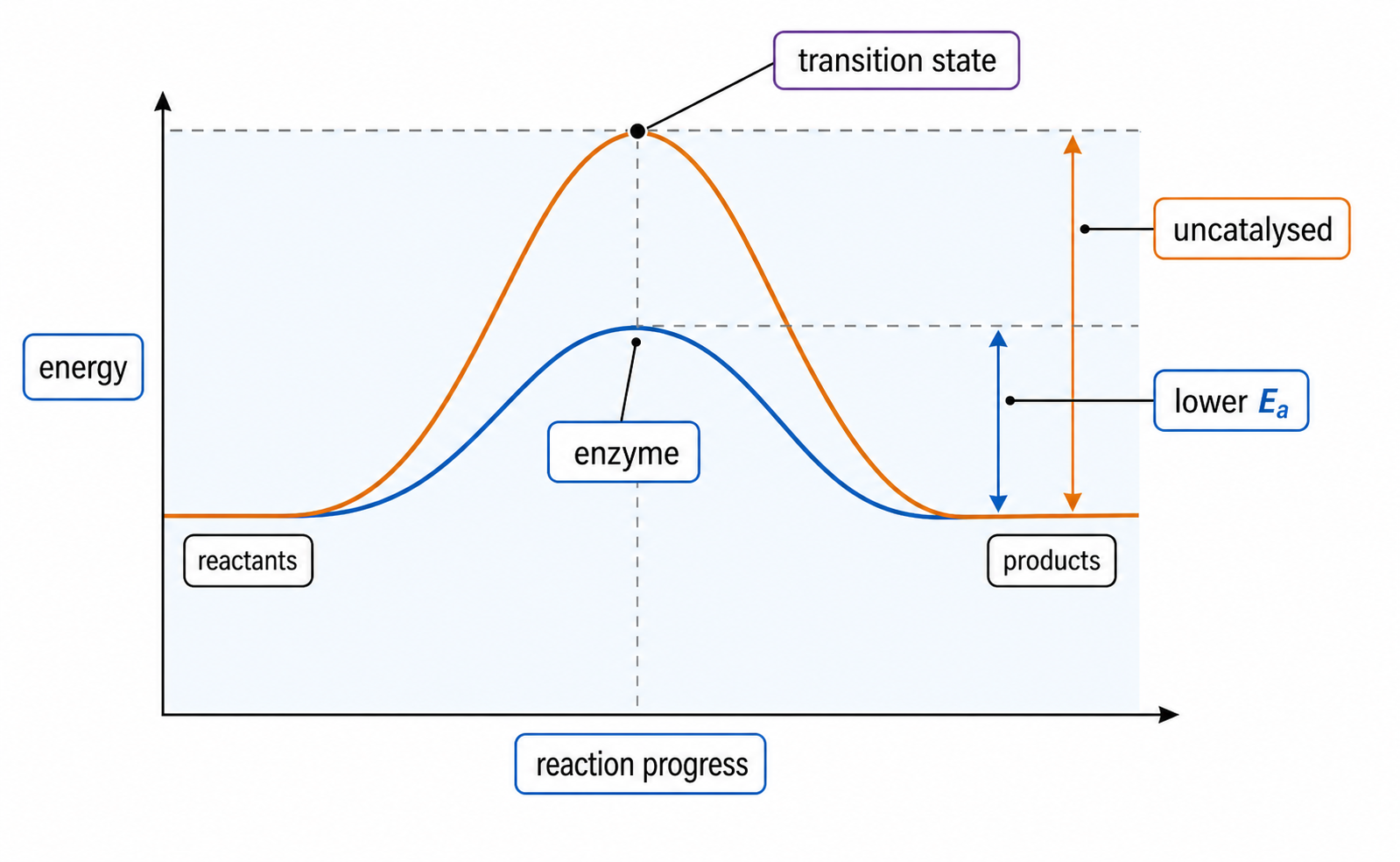
The enzyme provides an alternative pathway with lower activation energy, so more collisions can reach the transition state at the same temperature. It does not change the reactants, products or overall free-energy difference, and it does not remove the barrier completely.
A typical enzyme is a globular protein. Folding brings particular amino-acid side chains together to form a small active-site pocket; most of the protein maintains the three-dimensional environment that makes this pocket work.
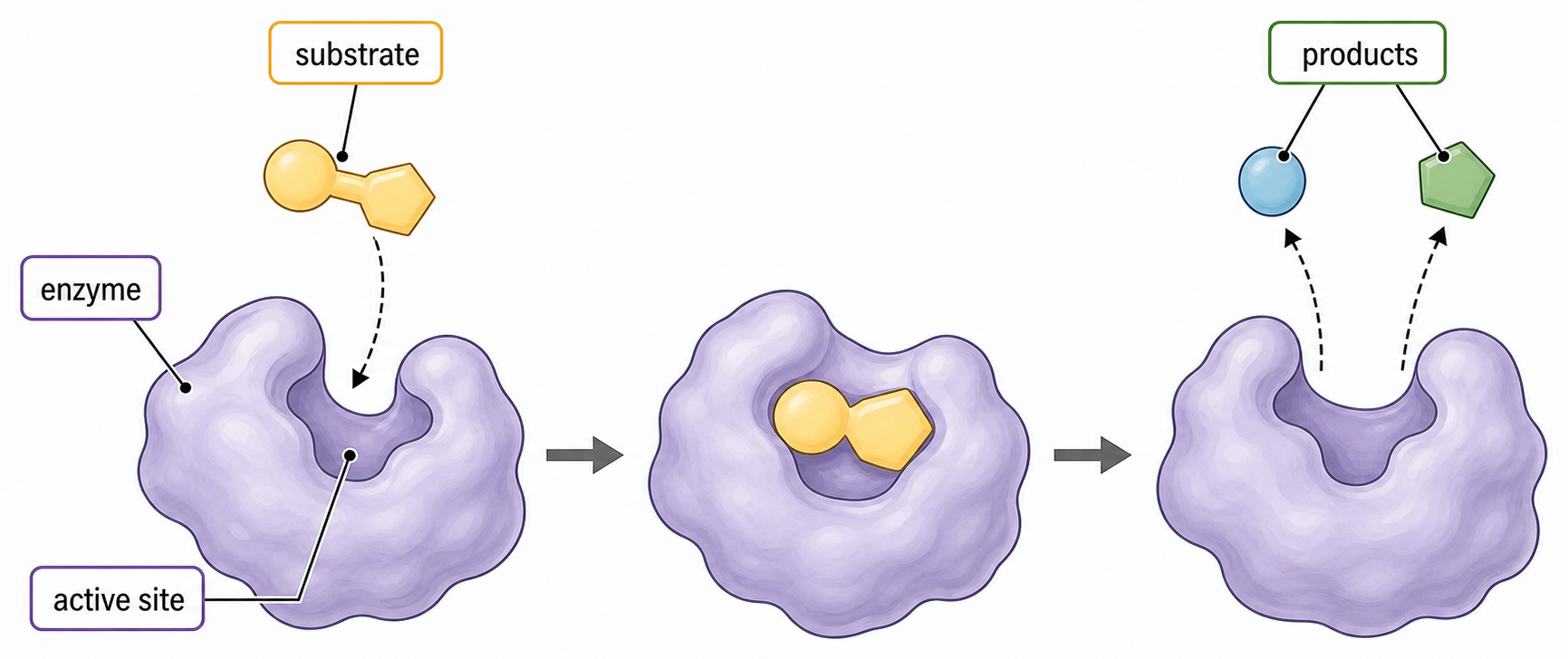
Substrate collides with and binds to the active site.
A short-lived enzyme–substrate complex forms and catalysis occurs.
Products no longer fit in the same way, so they leave; the enzyme can bind another substrate.
