D4.3.5—Ocean current changes

Ocean warming can alter circulating currents and reduce nutrient upwelling, lowering primary productivity and food supply near the surface waters.

Syllabus
First assessment 2025
Objective
D4.3.5
Level
HL

Exam analysis

Chance of appearing2%of analysed past papers
Latest appearanceMay 2025
Most common paperPaper1
Typical marks1

Recent exam appearances

May 2025Paper1A ["HL"] · TZ240[ 1 ]D4.3.5—Ocean current changes
May 2022Paper1 ["HL"] · TZ116[ 1 ]D4.3.5—Ocean current changes

Coverage 2022–2025 · Updated 16 Jul 2026

Surface Warming Strengthens Stratification and Weakens Upwelling

  1. Surface water warms and becomes less dense relative to deeper water.
  2. The density difference strengthens stratification.
  3. Vertical mixing and nutrient-rich upwelling weaken or shift in timing.
  4. Fewer nitrate and phosphate ions reach the sunlit layer.
  5. Phytoplankton primary production falls where nutrients become limiting.

Upwelling also depends on winds, coastline and circulation. Warming can alter its timing and extent; it does not impose one identical response in every ocean region.
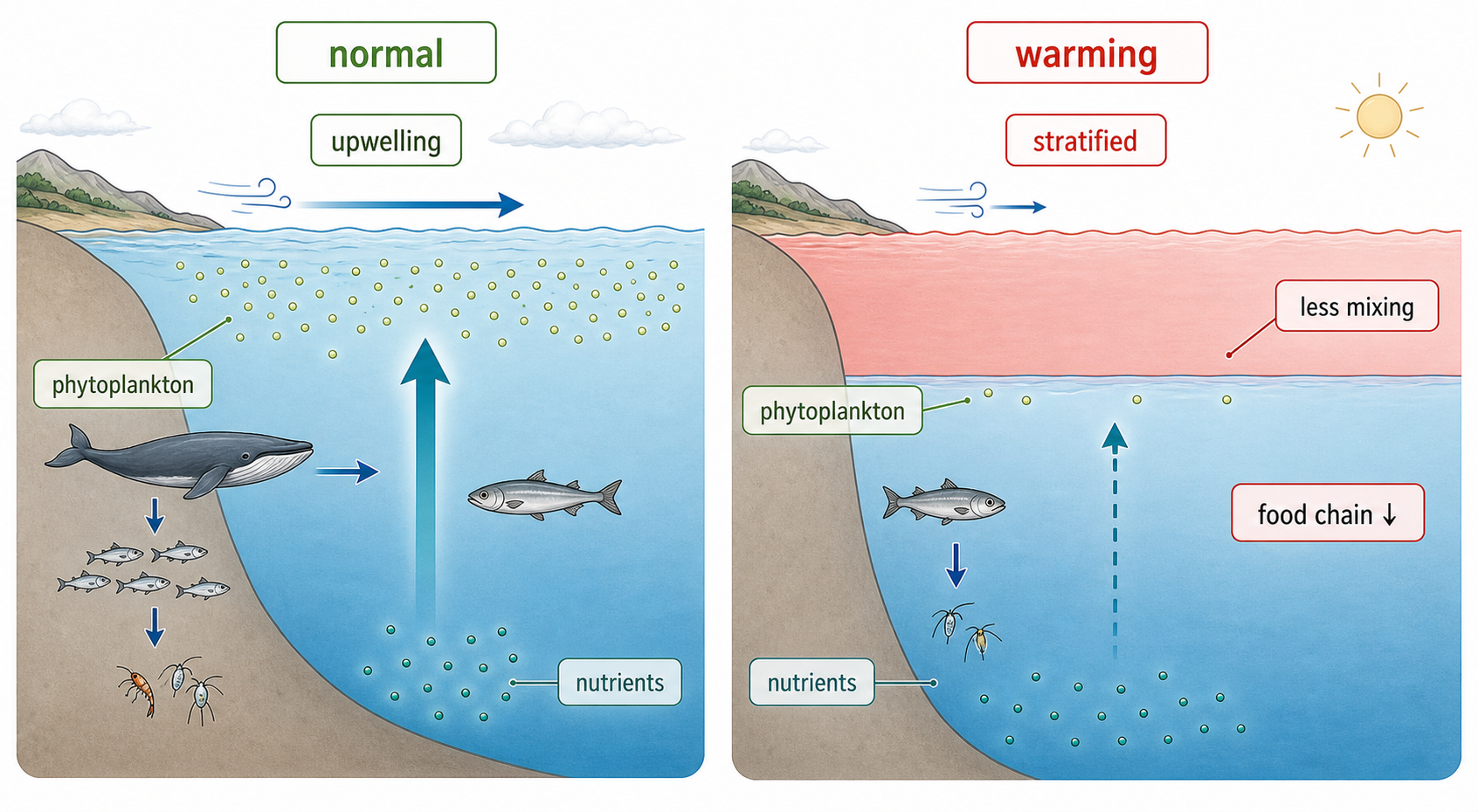
Normal upwelling brings cold nutrient-rich deep water into the sunlit surface layer; warming strengthens stratification, reduces mixing, lowers surface nutrients and weakens the food chain.

Reduced Upwelling Propagates from Phytoplankton through Marine Food Webs

  1. Lower surface nutrients limit phytoplankton growth.
  2. Less producer biomass feeds fewer zooplankton.
  3. Fish recruitment and biomass can fall as prey supply declines.
  4. Seabirds, marine mammals and fisheries receive less energy from the food web.

Phytoplankton also fix CO₂. Changes in production and sinking organic matter can alter biological carbon transfer to the deep ocean, linking food webs to climate feedback.

A predator decline alone does not prove reduced upwelling. Test the chain with current, nutrient, chlorophyll or phytoplankton, zooplankton and consumer data over time.

Climate Effects Follow Forcing, Feedback, Exposure and Biological Response

human greenhouse-gas source → enhanced infrared retention → climate variable changes → feedback may amplify the change → habitat or physiological mechanism alters survival, production or distribution → population and ecosystem consequences

Impact Mechanism that must appear
boreal sink becomes source carbon release exceeds uptake through drought, mortality, fire and thaw
ice-dependent species decline required resting or breeding platform is lost at the critical time
marine productivity falls stratification reduces nutrient upwelling to phytoplankton
range contracts or shifts climate space moves but dispersal and habitat constrain tracking
reef degrades bleaching removes symbiont energy and acidification suppresses calcification

Do not jump directly from “warming” to “species decline.” The biological mechanism and the relevant time or place make the explanation causal.

Ocean current changes

[ 1 ]

What is a consequence of ocean water having a very high temperature?

Concept essentials

  • Warmer surface water can strengthen stratification and reduce vertical mixing.
  • Reduced upwelling limits nutrients available to surface phytoplankton.
  • Changes in ocean currents can alter productivity and marine food-web support.