D3.3.3—Blood glucose regulation

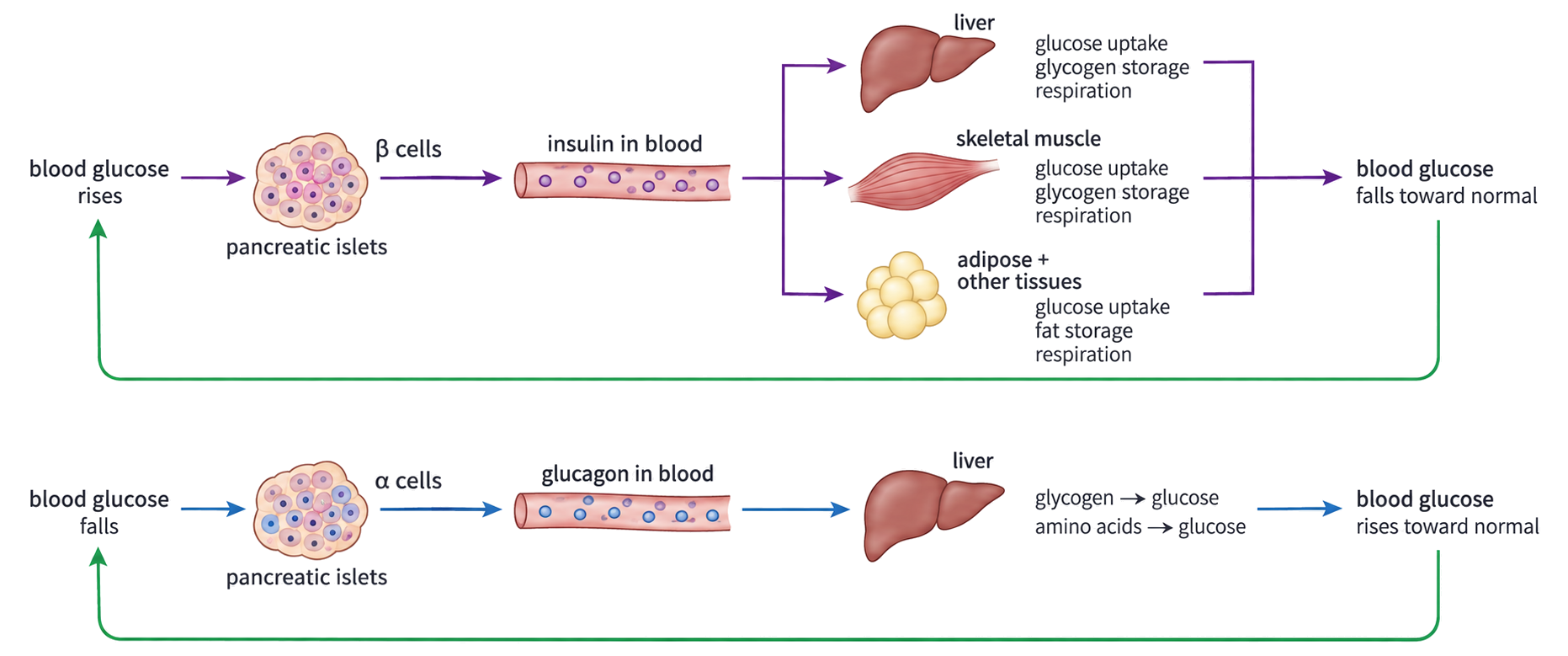
Blood glucose is regulated by pancreatic alpha and beta cells secreting glucagon and insulin in opposing negative feedback responses in human physiology.

Syllabus
First assessment 2025
Objective
D3.3.3
Level
HL

Exam analysis

Chance of appearing7%of analysed past papers
Latest appearanceNovember 2025
Most common paperPaper2
Typical marks1–5

Common command terms

  • Identify
  • Explain
  • Describe
  • Outline
  • State
  • Discuss

Recent exam appearances

November 2025Paper2 ["HL"] · TZ19(b)[ 7 ]D3.3.3—Blood glucose regulation
May 2025Paper1A ["HL"] · TZ130[ 1 ]D3.3.3—Blood glucose regulation
November 2023Paper2 ["HL"] · TZ21(e)[ 3 ]D3.3.3—Blood glucose regulation
November 2017Paper1 ["HL"] · TZ025[ 1 ]D3.3.3—Blood glucose regulation
November 2015Paper2 ["HL"] · TZ08(b)[ 5 ]D3.3.3—Blood glucose regulation
Practice this objective

Coverage 2013–2025 · Updated 16 Jul 2026

Insulin and Glucagon Regulate Blood Glucose

Pancreatic endocrine cells detect blood glucose: beta cells release insulin when it rises, while alpha cells release glucagon when it falls.

Change Hormone carried in blood Main target effects Result
Glucose above set point Insulin Increased glucose uptake by target cells; glycogen synthesis in liver and muscle Blood glucose falls
Glucose below set point Glucagon Liver glycogen breakdown and glucose release Blood glucose rises

The two opposing hormone responses form negative-feedback loops that reduce the original deviation.

After a carbohydrate-rich meal, rising glucose stimulates beta cells; insulin promotes uptake and storage until secretion falls as the set point is approached.

Glucagon acts mainly on the liver to raise circulating glucose; muscle glycogen is primarily a local fuel store and is not released as blood glucose in response to glucagon.

Blood glucose regulation

Assessment in practice

1–4 marks
How it is assessed

This objective is assessed through structured response, commonly using Identify / Explain / Describe.

Command terms

Identify / Explain / Describe / Outline / State / Discuss

What earns marks

Build the answer around this relationship: Beta cells secrete insulin when blood glucose is high.

Representative question

Question 1

[Maximum number: 8]

Explain the control of blood glucose concentrations in humans.

Retrieve the Core Homeostasis Route

Core D3.3 is secure when every example becomes a feedback route: identify the variable, detect deviation, coordinate a response, activate effectors, and reverse the change. Glucose and temperature are the key worked examples.

  • stable internal environment within narrow limits
  • detects deviation from set point and reverses it
  • insulin lowers high glucose; glucagon raises low glucose
  • hypothalamus coordinates cooling or warming responses

Core Homeostasis

Core homeostasis answers should use a control-loop structure, not a list of responses. The response starts with the variable and set point, then explains how the body detects deviation and activates the response that reverses it. Apply that loop to glucose, diabetes, or temperature.

  • Define homeostasis as maintaining stable internal conditions within narrow limits.
  • Use negative feedback language: receptor, coordinator, effector, set point, and reverse the deviation.
  • Apply the loop to insulin/glucagon, diabetes types, or hot/cold thermoregulation responses.

Concept essentials

  • Beta cells secrete insulin when blood glucose is high.
  • Alpha cells secrete glucagon when blood glucose is low.
  • Insulin promotes glucose uptake and glycogen formation, while glucagon promotes glucose release.