C1.2 Cell respiration

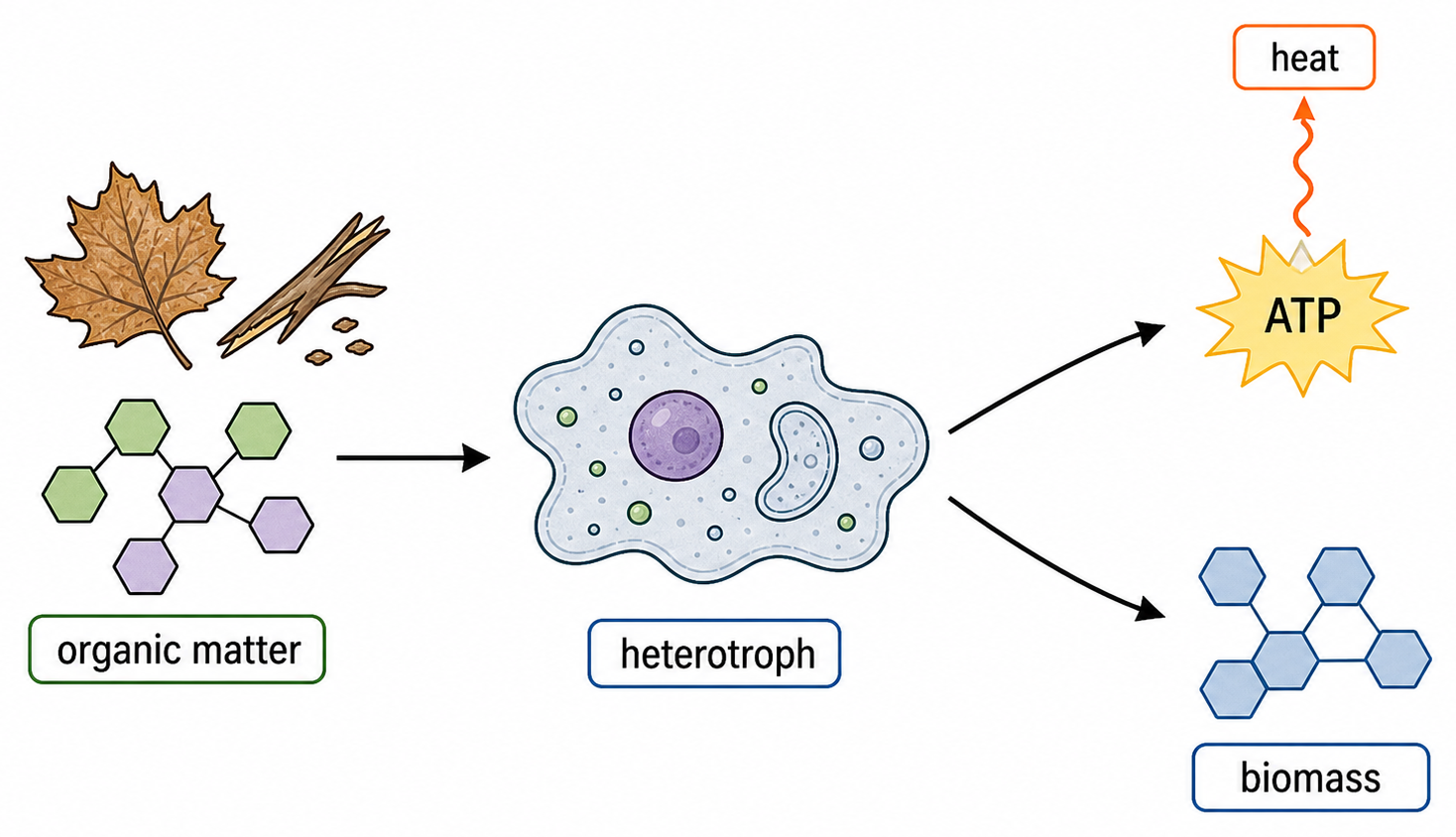
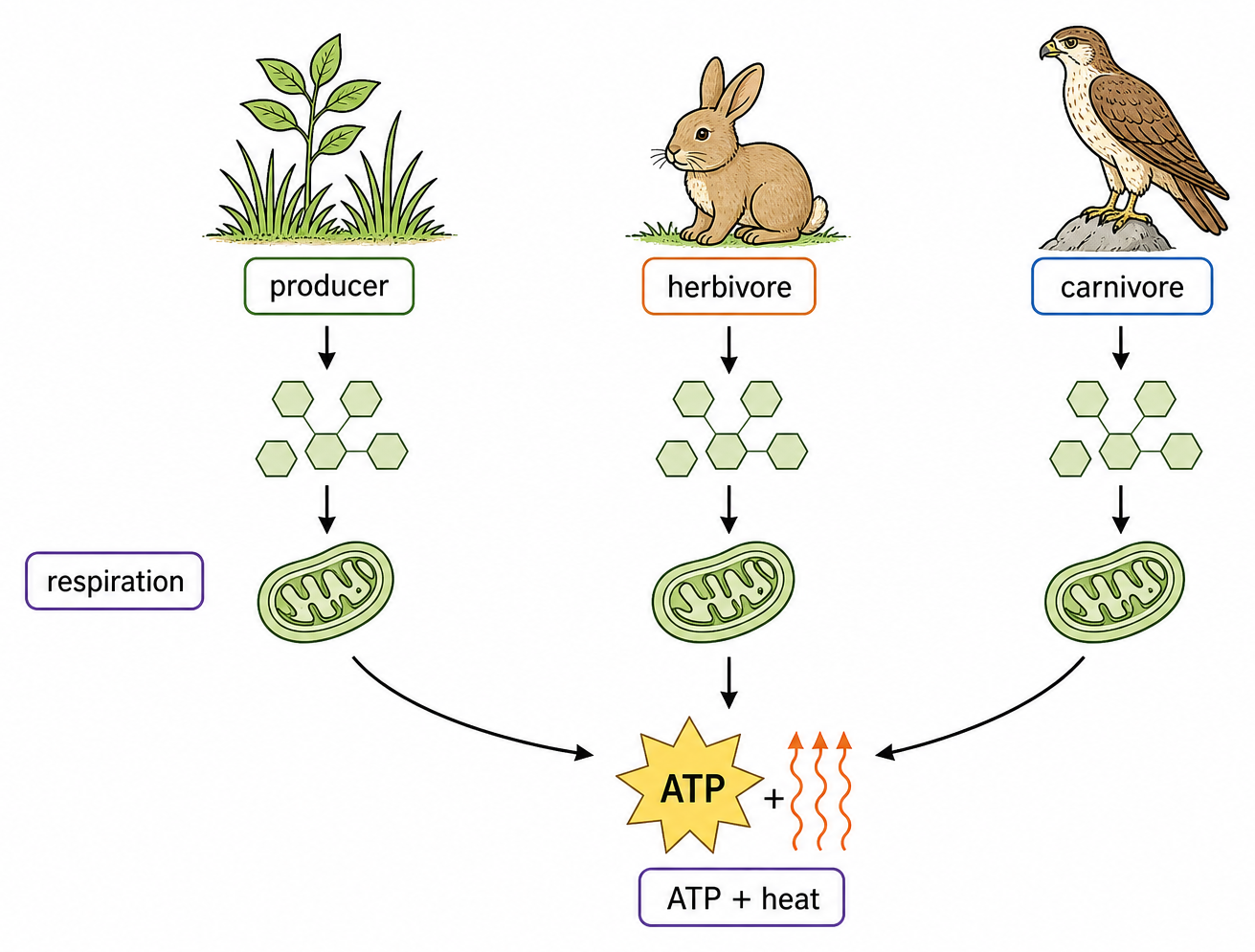
Cell respiration transfers energy from organic compounds into ATP through glycolysis, anaerobic pathways and aerobic mitochondrial stages, supporting usable cellular work and measurable biological activity.

Syllabus
First assessment 2025
Topic
C1.2
Level
HL

Learning objectives

C1.2.1ATP distributes energy• ATP is a small soluble nucleotide and universal energy currency• It links energy-yielding respiration to energy-requiring cellular processesC1.2.2Life processes using ATP• ATP supplies active transport, anabolic synthesis, and movement• Examples include membrane pumps, macromolecule synthesis, and chromosome movementC1.2.3ATP ↔ ADP interconversions• ATP hydrolysis to ADP and phosphate releases energy for coupled reactions• Respiration phosphorylates ADP to ATP; ATP is recycled rather than storedC1.2.4Cell respiration system• Cell respiration is enzyme-controlled release of energy from organic compounds• Carbon compounds are oxidized stepwise so energy can be transferred to ATPC1.2.5Anaerobic vs. aerobic respiration in humans• Aerobic respiration uses oxygen and mitochondria, producing CO₂, water, and high ATP• Anaerobic respiration in human cytoplasm produces lactate and low ATPC1.2.6Variables affecting rate• Rate depends on metabolic demand, organism size, oxygen, substrate, temperature, and pH• Respirometers measure oxygen uptake while soda lime absorbs CO₂C1.2.7(HL)—NAD as hydrogen carrier• NAD accepts hydrogen during oxidation/dehydrogenation reactions• Reduced NAD carries electrons and protons to the electron transport chainC1.2.8(HL)—Glycolysis• Glycolysis converts glucose to two pyruvate molecules in the cytoplasm• It is a linear pathway with substrate-level ATP and reduced NAD net yieldC1.2.9(HL)—Pyruvate → lactate• Pyruvate accepts hydrogen from reduced NAD to form lactate• Regenerated NAD allows glycolysis to continueC1.2.10(HL)—Anaerobic respiration in yeast• Yeast converts pyruvate to ethanol and CO₂ during alcoholic fermentation• Fermentation regenerates NAD for glycolysis and is used in baking and brewingC1.2.11(HL)—Link reaction• Pyruvate is oxidized and decarboxylated in the mitochondrial matrix• Acetyl groups join coenzyme A to form acetyl-CoA for the Krebs cycleC1.2.12(HL)—Krebs cycle• Acetyl-CoA combines with oxaloacetate to form citrate• The cycle regenerates oxaloacetate and yields CO₂, ATP, reduced NAD, and reduced FADC1.2.13(HL)—Electron transport chain• Reduced NAD and FAD donate electrons to carriers in the inner mitochondrial membrane• Electron transfers release energy while coenzymes are reoxidizedC1.2.14(HL)—Proton gradient generation• Electron transport energy pumps protons from matrix to intermembrane space• The inner membrane maintains a proton gradient and membrane potentialC1.2.15(HL)—Chemiosmosis• Protons flow through ATP synthase back into the matrix• ATP synthase couples proton flow to ADP phosphorylation by chemiosmosisC1.2.16(HL)—Oxygen as terminal electron acceptor• Oxygen is the terminal electron acceptor at the end of the chain• Oxygen combines with electrons and protons to form metabolic waterC1.2.17(HL)—Lipids vs. carbohydrates as substrates• Lipids yield more ATP and metabolic water per gram because they are more reduced• Carbohydrates are easier to hydrolyse and enter glycolysis quickly

ATP Is a Transfer Currency, Not a Long-Term Store

ATP is a small, soluble nucleotide found in all living cells. It transfers manageable amounts of energy between energy-yielding reactions and energy-requiring processes, and can move between nearby reaction sites in the aqueous cell.
ATP+H2O→ADP+PiATP + H_2O \rightarrow ADP + P_i

ADP+Pi→ATPADP + P_i \rightarrow ATP

Cells recycle ATP rapidly rather than storing large reserves of it. Glucose, glycogen and lipids are more stable energy stores; respiration transfers some of their energy into ATP when and where work is needed.

ATP Couples Energy Release to Three Kinds of Cellular Work

Work powered by ATP Example How coupling helps
transport membrane pump moves ions against a gradient phosphorylation changes pump conformation
chemical synthesis amino acids joined into a protein coupled reactions make an otherwise unfavourable step proceed
mechanical movement motor proteins move chromosomes or contractile filaments ATP-driven conformational cycles generate force

ATP hydrolysis is useful because it is coupled directly to another process, often by transferring a phosphate or changing a protein's conformation. Free energy is not released as a detached substance that a cell later collects.
One ATP transfer supplies a small task; continuous ATP regeneration allows many molecular events to combine into cell movement, active transport and growth.
Respiration Releases Energy in Controlled Steps

Cell respiration is the enzyme-controlled release of energy from organic compounds to produce ATP. Stepwise oxidation transfers energy in small amounts instead of releasing it suddenly as heat and light.

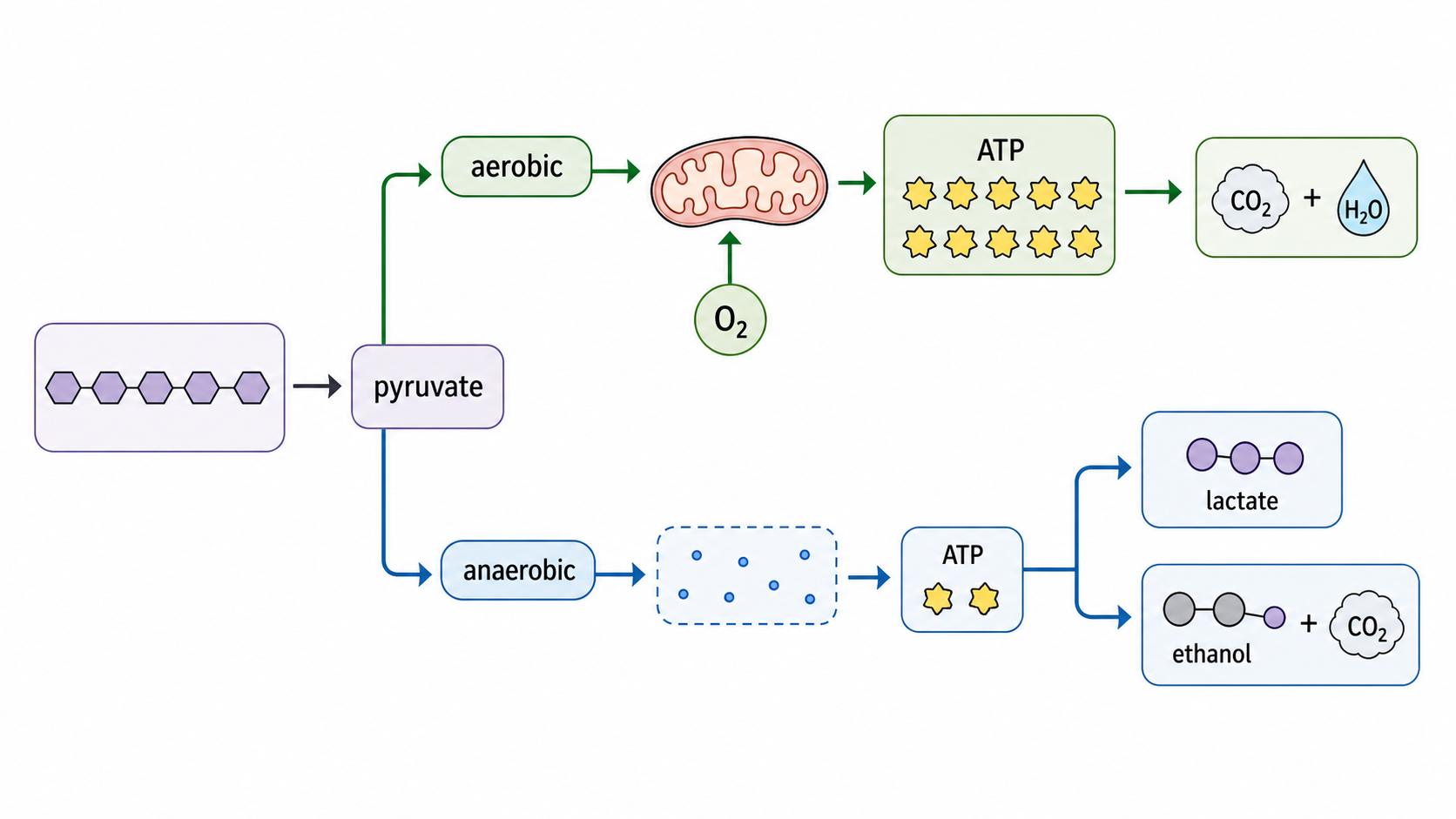
Glucose is converted to pyruvate, which enters a high-ATP aerobic route with oxygen or low-ATP anaerobic routes producing lactate or ethanol and carbon dioxide.
In humans Aerobic route Anaerobic route
oxygen required for continued electron transport not required
location glycolysis in cytoplasm, then mitochondria cytoplasm only
glucose oxidation complete incomplete
products CO₂ and H₂O lactate
ATP yield high net 2 ATP per glucose

Respiration Rate Reflects Demand, Supply and Enzyme Conditions

Variable Why rate may change
ATP demand active muscle or transport increases ADP supply and pathway flux
organism size smaller endotherms lose heat faster per unit mass and often need higher mass-specific respiration
oxygen shortage limits aerobic electron transport and shifts ATP production toward low-yield anaerobic pathways
respiratory substrate availability and entry route limit carbon and electron supply
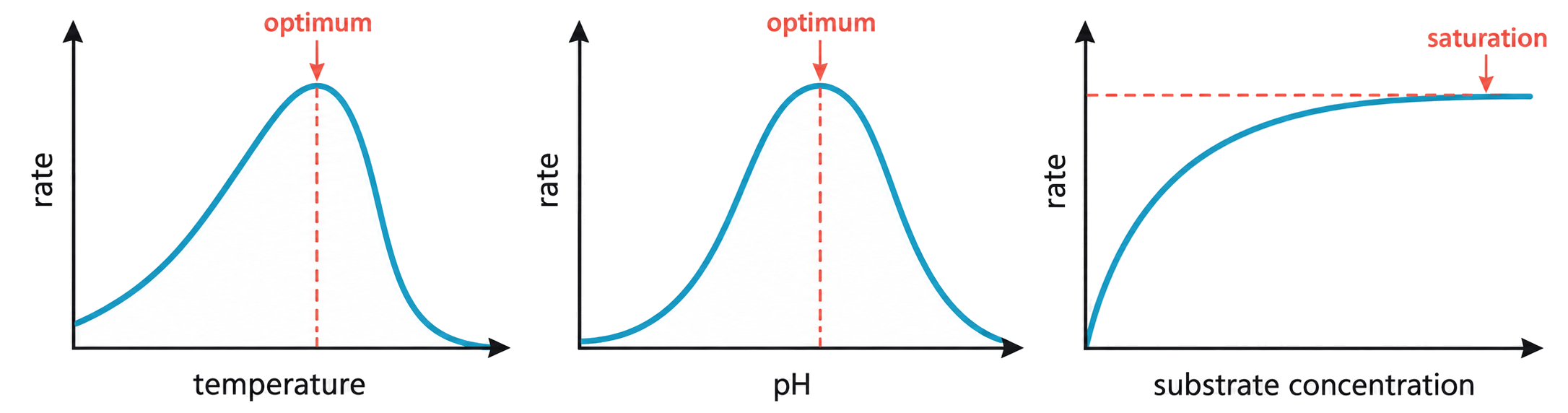
temperature enzyme activity rises to an optimum, then denaturation lowers rate
pH altered charges and protein structure change respiratory enzyme activity

A measured correlation does not prove a single cause. For example, exercise changes ATP demand, oxygen delivery, temperature and substrate use together; a controlled experiment isolates one variable.

A Respirometer Turns Oxygen Uptake into a Rate

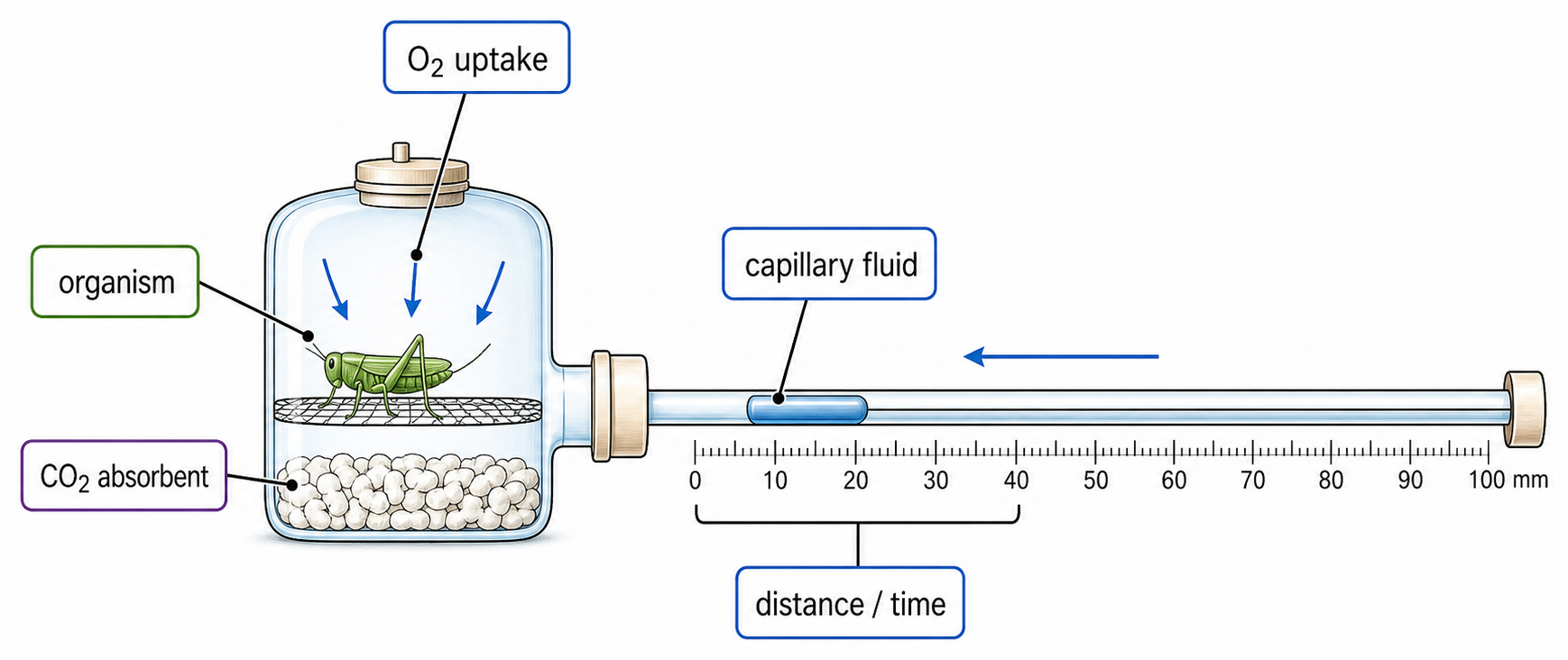
The organism consumes O₂ and releases CO₂. Soda lime absorbs the CO₂, so total gas volume falls by the volume of O₂ taken up; reduced pressure moves the capillary fluid toward the organisms.

A sealed respirometer contains a respiring organism and carbon dioxide absorbent; oxygen uptake lowers pressure and draws capillary fluid toward the chamber.

oxygen uptake rate=πr2dt\text{oxygen uptake rate}=\frac{\pi r^2 d}{t}

Use a control tube with an equal volume of inert beads, keep temperature constant in a water bath, allow equilibration before sealing, repeat measurements, and prevent direct contact between organisms and soda lime.

SL Checkpoint: Follow Energy from Fuel to Work

organic substrate → stepwise oxidation in respiration → ATP regeneration → coupled transport, synthesis or movement → ADP + Pᵢ recycled

With adequate oxygen, aerobic respiration completes oxidation and yields much more ATP. Without enough oxygen, human cells can regenerate NAD through lactate formation so glycolysis continues, but only its small ATP yield remains.

Respiration rate can be estimated from O₂ uptake only when CO₂ is absorbed and temperature, pressure, organism amount and measurement time are controlled.

NAD Carries Electrons Removed During Oxidation

HL only
Change Electron definition Common biological sign
oxidation loss of electrons hydrogen removed or oxygen added
reduction gain of electrons hydrogen added or oxygen removed

NAD++2H→NADH+H+NAD^+ + 2H \rightarrow NADH + H^+

A dehydrogenase removes hydrogen from a respiratory intermediate, oxidizing that substrate. NAD⁺ accepts the electrons and hydrogen, becoming reduced NAD; later it donates high-energy electrons to the electron transport chain and is reoxidized for reuse.

NAD does not create energy. It temporarily carries reducing power from oxidation reactions to a place where electron transfer can be coupled to proton pumping.

Glycolysis Invests ATP Before It Pays ATP Back

HL only
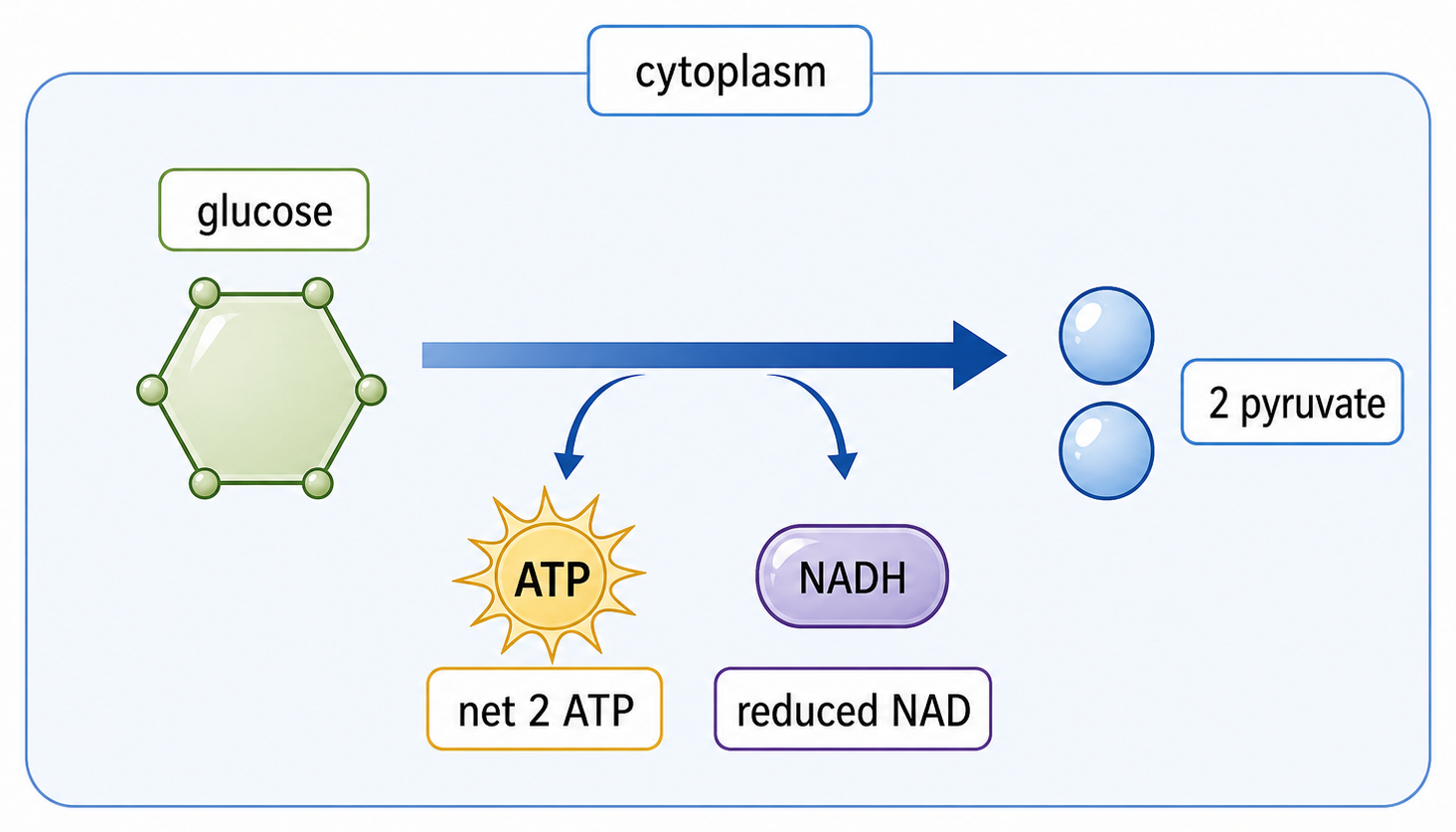
In cytoplasmic glycolysis, one glucose forms two pyruvate with net two ATP and reduced NAD.
1

Two ATP phosphorylate and activate one glucose, producing an unstable six-carbon intermediate.

2

The six-carbon compound splits into two three-carbon triose phosphates.

3

Both triose phosphates are oxidized; NAD⁺ is reduced and inorganic phosphate is added.

4

Substrate-level phosphorylation forms four ATP as the two three-carbon molecules become two pyruvate. Four made minus two invested gives a net gain of two ATP per glucose.

Fermentation Regenerates NAD So Glycolysis Can Continue

HL only

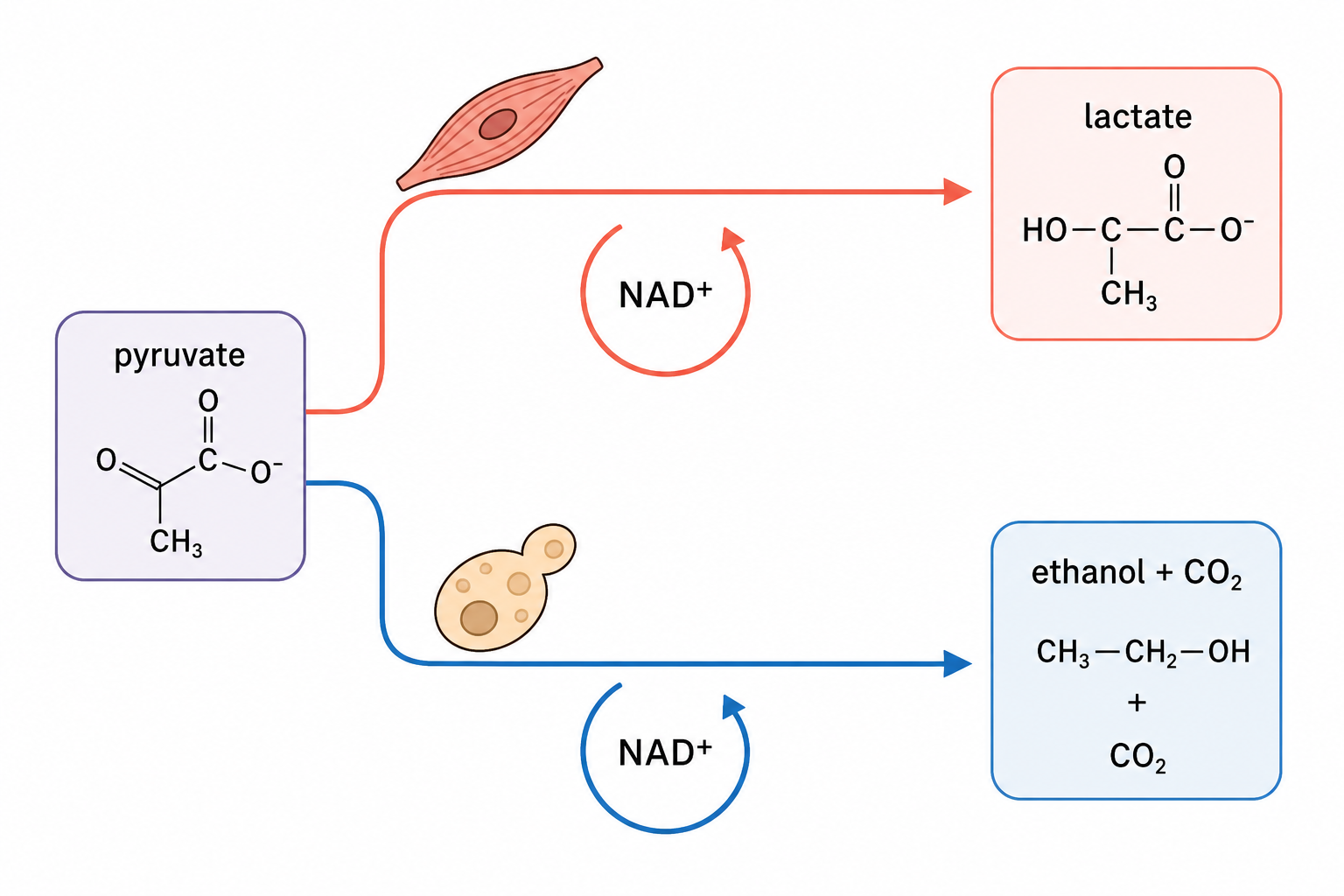
Without oxygen, reduced NAD cannot be reoxidized through the electron transport chain. Transferring its hydrogen to a pyruvate-derived acceptor regenerates NAD⁺, which glycolysis needs for its oxidation step.

Pyruvate accepts hydrogen from reduced NAD to form lactate in human muscle or is decarboxylated then reduced to ethanol in yeast, regenerating NAD in both routes.
Route Hydrogen acceptor and products Application or consequence
human lactate fermentation pyruvate accepts hydrogen → lactate; no CO₂ permits brief ATP production when oxygen delivery cannot meet demand
yeast alcoholic fermentation pyruvate loses CO₂ to ethanal; ethanal accepts hydrogen → ethanol CO₂ raises bread; ethanol and CO₂ are used in brewing

Fermentation adds no ATP beyond glycolysis. Lactate and ethanol remain energy-rich because glucose has been incompletely oxidized.

The Link Reaction Converts Pyruvate into an Acetyl Entry Ticket

HL only

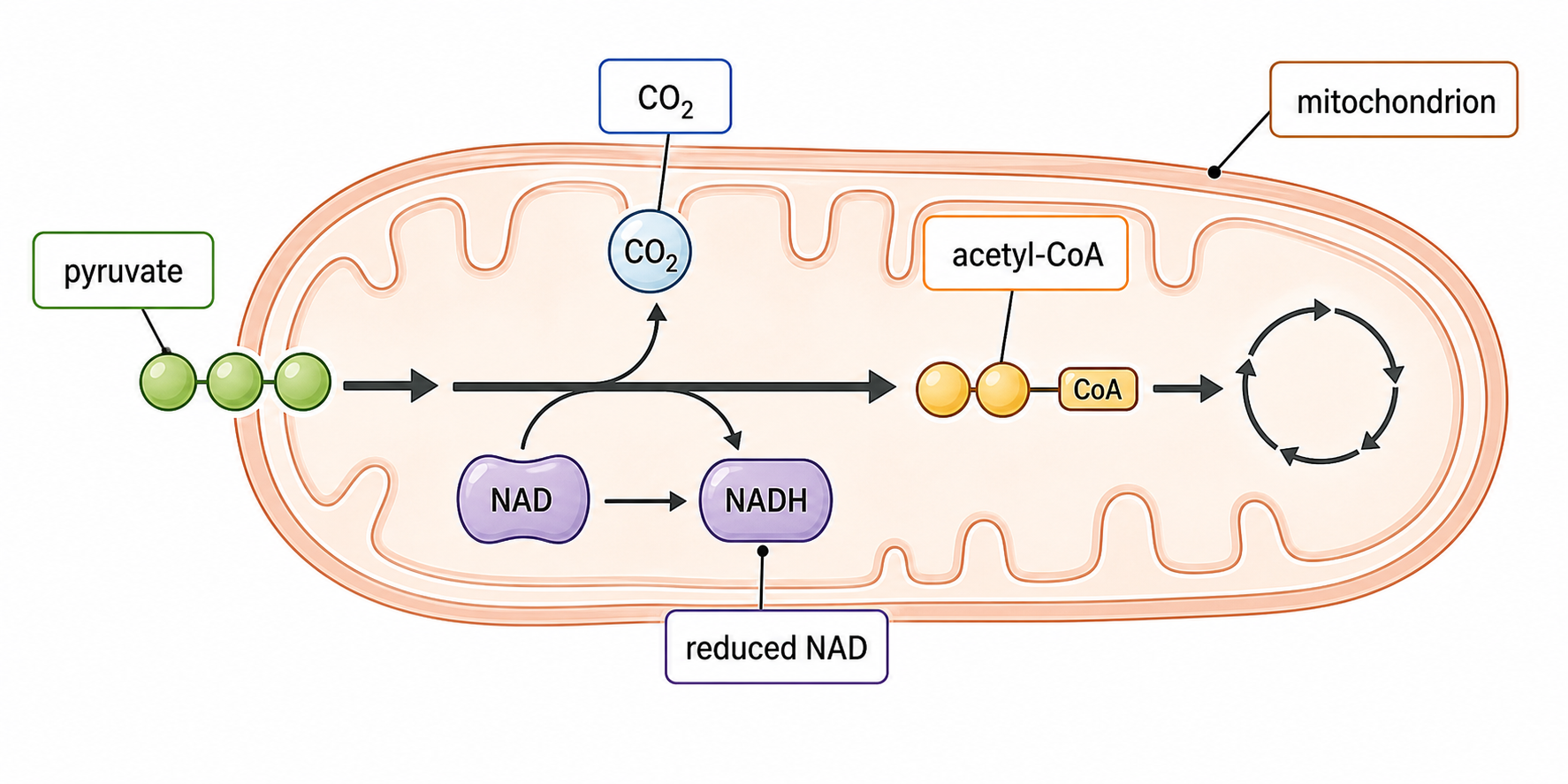
Each 3C pyruvate enters the mitochondrial matrix and is decarboxylated, releasing one CO₂. The remaining 2C fragment is oxidized, reducing NAD⁺.

The 2C acetyl group attaches to coenzyme A to form acetyl-CoA. CoA carries the acetyl group into the Krebs cycle; the link reaction produces no ATP directly.

In the mitochondrial matrix, three-carbon pyruvate loses carbon dioxide, reduces NAD and joins coenzyme A as two-carbon acetyl-CoA.

One glucose produces two pyruvate, so the link reaction happens twice per glucose: 2 acetyl-CoA + 2 CO₂ + 2 reduced NAD.

The Krebs Cycle Oxidizes Acetyl Groups and Regenerates Its Acceptor

HL only

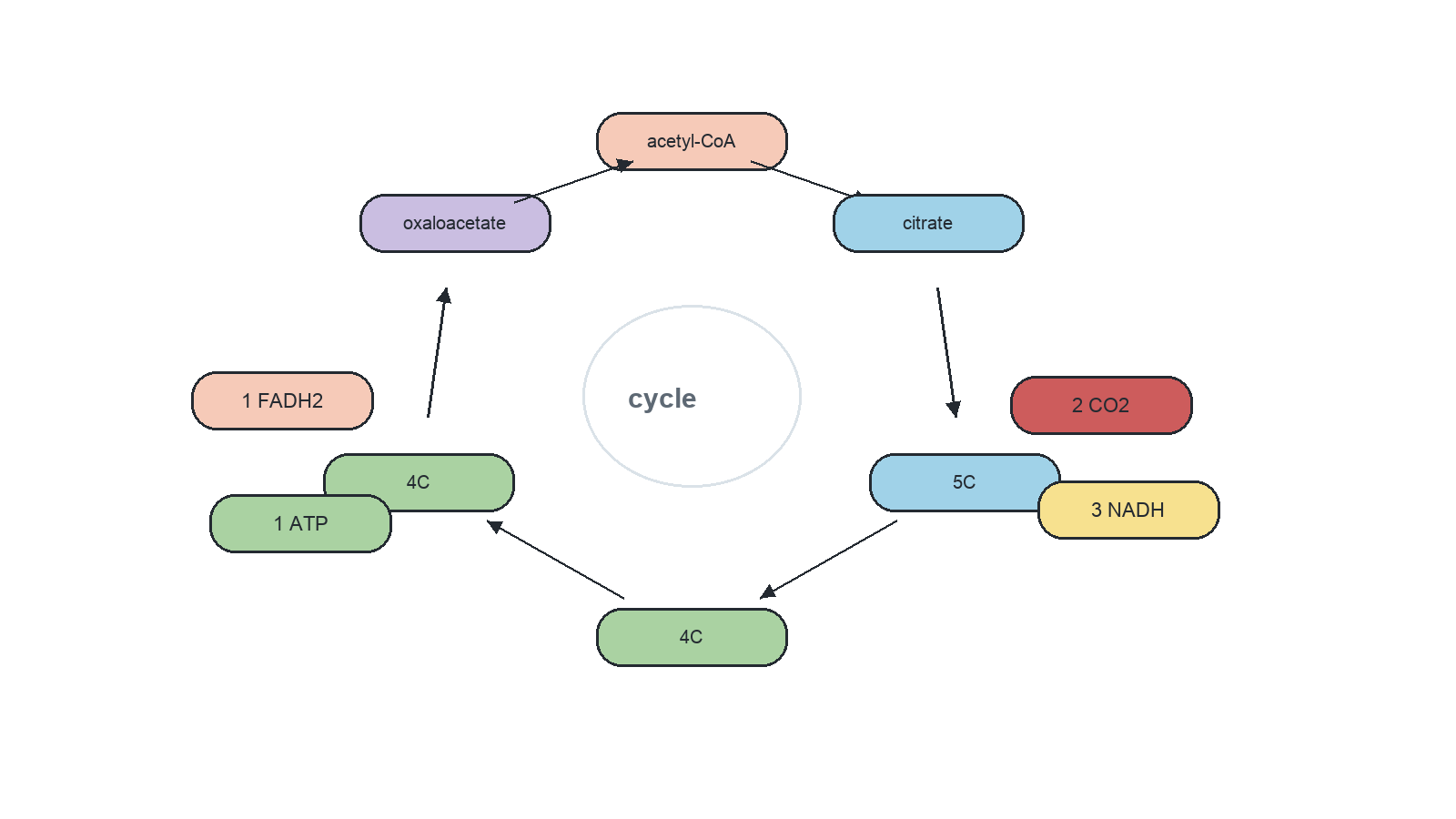
A 2C acetyl group combines with 4C oxaloacetate to form 6C citrate. Coenzyme A is released for reuse.

During one turn, citrate is rearranged and oxidized: 2 CO₂ are released, 3 NAD and 1 FAD are reduced, and 1 ATP is formed by substrate-level phosphorylation.

The remaining four-carbon skeleton is rebuilt as oxaloacetate, allowing another acetyl group to enter. Because two acetyl-CoA form per glucose, the cycle turns twice per glucose.

Two-carbon acetyl-CoA joins four-carbon oxaloacetate to form six-carbon citrate; the cycle releases two carbon dioxide, forms ATP and reduces three NAD and one FAD while regenerating oxaloacetate.

Reduced Coenzymes Feed Electrons into an Ordered Chain

HL only

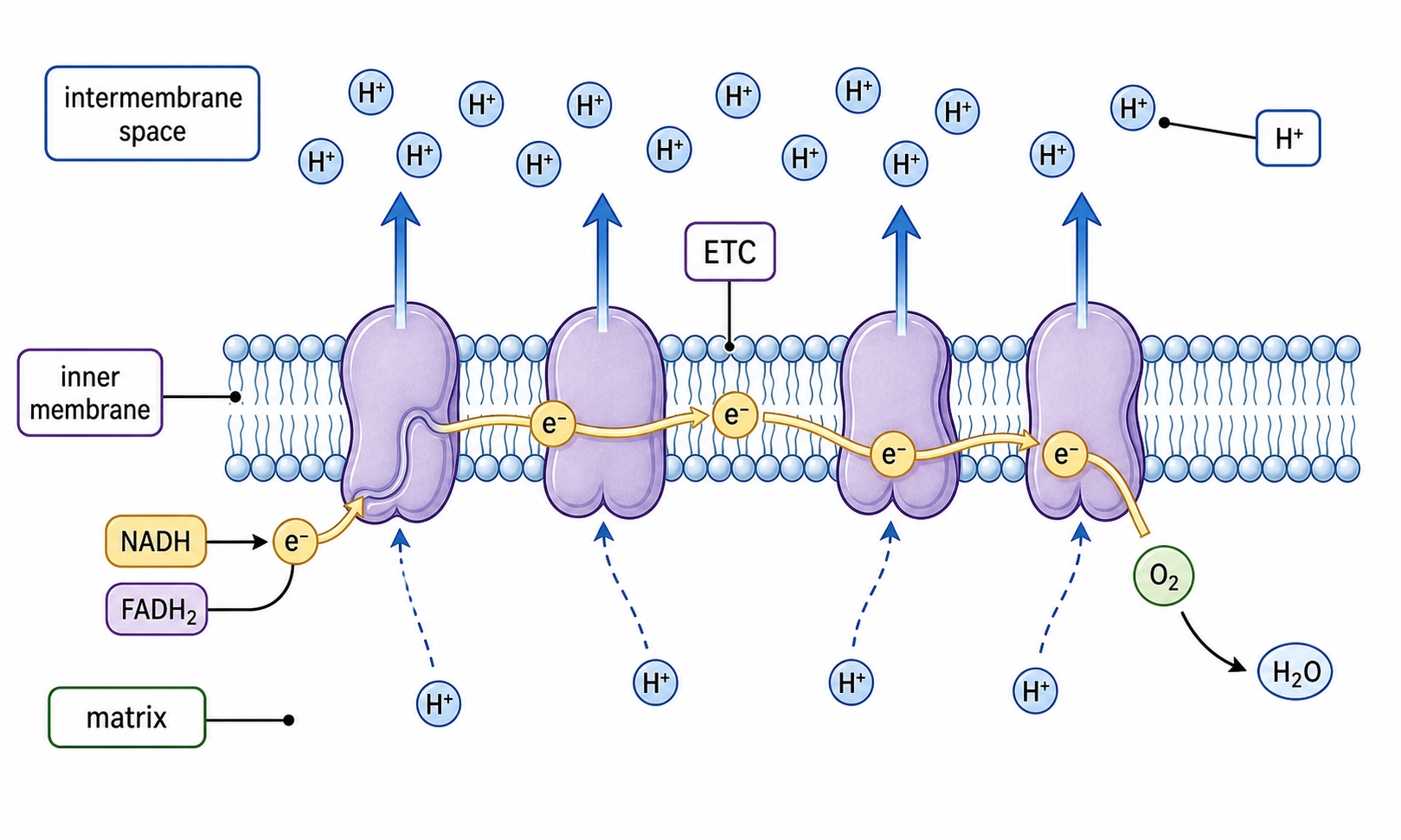
Reduced NAD and FAD donate electrons to carriers in the inner mitochondrial membrane and are reoxidized. Their electrons pass through a sequence of redox carriers, releasing energy in controlled steps.

Inner mitochondrial membrane electron transport chain: NADH and FADH2 donate electrons, selected complexes pump protons to the intermembrane space, and oxygen is reduced to water at the end.

O2+4e−+4H+→2H2OO_2 + 4e^- + 4H^+ \rightarrow 2H_2O

Oxygen is the terminal electron acceptor. By removing electrons and matrix protons as water, it permits continued electron flow and continued reoxidation of NAD and FAD.

Electron Transfer Builds an Electrochemical Proton Gradient

HL only

Energy released as electrons move along the chain drives proton pumps in the inner mitochondrial membrane. H⁺ moves from the matrix into the intermembrane space.

Gradient component Intermembrane space relative to matrix Stored tendency
concentration more H⁺ H⁺ diffuses back toward the matrix
electrical more positive positive H⁺ is attracted to the relatively negative matrix

The inner membrane is largely impermeable to ions, so H⁺ cannot simply diffuse through the phospholipid bilayer. The combined concentration and voltage difference is an electrochemical gradient that stores potential energy.

Electrons travel along carriers within the membrane; protons are pumped across it. These are coupled but distinct movements.

Chemiosmosis Couples Proton Return to ATP Formation

HL only

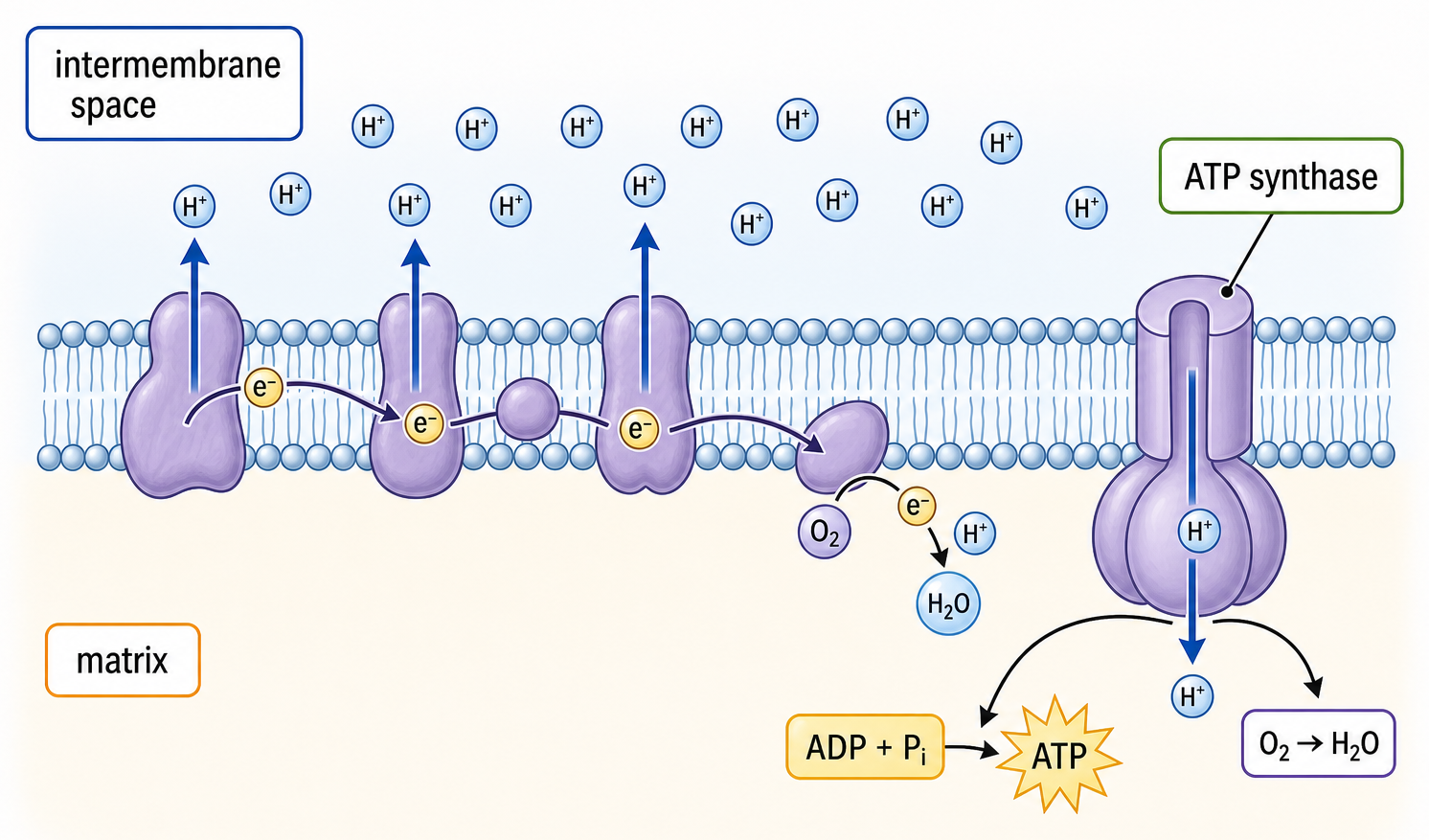
H⁺ flows down its electrochemical gradient from the intermembrane space to the matrix through ATP synthase. Proton movement drives conformational and rotational changes in the enzyme.

Electron transport pumps protons from the matrix to the intermembrane space; protons return through ATP synthase to form ATP, while oxygen accepts electrons and protons to form water.

ADP+Pi→proton flowATP synthaseATPADP + P_i \xrightarrow[\text{proton flow}]{\text{ATP synthase}} ATP

This coupling is oxidative phosphorylation: oxidation of reduced carriers powers the gradient, chemiosmosis powers ATP synthase, and oxygen removal of electrons and protons keeps the system from backing up.

Removing the Gradient Tests the Chemiosmotic Model

HL only

If a proton gradient across an intact inner membrane drives ATP synthesis, then destroying the membrane or allowing H⁺ to bypass ATP synthase should reduce ATP production even when electron transport continues.

Intervention Immediate effect ATP consequence
physically disrupt inner membrane compartments and gradient disappear oxidative ATP synthesis stops
add a proton-carrying uncoupler H⁺ returns without ATP synthase gradient falls and ATP output decreases
provide an intact membrane, gradient, ADP and Pᵢ H⁺ can flow through ATP synthase ATP synthesis is supported

During uncoupling, fuel oxidation energy is released mainly as heat instead of being captured in ATP. Brown adipose tissue uses controlled natural uncoupling for heat production.

Fuel Choice Trades Rapid Access for Energy Density

HL only
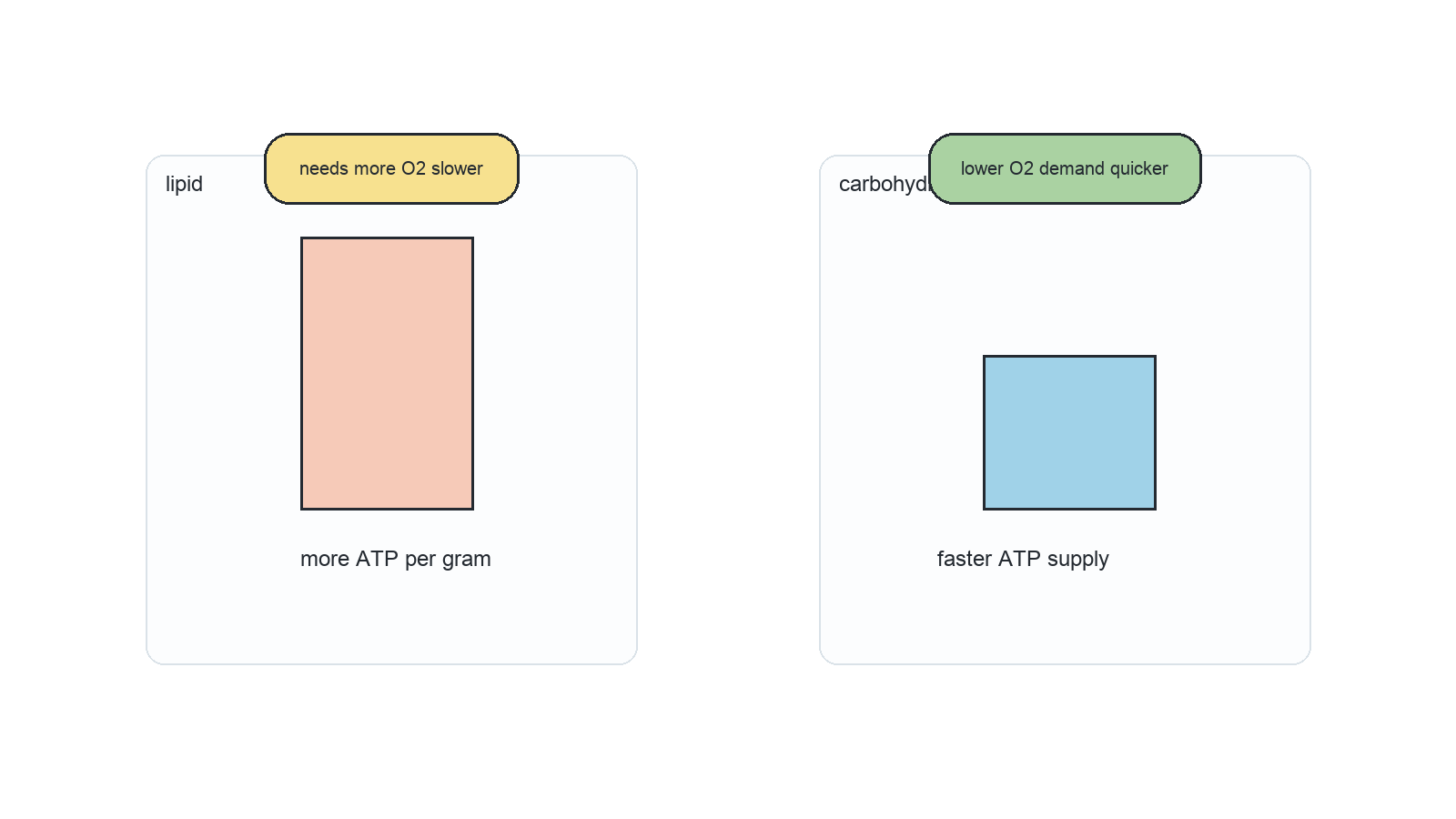
Carbohydrate and lipid respiratory substrates compared for pathway entry, ATP per gram, oxygen demand, metabolic water and suitability for short- or long-duration demand.
Property Carbohydrate Lipid
oxidation state already contains more oxygen; less reduced rich in C–H bonds; more reduced
energy and water per gram lower more than twice the energy and more metabolic water
oxygen demand lower per unit energy pathway entry higher because more electrons and hydrogen must reach oxygen
access glucose enters glycolysis rapidly fatty acids require mobilization and β-oxidation to acetyl-CoA
storage glycogen is hydrated and affects mass triglyceride is compact and osmotically inert

Carbohydrate suits rapid, high-intensity ATP demand and can support anaerobic glycolysis. Lipid suits sustained aerobic demand and long-term storage. The best fuel depends on oxygen supply, intensity and duration—not one universal ranking.

HL Summary: Track Carbon, Electrons, Protons and ATP

HL only

Carbon: glucose → 2 pyruvate → 2 acetyl-CoA → CO₂. Without oxygen, pyruvate-derived products retain much of the original chemical energy.

Electrons: substrate oxidation → reduced NAD/FAD → electron transport → O₂
Protons: matrix → pumped to intermembrane space → ATP synthase → matrix
ATP: substrate-level phosphorylation in glycolysis/Krebs + most ATP by oxidative phosphorylation

Missing condition First major consequence
NAD⁺ is not regenerated glycolysis oxidation step stops
oxygen is absent electron chain backs up; reduced carriers cannot be reoxidized there
inner membrane loses H⁺ impermeability gradient collapses
ATP synthase is blocked proton return cannot drive phosphorylation

A complete respiration explanation follows the transferred entity and location: carbon skeleton, electron carrier, proton gradient or phosphate—and states how its movement changes ATP production.

ATP distributes energy

3 marks

Explain the properties of ATP that make it useful for distributing energy within cells.

Life processes using ATP

5 marks

Outline, with examples, the wide range of uses of adenosine triphosphate (ATP) in cells.

ATP ↔ ADP interconversions

1 mark

Which reaction does not cause a net release of energy?

Cell respiration system

8 marks

Explain the need for energy in cells and how energy is released through cell respiration.

Anaerobic vs. aerobic respiration in humans

8 marks

Carbon dioxide is released during cell respiration. Explain anaerobic and aerobic respiration.

Variables affecting rate

3 marks

Describe how the apparatus measures the oxygen consumption of the mouse.

NAD as hydrogen carrier

HL only

1 mark

The diagram shows some reactions occurring during respiration in the mitochondrion.

Energy that is released by oxidation reactions in the mitochondrial matrix is carried to the cristae of the mitochondria. How is this energy carried?

Glycolysis exam focus

HL only

6 marks

In anaerobic conditions, plants release energy by glycolysis. Outline the process of glycolysis.

Pyruvate → lactate

HL only

2 marks

Outline how NAD is made available for glycolysis during anaerobic respiration in animal cells.

Anaerobic respiration in yeast

HL only

6 marks

Explain the use of yeast in the production of bread and beer.

Link reaction

HL only

4 marks

C3. Explain the link reaction that occurs between glycolysis and the Krebs cycle.

Krebs cycle

HL only

8 marks

Explain the processes involved in the Krebs cycle.

Electron transport chain

HL only

1 mark

Identify the letter which shows the location of the electron transport chain.

Proton gradient generation

HL only

1 mark

Where are protons pumped, to allow chemiosmosis in aerobic respiration to occur?

Chemiosmosis exam focus

HL only

4 marks

Explain how ATP is generated in mitochondria by chemiosmosis.

Oxygen as terminal electron acceptor

HL only

5 marks

Describe the role of oxygen in aerobic cell respiration.

Lipids vs. carbohydrates as substrates

HL only

3 marks

Studies of harbour seals led to the hypothesis that stores of fats (triglycerides) may play an important role in ATP production, especially during diving. Discuss this hypothesis using the data provided.