
EduNinja

IGCSE Chemistry Extended7.1.5—Alkalis in terms of their effect onTopic Practice

7.1.5—Alkalis in terms of their effect on

• Describe alkalis in terms of their effect on: (a) litmus (b) thymolphthalein (c) methyl orange

Question 2(d)(ii)

[Maximum number: 1]

Rubidium, Rb, is a Group I element. It has similar physical and chemical properties to the other elements in Group I.

When rubidium is added to cold water a reaction occurs.

What would be the colour of the solution if methyl orange was added to it after the reaction?
Question 2(c)(iii)

[Maximum number: 1]

Sodium is a reactive metal.

Sodium reacts vigorously with water to form aqueous sodium hydroxide, NaOH , which is a strong base.

State the colour of methyl orange in aqueous sodium hydroxide.

Question 2(c)(iii)

[Maximum number: 1]

Potassium is a Group I element.

When potassium is added to water, it reacts vigorously and a coloured flame is seen. The equation for the reaction is shown.

2 K( s)+2H2O(l)2KOH(aq)+H2( g)2 \mathrm{~K}(\mathrm{~s})+2 \mathrm{H}_{2} \mathrm{O}(\mathrm{l}) \rightarrow 2 \mathrm{KOH}(\mathrm{aq})+\mathrm{H}_{2}(\mathrm{~g})

State the colour of litmus in a strong alkali.

Question 3(d)(i)

[Maximum number: 1]

Sulfur is an important element.

In a titration, a student added 25.0 cm325.0 \mathrm{~cm}^{3} of 0.200 mol/dm30.200 \mathrm{~mol} / \mathrm{dm}^{3} aqueous sodium hydroxide to a conical flask. The student then added a few drops of methyl orange to the solution in the conical flask.
Dilute sulfuric acid was then added from a burette to the conical flask. The volume of dilute sulfuric acid needed to neutralise the aqueous sodium hydroxide was 20.0 cm320.0 \mathrm{~cm}^{3}.

2NaOH+H2SO4Na2SO4+2H2O2 \mathrm{NaOH}+\mathrm{H}_{2} \mathrm{SO}_{4} \rightarrow \mathrm{Na}_{2} \mathrm{SO}_{4}+2 \mathrm{H}_{2} \mathrm{O}

What was the colour of the methyl orange in the aqueous sodium hydroxide?

Question 4(c)(i)

[Maximum number: 1]

Sulfuric acid has many uses.

In a titration, a student added 25.0 cm325.0 \mathrm{~cm}^{3} of 0.200 mol/dm30.200 \mathrm{~mol} / \mathrm{dm}^{3} aqueous sodium hydroxide to a conical flask. The student then added a few drops of methyl orange to the solution in the conical flask.

Dilute sulfuric acid is then added from a burette to the conical flask. The volume of dilute sulfuric acid needed to neutralise the aqueous sodium hydroxide was 20.0 cm320.0 \mathrm{~cm}^{3}.

The reaction is shown by the equation.

2NaOH+H2SO4Na2SO4+2H2O2 \mathrm{NaOH}+\mathrm{H}_{2} \mathrm{SO}_{4} \rightarrow \mathrm{Na}_{2} \mathrm{SO}_{4}+2 \mathrm{H}_{2} \mathrm{O}

State the colour of methyl orange in aqueous sodium hydroxide.

Question 4(c)

[Maximum number: 1]

Solid sodium hydroxide is a base which dissolves to form an aqueous solution, NaOH(aq).

State the colour of thymolphthalein in NaOH(aq).

Question 3(c)

[Maximum number: 2]

This question is about acids, bases and alkalis.
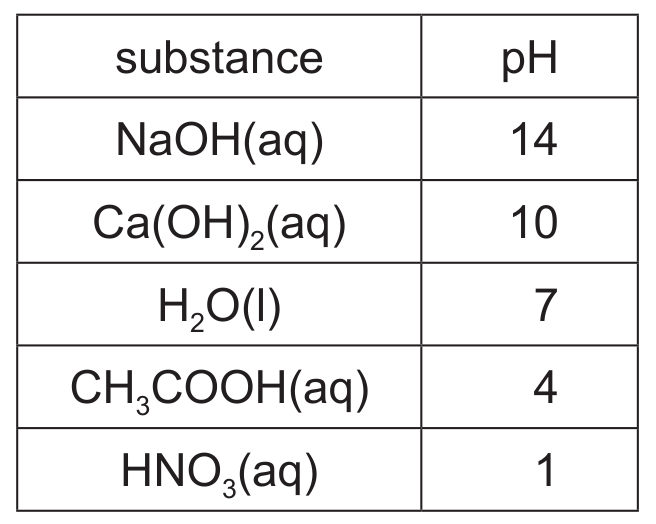
Table 3.1 shows the pH values of some substances.

Table 3.1

Table 3.1

Thymolphthalein is an indicator.

State the colour of thymolphthalein in:
- NaOH(aq)
- CH3COOH(aq)\mathrm{CH}_{3} \mathrm{COOH}(\mathrm{aq}).

0 selected