EduNinja

IGCSE Chemistry Extended3.1.4—Construct word equations and symbolTopic Practice

3.1.4—Construct word equations and symbol

• Construct word equations and symbol equations to show how reactants form products, including state symbols

Question 1(c)

[Maximum number: 2]

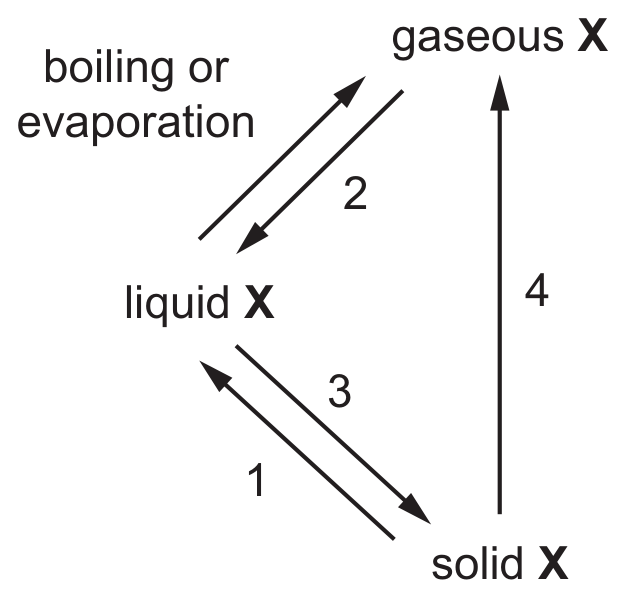
Element X can undergo the following physical changes.
Question image

Element X is a Group I metal. It burns in air to form an oxide X2O\mathbf{X}_{2} \mathrm{O}.

Write a chemical equation for this reaction.

Question 2(b)(ii)

[Maximum number: 2]

Magnesium exists as three isotopes, 1224Mg,1225Mg{ }_{12}^{24} \mathrm{Mg},{ }_{12}^{25} \mathrm{Mg} and 1226Mg{ }_{12}^{26} \mathrm{Mg}.

All isotopes of magnesium react with dilute hydrochloric acid to make hydrogen and a salt.

Write a chemical equation for the reaction between magnesium and dilute hydrochloric acid.

Question 2(d)(iii)

[Maximum number: 2]

Rubidium, Rb, is a Group I element. It has similar physical and chemical properties to the other elements in Group I.

When rubidium is added to cold water a reaction occurs.

Write a chemical equation for the reaction between rubidium and water.

Question 6

[Maximum number: 1]

Aqueous iron(III) sulfate and aqueous sodium hydroxide react to give a precipitate of iron(III) hydroxide and a solution of sodium sulfate.

What is the balanced symbol equation for this reaction?

A

Fe2(SO4)3(aq)+2NaOH(aq)Fe(OH)3( s)+Na2SO4(aq)\mathrm{Fe}_{2}\left(\mathrm{SO}_{4}\right)_{3}(\mathrm{aq})+2 \mathrm{NaOH}(\mathrm{aq}) \rightarrow \mathrm{Fe}(\mathrm{OH})_{3}(\mathrm{~s})+\mathrm{Na}_{2} \mathrm{SO}_{4}(\mathrm{aq})

B

Fe2(SO4)3(aq)+3NaOH(aq)Fe(OH)3( s)+3Na2SO4(aq)\mathrm{Fe}_{2}\left(\mathrm{SO}_{4}\right)_{3}(\mathrm{aq})+3 \mathrm{NaOH}(\mathrm{aq}) \rightarrow \mathrm{Fe}(\mathrm{OH})_{3}(\mathrm{~s})+3 \mathrm{Na}_{2} \mathrm{SO}_{4}(\mathrm{aq})

C

Fe2(SO4)3(aq)+6NaOH(aq)2Fe(OH)3( s)+3Na2SO4(aq)\mathrm{Fe}_{2}\left(\mathrm{SO}_{4}\right)_{3}(\mathrm{aq})+6 \mathrm{NaOH}(\mathrm{aq}) \rightarrow 2 \mathrm{Fe}(\mathrm{OH})_{3}(\mathrm{~s})+3 \mathrm{Na}_{2} \mathrm{SO}_{4}(\mathrm{aq})

D

2Fe2(SO4)3(aq)+6NaOH(aq)4Fe(OH)3( s)+6Na2SO4(aq)2 \mathrm{Fe}_{2}\left(\mathrm{SO}_{4}\right)_{3}(\mathrm{aq})+6 \mathrm{NaOH}(\mathrm{aq}) \rightarrow 4 \mathrm{Fe}(\mathrm{OH})_{3}(\mathrm{~s})+6 \mathrm{Na}_{2} \mathrm{SO}_{4}(\mathrm{aq})

Question 6

[Maximum number: 1]

Which equations are balanced?

1Fe2O3+3CO2Fe+3CO21 \mathrm{Fe}_{2} \mathrm{O}_{3}+3 \mathrm{CO} \rightarrow 2 \mathrm{Fe}+3 \mathrm{CO}_{2}

2ZnCO3+2HClZnCl2+CO2+2H2O2 \mathrm{ZnCO}_{3}+2 \mathrm{HCl} \rightarrow \mathrm{ZnCl}_{2}+\mathrm{CO}_{2}+2 \mathrm{H}_{2} \mathrm{O}

3Mg(NO3)2+NaOHMg(OH)2+2NaNO33 \mathrm{Mg}\left(\mathrm{NO}_{3}\right)_{2}+\mathrm{NaOH} \rightarrow \mathrm{Mg}(\mathrm{OH})_{2}+2 \mathrm{NaNO}_{3}

4CaCO3+H2SO4CaSO4+H2O+CO24 \mathrm{CaCO}_{3}+\mathrm{H}_{2} \mathrm{SO}_{4} \rightarrow \mathrm{CaSO}_{4}+\mathrm{H}_{2} \mathrm{O}+\mathrm{CO}_{2}

A

1 and 2

B

1 and 4

C

2 and 3

D

3 and 4

Question 7

[Maximum number: 1]

Propane burns in oxygen.

C3H8+xO23CO2+yH2O\mathrm{C}_{3} \mathrm{H}_{8}+x \mathrm{O}_{2} \rightarrow 3 \mathrm{CO}_{2}+y \mathrm{H}_{2} \mathrm{O}

Which values of x and y balance the equation?

x

y

5

4

7

4

10

8

13

8

Question 7

[Maximum number: 1]

Aqueous iron(III) sulfate and aqueous sodium hydroxide react to give a precipitate of iron(III) hydroxide and a solution of sodium sulfate.

What is the balanced equation for this reaction?

A

Fe2(SO4)3(aq)+2NaOH(aq)Fe(OH)3( s)+Na2SO4(aq)\mathrm{Fe}_{2}\left(\mathrm{SO}_{4}\right)_{3}(\mathrm{aq})+2 \mathrm{NaOH}(\mathrm{aq}) \rightarrow \mathrm{Fe}(\mathrm{OH})_{3}(\mathrm{~s})+\mathrm{Na}_{2} \mathrm{SO}_{4}(\mathrm{aq})

B

Fe2(SO4)3(aq)+3NaOH(aq)Fe(OH)3( s)+3Na2SO4(aq)\mathrm{Fe}_{2}\left(\mathrm{SO}_{4}\right)_{3}(\mathrm{aq})+3 \mathrm{NaOH}(\mathrm{aq}) \rightarrow \mathrm{Fe}(\mathrm{OH})_{3}(\mathrm{~s})+3 \mathrm{Na}_{2} \mathrm{SO}_{4}(\mathrm{aq})

C

Fe2(SO4)3(aq)+6NaOH(aq)2Fe(OH)3( s)+3Na2SO4(aq)\mathrm{Fe}_{2}\left(\mathrm{SO}_{4}\right)_{3}(\mathrm{aq})+6 \mathrm{NaOH}(\mathrm{aq}) \rightarrow 2 \mathrm{Fe}(\mathrm{OH})_{3}(\mathrm{~s})+3 \mathrm{Na}_{2} \mathrm{SO}_{4}(\mathrm{aq})

D

2Fe2(SO4)3(aq)+6NaOH(aq)4Fe(OH)3( s)+6Na2SO4(aq)2 \mathrm{Fe}_{2}\left(\mathrm{SO}_{4}\right)_{3}(\mathrm{aq})+6 \mathrm{NaOH}(\mathrm{aq}) \rightarrow 4 \mathrm{Fe}(\mathrm{OH})_{3}(\mathrm{~s})+6 \mathrm{Na}_{2} \mathrm{SO}_{4}(\mathrm{aq})

Question 7

[Maximum number: 1]

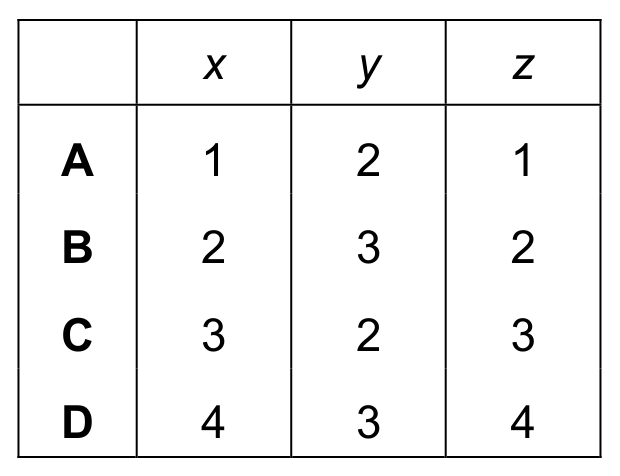
The equation for the reaction between phosphorus and oxygen is shown.

xP4+yO2zP2O5x \mathrm{P}_{4}+y \mathrm{O}_{2} \rightarrow z \mathrm{P}_{2} \mathrm{O}_{5}

Which values of x, y and z balance the equation?
x

y

z

1

5

2

1

10

2

2

5

2

2

10

1

Question 7

[Maximum number: 1]

The equation represents the reaction between solid magnesium oxide and dilute hydrochloric acid to form magnesium chloride and water.

MgO+2HClMgCl2+H2O\mathrm{MgO}+2 \mathrm{HCl} \rightarrow \mathrm{MgCl}_{2}+\mathrm{H}_{2} \mathrm{O}

Which row shows the state symbols for hydrochloric acid, magnesium chloride and water?

HCl

MgCl2\mathrm{MgCl}_{2}

H2O\mathrm{H}_{2} \mathrm{O}

(aq)(\mathrm{aq})

(aq)(\mathrm{aq})

(I)(\mathrm{I})

(aq)(\mathrm{aq})

(I)(\mathrm{I})

(I)(\mathrm{I})

(I)(\mathrm{I})

(aq)(\mathrm{aq})

(aq)(\mathrm{aq})

(I)(\mathrm{I})

(I)(\mathrm{I})

(aq)(\mathrm{aq})

Question 7

Aluminium reacts with fluorine.

xAl( s)+y F2( g)zAlF3( s)x \mathrm{Al}(\mathrm{~s})+y \mathrm{~F}_{2}(\mathrm{~g}) \rightarrow z \mathrm{AlF}_{3}(\mathrm{~s})

Which values of x, y and z balance the equation?

Table
0 selected