Question 2
[Maximum number: 1]
A mixture is separated using the apparatus shown.
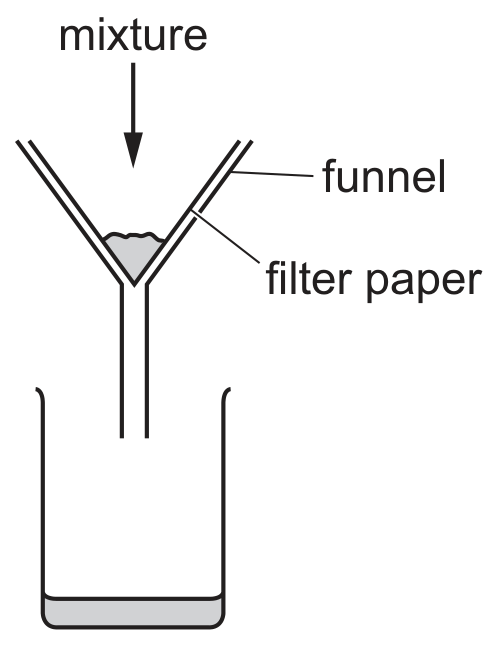
What is the mixture?
A
aqueous copper(II) sulfate and aqueous sodium chloride
B
aqueous copper(II) sulfate and copper
C
copper and sulfur
D
ethanol and ethanoic acid
 EduNinja
• Suggest suitable separation and purification techniques, given information about the substances involved
A mixture is separated using the apparatus shown.
What is the mixture?
aqueous copper(II) sulfate and aqueous sodium chloride
aqueous copper(II) sulfate and copper
copper and sulfur
ethanol and ethanoic acid
A mixture contains salt, sand and sulfur.
Salt dissolves in water but not in xylene.
Sulfur dissolves in xylene but not in water.
Sand does not dissolve in water or xylene.
What is the order of the processes used to separate the salt, the sand and the sulfur from the mixture?
add water → filter → add xylene to the filtrate → filter
add water → filter → add xylene to the residue → filter
add xylene → filter → add water to the filtrate → filter
add xylene → filter → add xylene to the residue → filter
Information about the solubility of four solids, P, Q, R and S, is given in the table.

A student attempted to separate mixtures of these solids using the following method.
1 Add the mixture to a beaker of water and stir.
2 Filter the mixture.
3 Crystallise one of the solids from the filtrate.
Which of the following mixtures could not be separated by this method?
a mixture of P and R
a mixture of Q and P
a mixture of Q and R
a mixture of R and S
Silver nitrate reacts with sodium chloride to produce silver chloride and sodium nitrate. The equation for the reaction is shown.
How is silver chloride separated from the reaction mixture?
crystallisation
distillation
evaporation
filtration
Lead(II) iodide is formed as a precipitate in the reaction shown.
Which method is used to separate the lead(II) iodide from the mixture?
crystallisation
distillation
evaporation
filtration
Lead(II) iodide is formed as a precipitate in the reaction shown.
Which method is used to separate the lead(II) iodide from the mixture?
crystallisation
distillation
evaporation
filtration
Air is a mixture of gases.
Oxygen and nitrogen are useful gases that can be obtained from air.
State the property of oxygen and nitrogen that allows these gases to be separated using this process.
The equation for the reaction of aqueous calcium nitrate and aqueous sodium hydroxide is shown.
Which process is used to remove calcium hydroxide from the mixture?
chromatography
crystallisation
distillation
filtration
Titanium is extracted from an ore called rutile. Rutile is an impure form of titanium(IV) oxide, .
Rutile is mixed with coke and heated in a furnace through which chlorine gas is passed. The product is gaseous titanium(IV) chloride, .
The gaseous titanium(IV) chloride produced is condensed into the liquid state. The titanium(IV) chloride is then separated from liquid impurities.
Suggest the name of the process by which liquid titanium(IV) chloride could be separated from the liquid impurities.
After titanium(IV) chloride is heated with magnesium, the unreacted magnesium is removed by adding an excess of dilute hydrochloric acid to the mixture.
The dilute hydrochloric acid also dissolves the magnesium chloride.
The dilute hydrochloric acid does not react with the titanium or dissolve it.
Name the process that is used to separate the titanium from the mixture after all the magnesium has been removed.