Question 1(d)(i)
[Maximum number: 1]
This question is about states of matter.
A solution is a mixture of a solute and a solvent.
Name the process when a solid substance mixes with a solvent to form a solution.
 EduNinja
• Define: solvent dissolves a solute; solute is dissolved; solution is solute(s) in solvent; saturated solution has maximum solute at a specified temperature; residue remains after separation; filtrate passes through a filter
This question is about states of matter.
A solution is a mixture of a solute and a solvent.
Name the process when a solid substance mixes with a solvent to form a solution.
A student separates sugar from pieces of broken glass by dissolving the sugar in water and filtering off the broken glass.
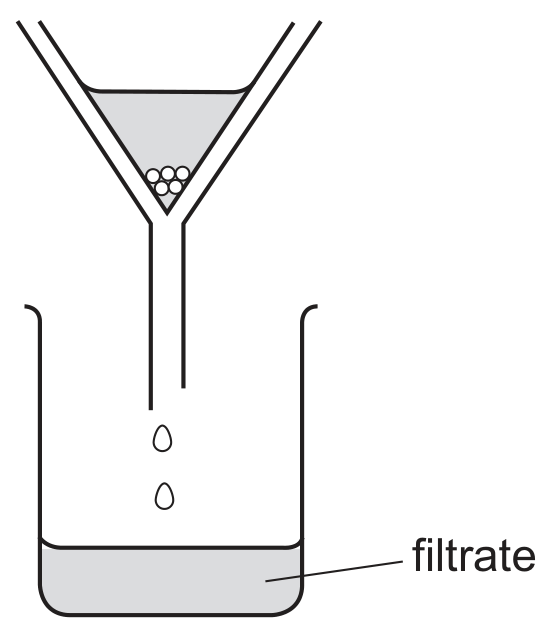
What is the filtrate?
broken glass only
broken glass and sugar solution
pure water
sugar solution
A student separates sugar from pieces of broken glass by dissolving the sugar in water and filtering off the broken glass.
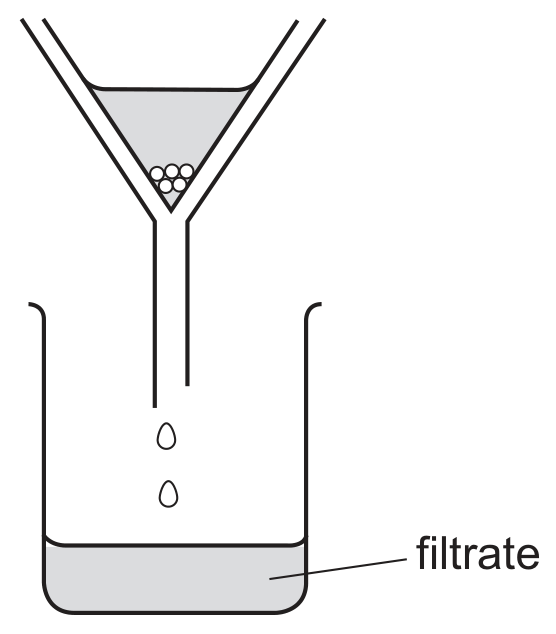
What is the filtrate?
broken glass only
broken glass and sugar solution
pure water
sugar solution
A student separates sugar from pieces of broken glass by dissolving the sugar in water and filtering off the broken glass.
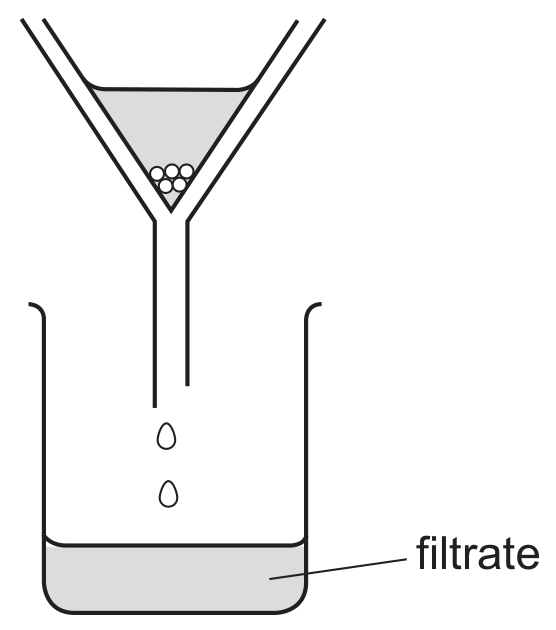
What is the filtrate?
broken glass only
broken glass and sugar solution
pure water
sugar solution
Calcium hydroxide, , is slightly soluble in water.
Limewater is a saturated solution of calcium hydroxide, .
Suggest what is meant by the term saturated solution.
Soluble salts can be made by adding a metal carbonate to a dilute acid.
A student wanted to make hydrated iron(II) sulfate crystals, , by adding excess iron(II) carbonate to dilute sulfuric acid. The student followed the procedure shown.
step 1 Add dilute sulfuric acid to a beaker.
step 2 Add small amounts of iron(II) carbonate to the dilute sulfuric acid in the beaker until the iron(II) carbonate is in excess.
step 3 Filter the mixture formed in step 2.
step 4 Heat the filtrate until it is a saturated solution. Allow to cool.
step 5 Once cold, pour away the remaining solution. Dry the crystals between filter papers.
A saturated solution is formed in step 4.
Describe what a saturated solution is.
Magnesium sulfate and lead(II) sulfate are examples of salts.
A student prepared magnesium sulfate crystals starting from magnesium carbonate. The student carried out the experiment in four steps.
step1 The student added excess magnesium carbonate to a small volume of dilute sulfuric acid until no more magnesium carbonate would react.
step 2 The student filtered the mixture.
step 3 The student heated the filtrate obtained from step 2 until it was saturated.
step 4 The student allowed the hot filtrate to cool to room temperature and then removed the crystals which formed.
A saturated solution forms in step 3.
What is a saturated solution?
Sulfur is an important element.
Dilute sulfuric acid is used to make salts known as sulfates.
A method consisting of three steps is used to make zinc sulfate from zinc carbonate.
step 1 Add an excess of zinc carbonate to of dilute sulfuric acid until the reaction is complete.
step 2 Filter the mixture.
step 3 Heat the filtrate until a saturated solution forms and then allow it to crystallise.
What is meant by the term saturated solution in step 3?
Zinc is manufactured from zinc blende. Zinc blende is an ore which consists mainly of zinc sulfide, ZnS .
Zinc reacts with dilute sulfuric acid to produce aqueous zinc sulfate.
Hydrated zinc sulfate crystals are made from aqueous zinc sulfate.
Step 1 Solid zinc is added to dilute sulfuric acid until zinc is in excess.
Step 2 Excess zinc is separated from aqueous zinc sulfate by filtration.
Step 3 Aqueous zinc sulfate is heated until the solution is saturated.
Step 4 The saturated solution is allowed to cool and crystallise.
Step 5 The crystals are removed and dried.
Name the residue in step 2 .
In step 3, a saturated solution is produced.
Describe what a saturated solution is.
Sulfuric acid has many uses.
Dilute sulfuric acid is used to make salts known as sulfates.
A method consisting of three steps is used to make zinc sulfate from zinc carbonate.
step 1 Add an excess of zinc carbonate to of dilute sulfuric acid until the reaction is complete.
step 2 Filter the mixture.
step 3 Heat the filtrate until a saturated solution forms and then allow it to crystallise.
Define the term saturated solution.