EduNinja

IGCSE Chemistry Extended1.2.1—Diffusion using kinetic particleTopic Practice

1.2.1—Diffusion using kinetic particle

• Describe/explain diffusion using kinetic particle theory

Question 1

[Maximum number: 1]

'Particles moving very slowly from an area of higher concentration to an area of lower concentration.'

Which process is being described?

A

a liquid being frozen

B

a solid melting

C

a substance diffusing through a liquid

D

a substance diffusing through the air
Question 1

[Maximum number: 1]

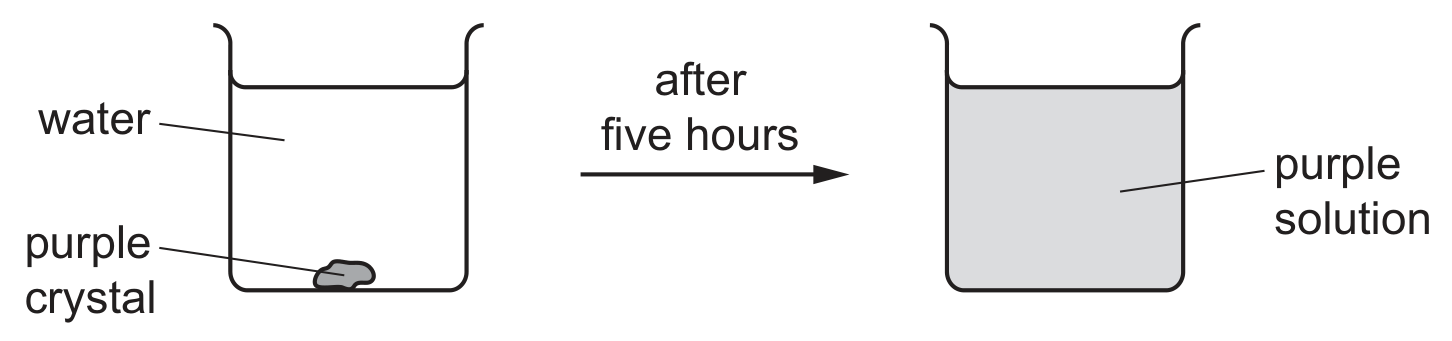
The diagram shows the result of dropping a purple crystal into water.

Question image

Which processes take place in this experiment?

chemical

reaction

diffusing

dissolving

\checkmark

\checkmark

x

\checkmark

x

x

x

x

\checkmark

x

\checkmark

\checkmark

Question 1

[Maximum number: 1]

'Particles moving very slowly from an area of higher concentration to an area of lower concentration.'

Which process is being described?

A

a liquid being frozen

B

a solid melting

C

a substance diffusing through a liquid

D

a substance diffusing through the air
Question 1

[Maximum number: 1]

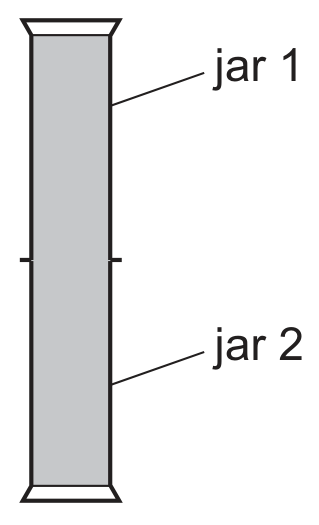
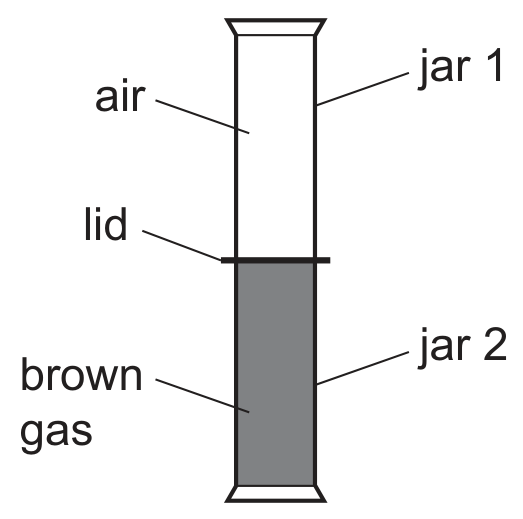
Two gas jars are set up as shown.

before

before

after

after

The lid is removed and the gas jars are left to stand. After some time the contents of both gas jars are brown.

Which process causes this to happen?

A

condensation

B

diffusion

C

evaporation

D

filtration

Question 1

Question 1(b)

(a)

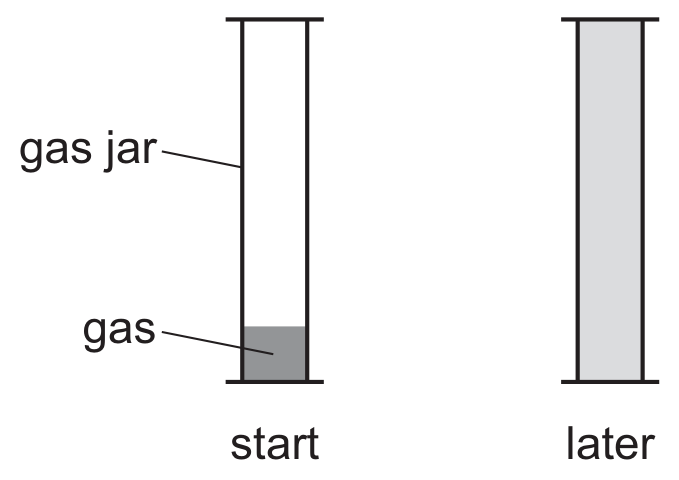
When chlorine gas, Cl2\mathrm{Cl}_{2}, is put into a gas jar, it spreads out to fill the gas jar.

When bromine gas, Br2\mathrm{Br}_{2}, is put into a gas jar, it also spreads out to fill the gas jar.
The process takes longer for bromine gas than for chlorine gas.

Question image
[ 2 ]

Question 1(b)(i)

(i)

What term describes the way that the gas particles spread out?

[ 1 ]

Question 1(b)(iii)

(ii)

Explain why increasing the temperature increases the rate at which the gas particles spread out.

[ 1 ]

Question 2

Which statements about diffusion are correct?

1 Aqueous ions cannot diffuse in water.
2 Diffusion is caused by the random movement of particles.
3 Particles spread out in all directions in diffusion.
4 Diffusion can only take place in solids and liquids.
A 1 and 2
B 1 and 4
C 2 and 3
D 3 and 4

Question 2

[Maximum number: 3]

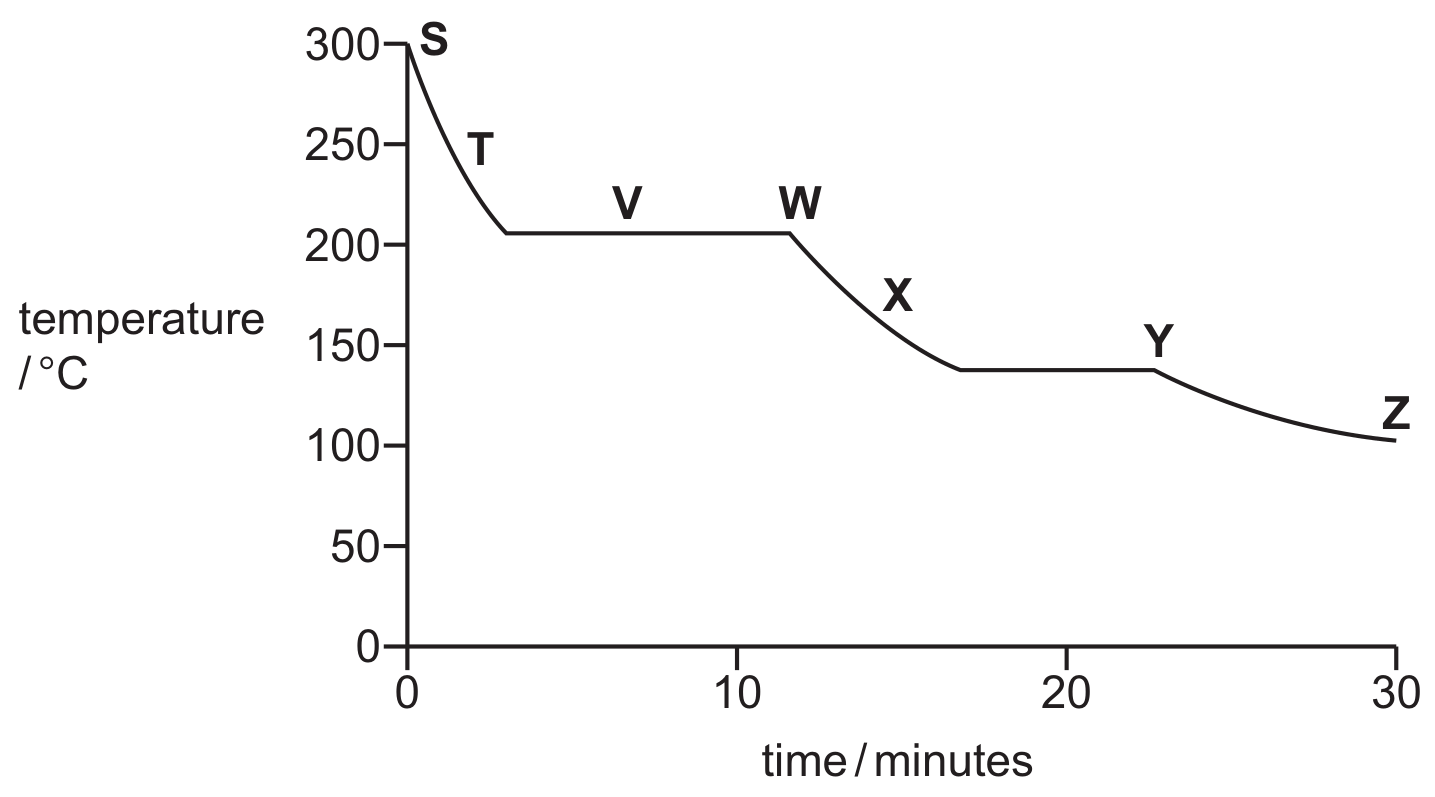
The graph shows how the temperature of a substance changes as it is cooled over a period of 30 minutes. The substance is a gas at the start.

Question image

Each letter on the graph may be used once, more than once or not at all.

Question 2(d)

(a)

When smoke is viewed through a microscope, the smoke particles in the air appear to jump around.

[ 3 ]

Question 2(d)(i)

(i)

What term describes this movement of the smoke particles?

[ 1 ]

Question 2(d)(ii)

(ii)

Explain why the smoke particles move in this way.

[ 2 ]

Question 2(c)(i)

[Maximum number: 1]

The elements shown are gases at room temperature and pressure.
> hydrogen nitrogen oxygen chlorine

When separate samples of each of these gases are placed in a container they will diffuse.

Describe why these gases diffuse.

Question 2

[Maximum number: 5]

Silver dichromate, Ag2Cr2O7\mathrm{Ag}_{2} \mathrm{Cr}_{2} \mathrm{O}_{7}, is a red insoluble salt.
Silver dichromate can be made by reacting silver nitrate solution with ammonium dichromate solution. The chemical equation for the reaction is shown.

2AgNO3(aq)+(NH4)2Cr2O7(aq)2NH4NO3(aq)+Ag2Cr2O7( s)2 \mathrm{AgNO}_{3}(\mathrm{aq})+\left(\mathrm{NH}_{4}\right)_{2} \mathrm{Cr}_{2} \mathrm{O}_{7}(\mathrm{aq}) \rightarrow 2 \mathrm{NH}_{4} \mathrm{NO}_{3}(\mathrm{aq})+\mathrm{Ag}_{2} \mathrm{Cr}_{2} \mathrm{O}_{7}(\mathrm{~s})

Question 2(d)

(a)

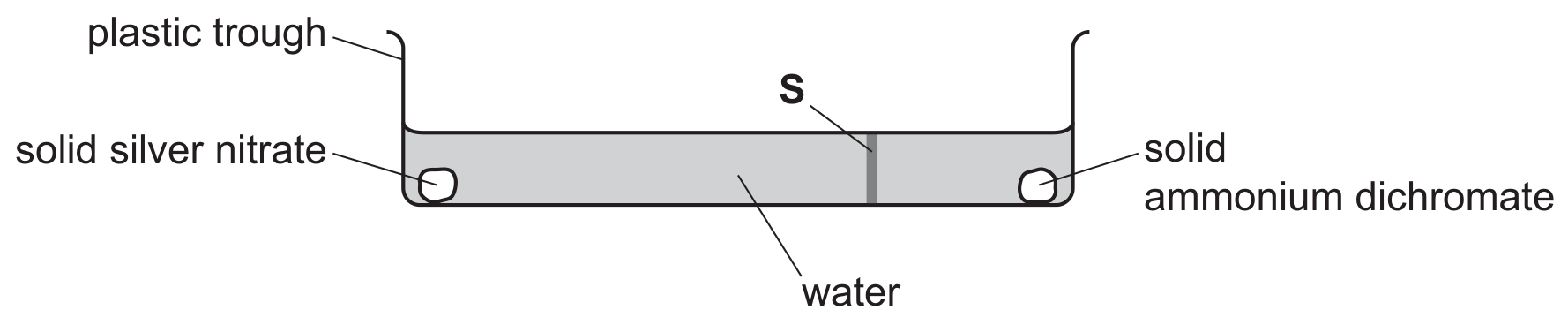
The apparatus shown was set up.

Question image

After five minutes, a red solid appeared along the line marked S on the diagram.

[ 5 ]

Question 2(d)(i)

(i)

Explain why a red solid appeared along the line marked S.

[ 3 ]

Question 2(d)(ii)

(ii)

The experiment was repeated at a higher temperature.

What effect, if any, would this have on the time taken for the red solid to appear? Explain your answer.

[ 2 ]

Question 3(c)(ii)

[Maximum number: 1]

Kinetic theory explains the properties of matter in terms of the arrangement and movement of particles.

Explain why the nitrogen gas diffuses faster at the higher temperature.

0 selected