EduNinja

IB Physics SLD.2 Electric and magnetic fieldsQuestion Bank

Question 1

[Maximum number: 2]

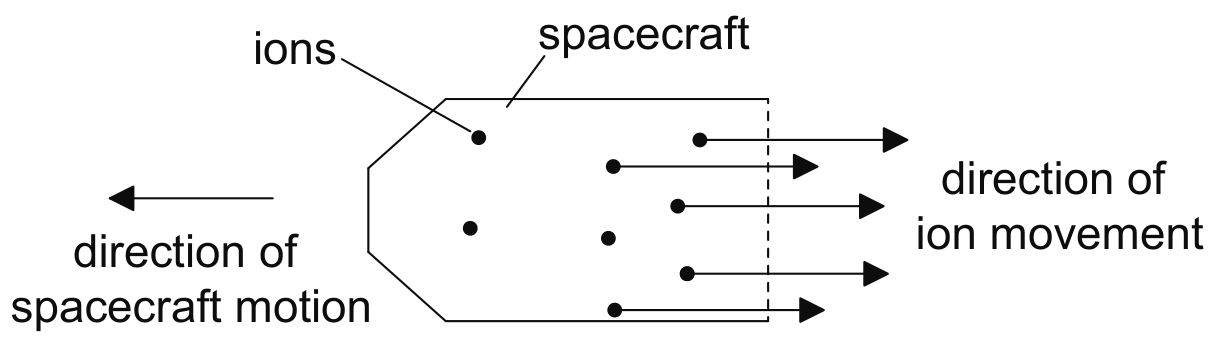
Ion-thrust engines can power spacecraft. In this type of engine, ions are created in a chamber and expelled from the spacecraft. The spacecraft is in outer space when the propulsion system is turned on. The spacecraft starts from rest.

Question image

The mass of ions ejected each second is 6.6×10⁶ kg6.6 \times 10^{-6} \mathrm{~kg} and the speed of each ion is 5.2×10⁴ m s15.2 \times 10^{4} \mathrm{~m} \mathrm{~s}^{-1}. The initial total mass of the spacecraft and its fuel is 740 kg . Assume that the ions travel away from the spacecraft parallel to its direction of motion.

Question 1(c)

(a)

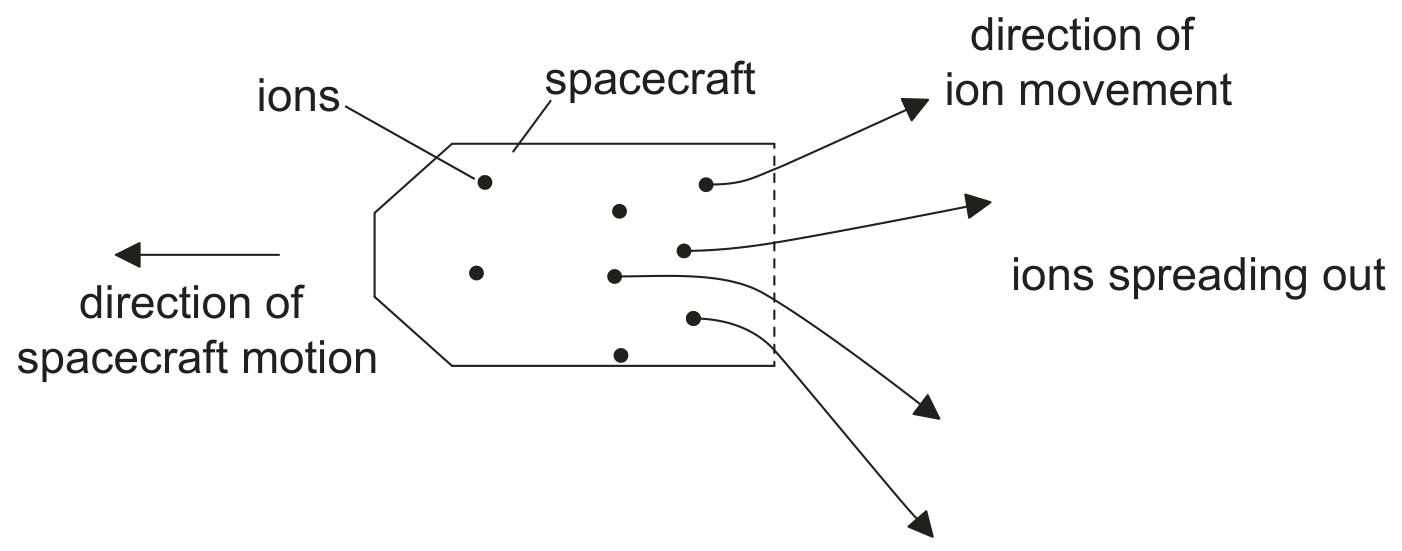
In practice, the ions leave the spacecraft at a range of angles as shown.

Question image
[ 2 ]

Question 1(c)(i)

(i)

Outline why the ions are likely to spread out.

[ 2 ]

Question A2

Question A2(b)

(a)

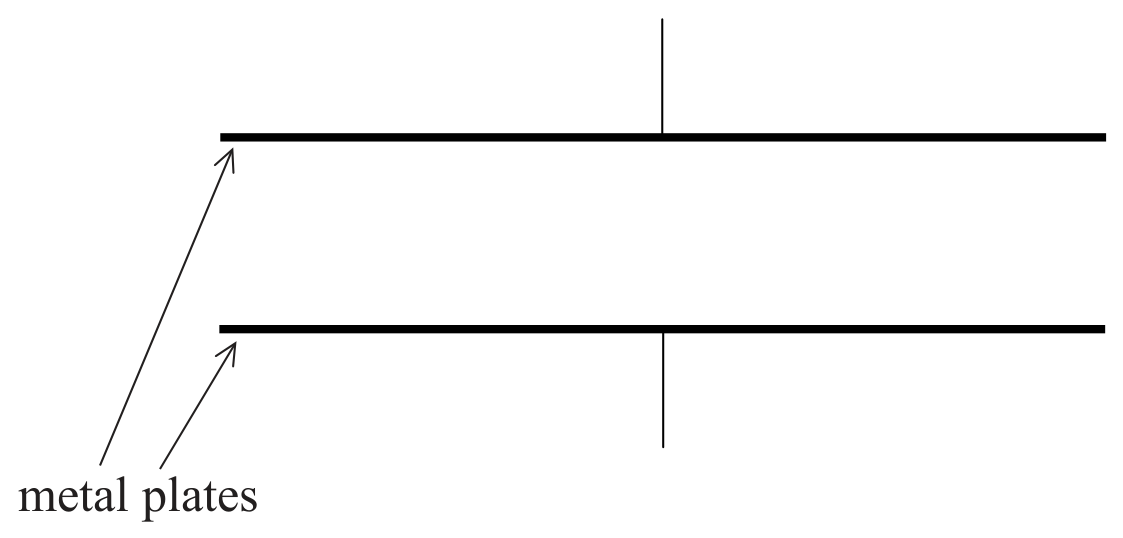
On the diagram below, sketch the magnetic field pattern around the long straight current-carrying conductor. The direction of the current is into the plane of the paper.

Question image
[ 2 ]

Question 3

Question 3(a)

(a)

Two identical conducting spheres X and Y that carry positive charges are separated by a centre-to-centre distance of 24.0 cm in a vacuum. The charge on X is 9 Q and the charge on Y is Q. Point R is 6.0 cm from the centre of Y, as shown.

Question image

The resultant electric field at R is 32.6MNC132.6 \mathrm{MNC}^{-1}. Determine Q, giving an appropriate unit.

[ 2 ]

Question 3

[Maximum number: 3]

A vertical wall carries a uniform positive charge on its surface. This produces a uniform horizontal electric field perpendicular to the wall. A small, positively-charged ball is suspended in equilibrium from the vertical wall by a thread of negligible mass.

Question image

Question 3(c)

(a)

The centre of the ball, still carrying a charge of 1.2×10⁶C1.2 \times 10^{-6} \mathrm{C}, is now placed 0.40 m from a point charge Q . The charge on the ball acts as a point charge at the centre of the ball.
P is the point on the line joining the charges where the electric field strength is zero. The distance PQ is 0.22 m .

Question image

Calculate the charge on Q . State your answer to an appropriate number of significant figures.

[ 3 ]

Question 3

[Maximum number: 1]

Two oppositely charged parallel plates are a distance 8.0 cm apart. The potential difference between the plates is 120 V . An alpha particle is placed on the positively charged plate and released from rest. Gravity is ignored.

Question image

Question 3(a)

(a)

Calculate the electric field between the plates.

[ 1 ]

Question 3

[Maximum number: 6]

A group of students wants to determine the horizontal component BHB_{\mathrm{H}} of the Earth's magnetic field.

They place a magnet (in the form of a magnetic needle) midway between two coils.
When there is no current through the coils, the magnet aligns itself in the north-south direction. When there is an identical current established in the coils, the magnetic field produced deflects the magnet.

Question image

Each coil has a radius r. The length of the magnet is 0.25 r.

The students have to decide on the horizontal separation of the two coils. Their choices are separations of 2 r, r and 0.5 r.

The variation with distance of the magnetic field strength due to each coil and the resultant magnetic field strength for both coils are shown for each of these separations. The dotted line represents the magnetic field from each coil, while the solid line shows the resultant magnetic field.

Question image
Question image
Question image

Question 3(a)

(a)

State and explain which coil separation the students should choose for this experiment.

[ 2 ]

Question 3(b)

(b)

Explain why the students place axis XX\mathrm{XX}^{\prime} of the coils in the east-west direction.

[ 2 ]

Question 3(c)

(c)

The deflection of the magnet is shown.

upper view

upper view

The magnet comes to rest when it makes an angle of 2424^{\circ} to XX\mathrm{XX}^{\prime}.
Determine, using the graphs, BHB_{\mathrm{H}}.

[ 2 ]

Question 17

[Maximum number: 1]

A charge +Q and a charge +2 Q are a distance 3 x apart. Point P is on the line joining the charges, at a distance x from one of the charges as shown.

Question image

What is the electric field strength E at P ?

Magnitude of E

Direction of E

kQ2x2\frac{k Q}{2 x^{2}}

left

kQ2x2\frac{k Q}{2 x^{2}}

right

kQx2\frac{k Q}{x^{2}}

left

kQx2\frac{k Q}{x^{2}}

right

Question 3

[Maximum number: 2]

This question is about electric and magnetic fields.

A proton travelling to the right with horizontal speed 1.6×10⁴ ms11.6 \times 10^{4} \mathrm{~ms}^{-1} enters a uniform electric field of strength E. The electric field has magnitude 2.0×10³NC12.0 \times 10^{3} \mathrm{NC}^{-1} and is directed downwards.

Question image

Question 3(a)

(a)

Calculate the magnitude of the electric force acting on the proton when it is in the electric field.

[ 2 ]

Question 4

[Maximum number: 4]

This question is in two parts. Part 1 is about electric fields and radioactive decay. Part 2 is about change of phase.

Part 1 Electric fields and radioactive decay

Question 4(a)

(a)

Define electric field strength.

[ 2 ]

Question 4(b)

(b)

A simple model of the proton is that of a sphere of radius 1.0×10¹⁵ m1.0 \times 10^{-15} \mathrm{~m} with charge concentrated at the centre of the sphere. Estimate the magnitude of the field strength at the surface of the proton.

[ 2 ]

Question 18

[Maximum number: 1]

A charge +Q and a charge -2 Q are a distance 3 x apart. Point P is on the line joining the charges, at a distance x from +Q.

Question image

The magnitude of the electric field produced at P by the charge +Q alone is E.
What is the total electric field at P ?

A

E2\frac{E}{2} to the right

B

E2\frac{E}{2} to the left

C

3E2\frac{3 E}{2} to the right

D

3E2\frac{3 E}{2} to the left

0 selected