EduNinja

IB Physics SLD.3 Motion in electromagnetic fieldsQuestion Bank

Question 3

[Maximum number: 2]

A long current-carrying wire is at rest in the reference frame S of the laboratory. A positively charged particle P outside the wire moves with velocity v relative to S . The electrons making up the current in the wire move with the same velocity v relative to S .

Question image
current-carrying wire

current-carrying wire

Question 3(b)

(a)

State and explain whether the force experienced by P is magnetic, electric or both

[ 2 ]

Question 3(b)(i)

(i)

in reference frame S .

[ 2 ]

Question A2

Question A2(c)

(a)

The long straight conductor is formed into a coil consisting of two separate turns, X and Y . The coil hangs with its axis vertical.

Question image

Assume that the turns of the coil each behave as a long straight conductor.

[ 5 ]

Question A2(c)(i)

(i)

Explain why, when there is a current in the coil, the separation of X and Y decreases.

[ 2 ]

Question A2(c)(ii)

(ii)

The current in the coil is 15 A and the circumference of one turn is 0.48 m . In order to restore X and Y to their original separation, a mass of 2.8×10⁴ kg2.8 \times 10^{-4} \mathrm{~kg} is suspended from turn Y . Estimate the magnetic field strength at X due to Y .

A3. This question is about radioactivity.

Caesium-137 ( 55137Cs{ }_{55}^{137} \mathrm{Cs} ) is a radioactive waste product with a half-life of 30 years that is formed during the fission of uranium. Caesium-137 decays by the emission of a beta-minus (β)\left(\beta^{-}\right)particle to form a nuclide of barium (Ba).

[ 3 ]

Question 3

Question 3(b)

(a)

A long straight current-carrying wire is at rest in a laboratory. A negatively-charged particle P outside the wire moves parallel to the current with constant velocity v relative to the laboratory.

Question image

In the reference frame of the laboratory the particle P experiences a repulsive force away from the wire.

[ 1 ]

Question 3(b)(i)

(i)

State the nature of the force on the particle P in the reference frame of the laboratory.

[ 1 ]

Question 3

Question 3(b)

(a)

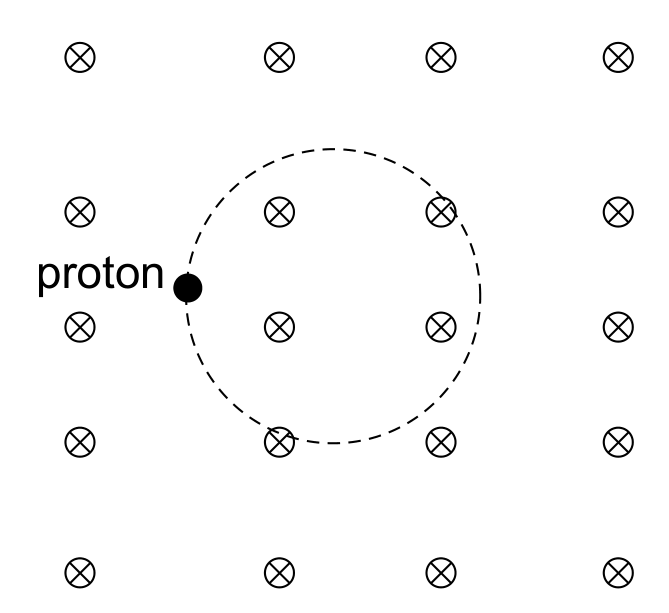
A particle of mass m and positive charge q moves on a circular path with speed v in a vacuum. A uniform magnetic field B is directed into the plane of the page.

Question image
[ 2 ]

Question 3(b)(i)

(i)

Show that the radius R of the circular path is given by R=mvqBR=\frac{m v}{q B}.

[ 1 ]

Question 3(b)(ii)

(ii)

Suggest why the speed of the particle stays constant, even though a force acts on the particle.

[ 1 ]

Question 3(c)

(b)

The particle in (b), now moving in a region of magnetic field in air, follows the path shown.

Question image

Explain the shape of this path.

[ 2 ]

Question 3

[Maximum number: 4]

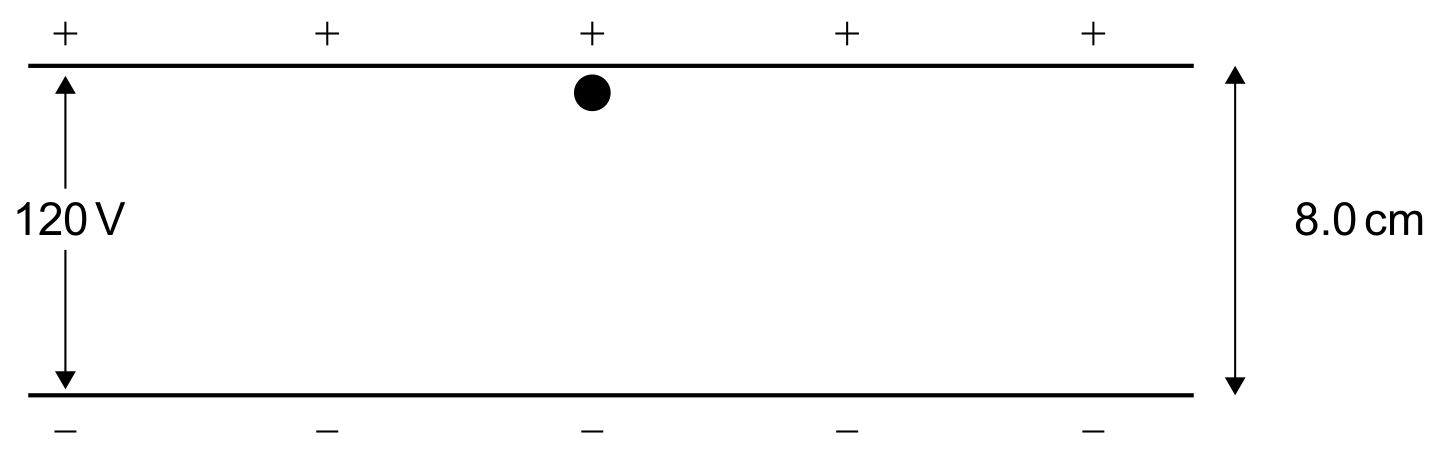
Two oppositely charged parallel plates are a distance 8.0 cm apart. The potential difference between the plates is 120 V . An alpha particle is placed on the positively charged plate and released from rest. Gravity is ignored.

Question image

Question 3(b)

Question 3(b)(i)

(a)
(i)

Show that the acceleration of the alpha particle is about 7×10¹⁰ ms27 \times 10^{10} \mathrm{~ms}^{-2}.

[ 2 ]

Question 3(c)

(b)

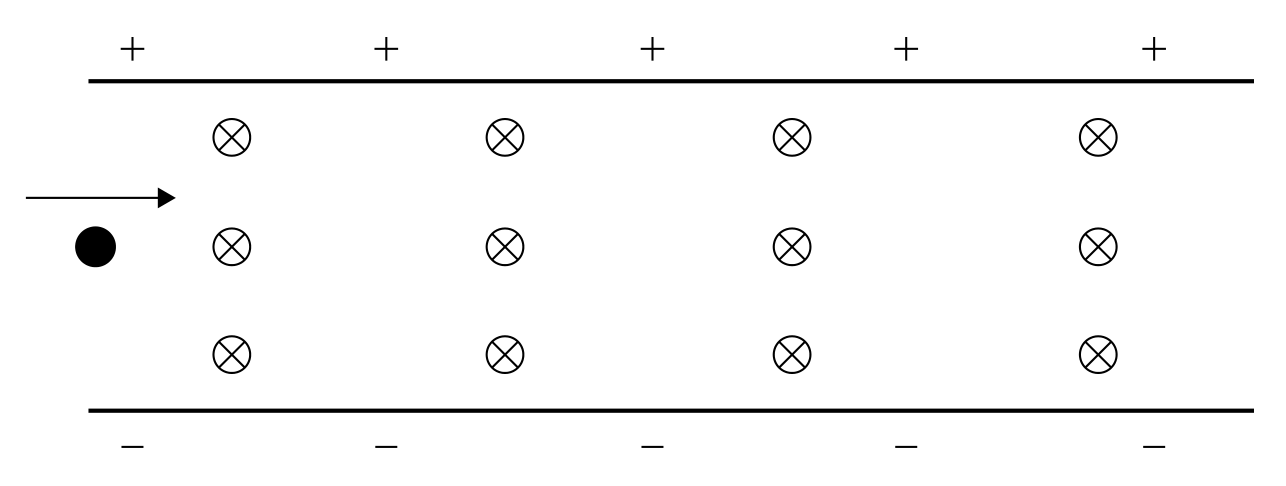
A magnetic field directed into the plane of the page is now established between the plates. An alpha particle enters the region between the plates with a horizontal speed of 5.0×10⁵ m s15.0 \times 10^{5} \mathrm{~m} \mathrm{~s}^{-1}. The particle is not deflected.

Question image

Calculate the magnitude of the magnetic field.

[ 2 ]

Question 3

Question 3(c)

(a)

Two parallel current-carrying wires have equal currents in the same direction. There is an attractive force between the wires.

[ 1 ]

Question 3(c)(i)

(i)

Identify the nature of the attractive force recorded by an observer stationary with respect to the wires.

[ 1 ]

Question 3

[Maximum number: 2]

A wire carries an electric current. An external electron e moves with the drift velocity v of the electrons in the wire. Observer O is at rest relative to the wire.

Question image
Question image

Question 3(b)

(a)

State and explain the nature of the electromagnetic force acting on electron e in the frame of reference of

[ 2 ]

Question 3(b)(i)

(i)

observer O .

[ 2 ]

Question 16

[Maximum number: 1]

The ampere is defined in terms of

A

power dissipated in a wire of known length, cross-sectional area and resistivity.

B

potential difference across a resistance of known value.

C

number of electrons flowing past a point in a circuit in a given time.

D

force per unit length between parallel current-carrying conductors.

Question 3

[Maximum number: 1]

A proton is moving in a region of magnetic field of strength B. The speed of the proton relative to the magnetic field is v.

Question image

In the reference frame in which the magnetic field is at rest, the proton experiences an initial magnetic force e v B upwards.

Question 3(a)

(a)

Outline why there can be no magnetic force on the proton in the proton's rest frame.

[ 1 ]

Question 4

[Maximum number: 4]

This question is in two parts. Part 1 is about electric fields and radioactive decay. Part 2 is about change of phase.

Part 1 Electric fields and radioactive decay

Question 4(c)

(a)

Protons travelling with a speed of 3.9×10⁶ m s13.9 \times 10^{6} \mathrm{~m} \mathrm{~s}^{-1} enter the region between two charged parallel plates X and Y . Plate X is positively charged and plate Y is connected to earth.

Question image

A uniform magnetic field also exists in the region between the plates. The direction of the field is such that the protons pass between the plates without deflection.

[ 4 ]

Question 4(c)(i)

(i)

State the direction of the magnetic field.

[ 1 ]

Question 4(c)(ii)

(ii)

The magnitude of the magnetic field strength is 2.3×10⁴ T2.3 \times 10^{-4} \mathrm{~T}. Determine the magnitude of the electric field strength between the plates, stating an appropriate unit for your answer.

[ 3 ]
0 selected