IB Physics SL D.2.1 Electric Charge Forces

Practise predicting attraction or repulsion between signed charges, drawing equal and opposite force pairs and determining the resultant direction in multi-charge arrangements.

Syllabus
First assessment 2025
Objective
Level
SL

Exam points

  • state that like charges repel and unlike charges attract along the line joining them
  • draw equal and opposite forces on the two interacting charges without confusing force and field
  • add electric-force vectors from several charges to find the net direction or equilibrium point

D.2.1—Electric charge forces question 1

[Maximum number: 2]

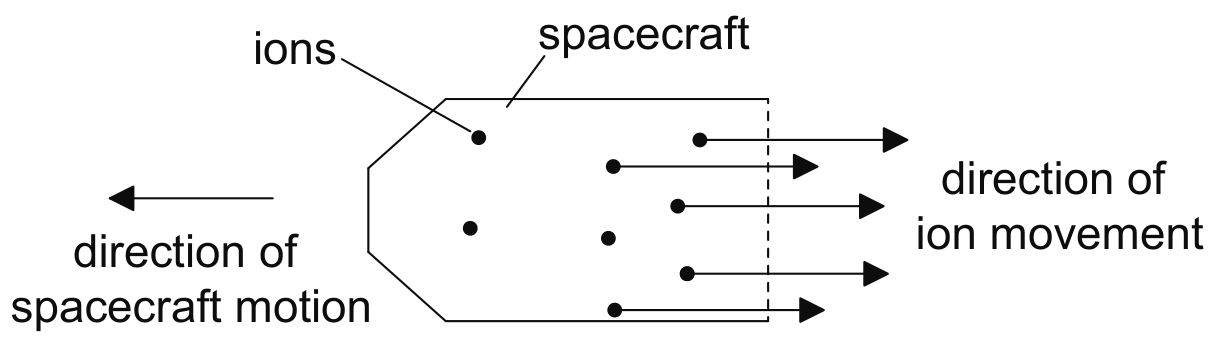
Ion-thrust engines can power spacecraft. In this type of engine, ions are created in a chamber and expelled from the spacecraft. The spacecraft is in outer space when the propulsion system is turned on. The spacecraft starts from rest.

Figure for Question D.2.1—Electric charge forces question 1 — IB Physics SL

The mass of ions ejected each second is 6.6×10⁶ kg6.6 \times 10^{-6} \mathrm{~kg} and the speed of each ion is 5.2×10⁴ m s15.2 \times 10^{4} \mathrm{~m} \mathrm{~s}^{-1}. The initial total mass of the spacecraft and its fuel is 740 kg . Assume that the ions travel away from the spacecraft parallel to its direction of motion.

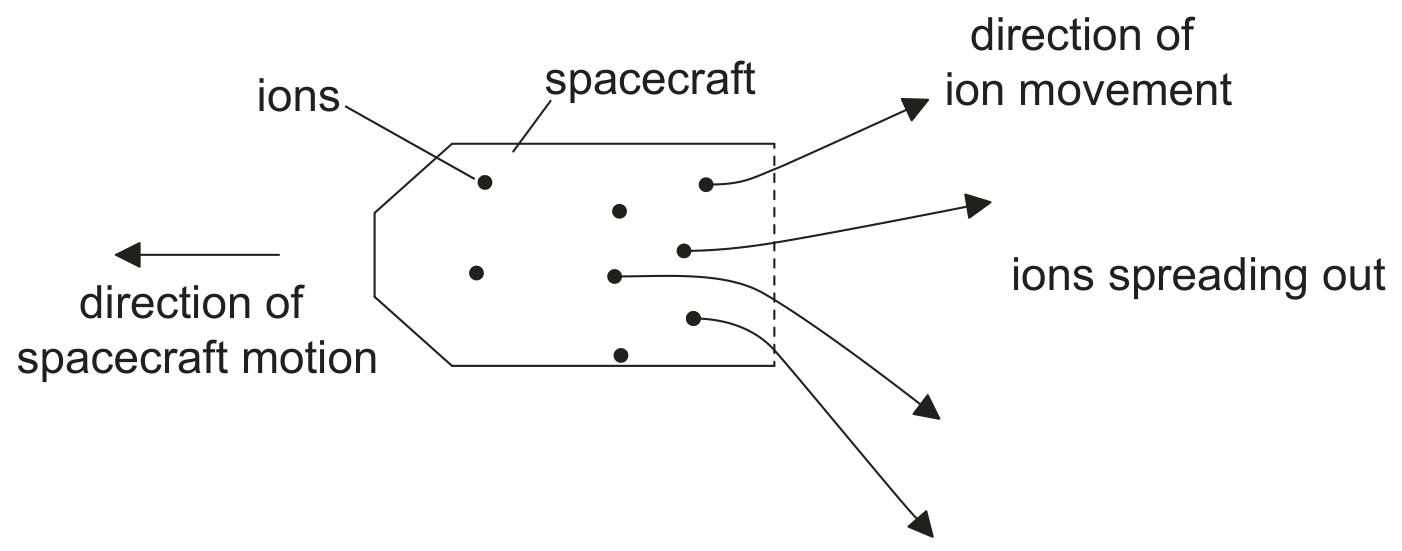
In practice, the ions leave the spacecraft at a range of angles as shown.

Figure for Question D.2.1—Electric charge forces question 1 — IB Physics SL

Outline why the ions are likely to spread out.

All question bank results loaded