EduNinja

IB Physics SLD.1 Gravitational fieldsQuestion Bank

Question 1

[Maximum number: 3]

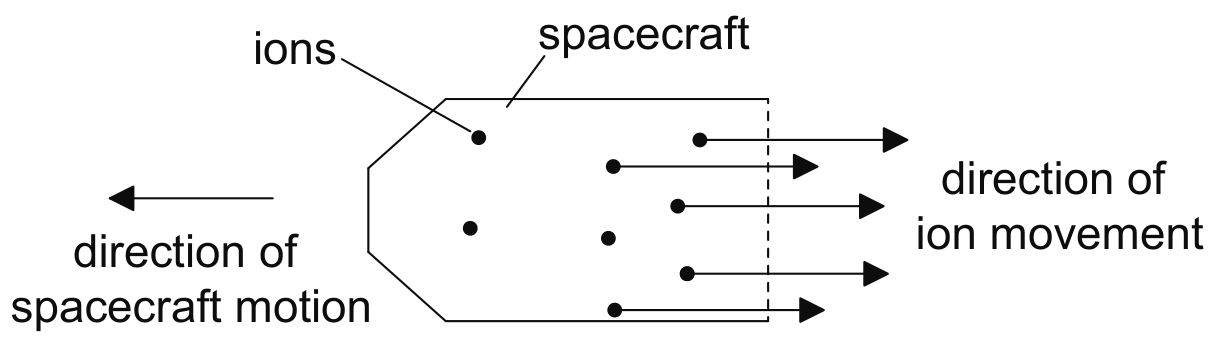
Ion-thrust engines can power spacecraft. In this type of engine, ions are created in a chamber and expelled from the spacecraft. The spacecraft is in outer space when the propulsion system is turned on. The spacecraft starts from rest.

Question image

The mass of ions ejected each second is 6.6×10⁶ kg6.6 \times 10^{-6} \mathrm{~kg} and the speed of each ion is 5.2×10⁴ m s15.2 \times 10^{4} \mathrm{~m} \mathrm{~s}^{-1}. The initial total mass of the spacecraft and its fuel is 740 kg . Assume that the ions travel away from the spacecraft parallel to its direction of motion.

Question 1(d)

(a)

On arrival at the planet, the spacecraft goes into orbit as it comes into the gravitational field of the planet.

[ 3 ]

Question 1(d)(i)

(i)

Outline what is meant by the gravitational field strength at a point.

[ 2 ]

Question 1(d)(ii)

(ii)

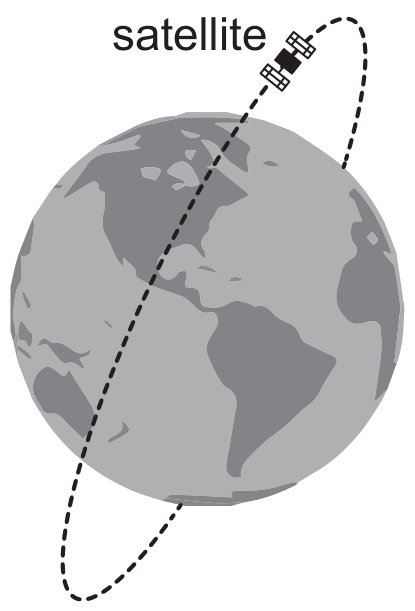
Newton's law of gravitation applies to point masses. Suggest why the law can be applied to a satellite orbiting a spherical planet of uniform density.

[ 1 ]

Question 1

[Maximum number: 2]

A space probe of mass 95 kg is designed to land on the surface of an asteroid. The gravitational field strength g of the asteroid at its surface is 2.7×10³ ms22.7 \times 10^{-3} \mathrm{~ms}^{-2}.

Question 1(a)

(a)

The radius r of the asteroid is 230 km . Calculate the mass of the asteroid.

[ 2 ]

Question 1

[Maximum number: 2]

A space probe of mass 95 kg is designed to land on the surface of an asteroid. The gravitational field strength g of the asteroid at its surface is 2.7×10³ ms22.7 \times 10^{-3} \mathrm{~ms}^{-2}.

Question 1(a)

(a)

The radius r of the asteroid is 230 km . Calculate the mass of the asteroid.

[ 2 ]

Question 2

[Maximum number: 4]

Venus is a planet in the Solar System. The following data are given:

Orbital period of Venus =225 days
Orbital period of Earth =365 days

Question 2(a)

(a)

Calculate the ratio orbital radius of Venus

[ 2 ]

Question 2(b)

(b)

Explain how observations of the motion of the planets allow scientists to determine the mass of the Sun.

[ 2 ]

Question 2

A planet is in a circular orbit around a star. The speed of the planet is constant.

Question 2(b)

(a)

Determine the gravitational field of the planet.

The following data are given:

 Mass of planet =8.0×1024 kg Radius of the planet =9.1×10⁶ m.\begin{array}{ll} \text { Mass of planet } & =8.0 \times 10^{24} \mathrm{~kg} \\ \text { Radius of the planet } & =9.1 \times 10^{6} \mathrm{~m} . \end{array}

Question 2

[Maximum number: 3]

This question is about gravitation and uniform circular motion.

Phobos, a moon of Mars, has an orbital period of 7.7 hours and an orbital radius of 9.4×10³ km9.4 \times 10^{3} \mathrm{~km}.

Question 2(c)

(a)

Deduce the mass of Mars.

[ 3 ]

Question 2

[Maximum number: 1]

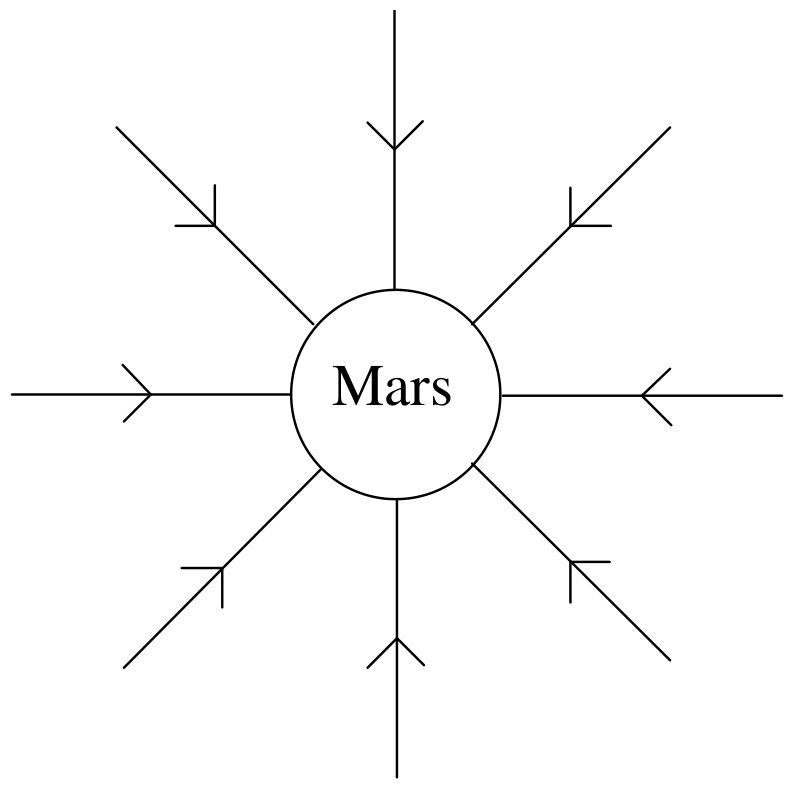
The two arrows in the diagram show the gravitational field strength vectors at the position of a planet due to each of two stars of equal mass M.

Question image

Each star has mass M=2.0×1030 kgM=2.0 \times 10^{30} \mathrm{~kg}. The planet is at a distance of 6.0×10¹¹ m6.0 \times 10^{11} \mathrm{~m} from each star.

Question 2(a)

(a)

Show that the gravitational field strength at the position of the planet due to one of the stars is g=3.7×10⁴Nkg1g=3.7 \times 10^{-4} \mathrm{Nkg}^{-1}.

[ 1 ]

Question 16

[Maximum number: 1]

Two point masses X and Y are released from rest at different positions in the gravitational field of a planet. Y is further from the planet's surface than X. The masses of X and Y are much smaller than that of the planet.

Question image

Both masses eventually collide with the planet.
Which is the correct comparison of the initial and final accelerations of X and Y ?

Initial acceleration

Final acceleration

different

same

different

different

same

same

same

different

Question 17

[Maximum number: 1]

Which is a statement of one of Kepler's laws of orbital motion?

A

The square of the planet's orbital period is proportional to the cube of the length of the semi-major axis of its orbit.

B

A line segment joining a planet and the Sun sweeps out equal arc lengths during equal intervals of time.

C

A planet's orbital period is proportional to the cube of the length of the semi-major axis of its orbit.

D

The orbit of a planet is an ellipse with the Sun positioned at the centre.

Question 17

[Maximum number: 1]

The relationship between the period of a planet's orbit T and the distance to the Sun R can be expressed as TnRmT^{\mathrm{n}} \propto R^{\mathrm{m}} where n and m are constants.

What is a possible pair of values for n and m ?

n

m

1.0

3.0

1.0

1.5

2.0

1.5

2.0

1.0

0 selected