IB Physics SL C.2.4 Transverse and Longitudinal Waves

Practise classifying waves from particle displacement relative to propagation, identifying crests or compressions and explaining polarization as evidence of transverse behaviour.

Syllabus
First assessment 2025
Objective
Level
SL

Exam points

  • classify a wave as transverse when oscillations are perpendicular to propagation and longitudinal when parallel
  • identify crests and troughs or compressions and rarefactions without confusing them with particle travel
  • use successful polarization to show that a wave is transverse rather than longitudinal

C.2.4—Transverse and longitudinal waves question 1

[Maximum number: 3]

This question is in two parts. Part 1 is about a thermistor circuit. Part 2 is about vibrations and waves.
Part 1 Thermistor circuit
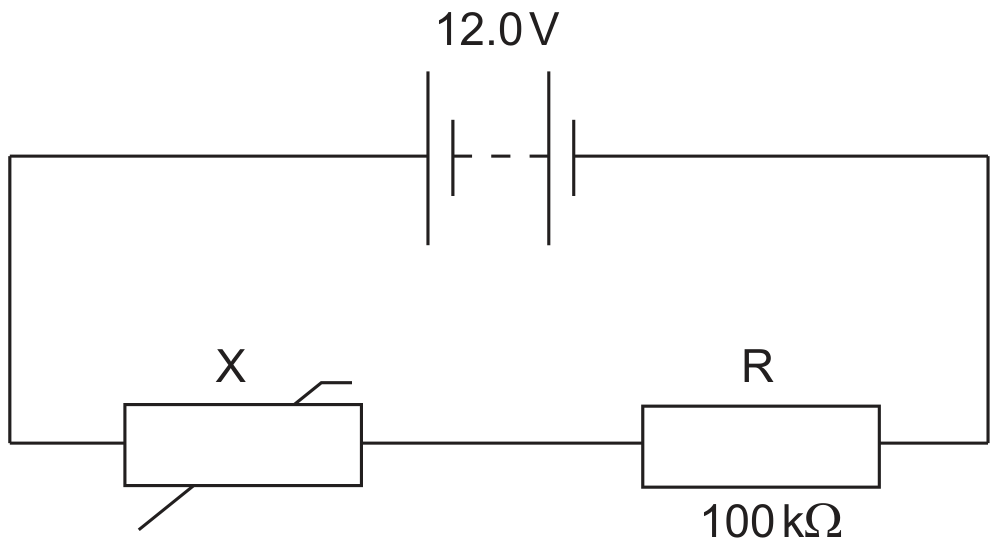
The circuit shows a negative temperature coefficient (NTC) thermistor X and a 100kΩ100 \mathrm{k} \Omega fixed resistor R connected across a battery.

Figure for Question C.2.4—Transverse and longitudinal waves question 1 — IB Physics SL

The battery has an electromotive force (emf) of 12.0 V and negligible internal resistance.

The sound waves from the loudspeaker travel in air with speed 330 m s1330 \mathrm{~m} \mathrm{~s}^{-1}.

Describe the characteristics of sound waves in air.

All question bank results loaded