IB Physics SL B.1.1 Molecular states
Practise comparing solids, liquids and gases using particle spacing, motion and forces, including why water’s density is unusual.
- Syllabus
- First assessment 2025
- Objective
- —
- Level
- SL
Practise comparing solids, liquids and gases using particle spacing, motion and forces, including why water’s density is unusual.
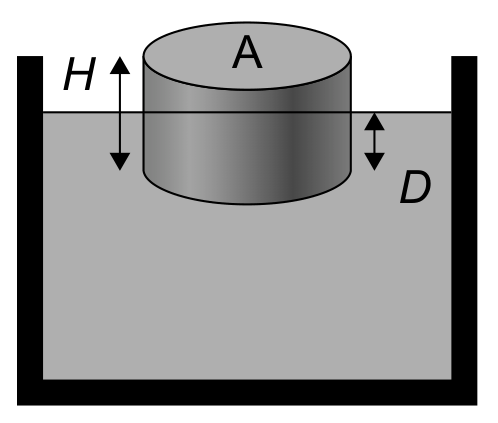
A cylindrical cork of height H and cross-sectional area A is floating stationary in water. Its depth below the water surface is D.
Explain why the density of most substances in a solid state is larger than its density in a liquid state.
Water shows an anomaly with respect to what is stated in (c)(i).
Graph 1 shows the variation with temperature of the density of water between and . Graph 2 shows the same graph enlarged for the range 0 to .