IB Physics SL A.3.5 Work-energy change
Practise using the work–energy principle to connect force, displacement and change in kinetic energy in multi-step motion.
- Syllabus
- First assessment 2025
- Objective
- —
- Level
- SL
Practise using the work–energy principle to connect force, displacement and change in kinetic energy in multi-step motion.
This question is about the motion of a bicycle.
A cyclist is moving up a slope that is at an angle of to the horizontal. The mass of the cyclist and the bicycle is 85 kg .
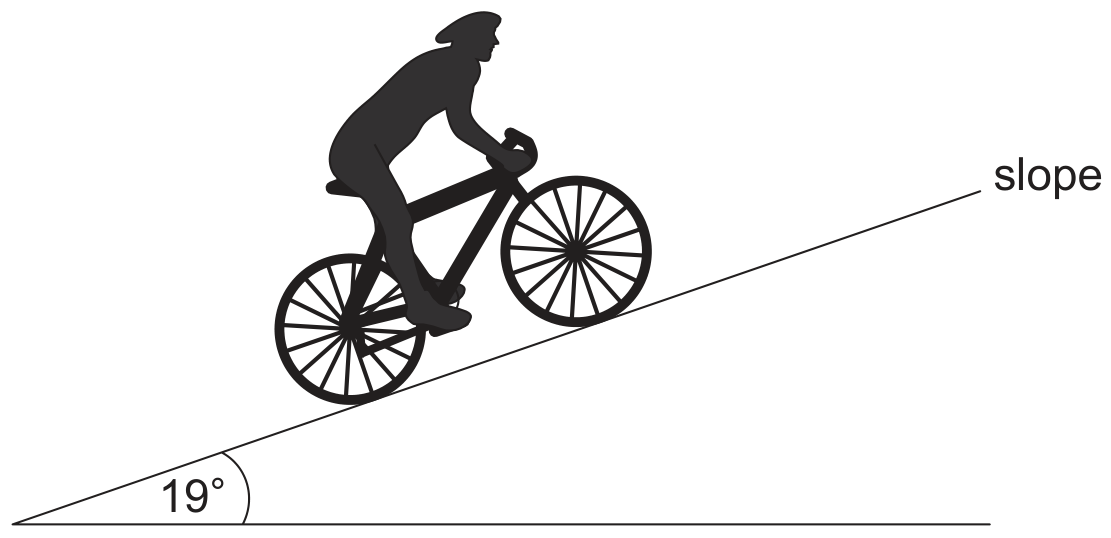
At the bottom of the slope the cyclist has a speed of . The cyclist stops pedalling and applies the brakes which provide an additional decelerating force of 250 N . Determine the distance taken for the cyclist to stop. Assume air resistance is negligible and that there are no other frictional forces.