

Question 4(d)(ii)
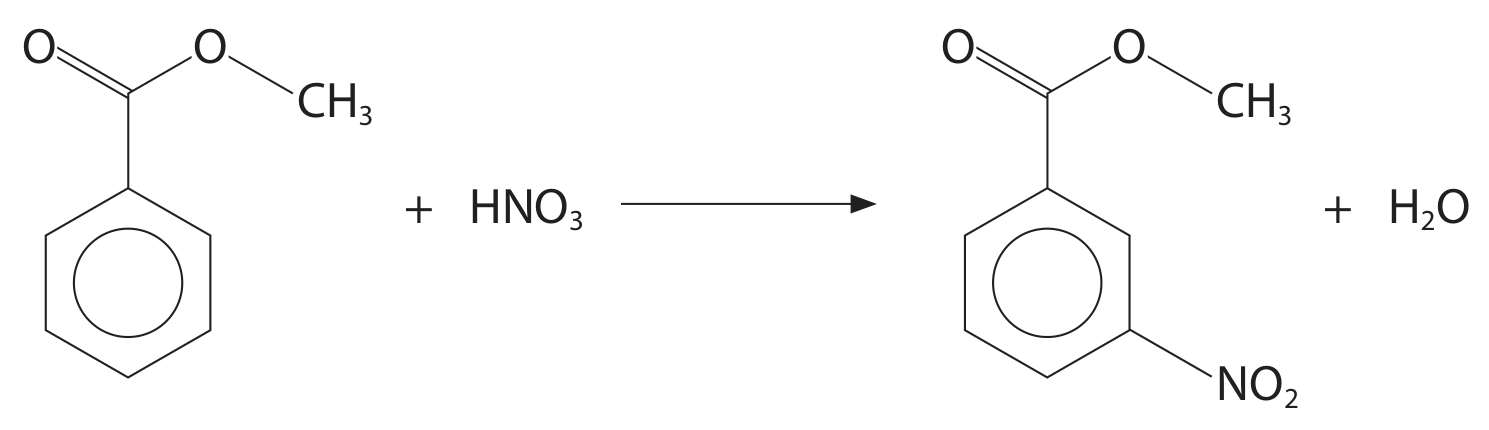
This question is about the nitration of methyl benzoate.
The equation for the reaction is shown.
Procedure
Step 1 Weigh between 1.9 g and 2.1 g of methyl benzoate in a conical flask.
Step 2 Slowly add of concentrated sulfuric acid to the methyl benzoate with swirling and place the flask in an ice-water bath to cool.
Step 3 Place of concentrated nitric acid into a test tube.
Cool the nitric acid by immersing the test tube in an ice-water bath before slowly adding of concentrated sulfuric acid.
Allow this nitrating mixture to cool.
Step 4 Using a teat pipette, add the nitrating mixture very slowly to the conical flask, ensuring the temperature does not exceed .
Step 5 Allow the flask to stand at room temperature for about 15 minutes and then pour the contents into a beaker containing some crushed ice. Impure methyl 3-nitrobenzoate will form.
Step 6 Recrystallise the methyl 3-nitrobenzoate using methanol as the solvent.
Step 7 Weigh the dry crystals and determine their melting temperature.
1.95 g of methyl benzoate reacted with an excess of nitric acid to form
1.51 g of methyl 3-nitrobenzoate.
[Molar mass values: methyl benzoate,
methyl 3-nitrobenzoate, ]
Give one possible reason why the yield in (d)(i) is less than 100\%.