EduNinja

Edexcel IAL Chemistry A2 Topic 11 Kinetics

Edexcel IAL Chemistry A2 Topic 11 Kinetics
Pearson Edexcel IAL Chemistry syllabusChemistry YCH11First assessment 2019

Compare controlled experiments to deduce orders, carry units through k or Eₐ calculations and test proposed rate-determining steps against the observed rate equation.

Exam points

  • Deduce reaction orders and rate equations from initial-rate, graph or half-life evidence.
  • Calculate rate constants or activation energy with correct rearrangement, units and graph gradients.
  • Use the experimental rate equation to test elementary steps and a rate-determining step.

Question 6

[Maximum number: 1]

Nitrogen monoxide and hydrogen react together to form nitrogen and water.

2NO+2H2 N2+2H2O2 \mathrm{NO}+2 \mathrm{H}_{2} \rightarrow \mathrm{~N}_{2}+2 \mathrm{H}_{2} \mathrm{O}

The steps in the mechanism of the reaction are
Step 12NON2O212 \mathrm{NO} \rightleftharpoons \mathrm{N}_{2} \mathrm{O}_{2} fast

Step 2 N2O2+H2 N2O+H2O2 \quad \mathrm{~N}_{2} \mathrm{O}_{2}+\mathrm{H}_{2} \rightarrow \mathrm{~N}_{2} \mathrm{O}+\mathrm{H}_{2} \mathrm{O} slow

Step 3 N2O+H2 N2+H2O3 \quad \mathrm{~N}_{2} \mathrm{O}+\mathrm{H}_{2} \rightarrow \mathrm{~N}_{2}+\mathrm{H}_{2} \mathrm{O} \quad fast

Which statement about the reaction is correct?

A

Step 3 is the rate determining step and the overall order is 2

B

Step 3 is the rate determining step and the overall order is 4

C

Step 2 is the rate determining step and the overall order is 2

D

Step 2 is the rate determining step and the overall order is 3

Question 7

[Maximum number: 1]

The Arrhenius equation can be shown as

lnk=EaR×1T+ constant \ln k=-\frac{E_{\mathrm{a}}}{R} \times \frac{1}{T}+\text { constant }

A graph is plotted of lnk\ln k against 1 / T for a reaction.
The activation energy, EaE_{\mathrm{a}}, of this reaction equals

A

- gradient ÷R\div R

B

+ gradient ÷R\div R

C

- gradient × R

D

+ gradient × R

Question 12(b)

[Maximum number: 1]

Propanone reacts with iodine in both acidic and alkaline conditions.

The rate equation for the reaction between propanone and iodine in acidic conditions is

 rate =k[H+][CH3COCH3]\text { rate }=\mathrm{k}\left[\mathrm{H}^{+}\right]\left[\mathrm{CH}_{3} \mathrm{COCH}_{3}\right]

The reaction was carried out at two different pH values, all other conditions remaining unchanged.

In the first reaction pH = 2.0
In the second reaction the rate was found to be 13\frac{1}{3} of the original value.
What was the pH of the second reaction, to 1 decimal place?

A

0.7

B

1.5

C

2.5

D

2.7

Question 3

[Maximum number: 8]

A student investigated the kinetics of the reaction between bromide ions, Br\mathrm{Br}^{-}, and bromate(V) ions, BrO3\mathrm{BrO}_{3}^{-}, in aqueous acid.

5Br(aq)+BrO3(aq)+6H+(aq)3Br2(aq)+3H2O(l)5 \mathrm{Br}^{-}(\mathrm{aq})+\mathrm{BrO}_{3}^{-}(\mathrm{aq})+6 \mathrm{H}^{+}(\mathrm{aq}) \rightarrow 3 \mathrm{Br}_{2}(\mathrm{aq})+3 \mathrm{H}_{2} \mathrm{O}(\mathrm{l})

To determine the rate equation for the reaction, the student varied the concentration of bromide ions, bromate(V) ions and acid in turn.

The effect of the concentration of bromide ions was investigated first.

Procedure

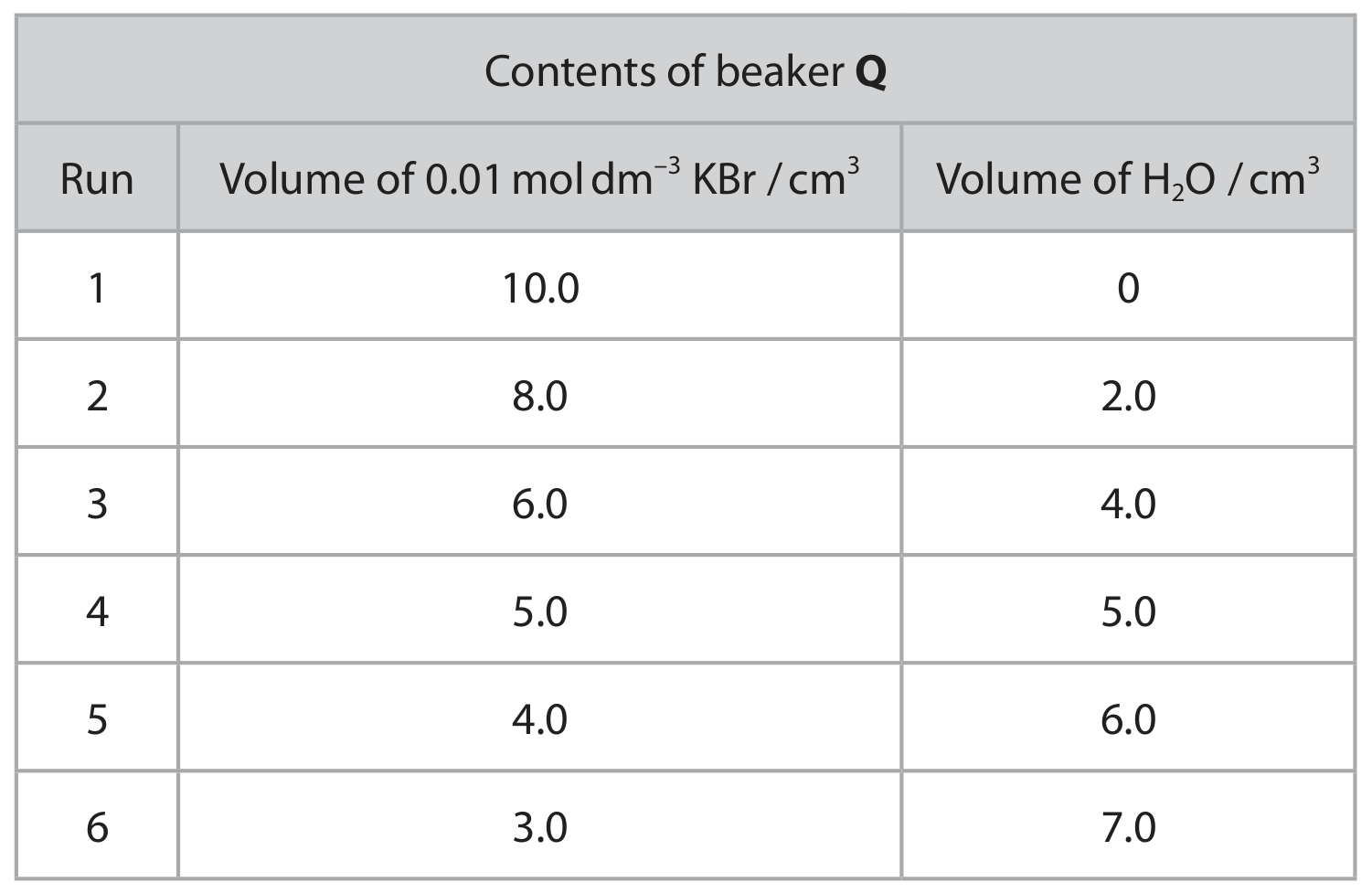
Step 1 Add 10.0 cm310.0 \mathrm{~cm}^{3} of 0.0050 moldm30.0050 \mathrm{~mol} \mathrm{dm}^{-3} potassium bromate(V), 15.0 cm315.0 \mathrm{~cm}^{3} of acidified methyl orange indicator solution and 5.0 cm35.0 \mathrm{~cm}^{3} of 0.00010 moldm30.00010 \mathrm{~mol} \mathrm{dm}^{-3} aqueous phenol to a beaker labelled P.

Step 2 Prepare the contents of beaker Q for Run 1 as specified in the table.
Step 3 Pour the contents of beaker Q into beaker P and start a timer. Pour the contents of beaker P back into beaker Q and place beaker Q on a white tile.

Step 4 Stop the timer as soon as the mixture turns colourless. Record the time, along with the temperature of the solution.

Step 5 Repeat Steps 1 to 4 for the remaining runs.

Table

Question 3(a)

(a)

Give one reason why the contents of beaker P are poured back into beaker Q in Step 3.
(1)

[ 1 ]

Question 3(b)

(b)

Methyl orange indicator is bleached colourless by bromine. Under the experimental conditions, the reciprocal of the time taken for the methyl orange to be bleached (1 / t) is proportional to the initial rate.

[ 4 ]

Question 3(b)(i)

(i)

Explain why phenol is added to the reaction mixture.

[ 2 ]

Question 3(b)(ii)

(ii)

Give the colour of the reaction mixture before it turns colourless.

[ 1 ]

Question 3(b)(iii)

(iii)

Give the reason why the temperature is measured in Step 4.

[ 1 ]

Question 3(c)

(c)

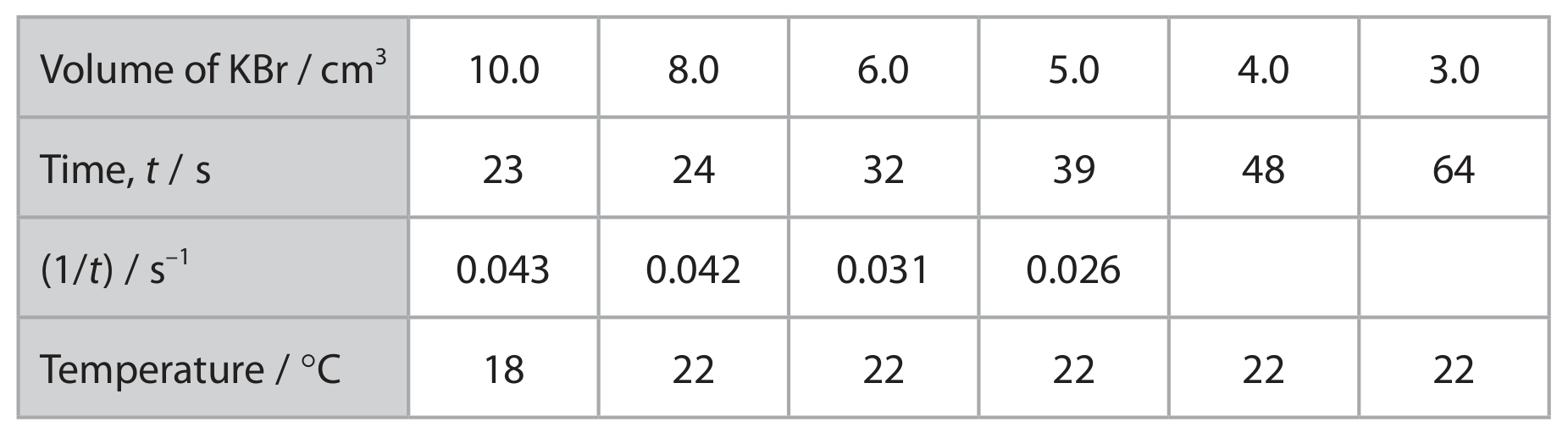
The student's results are shown.

Table
[ 2 ]

Question 3(c)(iii)

(i)

State why the volume of KBr is proportional to the concentration of bromide ions in the reaction mixture.

[ 1 ]

Question 3(c)(iv)

(ii)

State the order of reaction with respect to bromide ions, using your graph.

[ 1 ]

Question 3(d)

(d)

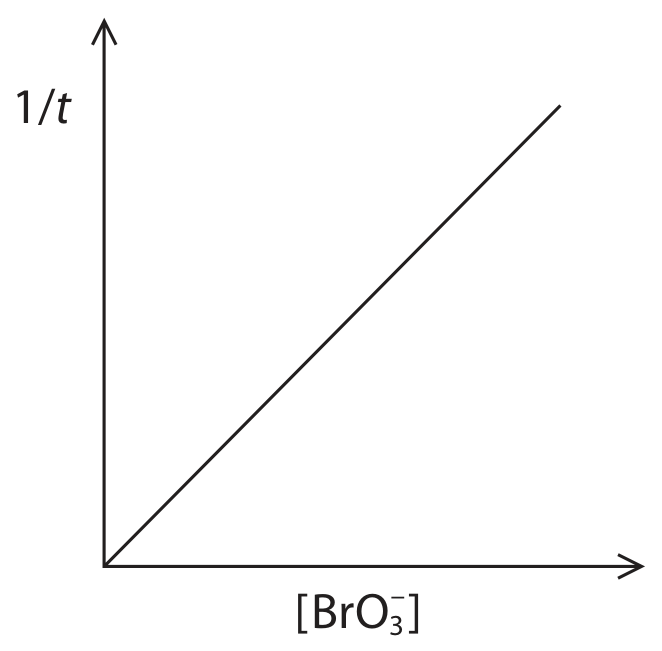
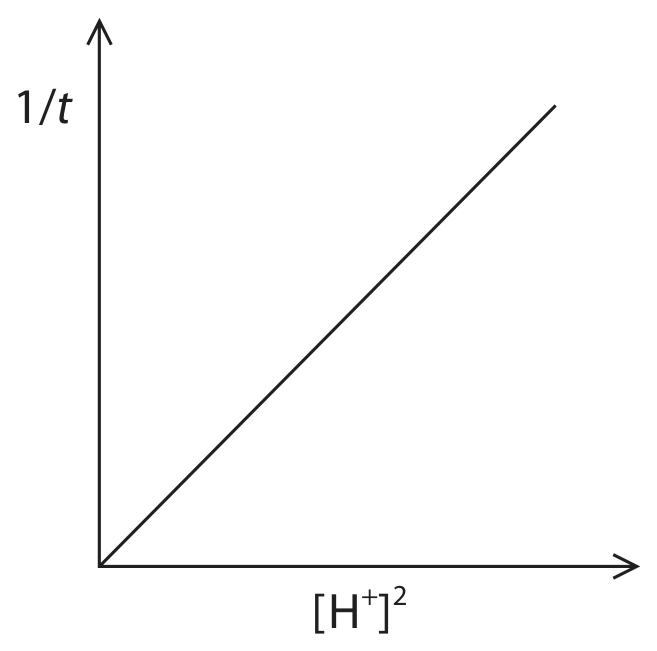
After investigating the effect on the rate of the concentration of bromate(V) ions and the concentration of hydrogen ions, the student obtained the graphs shown.

Question image
Question image

Deduce the rate equation for the reaction, using these data and your answer to (c)(iv).

[ 1 ]

Question 18

[Maximum number: 8]

Bromate(V) ions, BrO3\mathrm{BrO}_{3}^{-}, oxidise bromide ions, Br\mathrm{Br}^{-}, in dilute acid.

BrO3(aq)+5Br(aq)+6H+(aq)3Br2(aq)+3H2O(l)\mathrm{BrO}_{3}^{-}(\mathrm{aq})+5 \mathrm{Br}^{-}(\mathrm{aq})+6 \mathrm{H}^{+}(\mathrm{aq}) \rightarrow 3 \mathrm{Br}_{2}(\mathrm{aq})+3 \mathrm{H}_{2} \mathrm{O}(\mathrm{l})

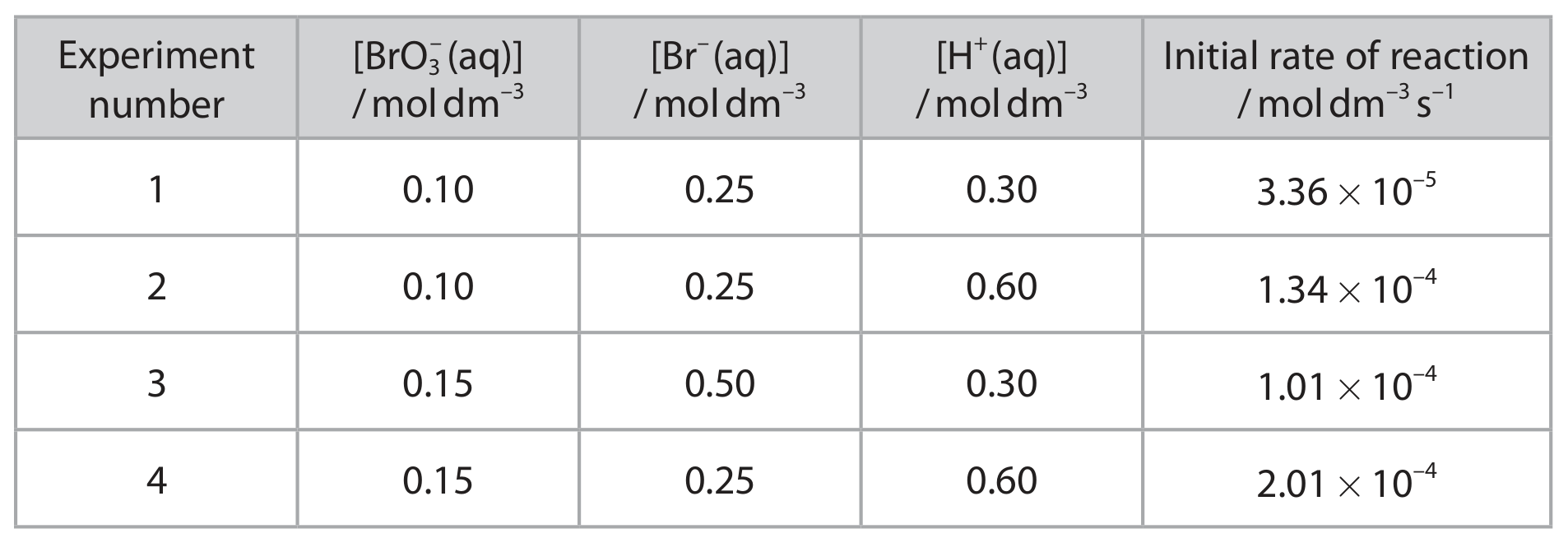
Experiments to determine initial reaction rates were carried out using different initial concentrations of the three reactants.

The results are shown in the table.

Table

Question 18(a)

(a)

The reaction is first order with respect to bromate(V) ions.

[ 7 ]

Question 18(a)(i)

(i)

Deduce the rate equation for the reaction.

Justify your answer using the data.

[ 4 ]

Question 18(a)(ii)

(ii)

Use the data from Experiment 4 and your answer to (a)(i) to calculate the rate constant for the reaction. Include units in your answer.
(3)

[ 3 ]

Question 18(b)

(b)

Give one possible reason why the rate equation shows that the reaction cannot proceed in one step.
(1)

[ 1 ]

Question 16

[Maximum number: 13]

A student investigated the kinetics of the reaction between bromate(V) ions and bromide ions in acidic conditions.

BrO3(aq)+5Br(aq)+6H+(aq)3Br2(aq)+3H2O(l)\mathrm{BrO}_{3}^{-}(\mathrm{aq})+5 \mathrm{Br}^{-}(\mathrm{aq})+6 \mathrm{H}^{+}(\mathrm{aq}) \rightarrow 3 \mathrm{Br}_{2}(\mathrm{aq})+3 \mathrm{H}_{2} \mathrm{O}(\mathrm{l})

Question 16(a)

(a)

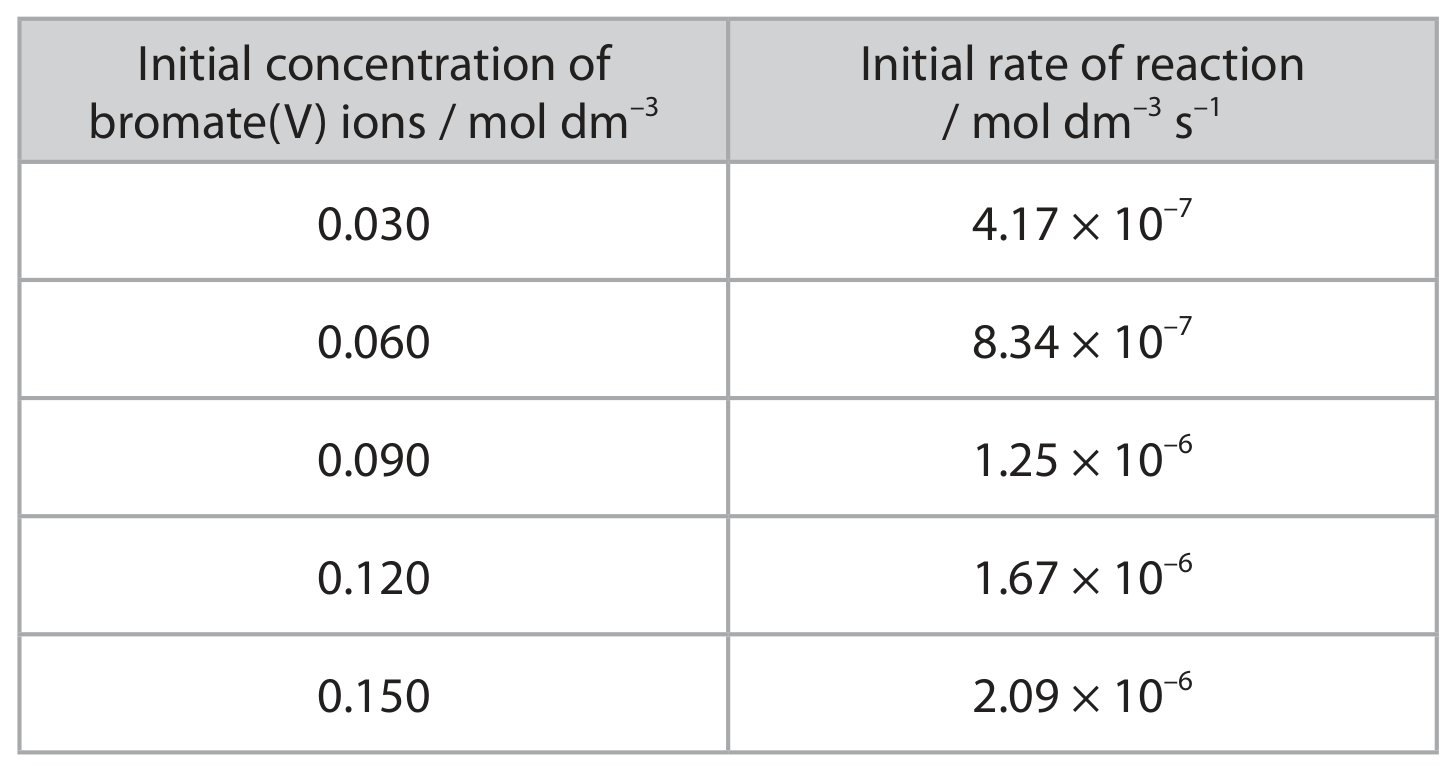
In the first experiment, the student measured the initial rate of the reaction at five different concentrations of bromate(V) ions, BrO3\mathrm{BrO}_{3}^{-}. In each case, the initial concentrations of bromide ions and hydrogen ions were constant and in large excess. The results obtained are shown.

Table
[ 4 ]

Question 16(a)(i)

(i)

Use the results to plot a suitable graph that can be used to show that the reaction is first order with respect to bromate(V) ions.

Question image
[ 3 ]

Question 16(a)(ii)

(ii)

State how your graph shows that the reaction is first order with respect to bromate(V) ions.

[ 1 ]

Question 16(b)

(b)

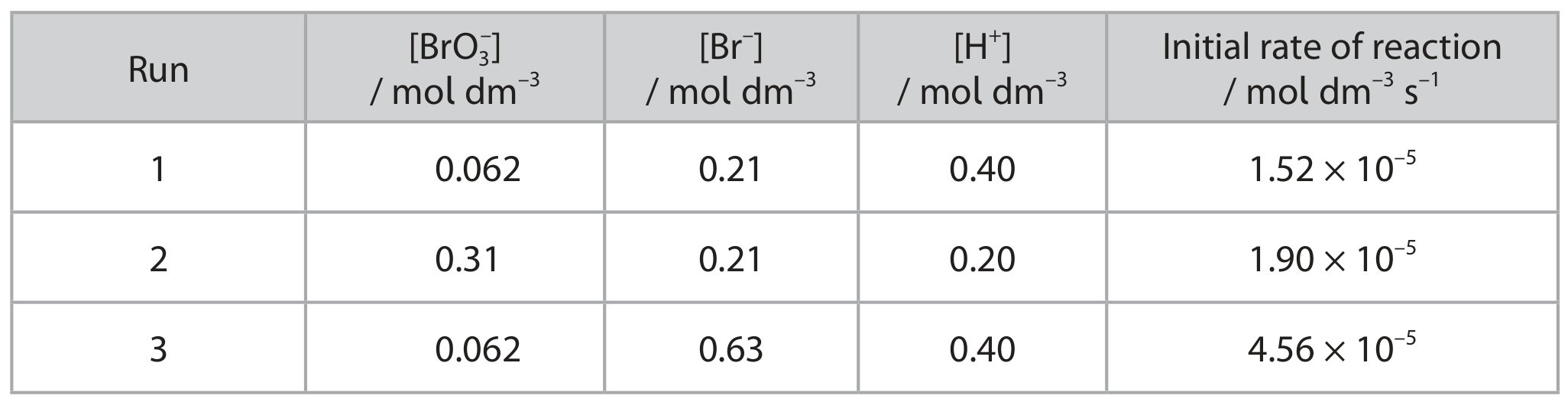
In the second experiment, the student determined the initial rates of the same reaction starting with different concentrations of the reactants.

Table
[ 6 ]

Question 16(b)(i)

(i)

Use these results and your answer to (a) to deduce the orders with respect to Br\mathrm{Br}^{-}ions and H+\mathrm{H}^{+}ions.
Br\mathrm{Br}^{-}ions
H+\mathrm{H}^{+}ions

[ 2 ]

Question 16(b)(ii)

(ii)

Write the rate equation for the reaction.

[ 1 ]

Question 16(b)(iii)

(iii)

Use the results for Run 1 and your rate equation from (b)(ii) to calculate the value for the rate constant, k. Include units in your answer.

[ 3 ]

Question 16(c)

(c)

The presence of bromate(V) ions in drinking water is harmful to humans. Bromate(V) ions can be converted to less harmful bromide ions by passing the water through palladium with a reducing agent.

Describe how a heterogeneous catalyst, such as palladium, increases the rate of a reaction.
(3)

[ 3 ]

Question 20

[Maximum number: 15]

This question is about some compounds of bromine.

Question 20(b)

(a)

Bromide ions react with bromate(V) ions in acidic solution.

5Br(aq)+BrO3(aq)+6H+(aq)3Br2(aq)+3H2O(l)5 \mathrm{Br}^{-}(\mathrm{aq})+\mathrm{BrO}_{3}^{-}(\mathrm{aq})+6 \mathrm{H}^{+}(\mathrm{aq}) \rightarrow 3 \mathrm{Br}_{2}(\mathrm{aq})+3 \mathrm{H}_{2} \mathrm{O}(\mathrm{l})

Two experiments are carried out.

[ 8 ]

Question 20(b)(i)

(i)

Experiment 1

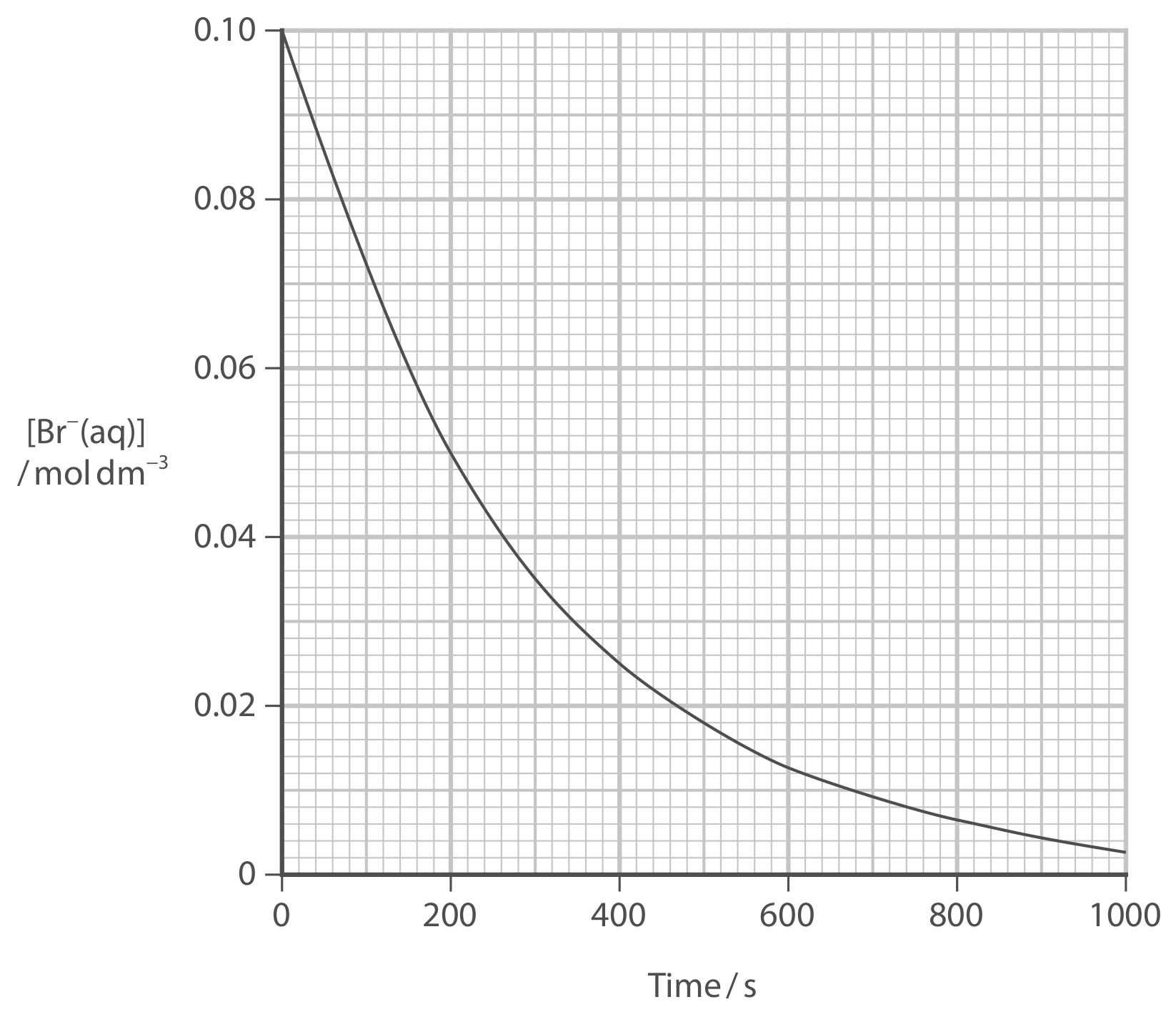
The concentration of Br\mathrm{Br}^{-}ions is determined at different times.
The concentrations of BrO3\mathrm{BrO}_{3}^{-}ions and H+\mathrm{H}^{+}ions are in large excess and effectively constant.

The graph of concentration of Br\mathrm{Br}^{-}ions against time is shown.

Question image

Determine the order of the reaction with respect to bromide ions. Show your working on the graph.

[ 3 ]

Question 20(b)(ii)

(ii)

Experiment 2

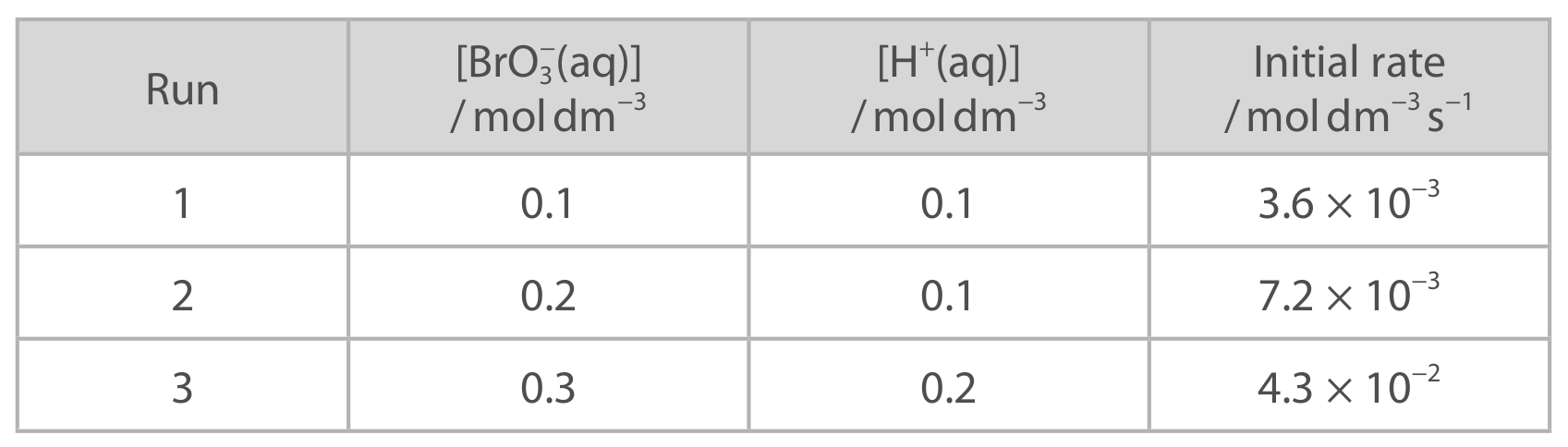
The initial concentrations of BrO3\mathrm{BrO}_{3}^{-}ions and H+\mathrm{H}^{+}ions are changed and the initial rate of reaction is determined.
The initial concentration of Br\mathrm{Br}^{-}ions is constant and in large excess.

Table

Determine the order of reaction with respect to BrO3\mathrm{BrO}_{3}^{-}ions and to H+\mathrm{H}^{+}ions.
You must explain your working.
(3)

[ 3 ]

Question 20(b)(iii)

(iii)

Give the overall rate equation for this reaction.

Include the units for the rate constant.

[ 2 ]

Question 20(c)

(b)

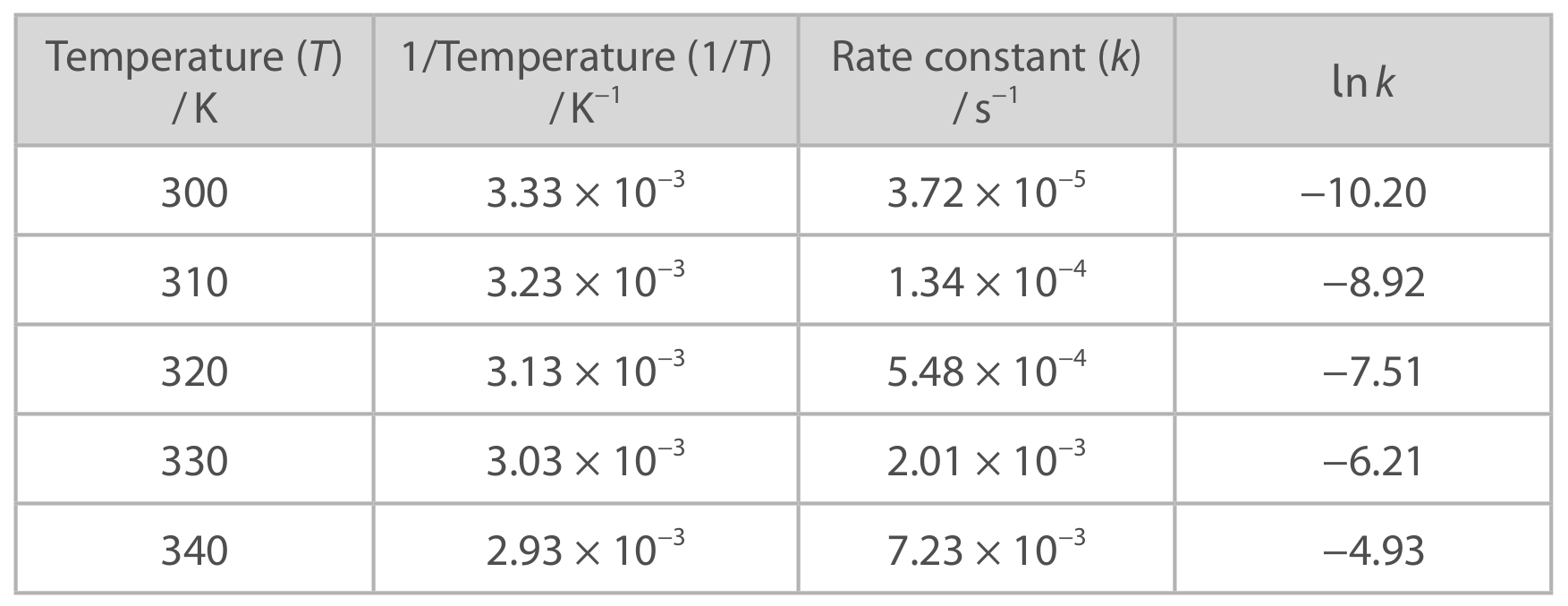
The rate constant for the reaction between bromoalkane and cyanide ions is determined at five different temperatures.

The results are given in the table.

Table

Plot a graph of lnk\ln k against 1 / T and use it to determine the activation energy, EaE_{\mathrm{a}}.
Include the sign and units of the gradient and the activation energy.

The Arrhenius equation can be expressed as

lnk=EaR×1T+ constant \ln \mathrm{k}=-\frac{E_{\mathrm{a}}}{R} \times \frac{1}{T}+\text { constant }

[R=8.31 J mol1 K1]\left[R=8.31 \mathrm{~J} \mathrm{~mol}^{-1} \mathrm{~K}^{-1}\right]

[ 7 ]