
Question 2
This question is about the identification of three organic compounds, X, Y and Z.
A molecule of each compound has only one type of functional group. Each compound contains six carbon atoms and two oxygen atoms.
In the mass spectrum of X, the molecular ion peak is at m / z=114.
Question 2(b)
Three chemical tests are carried out on X.
Test 1 When Brady's reagent (2,4-dinitrophenylhydrazine solution) is added to X, an orange precipitate is observed.
Test 2 When X is heated with an acidified solution of potassium dichromate(VI), no change is observed.
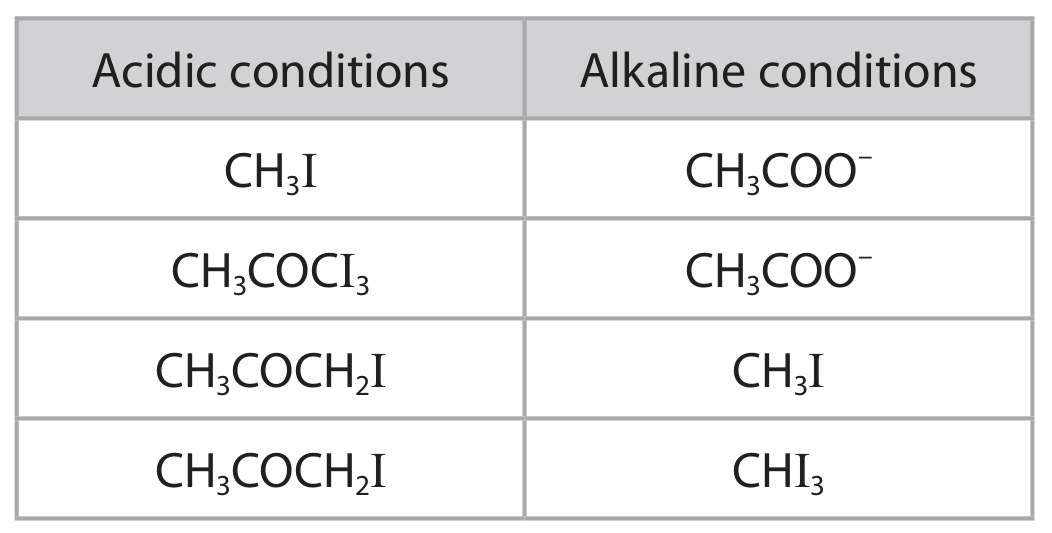
Test 3 When X is added to an alkaline solution of iodine, the formation of a pale yellow precipitate is observed.
Explain what can be deduced about the functional group present in X, by considering the results of each of these tests.
(b) Three chemical tests are carried out on X.
Question 2(c)
The high resolution proton NMR spectrum of X contains only two singlets with relative peak areas of 3: 2.
Draw the structure of X, identifying the two proton environments.
Question 2(d)
The molecular formula of Y is .
Question 2(d)(i)
When aqueous sodium carbonate is added to Y, effervescence is observed. Identify, by name or formula, the functional group present in Y.
Question 2(d)(ii)
The NMR spectrum of Y contains four peaks.
Give two possible structures for Y.
Question 2(d)(iii)
Explain how the low resolution proton NMR spectrum of Y would confirm which of your structures in (d)(ii) is correct. Chemical shifts are not required.