EduNinja

Edexcel IAL Chemistry A2 Topic 14 Acid–base equilibria

Edexcel IAL Chemistry A2 Topic 14 Acid–base equilibria
Pearson Edexcel IAL Chemistry syllabusChemistry YCH11First assessment 2019

Write the acid equilibrium first, identify the justified approximation and carry concentration units and logarithms carefully before interpreting acid strength or pH.

Exam points

  • Write proton-transfer equations and label Brønsted–Lowry conjugate acid–base pairs.
  • Calculate pH, hydrogen or hydroxide concentration using strong-acid, Ka or Kw relationships.
  • Compare acid strength through dissociation, Ka and pKa rather than concentration alone.

Question 4

[Maximum number: 3]

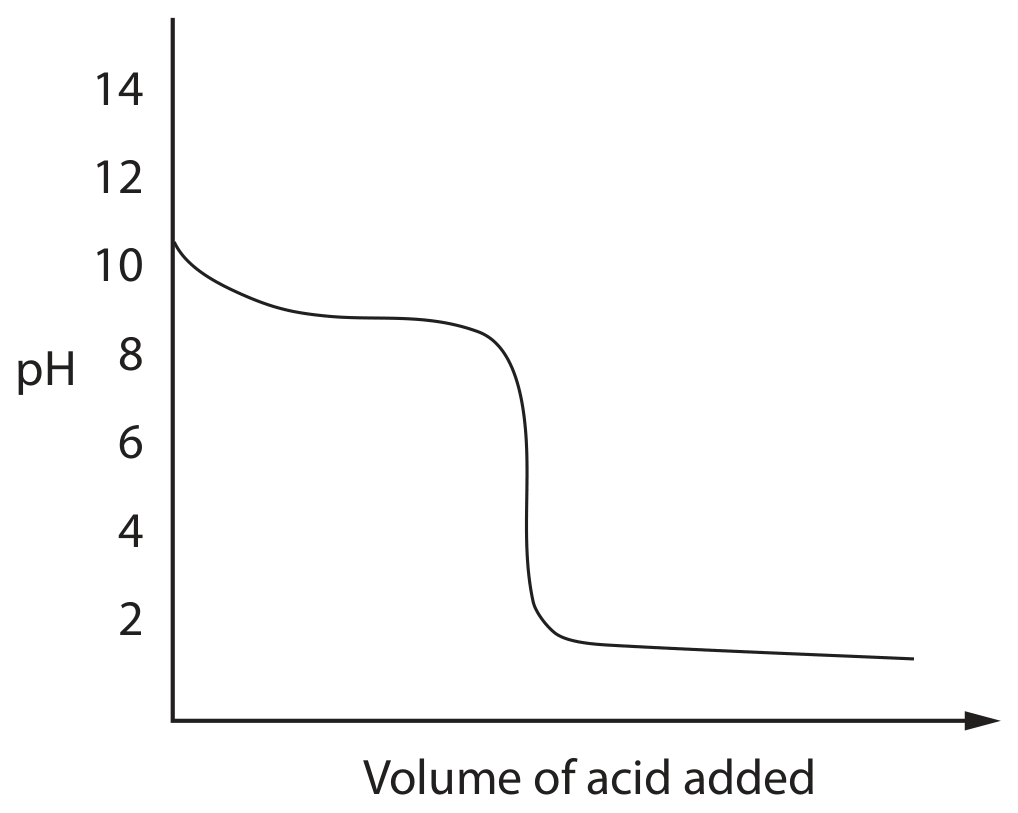
A graph of pH against volume of acid added for an acid-base titration is shown.
Question image

Question 4(a)

(a)

Which acidic solution was used in the titration?

A

0.1 moldm3CH3COOH0.1 \mathrm{~mol} \mathrm{dm}^{-3} \mathrm{CH}_{3} \mathrm{COOH}

B

1.0 moldm3CH3COOH1.0 \mathrm{~mol} \mathrm{dm}^{-3} \mathrm{CH}_{3} \mathrm{COOH}

C

0.1 moldm3HCl0.1 \mathrm{~mol} \mathrm{dm}^{-3} \mathrm{HCl}

D

1.0 moldm3HCl1.0 \mathrm{~mol} \mathrm{dm}^{-3} \mathrm{HCl}

[ 1 ]

Question 4(b)

(b)

Which basic solution was used in the titration?

A

NH3\mathrm{NH}_{3}

B

LiOH

C

Ba(OH)2\mathrm{Ba}(\mathrm{OH})_{2}

D

NaOH

[ 1 ]

Question 4(c)

(c)

A student suggested five indicators that might be used in this titration:
thymol blue
methyl orange
bromophenol blue
bromocresol green
phenolphthalein
How many of these indicators would be suitable? Use your Data Booklet.

A

5

B

4

C

3

D

2

[ 1 ]
Question 9

[Maximum number: 2]

This question is about weak acids.
pKa\mathrm{p} K_{\mathrm{a}} of ethanoic acid, CH3COOH=4.8\mathrm{CH}_{3} \mathrm{COOH}=4.8pKa\mathrm{p} K_{\mathrm{a}} of chloroethanoic acid, CH2ClCOOH=2.9\mathrm{CH}_{2} \mathrm{ClCOOH}=2.9

Question 9(a)

(a)

What is the pH of a 0.100 moldm30.100 \mathrm{~mol} \mathrm{dm}^{-3} solution of chloroethanoic acid?

A

0.27

B

1.95

C

2.90

D

3.90

[ 1 ]

Question 9(b)

(b)

Which is the acid-conjugate base pair in the reaction between ethanoic acid and chloroethanoic acid?

Acid

Conjugate base

A

CH3COOH\mathrm{CH}_{3} \mathrm{COOH}

CH3COO\mathrm{CH}_{3} \mathrm{COO}^{-}

B

CH3COOH\mathrm{CH}_{3} \mathrm{COOH}

CH3COOH2+\mathrm{CH}_{3} \mathrm{COOH}_{2}^{+}

C

CH2ClCOOH\mathrm{CH}_{2} \mathrm{ClCOOH}

CH2ClCOO\mathrm{CH}_{2} \mathrm{ClCOO}^{-}

D

CH2ClCOOH\mathrm{CH}_{2} \mathrm{ClCOOH}

CH2ClCOOH2+\mathrm{CH}_{2} \mathrm{ClCOOH}_{2}^{+}

[ 1 ]

Question 10

[Maximum number: 3]

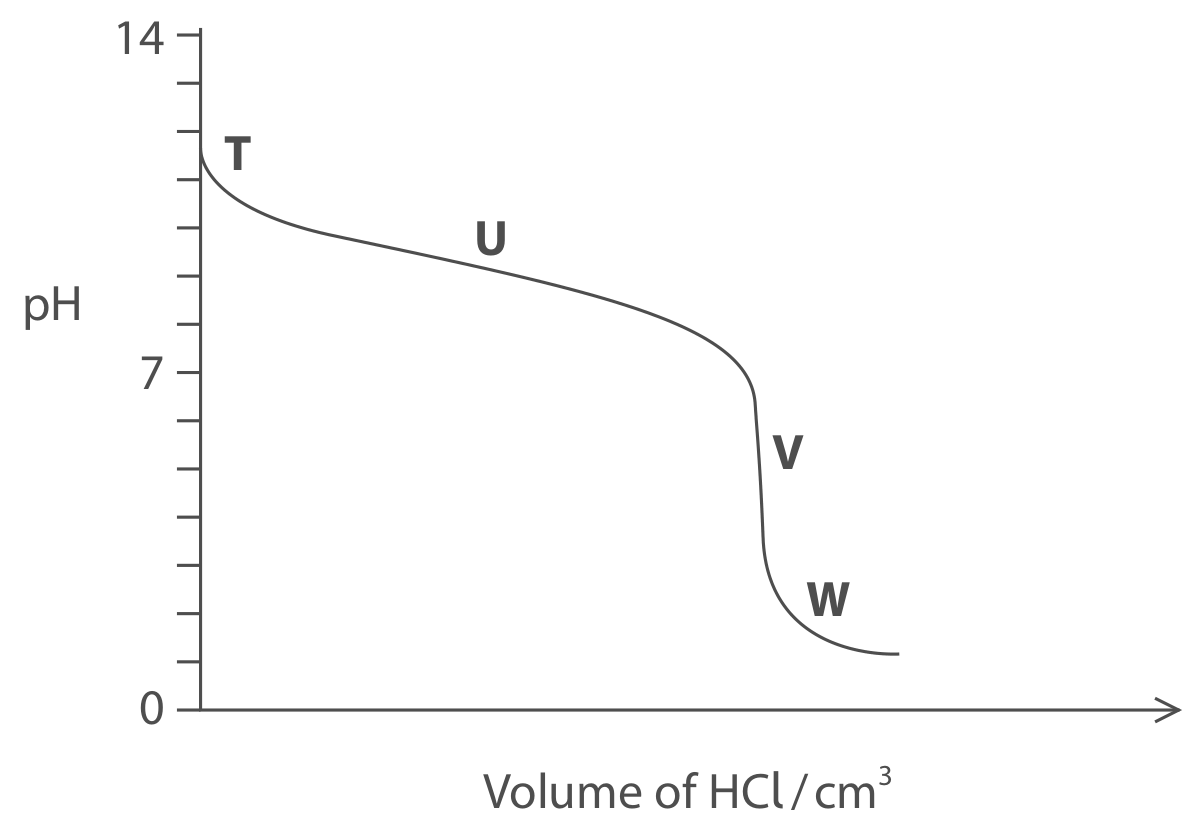
A titration was carried out by adding 0.1 moldm30.1 \mathrm{~mol} \mathrm{dm}^{-3} hydrochloric acid to 0.1 moldm30.1 \mathrm{~mol} \mathrm{dm}^{-3} aqueous ammonia.

HCl(aq)+NH3(aq)NH4Cl(aq)\mathrm{HCl}(\mathrm{aq})+\mathrm{NH}_{3}(\mathrm{aq}) \rightarrow \mathrm{NH}_{4} \mathrm{Cl}(\mathrm{aq})

The titration curve is shown.

Question image

Question 10(a)

(a)

Which region of the graph represents the most effective buffer solution?

A

region T

B

region U

C

region V

D

region W

[ 1 ]

Question 10(b)

(b)

Which of these is the best indicator to use in this titration?
[Refer to the Data Booklet]

A

methyl red

B

phenol red

C

phenolphthalein

D

thymol blue

[ 1 ]

Question 10(c)

(c)

What is the approximate pH of an ammonium chloride solution?

A

2.0

B

5.8

C

9.7

D

11.3

[ 1 ]

Question 18

[Maximum number: 10]

This question is about sulfuric acid and its salts.

Question 18(b)

(a)

Sulfur trioxide is used to produce sulfuric acid.

[ 3 ]

Question 18(b)(ii)

(i)

The pH of a 0.10 moldm30.10 \mathrm{~mol} \mathrm{dm}^{-3} solution of sulfuric acid at 25C25^{\circ} \mathrm{C} is 0.97 .

Calculate the concentration of hydrogen ions, in moldm3\mathrm{mol} \mathrm{dm}^{-3}, in this solution.

[ 1 ]

Question 18(b)(iii)

(ii)

In an aqueous solution of sulfuric acid, the following equilibria exist.

H2SO4(aq)+H2O(l)H3O+(aq)+HSO4(aq)Ka very large HSO4(aq)+H2O(l)H3O+(aq)+SO42(aq)Ka=0.012moldm3\begin{array}{ll} \mathrm{H}_{2} \mathrm{SO}_{4}(\mathrm{aq})+\mathrm{H}_{2} \mathrm{O}(\mathrm{l}) \rightleftharpoons \mathrm{H}_{3} \mathrm{O}^{+}(\mathrm{aq})+\mathrm{HSO}_{4}^{-}(\mathrm{aq}) & K_{\mathrm{a}} \text { very large } \\ \mathrm{HSO}_{4}^{-}(\mathrm{aq})+\mathrm{H}_{2} \mathrm{O}(\mathrm{l}) \rightleftharpoons \mathrm{H}_{3} \mathrm{O}^{+}(\mathrm{aq})+\mathrm{SO}_{4}^{2-}(\mathrm{aq}) & K_{\mathrm{a}}=0.012 \mathrm{moldm}^{-3} \end{array}

Explain, in terms of these equilibria, why the concentration of hydrogen ions in a 0.10 moldm30.10 \mathrm{~mol} \mathrm{dm}^{-3} solution of sulfuric acid is not 0.20 moldm30.20 \mathrm{~mol} \mathrm{dm}^{-3}. No calculation is required.

[ 2 ]

Question 18(c)

(b)

A buffer solution is made from HSO4\mathrm{HSO}_{4}^{-}and SO42\mathrm{SO}_{4}^{2-} ions.

[ 7 ]

Question 18(c)(i)

(i)

Write two ionic equations involving HSO4\mathrm{HSO}_{4}^{-}and SO42\mathrm{SO}_{4}^{2-} ions to show how this

[ 2 ]

Question 18(c)(ii)

(ii)

A buffer solution is formed by mixing
25.0 cm325.0 \mathrm{~cm}^{3} of a solution that is 0.150 moldm30.150 \mathrm{~mol} \mathrm{dm}^{-3} with respect to SO42\mathrm{SO}_{4}^{2-} ions with 75.0 cm375.0 \mathrm{~cm}^{3} of a solution that is 0.100 moldm30.100 \mathrm{~mol} \mathrm{dm}^{-3} with respect to HSO4\mathrm{HSO}_{4}^{-}ions.

Calculate the pH of this buffer solution.
[Ka\left[K_{\mathrm{a}}\right. for HSO4\mathrm{HSO}_{4}^{-}ions =0.012 moldm3=0.012 \mathrm{~mol} \mathrm{dm}^{-3} ]

Question image

" "
t

[ 5 ]

Question 20

[Maximum number: 5]

This question is about compounds with the molecular formula C6H12O2\mathrm{C}_{6} \mathrm{H}_{12} \mathrm{O}_{2}.

Question 20(a)

(a)

Hexanoic acid, C5H11COOH\mathrm{C}_{5} \mathrm{H}_{11} \mathrm{COOH}, is a weak acid.

[ 5 ]

Question 20(a)(i)

(i)

Write the equation for the acid dissociation constant, KaK_{a}, of hexanoic acid.

[ 1 ]

Question 20(a)(ii)

(ii)

Calculate the pH of a 0.100 moldm30.100 \mathrm{~mol} \mathrm{dm}^{-3} solution of hexanoic acid.
[pKa\left[\mathrm{p} K_{\mathrm{a}}\right. of hexanoic acid =4.88]\left.=4.88\right]

[ 4 ]

Question 19

[Maximum number: 3]

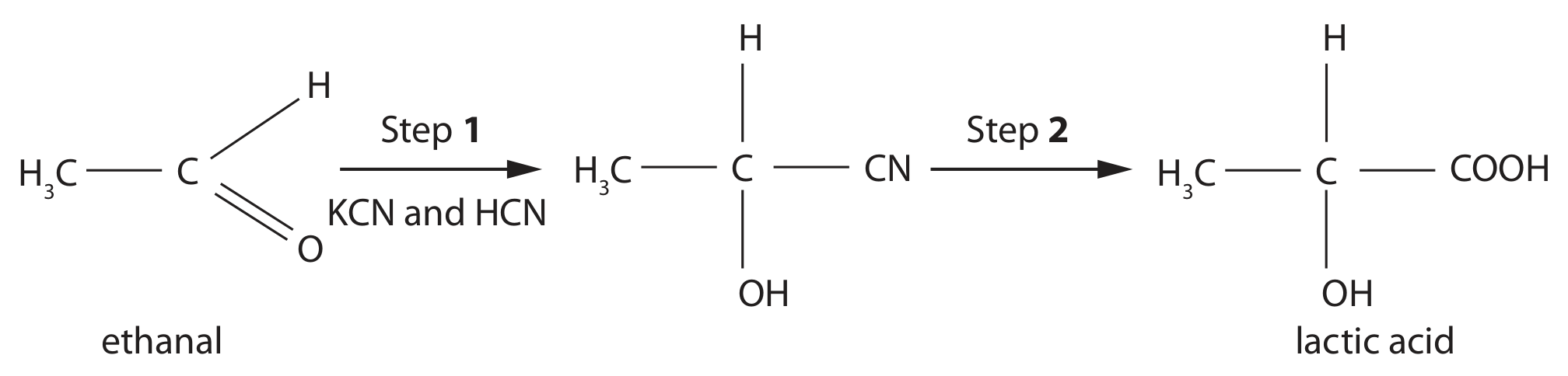
The compound lactic acid can be synthesised from ethanal in two steps.

Question image

Question 19(c)

(a)

Sodium hydrogencarbonate is part of a buffer in the body that controls the pH of blood. Two of the equilibria involved in this process are shown.

Equilibrium 1HCO3+H3O+H2CO3+H2O1 \quad \mathrm{HCO}_{3}^{-}+\mathrm{H}_{3} \mathrm{O}^{+} \rightleftharpoons \mathrm{H}_{2} \mathrm{CO}_{3}+\mathrm{H}_{2} \mathrm{O}
Equilibrium 2H2CO3CO2+H2O2 \quad \mathrm{H}_{2} \mathrm{CO}_{3} \rightleftharpoons \mathrm{CO}_{2}+\mathrm{H}_{2} \mathrm{O}

[ 3 ]

Question 19(c)(i)

(i)

Use the equilibria to explain how the buffer keeps the pH of blood nearly constant when a small increase in the concentration of hydrogen ions occurs.
(3)

[ 3 ]

Question 19(c)(ii)

(ii)

The pH of a blood sample was found to be 7.41.

Calculate the ratio of the concentration of HCO3\mathrm{HCO}_{3}^{-}to H2CO3\mathrm{H}_{2} \mathrm{CO}_{3} in the blood sample.

H2CO3+H2OHCO3+H3O+Ka=4.50×10⁷ moldm3\begin{aligned} & \mathrm{H}_{2} \mathrm{CO}_{3}+\mathrm{H}_{2} \mathrm{O} \rightleftharpoons \mathrm{HCO}_{3}^{-}+\mathrm{H}_{3} \mathrm{O}^{+} \\ & K_{\mathrm{a}}=4.50 \times 10^{-7} \mathrm{~mol} \mathrm{dm}^{-3} \end{aligned}

SECTION C

DO NOTT WRITE IN THIS AREADO NOT WRITE IN THIS AREADO NOT WRITE IN THIS AREA

Answer ALL the questions. Write your answers in the spaces provided.

Question 22

[Maximum number: 4]

The equation for the formation of ammonia in the Haber Process is shown

1/2 N2( g)+112H2( g)NH3( g)1 / 2 \mathrm{~N}_{2}(\mathrm{~g})+1 \frac{1}{2} \mathrm{H}_{2}(\mathrm{~g}) \rightleftharpoons \mathrm{NH}_{3}(\mathrm{~g})

Question 22(e)

(a)

Ammonia from the Haber Process reacts with acids.

With phosphoric acid, H3PO4\mathrm{H}_{3} \mathrm{PO}_{4}, a number of products are formed in solution. One of these is the fertiliser diammonium hydrogenphosphate.

[ 4 ]

Question 22(e)(ii)

(i)

Write an ionic equation to show that ammonium ions are acidic in aqueous solution.
State symbols are not required.

[ 1 ]

Question 22(e)(iii)

(ii)

A solution containing both ammonia and ammonium ions acts as a buffer. Explain, using a relevant ionic equation, the effect of adding a small amount of acid to this buffer.

[ 3 ]