

EduNinja

Edexcel IAL Chemistry A2 Topic 13 Chemical equilibria

Edexcel IAL Chemistry A2 Topic 13 Chemical equilibria
Pearson Edexcel IAL Chemistry syllabusChemistry YCH11First assessment 2019

Start from the balanced equation, construct the correct concentration or partial-pressure expression and build an equilibrium table before explaining what can change K.

Exam points

  • Write Kc or Kp expressions with stoichiometric powers and omitted pure solids or liquids.
  • Calculate equilibrium concentrations or partial pressures and constants with appropriate units.
  • Distinguish changes to composition from the temperature-dependent value of the equilibrium constant.

Question 3

[Maximum number: 2]

The reaction shown is at equilibrium. The forward reaction is endothermic.

C( s)+CO2( g)2CO( g)\mathrm{C}(\mathrm{~s})+\mathrm{CO}_{2}(\mathrm{~g}) \rightleftharpoons 2 \mathrm{CO}(\mathrm{~g})

Question 3(a)

(a)

Which will increase when the temperature is lowered?

A

the mole fraction of carbon dioxide

B

the partial pressure of carbon monoxide

C

the rate of the backward reaction

D

the value of KpK_{\mathrm{p}} for the forward reaction

[ 1 ]

Question 3(b)

(b)

At 680C680^{\circ} \mathrm{C} and 1 atm,52.6%1 \mathrm{~atm}, 52.6 \% of the molecules in the gas mixture are carbon monoxide. What is the partial pressure of carbon dioxide, in atmospheres?

A

0.237

B

0.263

C

0.474

D

0.526

[ 1 ]
Question 6

[Maximum number: 1]

The total entropy change, ΔStotal \Delta S_{\text {total }}, of a reaction at 298 K is 85.0JK1 mol1-85.0 \mathrm{JK}^{-1} \mathrm{~mol}^{-1}.
What is the value of the equilibrium constant for this reaction at 298 K ?

[R=8.31 J mol1 K1]\left[R=8.31 \mathrm{~J} \mathrm{~mol}^{-1} \mathrm{~K}^{-1}\right]
A

3.61×1053.61 \times 10^{-5}

B

9.07×1019.07 \times 10^{-1}

C

9.66×1019.66 \times 10^{-1}

D

2.77×1042.77 \times 10^{4}

Question 18

[Maximum number: 8]

This question is about sulfuric acid and its salts.

Question 18(a)

(a)

The manufacture of sulfuric acid involves the equilibrium

2SO2( g)+O2( g)2SO3( g)ΔrH=197 kJ mol12 \mathrm{SO}_{2}(\mathrm{~g})+\mathrm{O}_{2}(\mathrm{~g}) \rightleftharpoons 2 \mathrm{SO}_{3}(\mathrm{~g}) \quad \Delta_{\mathrm{r}} H=-197 \mathrm{~kJ} \mathrm{~mol}^{-1}
[ 8 ]

Question 18(a)(i)

(i)

A catalyst of vanadium(V) oxide is used in this reaction.

State the effect, if any, of the catalyst on the value of the equilibrium constant, KpK_{p}.

[ 1 ]

Question 18(a)(ii)

(ii)

The temperature used for this reaction in industry is 700 K .

Explain, in terms of the equilibrium constant and the equilibrium position, the effect of an increase in temperature on the equilibrium yield of sulfur trioxide.
(2)

[ 2 ]

Question 18(a)(iii)

(iii)

Write the expression for the equilibrium constant, KpK_{p}, for this equilibrium. State symbols are not required.

[ 1 ]

Question 18(a)(iv)

(iv)

A mixture of 2.00 mol of sulfur dioxide and 1.00 mol of oxygen is allowed to reach equilibrium at 5.00 atm pressure. 1.60 mol of sulfur trioxide is formed.

Calculate the value of KpK_{p}.
Include units and give your answer to an appropriate number of significant figures.
(4)

[ 4 ]

Question 21(a)(i)

[Maximum number: 4]

Esters are used in flavourings and perfumes.
They can be made by reactions involving alcohols.

A flask containing a mixture of 0.200 mol of ethanoic acid and 0.150 mol of ethanol was left at 25C25^{\circ} \mathrm{C}, in the presence of a catalyst, until equilibrium had been established.

CH3COOH(l)+C2H5OH(l)CH3COOC2H5(l)+H2O(l)\mathrm{CH}_{3} \mathrm{COOH}(\mathrm{l})+\mathrm{C}_{2} \mathrm{H}_{5} \mathrm{OH}(\mathrm{l}) \rightleftharpoons \mathrm{CH}_{3} \mathrm{COOC}_{2} \mathrm{H}_{5}(\mathrm{l})+\mathrm{H}_{2} \mathrm{O}(\mathrm{l})

The ethanoic acid present in the equilibrium mixture required 34.8 cm334.8 \mathrm{~cm}^{3} of a 2.50 moldm32.50 \mathrm{~mol} \mathrm{dm}^{-3} solution of sodium hydroxide for complete neutralisation.

Calculate the value of the equilibrium constant, KcK_{c}, for this reaction at 25C25^{\circ} \mathrm{C}.

Question 19

[Maximum number: 6]

Ammonia is manufactured in the Haber Process.

N2( g)+3H2( g)2NH3( g)\mathrm{N}_{2}(\mathrm{~g})+3 \mathrm{H}_{2}(\mathrm{~g}) \rightleftharpoons 2 \mathrm{NH}_{3}(\mathrm{~g})

In this process, pressures between 100 atm and 300 atm and temperatures between 675 K and 725 K are usually used.

Question 19(b)(i)

(a)

Write the expression for the equilibrium constant, KpK_{\mathrm{p}}, for the reaction in the Haber Process.

N2( g)+3H2( g)2NH3( g)\mathrm{N}_{2}(\mathrm{~g})+3 \mathrm{H}_{2}(\mathrm{~g}) \rightleftharpoons 2 \mathrm{NH}_{3}(\mathrm{~g})

Question 19(b)(ii)

(b)

A mixture of nitrogen, hydrogen and ammonia is at equilibrium at 255 atm and 700 K . The partial pressure of nitrogen is 25 atm and that of hydrogen is 150 atm .

Calculate the equilibrium constant, KpK_{p}, for the formation of ammonia, at 700 K . Include units in your answer.

[ 3 ]

Question 19(b)(iii)

(c)

The pressure of the system is doubled at constant temperature.

Explain the effect of this on the yield of ammonia by considering the change in the KpK_{\mathrm{p}} expression and hence the position of equilibrium.
(3)

[ 3 ]

Question 22

[Maximum number: 3]

The equation for the formation of ammonia in the Haber Process is shown

1/2 N2( g)+112H2( g)NH3( g)1 / 2 \mathrm{~N}_{2}(\mathrm{~g})+1 \frac{1}{2} \mathrm{H}_{2}(\mathrm{~g}) \rightleftharpoons \mathrm{NH}_{3}(\mathrm{~g})

Question 22(d)

(a)

The industrial synthesis of ammonia

1/2 N2( g)+11/2H2( g)NH3( g)1 / 2 \mathrm{~N}_{2}(\mathrm{~g})+11 / 2 \mathrm{H}_{2}(\mathrm{~g}) \rightleftharpoons \mathrm{NH}_{3}(\mathrm{~g})

is carried out at pressures of about 20000 kPa and temperatures between 700 K and 750 K . These temperatures are higher than the answer to (c)(iii).

[ 3 ]

Question 22(d)(i)

(i)

State the relationship between the total entropy, ΔStotal \Delta S_{\text {total }}, and the equilibrium constant, K.

[ 1 ]

Question 22(d)(ii)

(ii)

Calculate the value of the equilibrium constant K at 750 K.

[ 2 ]

Question 20

[Maximum number: 16]

The reversible reaction between hydrogen chloride and oxygen produces water vapour and chlorine.

4HCl( g)+O2( g)2H2O( g)+2Cl2( g)ΔH=114 kJ mol14 \mathrm{HCl}(\mathrm{~g})+\mathrm{O}_{2}(\mathrm{~g}) \rightleftharpoons 2 \mathrm{H}_{2} \mathrm{O}(\mathrm{~g})+2 \mathrm{Cl}_{2}(\mathrm{~g}) \quad \Delta H=-114 \mathrm{~kJ} \mathrm{~mol}^{-1}

Question 20(a)

(a)

Explain what effect, if any, each of the following changes has on the yield of chlorine at equilibrium and on the equilibrium constant, KpK_{\mathrm{p}}.

[ 7 ]

Question 20(a)(i)

(i)

An increase in the total pressure

[ 3 ]

Question 20(a)(ii)

(ii)

An increase in the temperature

[ 2 ]

Question 20(a)(iii)

(iii)

The use of a catalyst

[ 2 ]

Question 20(b)

(b)

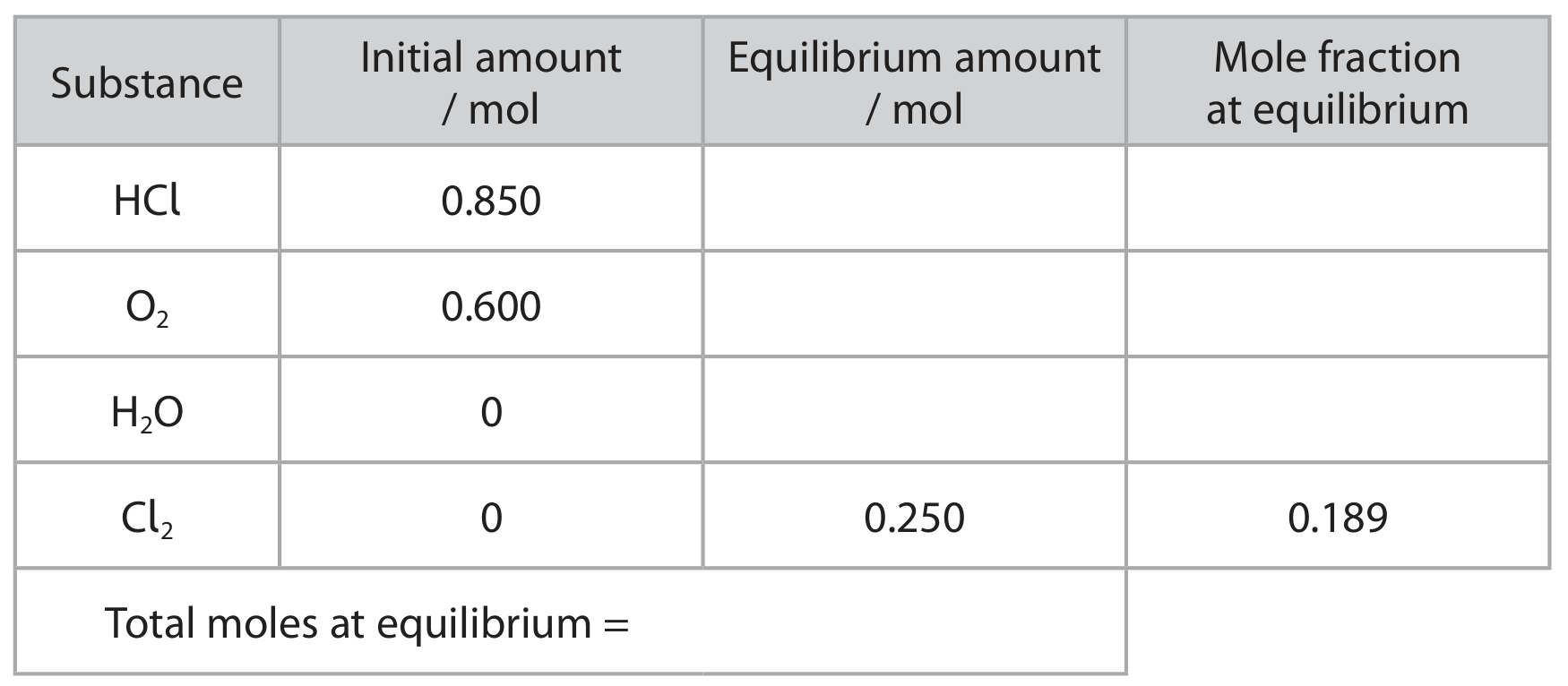
0.850 mol of hydrogen chloride was mixed with 0.600 mol of oxygen and allowed to reach equilibrium in a closed flask.
At equilibrium the total pressure was 1.50 atm and there was 0.250 mol of chlorine in the flask.

4HCl( g)+O2( g)2H2O( g)+2Cl2( g)4 \mathrm{HCl}(\mathrm{~g})+\mathrm{O}_{2}(\mathrm{~g}) \rightleftharpoons 2 \mathrm{H}_{2} \mathrm{O}(\mathrm{~g})+2 \mathrm{Cl}_{2}(\mathrm{~g})
[ 9 ]

Question 20(b)(i)

(i)

Complete the table.

Table
[ 3 ]

Question 20(b)(ii)

(ii)

Write the expression for the equilibrium constant, KpK_{\mathrm{p}}.

[ 1 ]

Question 20(b)(iii)

(iii)

Use your answers to (b)(i) and (b)(ii) to calculate the value for KpK_{\mathrm{p}}. Give your answer to an appropriate number of significant figures, and include units.

[ 3 ]

Question 20(b)(iv)

(iv)

Use your answer to (b)(iii) to calculate a value for the total entropy change of the reaction, ΔStotal \Delta S_{\text {total }}.

[ 2 ]