EduNinja

Edexcel IAL Chemistry A2 Topic 17 Transition Metals and their Chemistry

Edexcel IAL Chemistry A2 Topic 17 Transition Metals and their Chemistry
Pearson Edexcel IAL Chemistry syllabusChemistry YCH11First assessment 2019

Topic 17 questions move from definitions and electron configurations into ligands, complex ions, colour changes, catalysis and transition-metal redox chemistry.

Exam points

  • Classify transition metals by stable ions with incompletely filled d orbitals.
  • Deduce Period 4 d-block atom and ion configurations, including Cr and Cu exceptions.
  • Use ligand, complex-ion and colour evidence to interpret transition-metal reactions.

Question 1

[Maximum number: 3]

This question is about transition metal complexes.

Question 1(a)

(a)

The bonding within the complex [Cu(NH3)4(H2O)2]2+\left[\mathrm{Cu}\left(\mathrm{NH}_{3}\right)_{4}\left(\mathrm{H}_{2} \mathrm{O}\right)_{2}\right]^{2+} is

A

covalent, dative covalent and ionic

B

covalent and dative covalent only

C

covalent only

D

dative covalent only

[ 1 ]

Question 1(b)

(b)

Which complex is tetrahedral?

A

[Pt(NH3)2Cl2]\left[\mathrm{Pt}\left(\mathrm{NH}_{3}\right)_{2} \mathrm{Cl}_{2}\right]

B

[Cu(H2O)4(OH)2]\left[\mathrm{Cu}\left(\mathrm{H}_{2} \mathrm{O}\right)_{4}(\mathrm{OH})_{2}\right]

C

[Cu(NH3)4(H2O)2]2+\left[\mathrm{Cu}\left(\mathrm{NH}_{3}\right)_{4}\left(\mathrm{H}_{2} \mathrm{O}\right)_{2}\right]^{2+}

D

[CoCl4]2\left[\mathrm{CoCl}_{4}\right]^{2-}

[ 1 ]

Question 1(c)

(c)

Which complex contains a bidentate ligand?

A

[Co(NH2CH2CH2NHCH2CH2NH2)2]3+\left[\mathrm{Co}\left(\mathrm{NH}_{2} \mathrm{CH}_{2} \mathrm{CH}_{2} \mathrm{NHCH}_{2} \mathrm{CH}_{2} \mathrm{NH}_{2}\right)_{2}\right]^{3+}

B

[Cu(NH3)4(H2O)2]2+\left[\mathrm{Cu}\left(\mathrm{NH}_{3}\right)_{4}\left(\mathrm{H}_{2} \mathrm{O}\right)_{2}\right]^{2+}

C

[Ni(NH2CH2CH2NH2)3]2+\left[\mathrm{Ni}\left(\mathrm{NH}_{2} \mathrm{CH}_{2} \mathrm{CH}_{2} \mathrm{NH}_{2}\right)_{3}\right]^{2+}

D

[Mn( EDTA )]2[\mathrm{Mn}(\text { EDTA })]^{2-}

[ 1 ]

Question 4

[Maximum number: 1]

A ligand must be an

A

electron-pair donor

B

electron-pair donor and negatively charged

C

electron-pair acceptor

D

electron-pair acceptor and negatively charged

Question 5

[Maximum number: 1]

Diamminecopper(I) ions are not coloured because

A

the d orbitals in copper(I) cannot be split

B

the energy difference between the split d orbitals is outside the visible region of the spectrum

C

d-d transitions are not possible because the d orbitals are fully occupied

D

copper(I) complexes are readily oxidised

Question 7

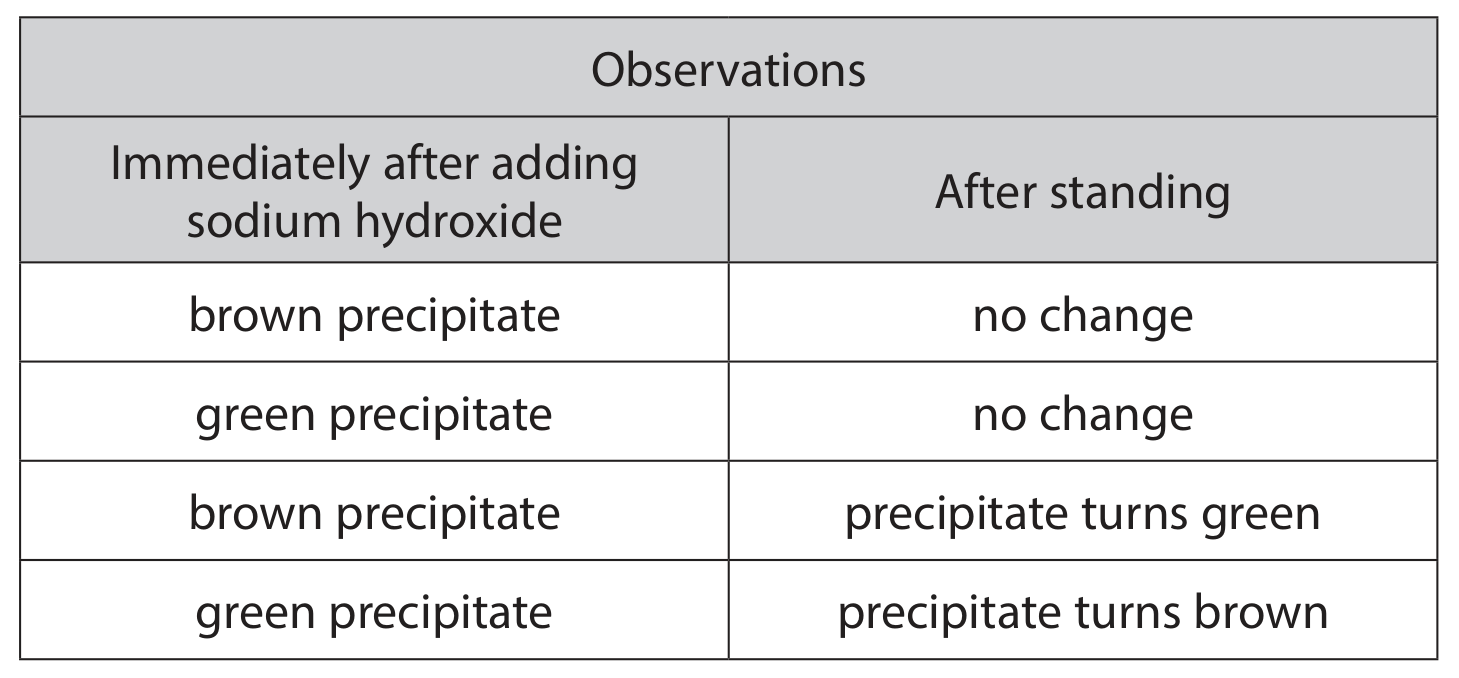
Aqueous sodium hydroxide was added to aqueous iron(II) sulfate and the mixture allowed to stand.

What would be observed?

Table

□ A
□ B
□ C
□ D

Use this space for any rough working. Anything you write in this space will gain no credit.

Question 8

[Maximum number: 1]

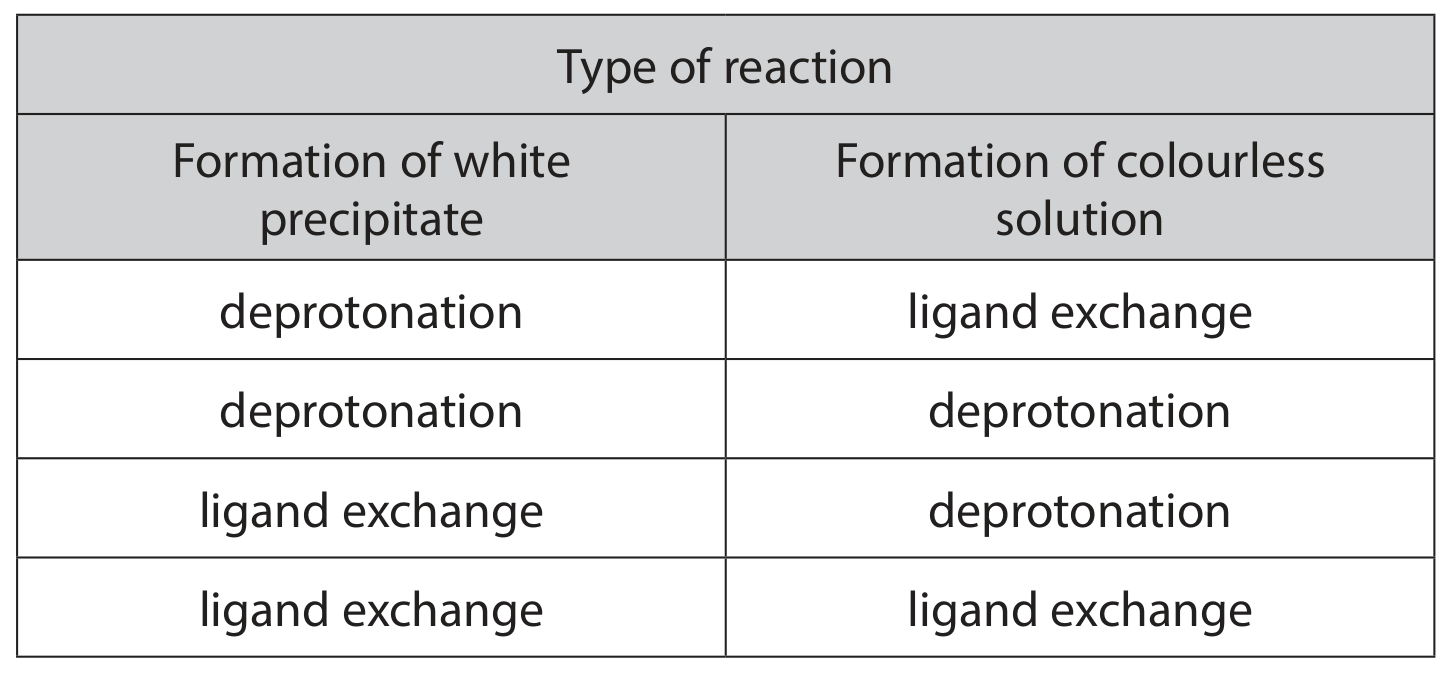
When aqueous ammonia is added to an aqueous solution of zinc sulfate, a white precipitate forms which dissolves in excess ammonia to give a colourless solution.

What types of reaction are occurring?
□ A
□ B
□ C
□ D

Table

(Total for Question 8 = 1 mark)

Question 10

[Maximum number: 5]

This question is about silver and silver compounds.
Glass decorations are made reflective by coating their inner surface with silver. This is achieved by using the reaction between silver nitrate solution, ammonia and glucose, under alkaline conditions.

Initially the colourless complex ion diamminesilver(I), [Ag(NH3)2]+\left[\mathrm{Ag}\left(\mathrm{NH}_{3}\right)_{2}\right]^{+}, forms.

Question 10(a)(i)

(a)

Explain the shape of [Ag(NH3)2]+\left[\mathrm{Ag}\left(\mathrm{NH}_{3}\right)_{2}\right]^{+}.

[ 3 ]

Question 10(a)(ii)

(b)

Explain why [Ag(NH3)2]+\left[\mathrm{Ag}\left(\mathrm{NH}_{3}\right)_{2}\right]^{+}is colourless.

[ 2 ]

Question 21

Question 21(a)

(a)

Explain, in terms of electronic structure, why iron(III) compounds are more stable than iron(II) compounds.

[ 2 ]

Question 21(c)

(b)

Invertebrates use a copper complex, haemocyanin, to transport oxygen. Blue oxyhaemocyanin gives invertebrate blood its characteristic colour.

Explain why oxyhaemocyanin and oxyhaemoglobin have different colours.
(3)

[ 3 ]

Question 21(d)

(c)

The presence of iron in sodium carbonate can affect its properties; the higher the quality of the sodium carbonate, the lower the proportion of iron.

The proportion of iron in a laboratory grade anhydrous sodium carbonate was listed as less than 20 ppm by mass.

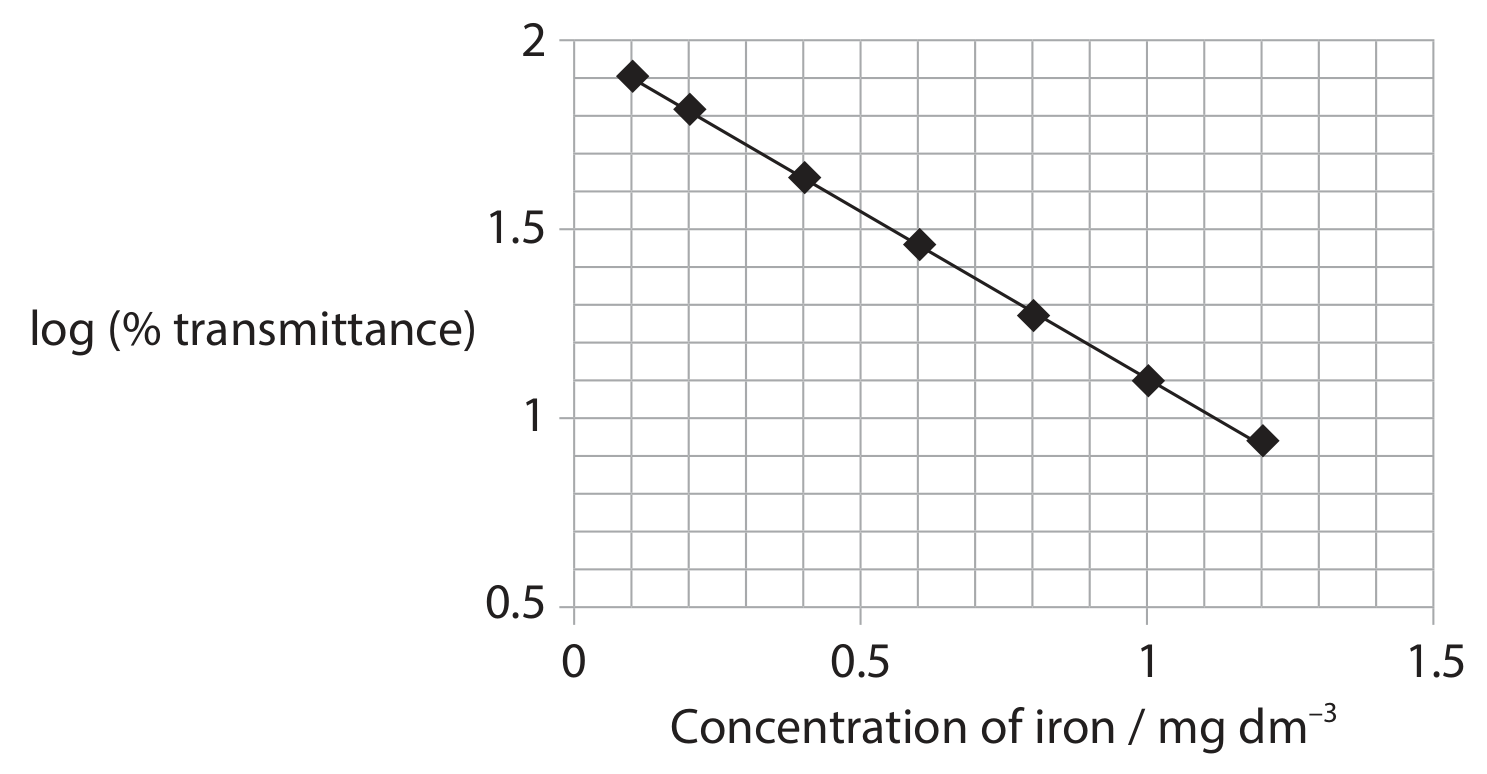
In an experiment to check this specification, 20 g of the sodium carbonate was dissolved in sulfuric acid, and thioglycolic acid added in excess to form the iron(III) thioglycolic acid complex, Fe(HSCH2COOH)33+\mathrm{Fe}\left(\mathrm{HSCH}_{2} \mathrm{COOH}\right)_{3}^{3+}. The solution was made up to 500 cm3500 \mathrm{~cm}^{3} in a volumetric flask and thoroughly mixed.

Colorimeter calibration graph

Colorimeter calibration graph

The transmittance of the resulting solution was determined using a colorimeter and found to be 39.8%.

[ 2 ]

Question 21(d)(ii)

(i)

Suggest what type of ligand thioglycolic acid is in the iron(III) thioglycolic acid complex. Justify your answer.
(2)

[ 2 ]

Question 21(e)

(d)

lodide ions are oxidised to iodine by peroxodisulfate ions.

2I(aq)+S2O82(aq)I2(aq)+2SO42(aq)2 \mathrm{I}^{-}(\mathrm{aq})+\mathrm{S}_{2} \mathrm{O}_{8}^{2-}(\mathrm{aq}) \rightarrow \mathrm{I}_{2}(\mathrm{aq})+2 \mathrm{SO}_{4}^{2-}(\mathrm{aq})

Iron(II) ions act as a homogeneous catalyst for this reaction.

[ 4 ]

Question 21(e)(i)

(i)

State why the catalyst is described as 'homogeneous'.
(e) lodide ions are oxidised to iodine by peroxodisulfate ions.
(i) State why the catalyst is described as 'homogeneous'.

[ 1 ]

Question 21(e)(ii)

(ii)

Write two equations to show how iron(II) ions catalyse this oxidation. State symbols are not required.

[ 2 ]

Question 21(e)(iii)

(iii)

Suggest how iron(II) ions lower the activation energy of this reaction.

[ 1 ]

Question 21(f)

(e)

Give a possible reason why the chloro complexes of iron ions have a coordination number of four rather than six.
(1)

[ 1 ]