
EduNinja

Edexcel IAL Chemistry A2 Topic 12 Entropy and energetics

Edexcel IAL Chemistry A2 Topic 12 Entropy and energetics
Pearson Edexcel IAL Chemistry syllabusChemistry YCH11First assessment 2019

Translate equations and physical changes into entropy direction, calculate each contribution with compatible units and use total entropy rather than system entropy alone for…

Exam points

  • Explain entropy changes through molecular dispersal, energy distribution, state and gas moles.
  • Calculate ΔSsystem and ΔSsurroundings from tabulated entropy, enthalpy and temperature data.
  • Combine contributions to obtain ΔStotal and judge feasibility at a stated temperature.

Question 1

[Maximum number: 2]

A simplified Born-Haber cycle for the formation of lithium iodide is shown.
+520 kJ mol1+Li+(g) electron  affinity Li(g)+LiI(s)270 kJ mol1+160 kJ mol1+107 kJ mol1Li(s)+\begin{aligned}+520 \mathrm{~kJ} \mathrm{~mol}^{-1} \uparrow & +\underset{\substack{\text { electron } \\ \text { affinity }}}{\mathrm{Li}^{+}(\mathrm{g})} \xrightarrow{\mathrm{Li}(\mathrm{g})}+\underset{-270 \mathrm{~kJ} \mathrm{~mol}^{-1}}{\mathrm{LiI}(\mathrm{s})} \\ +160 \mathrm{~kJ} \mathrm{~mol}^{-1} \uparrow & +107 \mathrm{~kJ} \mathrm{~mol}^{-1} \uparrow \\ \mathrm{Li}(\mathrm{s}) & +\end{aligned}

Question 1(a)

(a)

The enthalpy change of atomisation of iodine (+107 kJ mol1)\left(+107 \mathrm{~kJ} \mathrm{~mol}^{-1}\right) is given by the equation

A

1/2I2( g)I(g)1 / 2 \mathrm{I}_{2}(\mathrm{~g}) \rightarrow \mathrm{I}(\mathrm{g})

B

1/2I2( s)I(g)1 / 2 \mathrm{I}_{2}(\mathrm{~s}) \rightarrow \mathrm{I}(\mathrm{g})

C

I2( g)2I(g)\mathrm{I}_{2}(\mathrm{~g}) \rightarrow 2 \mathrm{I}(\mathrm{g})

D

I2( s)2I(g)\mathrm{I}_{2}(\mathrm{~s}) \rightarrow 2 \mathrm{I}(\mathrm{g})

[ 1 ]

Question 1(b)

(b)

Use the information in the cycle to calculate the electron affinity of iodine.

A

298 kJ mol1-298 \mathrm{~kJ} \mathrm{~mol}^{-1}

B

242 kJ mol1-242 \mathrm{~kJ} \mathrm{~mol}^{-1}

C

+242 kJ mol1+242 \mathrm{~kJ} \mathrm{~mol}^{-1}

D

+298 kJ mol1+298 \mathrm{~kJ} \mathrm{~mol}^{-1}

[ 1 ]

Question 2

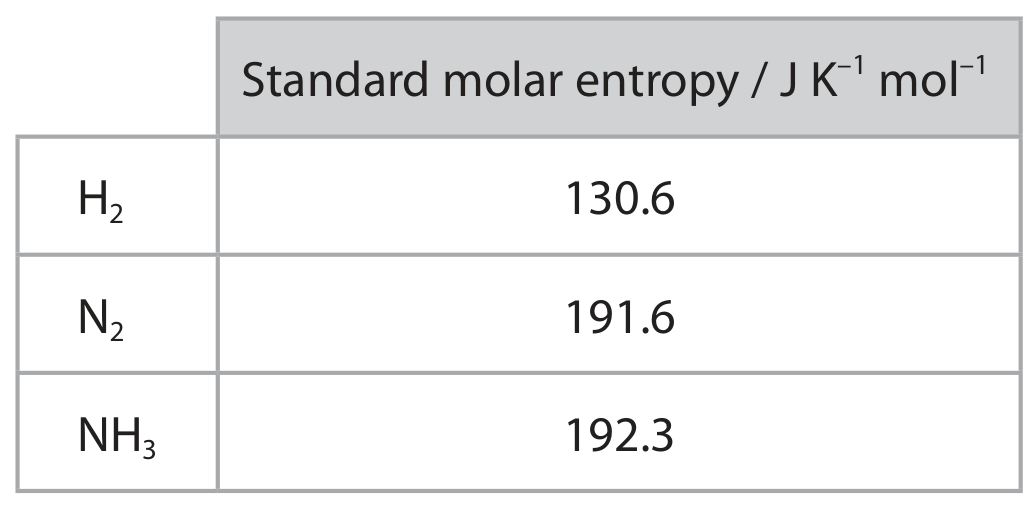
What is the standard entropy change of the system, in JK1 mol1\mathrm{JK}^{-1} \mathrm{~mol}^{-1}, for the reaction between nitrogen and hydrogen to form ammonia?

N2+3H22NH3\mathrm{N}_{2}+3 \mathrm{H}_{2} \rightarrow 2 \mathrm{NH}_{3}
Table

□ A -198.8
□ B -129.9
□ C +129.9
□ D +198.8

Question 3

[Maximum number: 1]

The enthalpy change of solution of sodium sulfate, Na2SO4\mathrm{Na}_{2} \mathrm{SO}_{4}, may be calculated using three pieces of data. Which of these pieces of data is not required?

A

lattice energy of Na2SO4\mathrm{Na}_{2} \mathrm{SO}_{4}

B

enthalpy change of hydration of Na+\mathrm{Na}^{+}

C

enthalpy change of formation of Na2SO4\mathrm{Na}_{2} \mathrm{SO}_{4}

D

enthalpy change of hydration of SO42\mathrm{SO}_{4}^{2-}

Question 15

[Maximum number: 5]

The standard enthalpy change of solution for ammonium nitrate, NH4NO3\mathrm{NH}_{4} \mathrm{NO}_{3}, is +25.7 kJ mol1+25.7 \mathrm{~kJ} \mathrm{~mol}^{-1}.

Question 15(a)

(a)

Calculate the value for the standard entropy change in the surroundings, ΔSsurroundings \Delta S_{\text {surroundings }}^{\ominus}, when ammonium nitrate dissolves in water at 298 K .
Include a sign and units with your answer.

[ 2 ]

Question 15(b)

(b)

Explain what can be deduced from your answer in (a) about the sign and the value of the standard entropy change in the system, ΔSsystem \Delta S_{\text {system }}^{\ominus}, when NH4NO3\mathrm{NH}_{4} \mathrm{NO}_{3} dissolves.

A
"
ΔSsurroundings \Delta S_{\text {surroundings }}^{\ominus}, when ammonium nitrate dissolves in water at 298 K .
Include a sign and units with your answer.
(b) Explain what can be deduced from your answer in (a) about the sign and the value of the stana
NH4NO3\mathrm{NH}_{4} \mathrm{NO}_{3} dissolves.

[ 3 ]

Question 18

[Maximum number: 6]

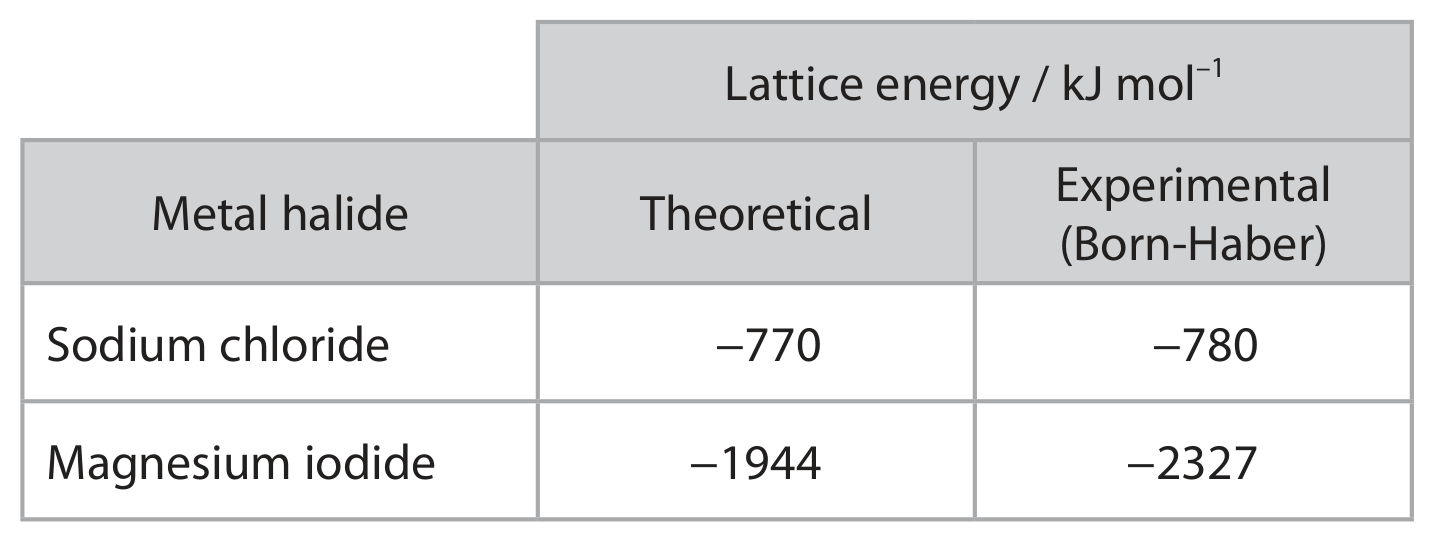
*18 The table shows the theoretical and experimental (Born-Haber) lattice energy data for two metal halide compounds, sodium chloride and magnesium iodide.

Table

Using the data, compare and contrast the type and strength of bonding in these compounds.
Give reasons for your answers.
(6)

Question 22

[Maximum number: 7]

The equation for the formation of ammonia in the Haber Process is shown

1/2 N2( g)+112H2( g)NH3( g)1 / 2 \mathrm{~N}_{2}(\mathrm{~g})+1 \frac{1}{2} \mathrm{H}_{2}(\mathrm{~g}) \rightleftharpoons \mathrm{NH}_{3}(\mathrm{~g})

Question 22(a)

(a)

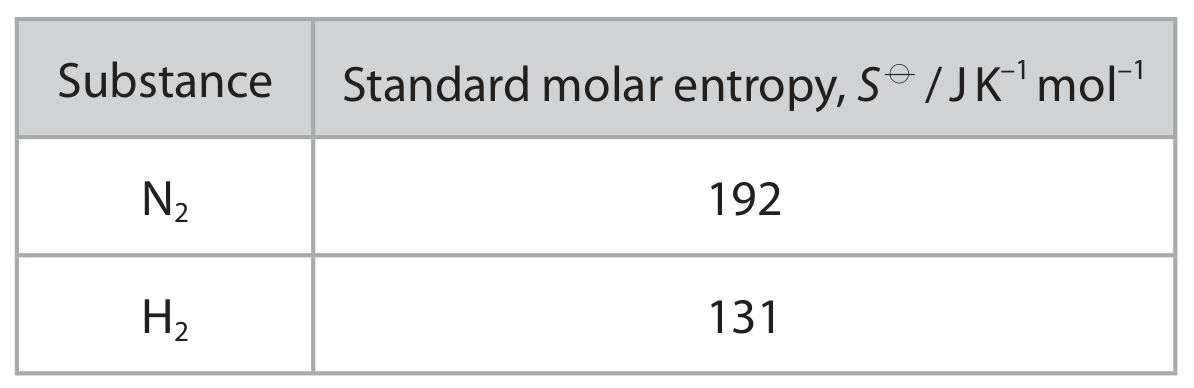
At 298 K the standard entropy change of the system, ΔSsystem =98JK1 mol1\Delta S_{\text {system }}^{\ominus}=-98 \mathrm{JK}^{-1} \mathrm{~mol}^{-1}.

Calculate the standard entropy of one mole of ammonia.
Use the value of ΔSsystem \Delta S_{\text {system }}^{\ominus} and the data in the table.

Table
[ 2 ]

Question 22(c)

(b)

The relationship between ΔStotal \Delta S_{\text {total }} and 1 / T can be found by combining the two equations:

ΔStotal =ΔSsurroundings +ΔSsystem \Delta S_{\text {total }}=\Delta S_{\text {surroundings }}+\Delta S_{\text {system }}

and ΔSsurroundings =ΔH/T\Delta S_{\text {surroundings }}=-\Delta H / T
to give

ΔStotal =ΔH/T+ΔSsystem \Delta S_{\text {total }}=-\Delta H / T+\Delta S_{\text {system }}
[ 2 ]

Question 22(c)(ii)

(i)

Identify the thermodynamic quantity that can be obtained from this gradient.

[ 1 ]

Question 22(c)(iii)

(ii)

Determine the temperature at which the reaction ceases to be thermodynamically feasible at a pressure of 100 kPa .

[ 1 ]

Question 22(d)

(c)

The industrial synthesis of ammonia

1/2 N2( g)+11/2H2( g)NH3( g)1 / 2 \mathrm{~N}_{2}(\mathrm{~g})+11 / 2 \mathrm{H}_{2}(\mathrm{~g}) \rightleftharpoons \mathrm{NH}_{3}(\mathrm{~g})

is carried out at pressures of about 20000 kPa and temperatures between 700 K and 750 K . These temperatures are higher than the answer to (c)(iii).

[ 3 ]

Question 22(d)(iii)

(i)

Explain why ΔStotal \Delta S_{\text {total }} decreases with an increase in temperature.

[ 3 ]

Question 20(c)

[Maximum number: 3]

The reversible reaction between hydrogen chloride and oxygen produces water vapour and chlorine.

4HCl( g)+O2( g)2H2O( g)+2Cl2( g)ΔH=114 kJ mol14 \mathrm{HCl}(\mathrm{~g})+\mathrm{O}_{2}(\mathrm{~g}) \rightleftharpoons 2 \mathrm{H}_{2} \mathrm{O}(\mathrm{~g})+2 \mathrm{Cl}_{2}(\mathrm{~g}) \quad \Delta H=-114 \mathrm{~kJ} \mathrm{~mol}^{-1}

Draw a sketch of entropy against temperature for water to illustrate the entropy changes as temperature increases, including when water changes state.

A scale is not required for the vertical axis