EduNinja
[Maximum number: 1]

A group of students is trying to determine the density and the viscosity of a liquid.

To determine the density, they use a balance to read the mass m of a sphere in air and immersed in the liquid.

They use a sphere of volume V=1.827×10⁷ m3V=1.827 \times 10^{-7} \mathrm{~m}^{3}.
The readings are mair =1.427 gm_{\text {air }}=1.427 \mathrm{~g} in air and mlmmersed =1.208 gm_{\text {lmmersed }}=1.208 \mathrm{~g} in the liquid.
The readings are different due to buoyancy. The buoyancy force FbF_{\mathrm{b}} is given by

Fb=ρVgF_{\mathrm{b}}=\rho V g

where V is the volume of the sphere and ρ\rho is the density of the liquid.

(a)

Suggest a conclusion reached by the students.

[ 1 ]
[Maximum number: 1]

A spherical soap bubble is made of a thin film of soapy water. The bubble has an internal air pressure PiP_{\mathrm{i}} and is formed in air of constant pressure PoP_{\mathrm{o}}. The theoretical prediction for the variation of ( PiPoP_{\mathrm{i}}-P_{\mathrm{o}} ) is given by the equation

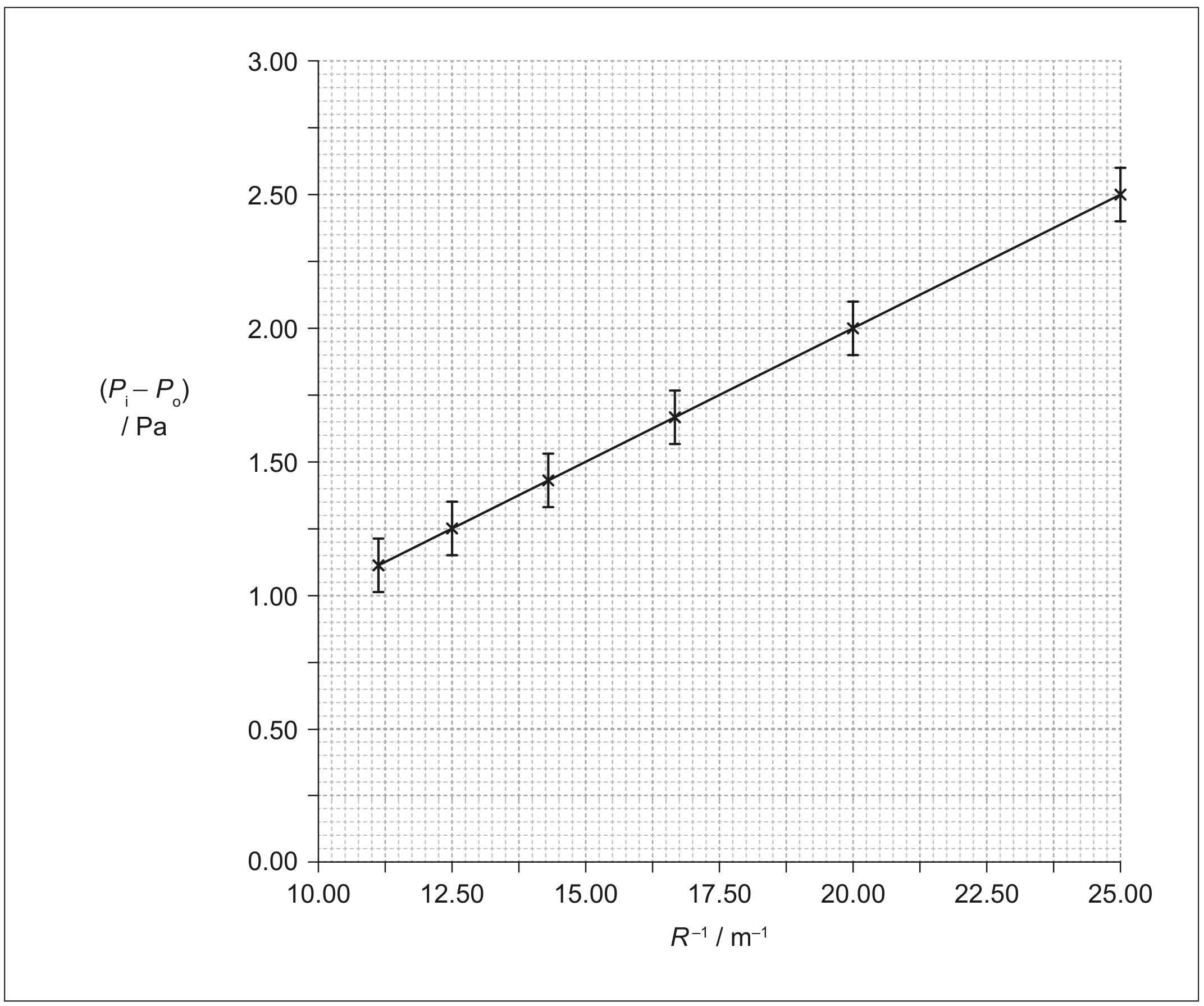
(PiPo)=4 gR\left(P_{\mathrm{i}}-P_{\mathrm{o}}\right)=\frac{4 \mathrm{~g}}{R}

where γ\gamma is a constant for the thin film and R is the radius of the bubble.
Data for ( PiPoP_{\mathrm{i}}-P_{\mathrm{o}} ) and R were collected under controlled conditions and plotted as a graph showing the variation of ( PiPoP_{\mathrm{i}}-P_{\mathrm{o}} ) with 1R\frac{1}{R}.

Question image
(a)
(i)

The expected value of γ\gamma is 0.027 . Comment on your result.

[ 1 ]
[Maximum number: 1]

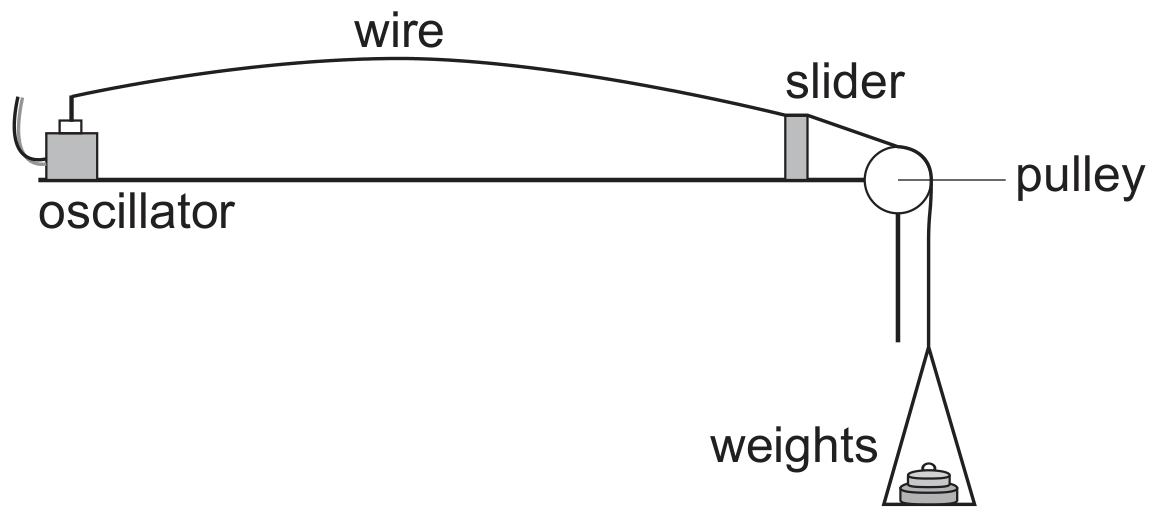
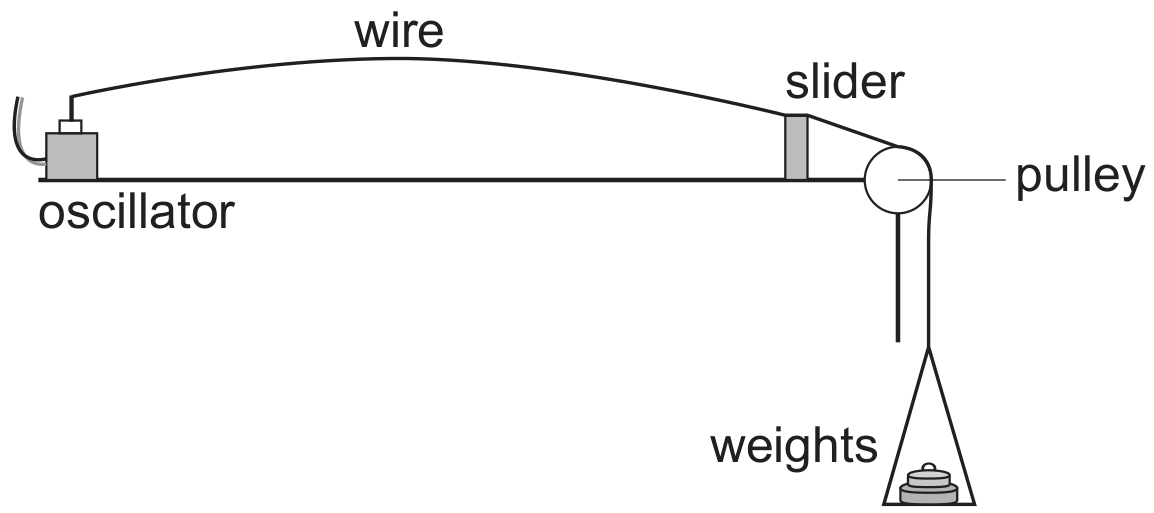
A student attaches one end of a copper wire to an oscillator operating at a fixed frequency. The other end of the wire passes over a pulley to weights that hang vertically. The first harmonic standing wave is established by using the slider to change the length of the wire. The procedure is repeated for different weights.

Question image

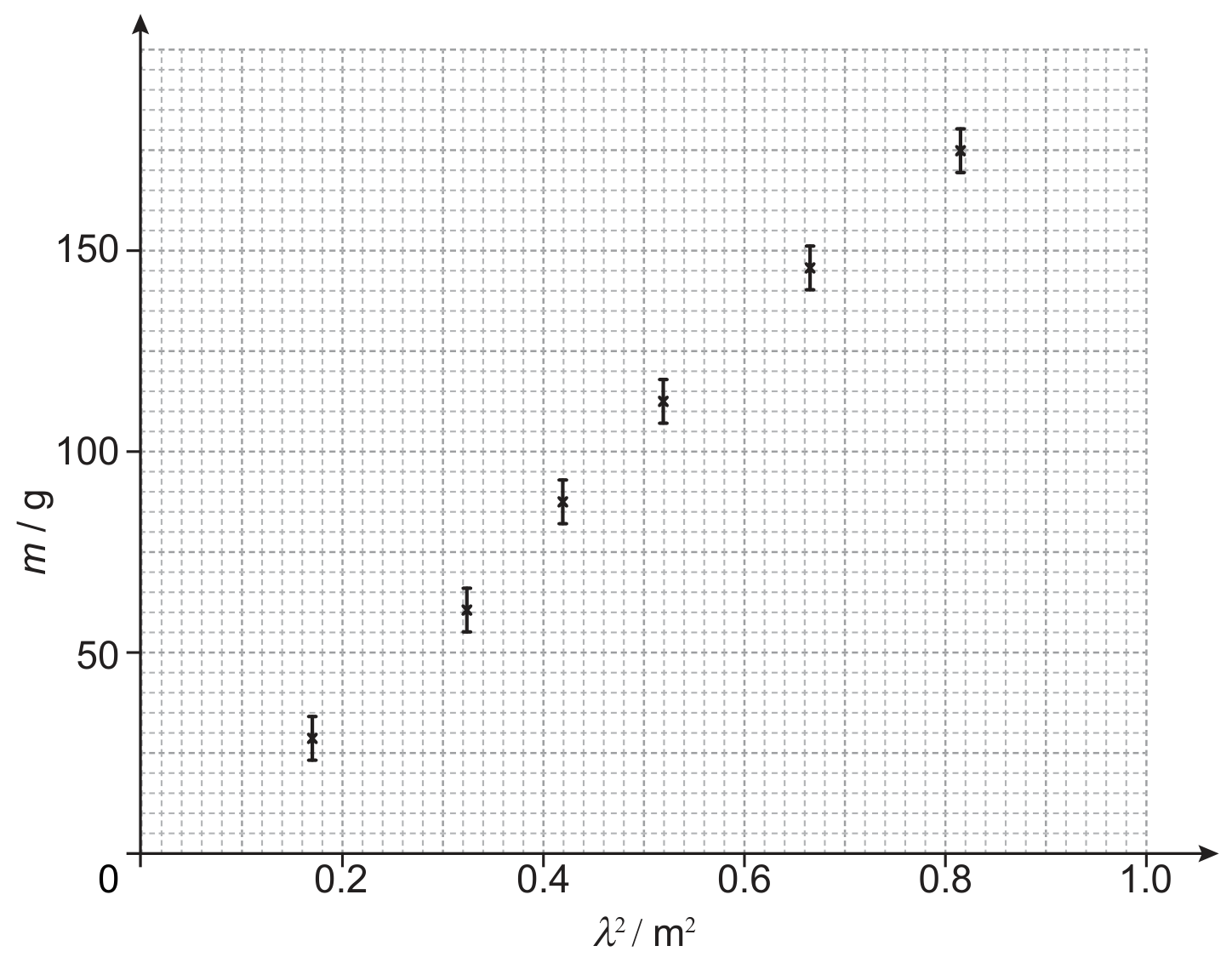
The mass m of the weights and the wavelength λ\lambda of the wave are related by

m=μf2gλ2m=\frac{\mu f^{2}}{g} \lambda^{2}

where μ\mu is a constant, f is the frequency of the wave and g=9.8 ms2g=9.8 \mathrm{~ms}^{-2}.

(a)

The graph shows the data obtained by the student, plotted to show the variation of m with λ2\lambda^{2}.

Question image
[ 1 ]
(i)

Suggest a possible reason for the systematic error.

[ 1 ]
[Maximum number: 2]

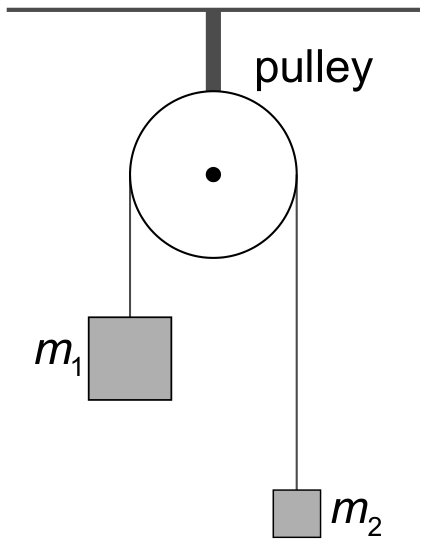
In an experiment to measure the acceleration of free fall a student ties two different blocks of masses m1m_{1} and m2m_{2} to the ends of a string that passes over a frictionless pulley.

Question image

The student calculates the acceleration a of the blocks by measuring the time taken by the heavier mass to fall through a given distance. Their theory predicts that a=gm1m2m1+m2a=g \frac{m_{1}-m_{2}}{m_{1}+m_{2}} and this can be re-arranged to give g=am1+m2m1m2g=a \frac{m_{1}+m_{2}}{m_{1}-m_{2}}.

(a)

There is an advantage and a disadvantage in using two masses that are almost equal.

State and explain,

[ 2 ]
(i)

the disadvantage with reference to your answer to (a)(ii).

[ 2 ]
[Maximum number: 1]

A student attaches one end of a copper wire to an oscillator operating at a fixed frequency. The other end of the wire passes over a pulley to weights that hang vertically. The first harmonic standing wave is established by using the slider to change the length of the wire. The procedure is repeated for different weights.

Question image

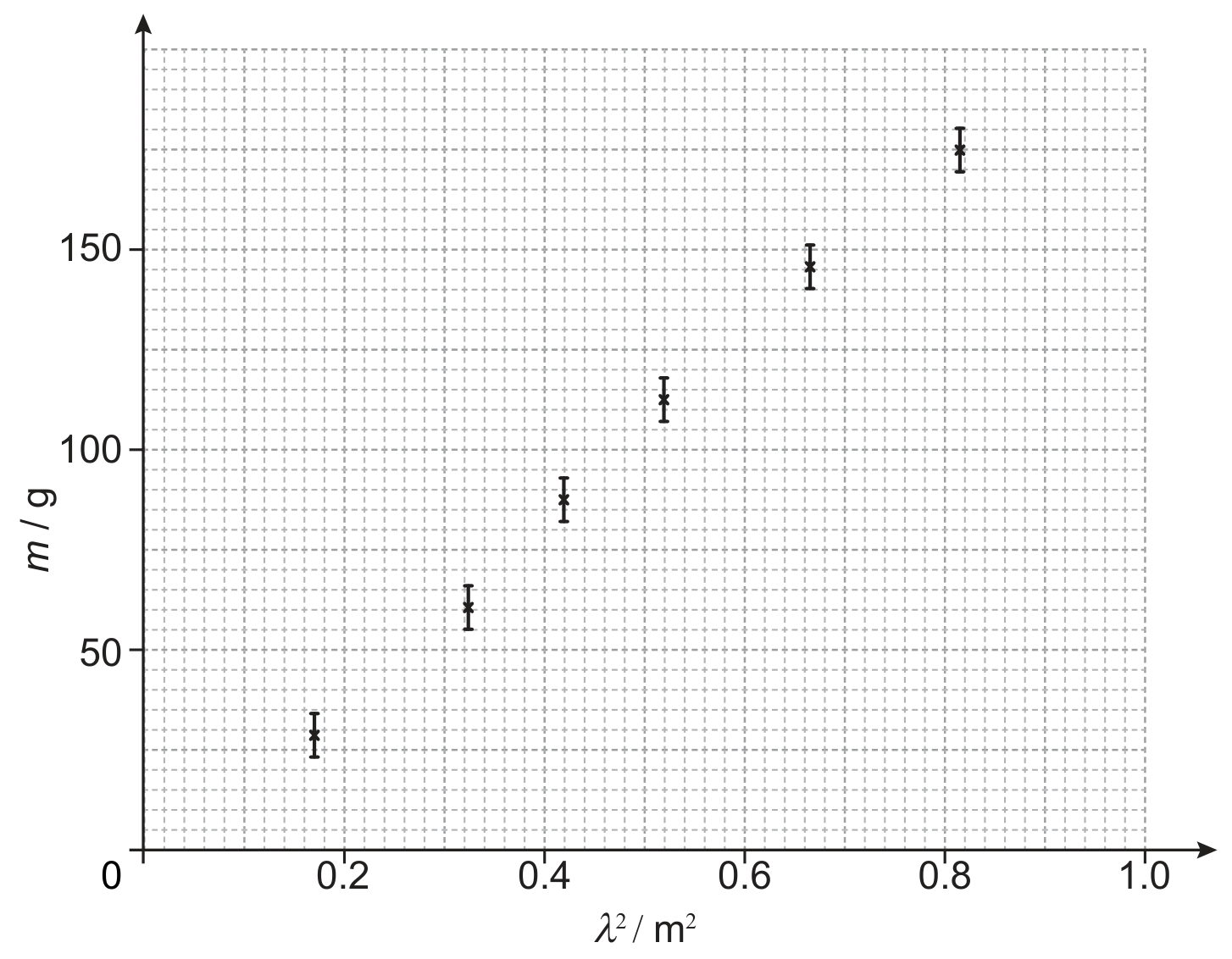
The mass m of the weights and the wavelength λ\lambda of the wave are related by

m=μf2gλ2m=\frac{\mu f^{2}}{g} \lambda^{2}

where μ\mu is a constant, f is the frequency of the wave and g=9.8 ms2g=9.8 \mathrm{~ms}^{-2}.

(a)

The graph shows the data obtained by the student, plotted to show the variation of m with λ2\lambda^{2}.

Question image
[ 1 ]
(i)

Suggest a possible reason for the systematic error.

[ 1 ]
[Maximum number: 1]

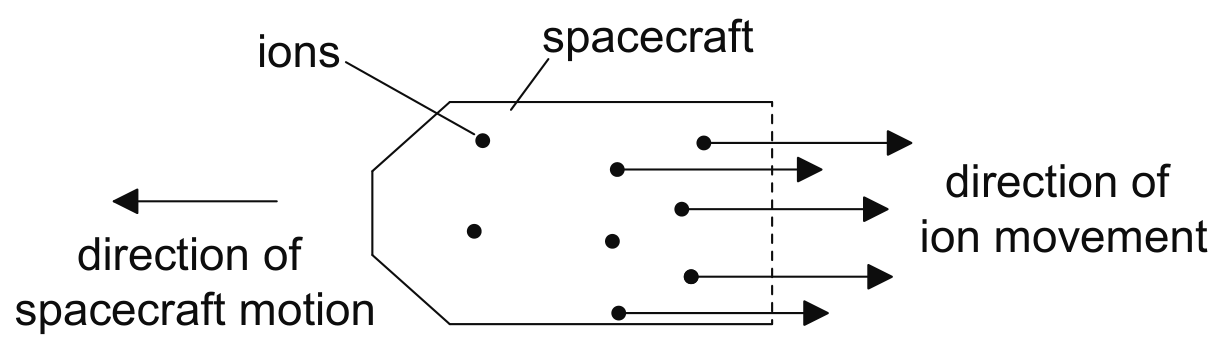
Ion-thrust engines can power spacecraft. In this type of engine, ions are created in a chamber and expelled from the spacecraft. The spacecraft is in outer space when the propulsion system is turned on. The spacecraft starts from rest.

Question image

The mass of ions ejected each second is 6.6×10⁶ kg6.6 \times 10^{-6} \mathrm{~kg} and the speed of each ion is 5.2×10⁴ m s15.2 \times 10^{4} \mathrm{~m} \mathrm{~s}^{-1}. The initial total mass of the spacecraft and its fuel is 740 kg . Assume that the ions travel away from the spacecraft parallel to its direction of motion.

(a)

An initial mass of 60 kg of fuel is in the spacecraft for a journey to a planet. Half of the fuel will be required to slow down the spacecraft before arrival at the destination planet.

[ 1 ]
(i)

Outline why the answer to (b)(i) is an estimate.

[ 1 ]
[Maximum number: 1]

A group of students is trying to determine the density and the viscosity of a liquid.

To determine the density, they use a balance to read the mass m of a sphere in air and immersed in the liquid.

They use a sphere of volume V=1.827×10⁷ m3V=1.827 \times 10^{-7} \mathrm{~m}^{3}.
The readings are mair =1.427 gm_{\text {air }}=1.427 \mathrm{~g} in air and mlmmersed =1.208 gm_{\text {lmmersed }}=1.208 \mathrm{~g} in the liquid.
The readings are different due to buoyancy. The buoyancy force FbF_{\mathrm{b}} is given by

Fb=ρVgF_{\mathrm{b}}=\rho V g

where V is the volume of the sphere and ρ\rho is the density of the liquid.

(a)

Suggest a conclusion reached by the students.

[ 1 ]
[Maximum number: 2]

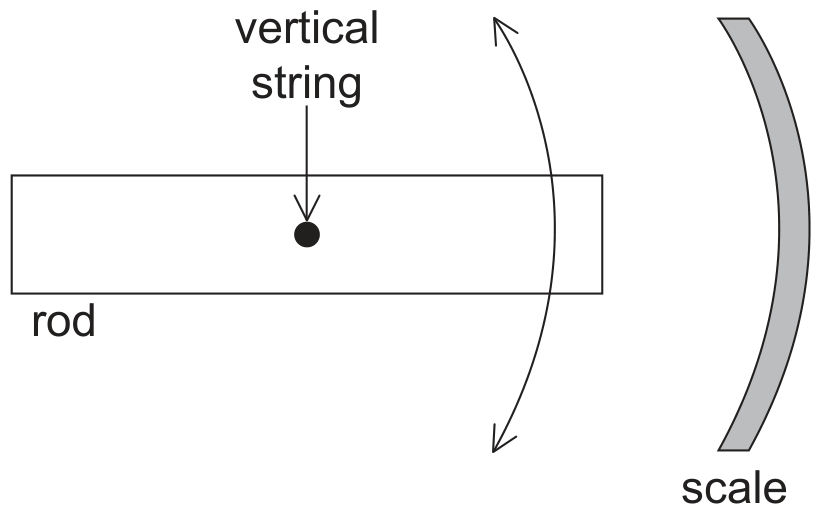
A student investigates the oscillation of a horizontal rod hanging at the end of a vertical string. The diagram shows the view from above.

Question image

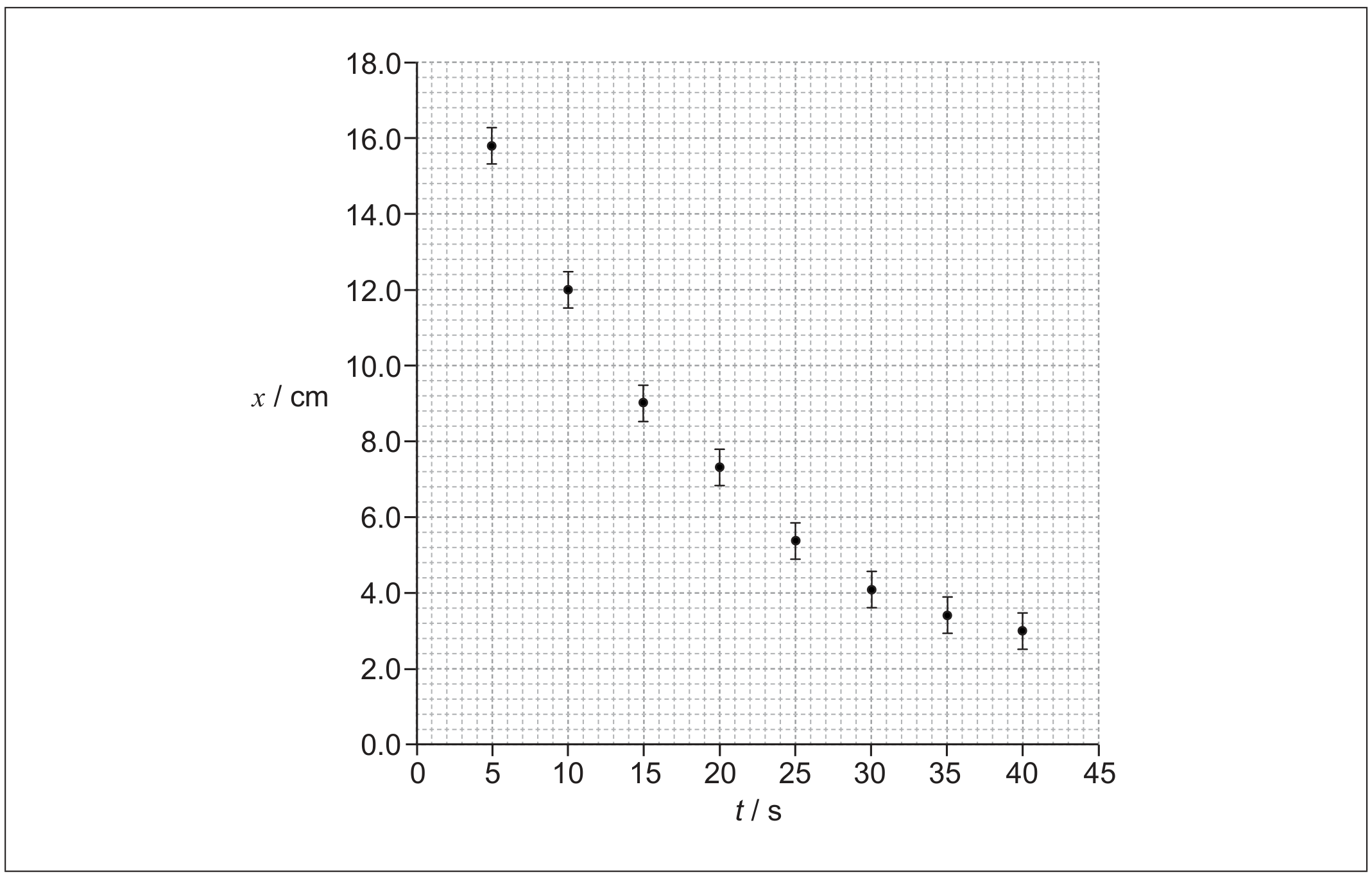
The student starts the rod oscillating and measures the largest displacement for each cycle of the oscillation on the scale and the time at which it occurs. The student begins to take measurements a few seconds after releasing the rod.

The graph shows the variation of displacement x with time t since the release of the rod. The uncertainty for t is negligible.

Question image
(a)

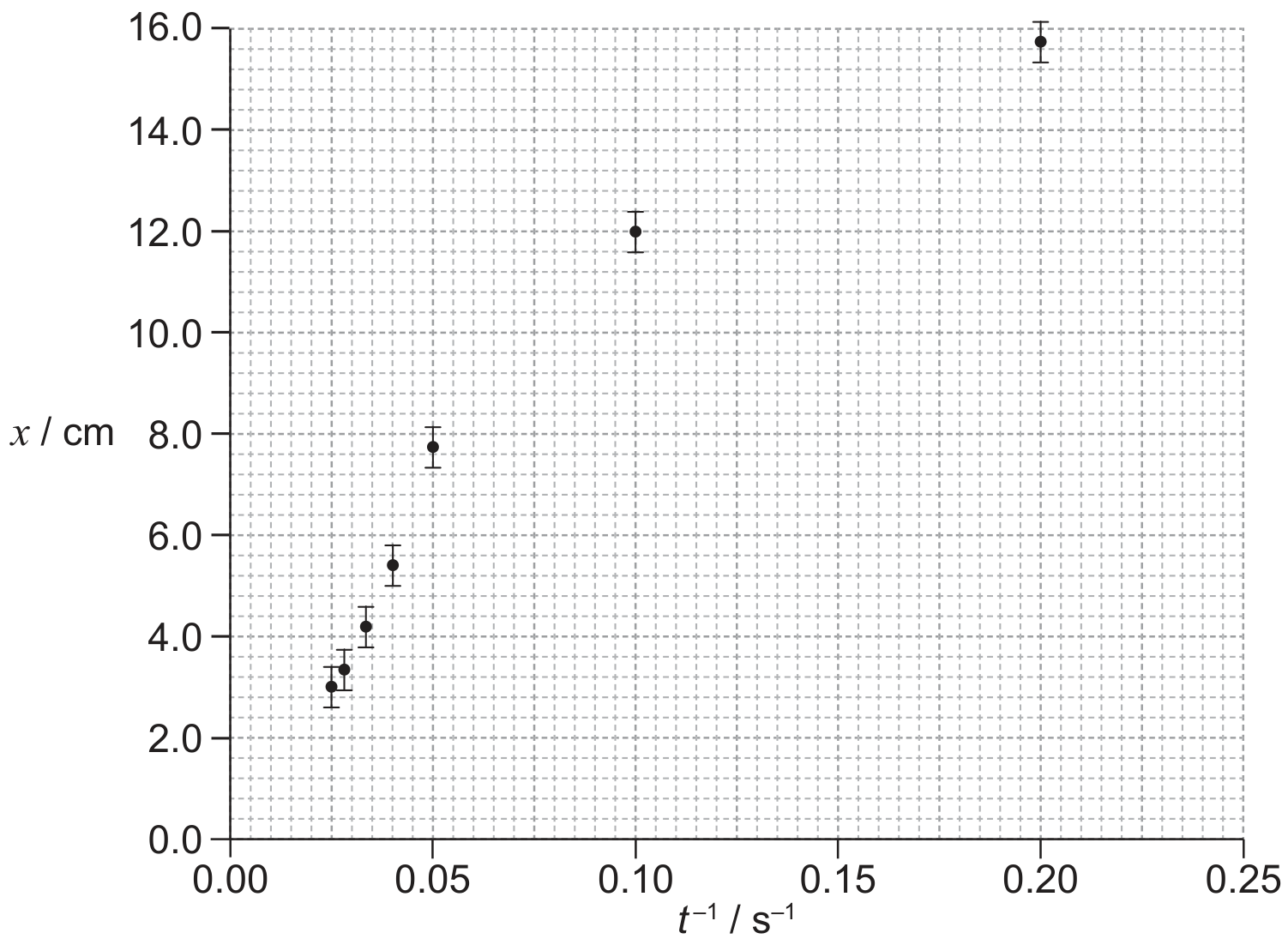
The student hypothesizes that the relationship between x and t is x=atx=\frac{a}{t} where a is a constant.

To test the hypothesis x is plotted against 1t\frac{1}{t} as shown in the graph.

Question image
[ 2 ]
(i)

Suggest the range of values of t for which the hypothesis may be assumed to be correct.

[ 2 ]
[Maximum number: 5]

Data analysis question.

An experiment is undertaken to investigate the relationship between the temperature of a ball and the height of its first bounce.

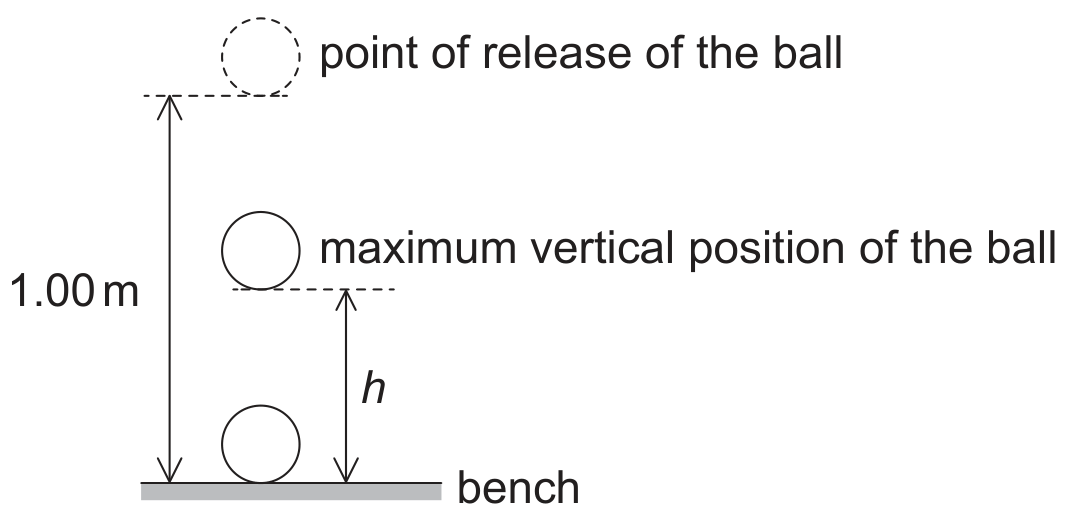
A ball is placed in a beaker of water until the ball and the water are at the same temperature. The ball is released from a height of 1.00 m above a bench. The maximum vertical height h from the bottom of the ball above the bench is measured for the first bounce. This procedure is repeated twice and an average hmean h_{\text {mean }} is calculated from the three measurements.

Question image

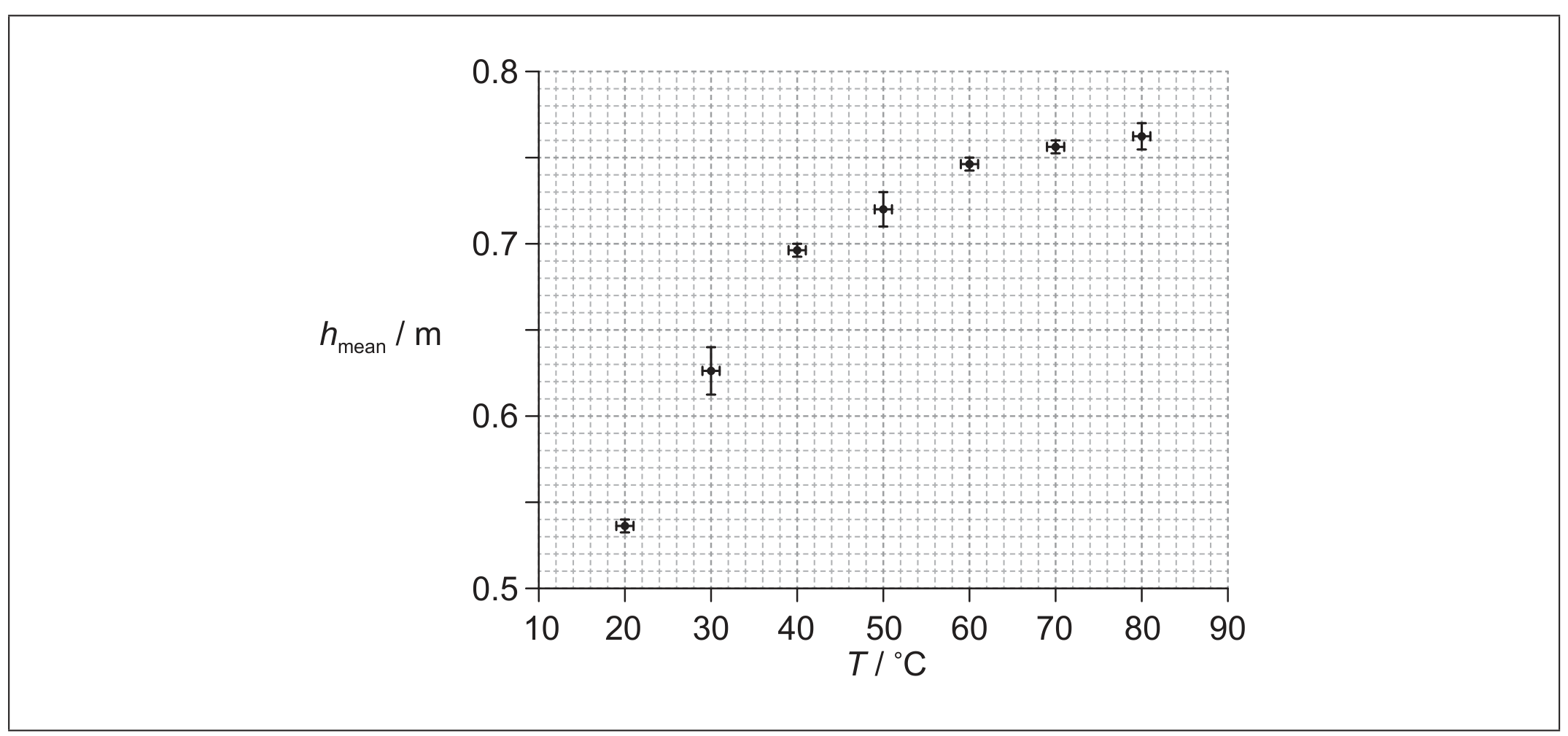
The procedure is repeated for a range of temperatures. The graph shows the variation of hmean h_{\text {mean }} with temperature T.

Question image
(a)

A student hypothesizes that hmean h_{\text {mean }} is proportional to T2T^{2}.

[ 5 ]
(i)

Comment, using two points on your line of best-fit, whether or not this is a valid hypothesis.

[ 3 ]
(ii)

Suggest why using two points cannot confirm that hmean h_{\text {mean }} is proportional to T2T^{2}.

[ 2 ]
[Maximum number: 2]

Data analysis question.

Connie and Sophie investigate the effect of colour on heat absorption. They make grey paint by mixing black and white paint in different ratios. Five identical tin cans are painted in five different shades of grey.

Question image

Connie and Sophie put an equal amount of water at the same initial temperature into each can. They leave the cans under a heat lamp at equal distances from the lamp. They measure the temperature increase of the water, T, in each can after one hour.

(a)

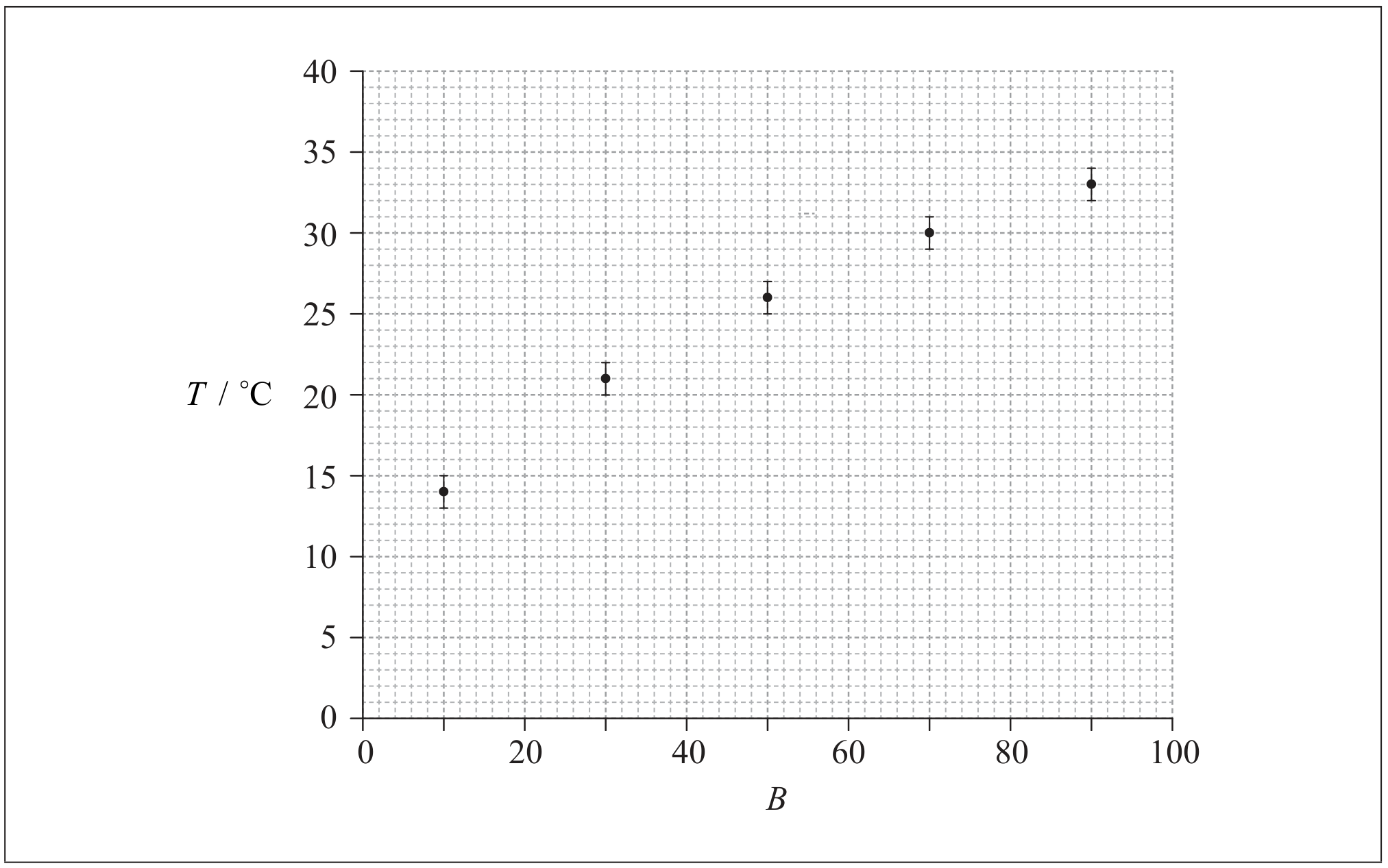
Connie suggests that T is proportional to B, where B is the percentage of black in the paint. To test this hypothesis, she plots a graph of T against B, as shown on the axes below. The uncertainty in T is shown and the uncertainty in B is negligible.

Question image
[ 2 ]
(i)

Outline why the data do not support the hypothesis that T is proportional to B.

[ 2 ]
0