EduNinja
[Maximum number: 2]

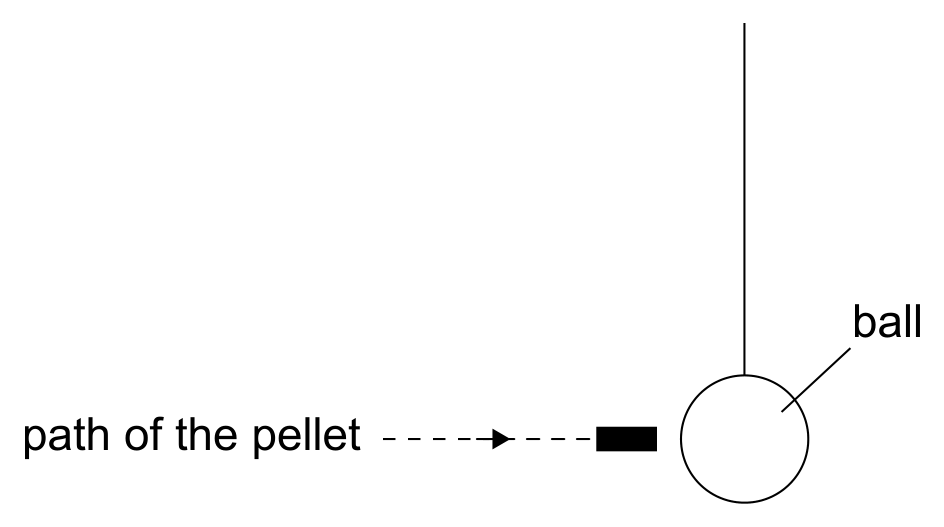
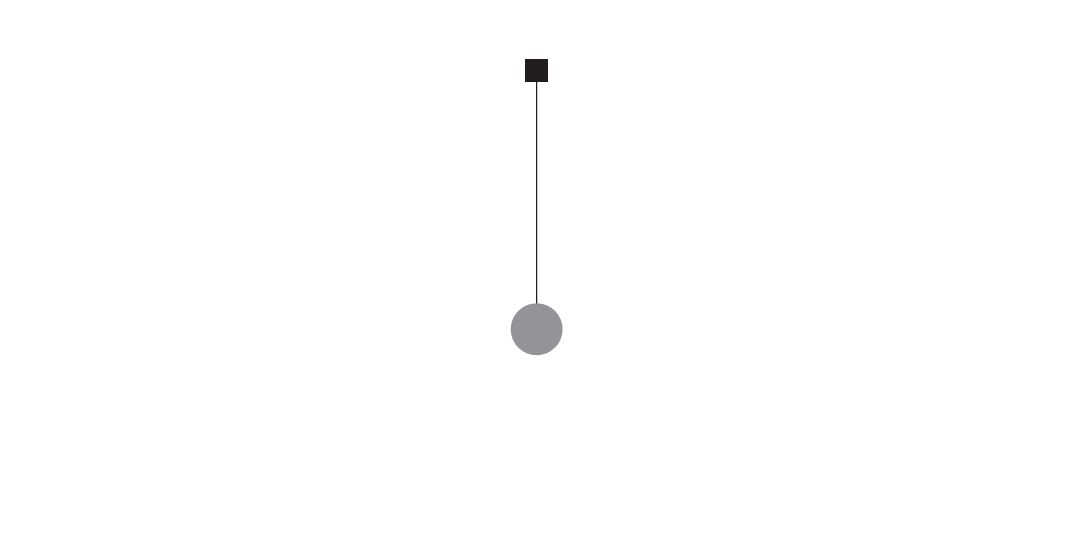
A stationary ball is hanging from a light string. A pellet from an air rifle is travelling horizontally and becomes embedded in the ball. The velocity of the pellet when it strikes the ball is 160 ms1160 \mathrm{~ms}^{-1}.

Question image

The following data are given.

 Mass of the ball =250 g Mass of the pellet =2.0 g\begin{aligned} \text { Mass of the ball } & =250 \mathrm{~g} \\ \text { Mass of the pellet } & =2.0 \mathrm{~g} \end{aligned}
(a)

Determine h.

[ 2 ]
[Maximum number: 4]

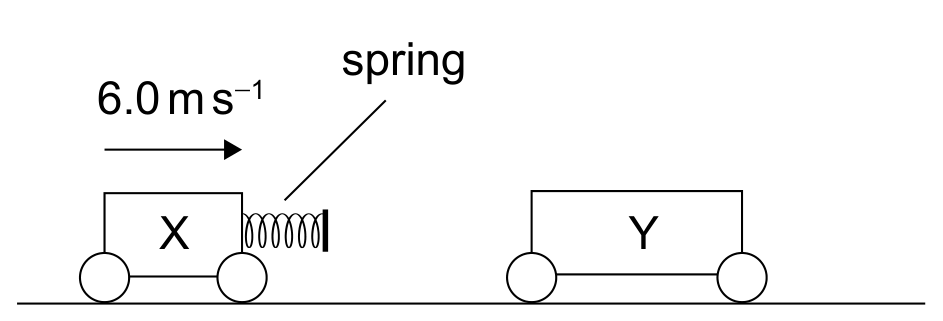
A cart X of mass 3.0 kg moving at 6.0 m s16.0 \mathrm{~m} \mathrm{~s}^{-1} collides with a stationary cart Y of mass 6.0 kg . A spring is attached to X as shown.

Question image

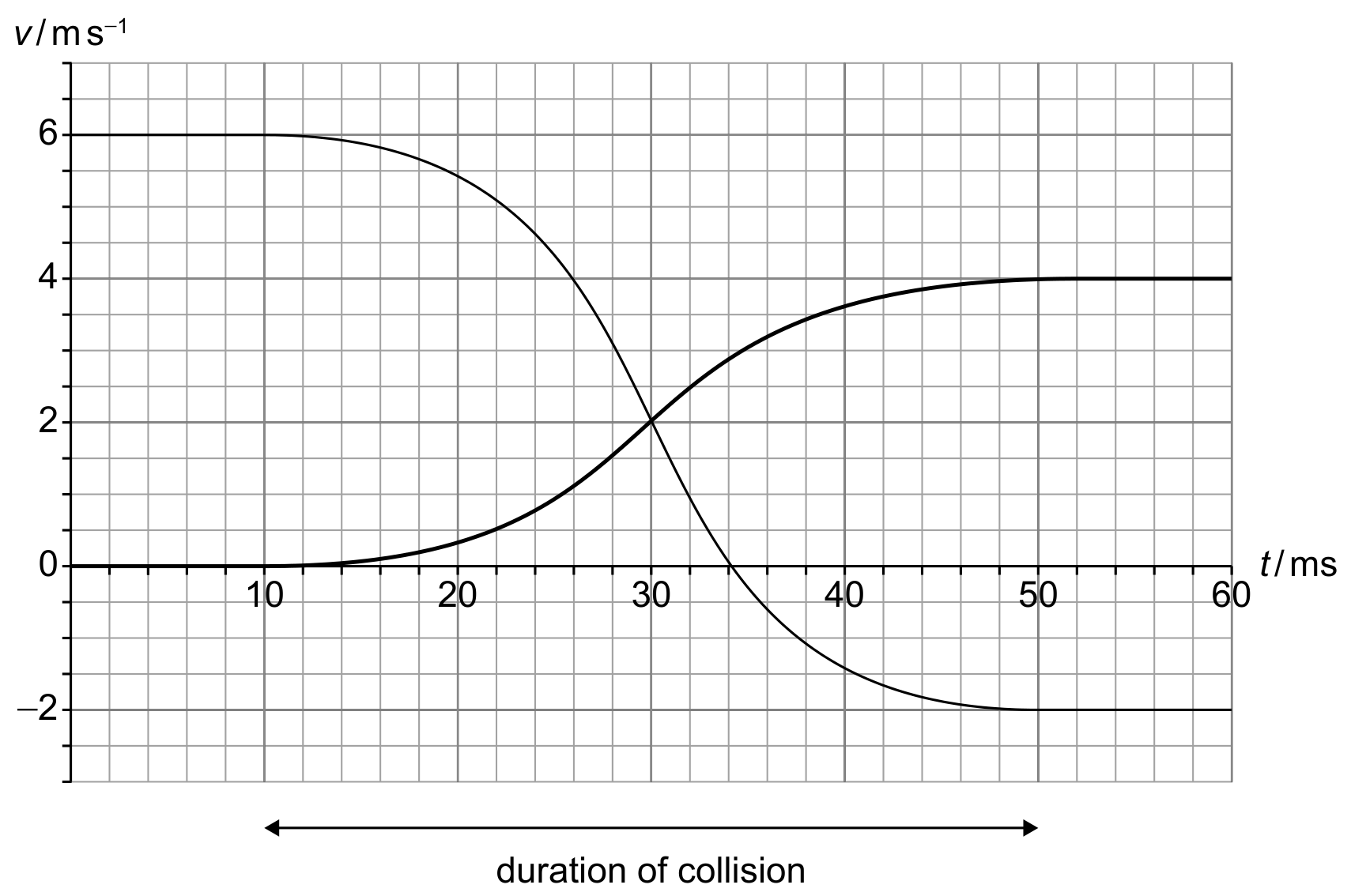
The graph shows the velocities of X and Y before, during and after the collision.

Question image

The collision lasted for 40 ms .

(a)

Determine

[ 4 ]
(i)

the average power delivered to Y ,

[ 2 ]
(ii)

the elastic energy stored in the spring at t=30 mst=30 \mathrm{~ms}.

[ 2 ]
(a)

A car of mass 1600 kg accelerates from rest.

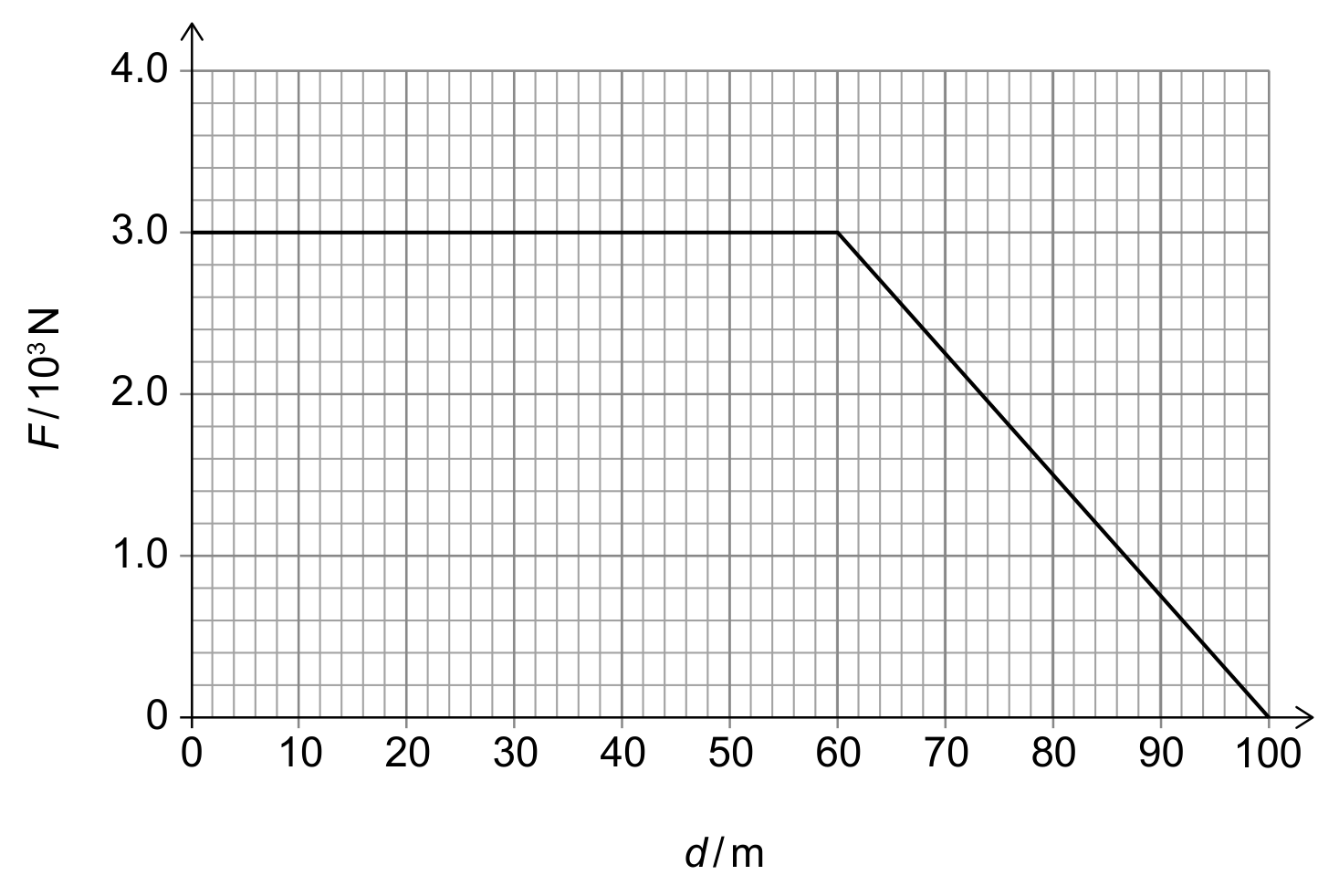
The graph shows how the resultant force F acting in the direction of motion of the car varies with the distance d travelled by the car.

Question image
[ 3 ]
(i)

State what is represented by the area under the graph.

[ 1 ]
(ii)

Calculate the final speed of the car.

A different car travels on a horizontal road at a constant speed of 45 m s145 \mathrm{~m} \mathrm{~s}^{-1}. The engine of the car develops a power of 140 kW . The resistive force FdF_{\mathrm{d}} acting on the car is given by

Fd=cv2F_{d}=c v^{2}

where v is the speed of the car and c is a constant.

[ 2 ]
(b)

Determine c. State the fundamental SI unit for your answer.

[ 3 ]
[Maximum number: 2]

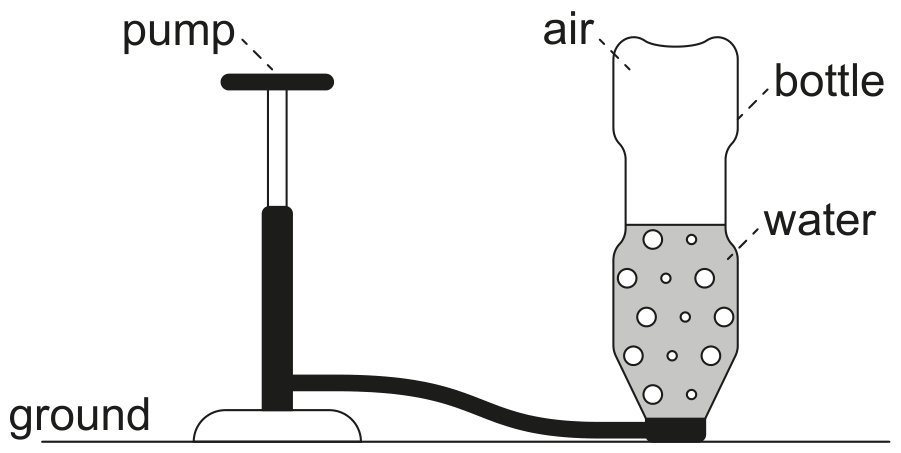
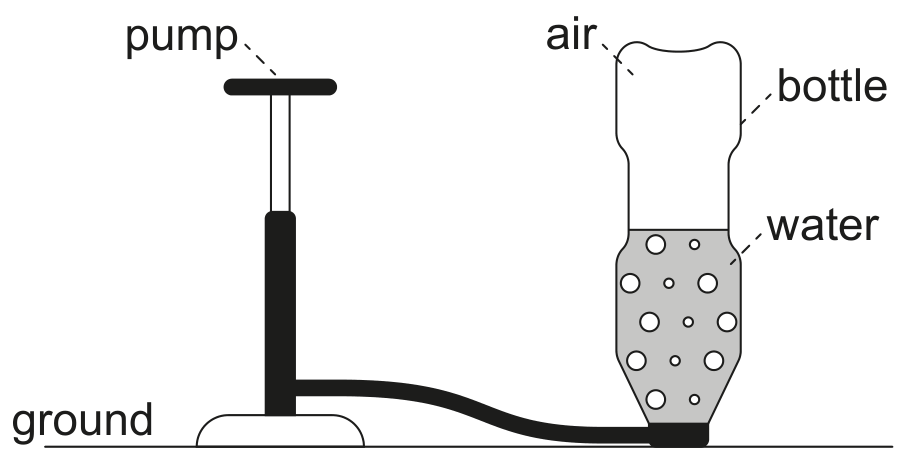
A toy rocket is made from a plastic bottle that contains some water.

Air is pumped into the vertical bottle until the pressure inside forces water and air out of the bottle. The bottle then travels vertically upwards.

Question image

The air-water mixture is called the propellant.
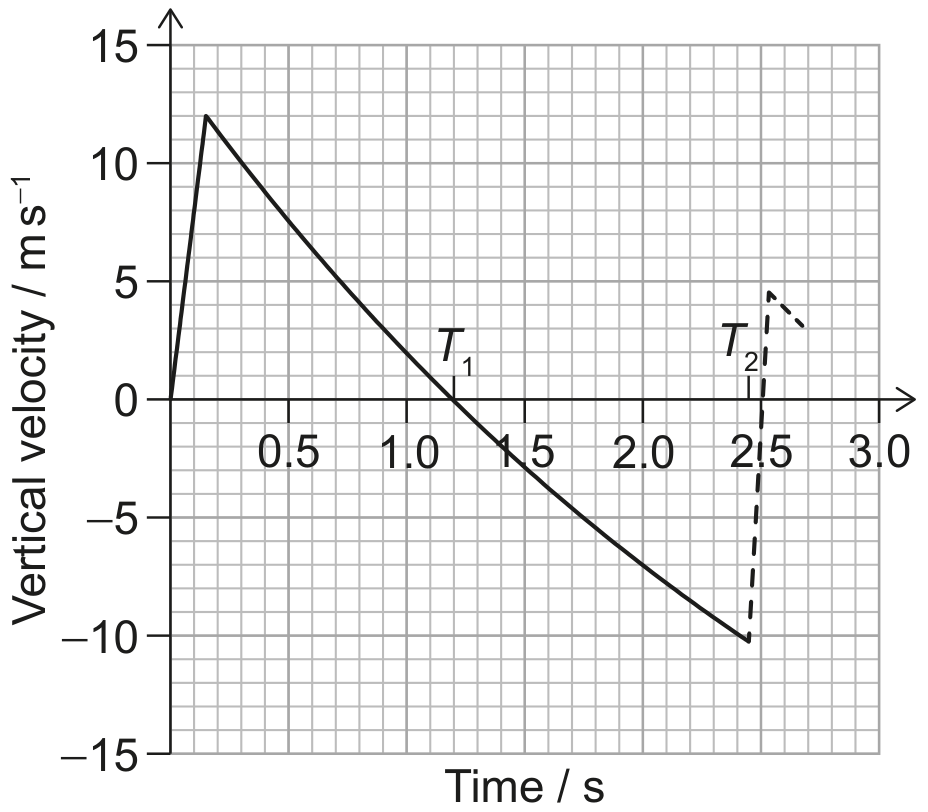
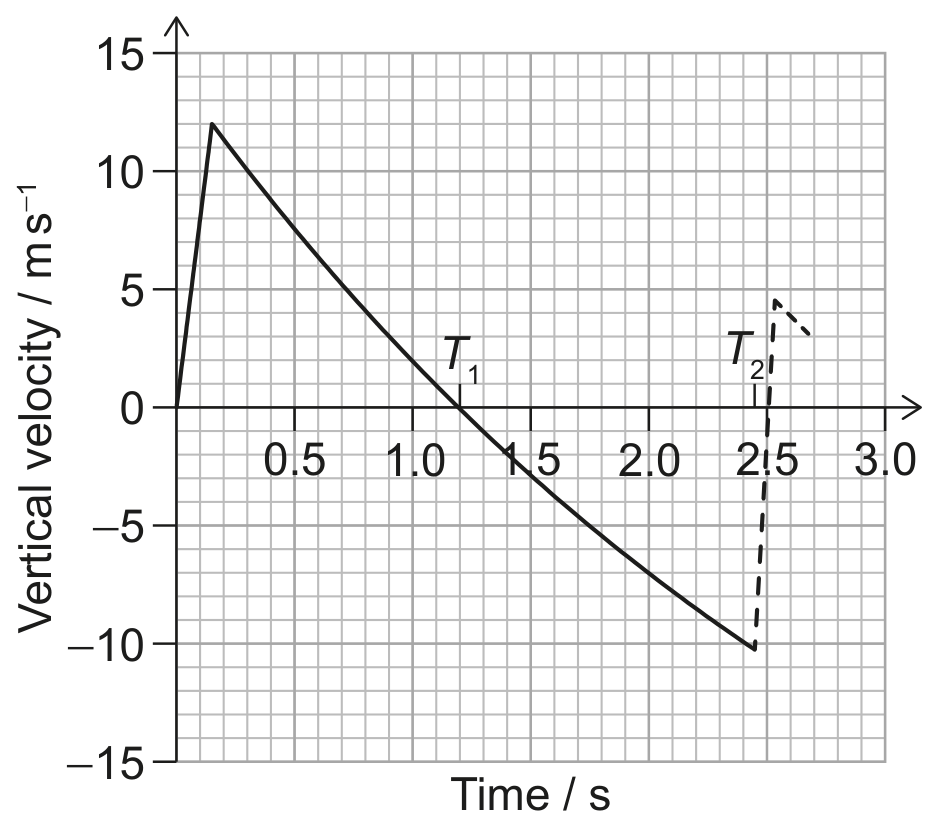
The variation with time of the vertical velocity of the bottle is shown.

Question image

The bottle reaches its highest point at time T1T_{1} on the graph and returns to the ground at time T2T_{2}. The bottle then bounces. The motion of the bottle after the bounce is shown as a dashed line.

(a)

The bottle bounces when it returns to the ground.

[ 2 ]
(i)

Calculate the fraction of the kinetic energy of the bottle that remains after the bounce.

[ 2 ]
[Maximum number: 3]

A box of mass 1.2 kg is lying at rest on a surface. The coefficient of static friction between the box and the surface is 0.36 and the coefficient of dynamic friction between the box and the surface is 0.28 .

(a)

A force of 14.0 N acts on the box for 0.35 m as shown. The force is then removed and the box continues to move. The box comes to rest after a further displacement d.

Question image

Determine d.

[ 3 ]
[Maximum number: 3]

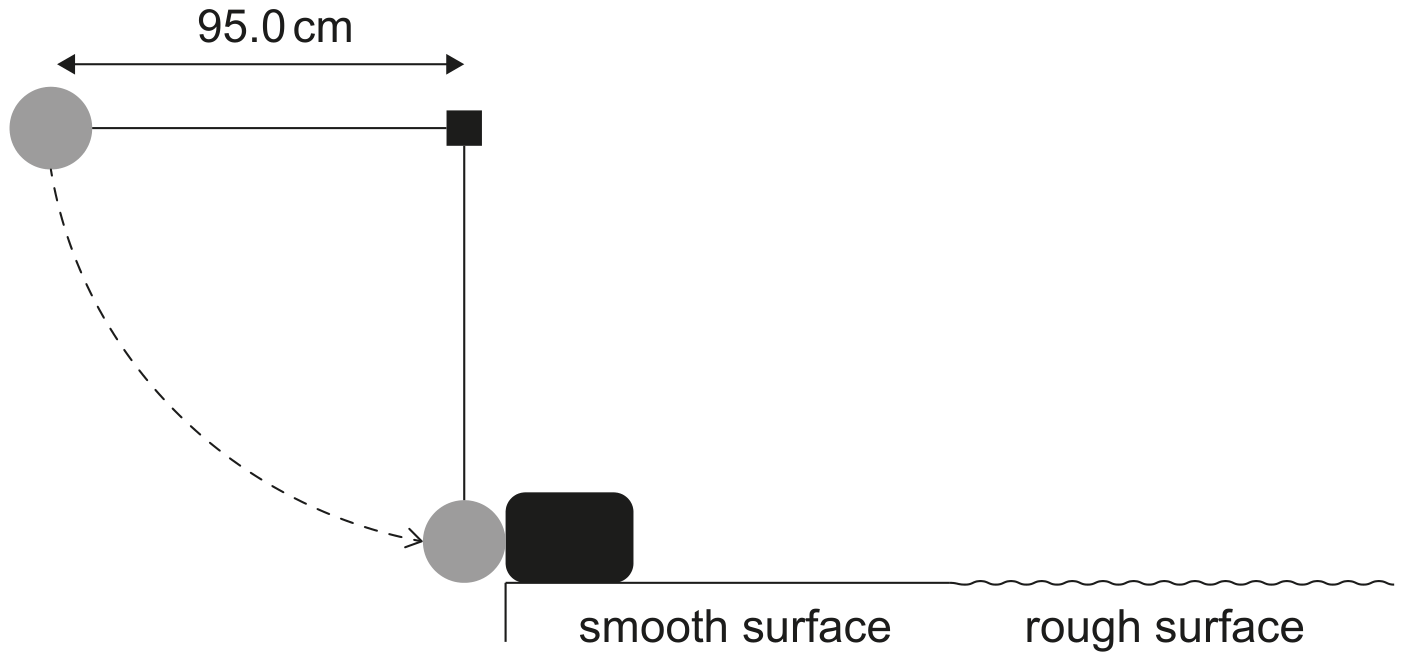
A ball of mass 0.800 kg is attached to a string. The distance to the centre of the mass of the ball from the point of support is 95.0 cm . The ball is released from rest when the string is horizontal. When the string becomes vertical the ball collides with a block of mass 2.40 kg that is at rest on a horizontal surface.

Question image
(a)

Just before the collision of the ball with the block,

[ 1 ]
(i)

show that the speed of the ball is about 4.3 ms14.3 \mathrm{~ms}^{-1}.

[ 1 ]
(b)

After the collision, the ball rebounds and the block moves with speed 2.16 ms12.16 \mathrm{~ms}^{-1}.

[ 2 ]
(i)

Calculate the maximum height risen by the centre of the ball.

[ 2 ]
[Maximum number: 3]

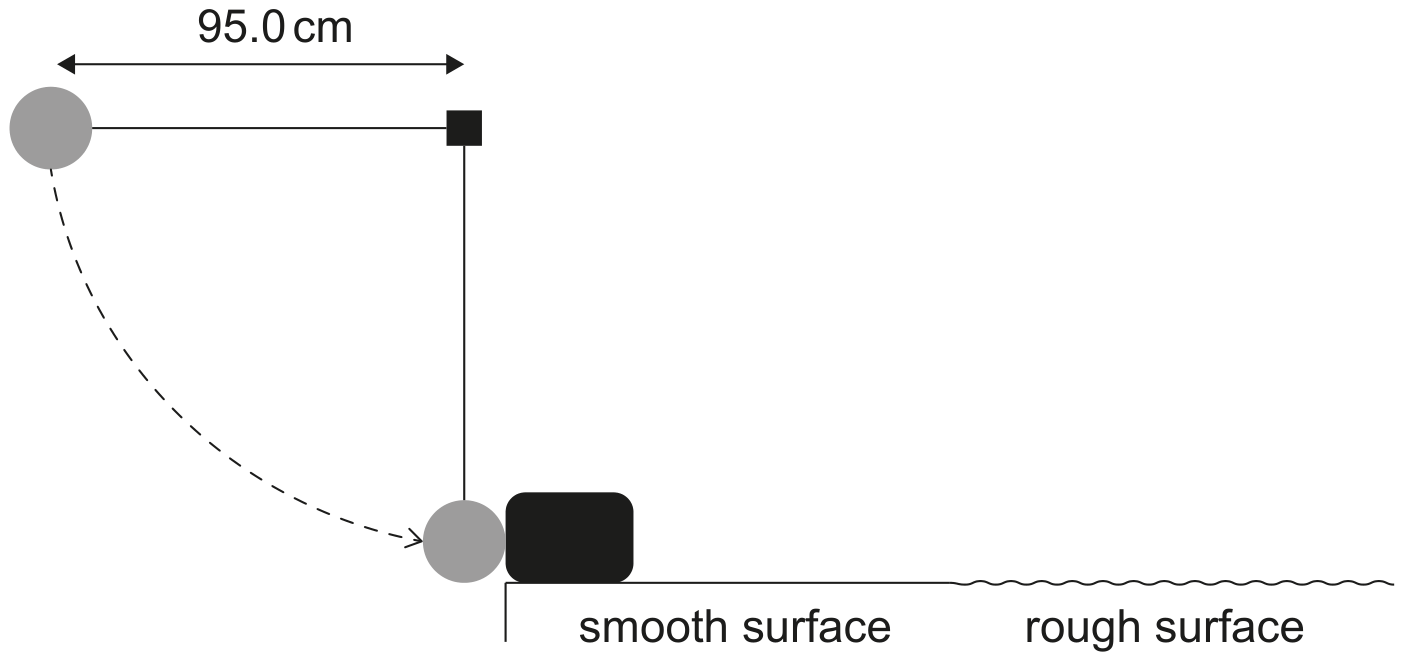
A ball of mass 0.800 kg is attached to a string. The distance to the centre of the mass of the ball from the point of support is 95.0 cm . The ball is released from rest when the string is horizontal. When the string becomes vertical the ball collides with a block of mass 2.40 kg that is at rest on a horizontal surface.

Question image
(a)

Just before the collision of the ball with the block,
(i) draw a free-body diagram for the ball.

Question image
[ 1 ]
(i)

show that the speed of the ball is about 4.3 ms14.3 \mathrm{~ms}^{-1}.

[ 1 ]
(b)

After the collision, the ball rebounds and the block moves with speed 2.16 ms12.16 \mathrm{~ms}^{-1}.

[ 2 ]
(i)

Calculate the maximum height risen by the centre of the ball.

[ 2 ]
[Maximum number: 2]

A toy rocket is made from a plastic bottle that contains some water.

Air is pumped into the vertical bottle until the pressure inside forces water and air out of the bottle. The bottle then travels vertically upwards.

Question image

The air-water mixture is called the propellant.
The variation with time of the vertical velocity of the bottle is shown.

Question image

The bottle reaches its highest point at time T1T_{1} on the graph and returns to the ground at time T2T_{2}. The bottle then bounces. The motion of the bottle after the bounce is shown as a dashed line.

(a)

The bottle bounces when it returns to the ground.

[ 2 ]
(i)

Calculate the fraction of the kinetic energy of the bottle that remains after the bounce.

[ 2 ]
[Maximum number: 3]

A box of mass 1.2 kg is lying at rest on a surface. The coefficient of static friction between the box and the surface is 0.36 and the coefficient of dynamic friction between the box and the surface is 0.28 .

(a)

A force of 14.0 N acts on the box for 0.35 m as shown. The force is then removed and the box continues to move. The box comes to rest after a further displacement d.

Question image

Determine d.

[ 3 ]
[Maximum number: 4]

A raindrop falls vertically from rest.

(a)

During the first 3.0 s of motion, the raindrop falls a distance of 21 m and reaches a speed of 9.0 m s19.0 \mathrm{~m} \mathrm{~s}^{-1}. The mass of the raindrop is 34 mg . The temperature of the raindrop does not change.

[ 4 ]
(i)

Determine the energy transferred to the air during the first 3.0 s of motion. State your answer to an appropriate number of significant figures.

[ 3 ]
(ii)

Describe the energy change that takes place for t>3.0 st>3.0 \mathrm{~s}.

[ 1 ]
0